Tag: lymphoma

Epstein–Barr Virus Influences Rare Brain Lymphomas
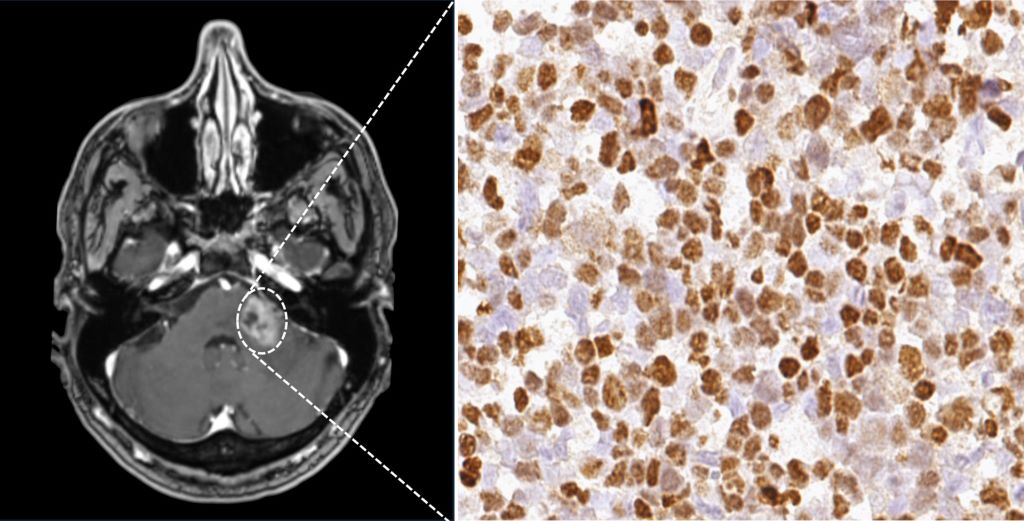
Primary CNS lymphomas in immunocompromised patients are among the rarest and at the same time most aggressive cancers – yet evidence-based recommendations for diagnosis and treatment have been lacking. An international research team led by Heidelberg Faculty of Medicine at Heidelberg University and the German Cancer Research Center has now identified characteristic imaging features of these tumours and developed a prognostic model to better assess disease outcomes. The researchers found that tumours positive for Epstein-Barr virus were associated with particularly poor prognosis. The findings, published in the journal Blood, may help guide future diagnostic and treatment strategies.

Primary CNS lymphoma is a rare cancer that arises from malignant white blood cells. Affected individuals develop tumours in the brain and, more rarely in the spinal cord, the eyes, or within the cerebrospinal fluid. These lymphomas can occur in people with weakened immune systems, for example after organ transplantation, in autoimmune diseases, or in association with HIV infection. This subtype, known as immunodeficiency-associated primary CNS lymphoma (ID-PCNSL) affects approximately 50 people per year in Germany. Researchers at the Heidelberg Faculty of Medicine at Heidelberg University had already shown in earlier work that ID-PCNSL is not simply a variant of classical CNS lymphoma, but a distinct disease entity characterised by specific genetic alterations.

A recent study by the International Primary CNS Lymphoma Collaborative Group – an international network dedicated to the study of CNS lymphomas – has now provided further insights into the diagnosis and treatment of ID-PCNSL. Including data from 308 patients treated at 23 hospitals across seven countries, the study is the largest conducted to date on this rare cancer. The researchers analysed clinical findings, magnetic resonance imaging scans, and tumour tissue samples. Scientists from the Heidelberg Faculty of Medicine at Heidelberg University and the German Cancer Research Center (DKFZ) played a leading role in the study.

Epstein-Barr Virus influences imaging and prognosis

Epstein-Barr virus (EBV) is known to play a central role in this cancer and was detected in 79.2 percent of the tumours examined. “Our analyses show that EBV-positive tumours often follow a more aggressive course and are associated with an unfavourable prognosis,” says first author Dr Leon Kaulen. He conducts research at the Heidelberg Faculty of Medicine at Heidelberg University and at the DKFZ and is a physician at the Department of Neurology at Heidelberg University Hospital (UKHD). EBV-positive tumours also showed characteristic imaging features including different patterns of contrast enhancement compared with EBV-negative tumours.

The researchers developed a prognostic model based on three factors that can help to better predict the course of ID-PCNSL and patient survival more accurately. The three identified factors are the detection of EBV in tumour tissue, age, and the patient’s performance status. Depending on the combination of these three factors, disease courses differed markedly among the patients studied. If only one of the three risk factors was present, the median survival was 135 months. With two risk factors, it decreased to 29 months. If all three factors were present, median survival was reduced to three months. “The prognostic model, with its clear stratification, represents a major advance. It will enable us to assess patients much more precisely in the future and to tailor therapies more effectively to the individual clinical situation,” says senior author Professor Wolfgang Wick, Heidelberg Faculty of Medicine at Heidelberg University, Chair of the Department of Neurology at UKHD, and Head of the Clinical Cooperation Unit Neurooncology at DKFZ and UKHD.

Considering immunodeficiency and cancer together

So far, no standardised therapy has been established for patients with immunodeficiency-associated primary CNS lymphoma. “Our research provides important insights into which approaches may be associated with more favourable outcomes,” says Dr Leon Kaulen. Patients whose immune system could at least partially be reconstituted – for example through adjustment of immunosuppressive medication or effective treatment of HIV infection – and who additionally received combination chemotherapy with rituximab and methotrexate typically (85 percent) responded well to treatment. In a substantial proportion of patients, the disease also remained stable in the long term and became undetectable.“ Our data suggest that the interplay between the tumour and the weakened immune system plays a central role,” says Dr Kaulen. “Both aspects should therefore be addressed together in treatment.”

“With the current study, a robust evidence base for this rare disease is now available for the first time,” summarises Professor Wick. “This represents an important step toward precision medicine even in rare diseases. Relevant research in rare tumour entities can often only be carried out in large international consortia. International scientific collaboration therefore deserves particular attention.”

Source: Heidelberg University
Long-term Results Suggest that Follicular Lymphoma Is Curable

Long-term data suggests an overall cure rate of 42%

Photo by National Cancer Institute on Unsplash

Unlike some other forms of lymphoma, advanced stage follicular lymphoma is considered incurable. But a new analysis of long-term data on patients treated for the disease years ago with standard regimens of immunotherapy and a chemotherapy combination known as CHOP suggests that many of those patients can now be considered cured.

The analysis is just published in the journal JAMA Oncology

“A subset of advanced-stage follicular lymphoma patients can achieve cure with CHOP-based chemoimmunotherapy, as relapse rates decline over time,” said Wilmot Cancer Institute Director Jonathan W. Friedberg, MD, MMSc, at the University of Rochester Medical Center, who is senior and corresponding author on the paper.  

“This finding represents a paradigm shift in our understanding and approach to follicular lymphoma, with broad implications for initial patient discussions and future research strategies.” 

Historically, follicular lymphoma has been considered an incurable disease, with most patients experiencing relapses even years after initial treatment.

The JAMA Oncology paper reports on an analysis of follow-up data from patients with advanced follicular lymphoma who had been treated with a standard first-line chemoimmunotherapy regimen on a large clinical trial.

Roughly 70 percent of the patients remained alive 15 years after beginning treatment, and a statistical method known as cure modelling estimated that 42% of treated patients had been cured. 

Cure modelling incorporates background mortality rates in an analysis of patient survival data to estimate what fraction of a group of patients can be considered cured of a disease. Such modelling accounts for the fact that over time some patient deaths will occur that are unrelated to the given disease.

The researchers applied a cure model to 15-year follow-up data from the S0016 clinical trial conducted by the SWOG Cancer Research Network, a clinical trials group funded by the National Cancer Institute (NCI), part of the National Institutes of Health (NIH), with the participation of other groups within the NCI-funded National Clinical Trials Network (NCTN).

This phase 3 trial, which opened in 2001, enrolled patients with untreated advanced-stage CD20-positive follicular lymphoma and randomised 531 of them to one of two treatments, both of which were built around a core chemotherapy regimen known as CHOP (cyclophosphamide, hydroxydaunorubicin, vincristine, and prednisone). One arm treated patients with rituximab plus the CHOP combination (R-CHOP), while the other arm used CHOP followed by radioimmunotherapy (CHOP-RIT). Primary results of the S0016 trial were published in 2013 (Press, OW. J Clin Oncol. 2013).

The S0016 modeling, including cure analysis, was carried out by Michael LeBlanc, PhD, a biostatistician at Fred Hutch Cancer Center and director of SWOG’s Statistics and Data Management Center (SDMC), and Hongli Li, MS, also at Fred Hutch and the SWOG SDMC.  

It showed that, with a median follow-up time of 15.5 years after a patient had begun treatment, the rate of disease relapse dropped substantially over time, falling from 6.8% of patients relapsing in the first 5 years to only 0.6% relapsing between years 15 and 20.

Fifteen years after starting treatment, about 70%of patients remained alive. The analysis also showed no statistically significant difference between the two treatment arms in the rates of 15-year overall survival.

Based on their work, the authors conclude that a substantial subset of patients with advanced-stage follicular lymphoma can, when treated with a standard regimen that includes immunotherapy and chemotherapy, achieve a functional cure – defined as having no chance of lymphoma recurring during the patient’s expected lifespan.

“These results reinforce that front-line chemoimmunotherapy remains an important option – particularly for appropriate patients – because it can deliver long-term disease control after a time-limited course of treatment, ” said first author Mazyar Shadman, MD, MPH, of Fred Hutch Cancer Center. Shadman is medical director of cellular immunotherapy at Fred Hutch, where he holds the Innovators Network Endowed Chair.

“As we bring novel agents into the first-line setting, the durability seen here sets a high benchmark; new strategies should aim not only to improve short-term response rates but to match or exceed long-term remission and cure potential.”

The idea that many of these patients can be cured could change how newly diagnosed patients are counseled and could eliminate the need for indefinite oncology and radiologic follow-up visits after treatment, with patients eventually transitioning from oncology care back to a primary care team.

Source: SWOG Cancer Research Network

Study Explains How Lymphoma Rewires Human Genome

Source: Pixabay CC0

Translocations are chromosomal “cut and paste” errors that drive many lymphomas, a type of blood cancer and the sixth most common form of cancer overall. This includes mantle cell lymphoma, a rare but aggressive subtype diagnosed in about one in every 100 000 people each year.

Translocations are known to spark cancer by altering the activity of the genes near the breakpoints where chromosomes snap and rejoin. For example, a translocation can accidentally cut a gene in half, silencing its activity, or create new hybrid proteins that help promote cancer.

A study published today in Nucleic Acids Research shows a new way translocations promote cancer. The translocation most typically found in mantle cell lymphoma drags a powerful regulatory element into a new area of the human genome, where its new position allows it to boost the activity of not just one but 50 genes at once.

The discovery of this genome rewiring mechanism shows the traditional focus on the handful of genes at chromosomal breakpoints is too narrow. The study also greatly expands the list of potential drug targets for mantle cell lymphoma, for which there is no known cure.

“We did not expect to see a single translocation boosting the expression of almost 7% of all genes on a single chromosome. The ripples of disruption are much bigger than expected, and also identify new cancer driver genes, each of which represents a new potential therapeutic target,” says Dr. Renée Beekman, corresponding author of the study and researcher at the Centre for Genomic Regulation (CRG) in Barcelona.

In mantle cell lymphoma, a piece of chromosome 14 swaps places with a piece of chromosome 11. A gene regulatory element called the IGH enhancer, which normally boosts the activity of antibody production in healthy B cells, lands right beside CCND1, a gene which helps cells divide. The enhancer treats CCND1 as if it were a gene encoding for antibodies, boosting its activity and fuelling the disease.

Previous research has shown that boosting CCND1 expression alone is insufficient to kickstart the formation of mantle cell lymphoma. To understand why, the scientists first created translocations in cells in a dish. They used CRISPR to replicate the exact chromosome break seen in patients.

“We built a system to generate translocations in healthy B cells. Because these are engineered cells, we can carry out experiments that are technically or ethically unfeasible with patient tissues, making it a really useful early disease model,” explains Dr. Roser Zaurin, co-author of the study.

The experiments revealed that over fifty genes along the entire chromosome 11 were much more active after the translocation took place. The translocation affected gene activity across 50 million base pairs, a significantly larger space than previously thought.

How DNA folds inside the engineered cells revealed why the translocation affects so many genes at once. “DNA loops inside cells. It’s what brings two segments of DNA that are far away from each other in two-dimensional space closer together in three-dimensional space. The translocation drags the strong IGH enhancer into a preexisting loop, placing it in a privileged position of control, enabling it to have a widespread impact on dozens of genes at the same time,” explains Dr. Anna Oncins, first author of the study.

Intriguingly, most of the genes affected by the enhancer were not silent to begin with. The IGH enhancer simply dials their activity up. This biological nuance may explain why the same translocation can have different consequences in different cell types or stages of development. Only genes which were already active are boosted.

The findings could lead to new strategies for the early-stage detection of mantle cell lymphomas. “Because the enhancer mainly supercharges genes that were already active in the very first B cell that acquires the swap, epigenetic profiling of at-risk cells could spot dangerous combinations before a mantle cell lymphoma appears,” explains Dr. Beekman.

The authors of the study next plan on studying exactly how the newly identified genes contribute to the initiation and progression of lymphoma. Understanding and eventually interrupting the effects of the chromosomal translocation could yield broader, more durable therapies for mantle-cell lymphoma and other types of cancers driven by chromosome swaps.

Source: Centre for Genomic Regulation