

Tag: immunisation

Sepsis Survivors Don’t Respond to Vaccines in the Same Way

Image from Rawpixel

People who have survived intensive care unit admission with sepsis don’t respond to vaccines in the same way as those who haven’t had sepsis, according to new clinical trial results. The findings suggest that more work is needed to understand why the vaccine-related immune response is altered in sepsis survivors, so that vaccination programmes can be tailored to reduce sepsis survivors’ risk of infections and improve long-term health outcomes.

Sepsis survivors can have a weakened or altered immune system, which can increase the risk of new infections and death. Fifteen per cent of sepsis survivors die within a year of leaving hospital, with a further six to eight per cent dying every year over the next five years.

The VACIRiSS trial, led by King’s College London and Guy’s and St Thomas’ NHS Foundation Trust and funded by the National Institute for Health and Care Research (NIHR), found that a vaccine that helps protect against serious illnesses like pneumonia and meningitis in the general population did not reduce the risk of future infections or re-hospitalisations in adults who had survived sepsis.

The findings were published in Science Translational Medicine.

The long-term health impacts of sepsis survivors may not be receiving enough attention in health care. In the UK, one in three sepsis survivors are re-hospitalised within 90 days, with the majority of these re-hospitalisations from infections, and one in six patients are no longer alive at the end of the first year after recovering from sepsis. Despite this, there is no routine long-term follow up care for sepsis survivors in the NHS.

Professor Manu Shankar-Hari, Professor of Critical Care Medicine at King’s College London and Principal Investigator on the trial

Sepsis, a misfiring of immune responses to infection, can cause failure of vital organs and death if not treated quickly. Globally, it’s estimated that there are about 166 million sepsis cases and 21 million deaths from sepsis each year. Those who survive (approximately 145 million patients globally every year) are at increased risk of long-term ill health, including from recurrent infections.

While sepsis survivors may receive vaccinations as part of established vaccination programmes (such as flu or pneumonia vaccinations for older adults), vaccinations are not part of standard of care for sepsis survivors.

In the trial, 214 sepsis survivors were randomly assigned to receive a vaccine, called PCV13, or a placebo injection. Participants were followed up for a year to see whether the vaccine reduced their risk of re-hospitalisation with infection or death.

Overall, the vaccine did not reduce re-hospitalisation with infection or death in sepsis survivors. While blood tests showed that many participants did produce immune responses to the vaccine, the responses varied widely from person to person. The differences in vaccine responses were linked to factors such as age, body weight, sex, and levels of altered immune system before vaccination.

The findings suggest that established vaccination programmes may need to be modified to provide better protection to sepsis survivors. However, more needs to be done to understand the varied responses in sepsis survivors to inform what changes are needed.

Source: King’s College London
Can African Countries Meet 2030 Childhood Immunisation Goals?

Researchers analysed 1 million records from national health surveys in 38 African countries and found progress in childhood immunisation coverage – but many countries, including South Africa, may still fall short of global targets

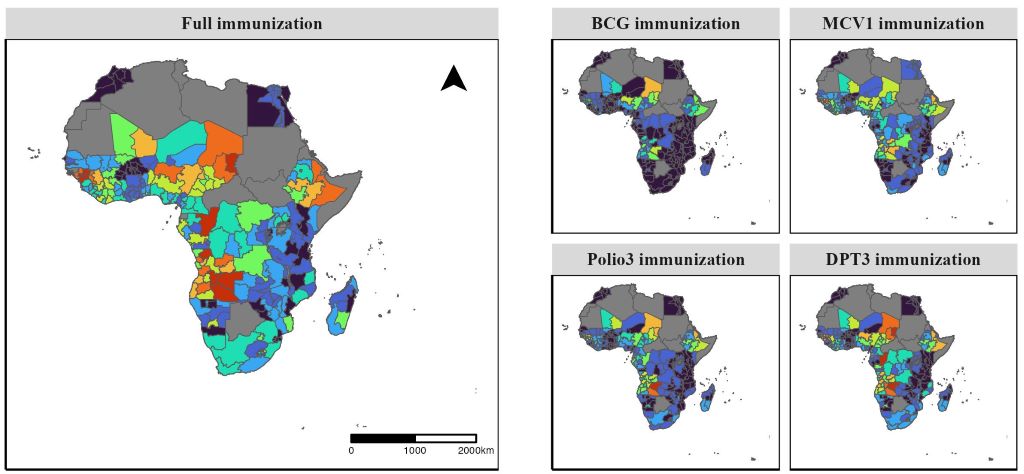
Maps of childhood immunisation coverage in African countries at regional level for 2020.

Image credit: Nguyen PT et al., 2025, PLOS Medicine, CC-BY 4.0

In the last two decades, childhood immunisation coverage improved significantly across most African countries. However, at least 12 countries, including South Africa, are unlikely to achieve global targets for full immunisation by 2030, according to a new study published July 29th in the open-access journal PLOS Medicine by Phuong The Nguyen of Hitotsubashi University, Japan, and colleagues.

Vaccines are one of the most effective ways to protect children from deadly diseases, yet immunisation coverage is still suboptimal in many African countries. Monitoring and progress in childhood immunisations at the national and local level is essential for refining health programmes and achieving global targets in these countries.

In the new study, researchers used childhood immunisation data contained in approximately 1 million records from 104 nationally representative Demographic and Health Surveys (DHS) conducted in 38 African countries between 2000 and 2019. Using modelling techniques, they estimated immunisation coverage trends through 2030 and assessed disparities across geographic regions and between socioeconomic groups.

The data showed overall improvements in immunisation coverage between 2000 and 2019. It forecast that, if current trends continue, most countries are projected to meet or exceed targets for achieving 80% or 90% coverage of vaccines against tuberculosis, measles, polio, diphtheria, pertussis (whooping cough), and tetanus. However, 12 of 38 countries are not on track to meet full immunisation goals, including high-development nations like South Africa, Egypt, and Congo Brazzaville. The study also pinpointed significant socioeconomic inequalities in coverage, with gaps in coverage of up to 58% between wealth quintiles. While these disparities were present across all countries, most are projected to shrink by 2030 –except in Nigeria and Angola, where inequalities are expected to persist or grow.

“These achievements are likely the result of sustained progress driven by decades of national and sub-national initiatives along with international support aimed at prioritising immunisation,” the authors say. “However, progress towards full immunisation coverage remains slow in 12 African countries examined. In most African nations, challenges related to vaccine affordability, accessibility, and availability remain major obstacles, driven by weak primary healthcare systems and limited resources.”

The authors add, “This study shows that while childhood immunisation coverage has improved in Africa, progress is uneven. Many countries and regions remain off track to meet global targets by 2030.”

The authors conclude, “Conducting this study reinforced how critical reliable sub-national data is for identifying communities being left behind. We hope the findings will help inform more equitable and targeted immunisation strategies.”

Provided by PLOS

Single Dose Typhoid Conjugate Vaccine (TCV) Provides Lasting Efficacy in Children

Healthy children in Malawi participating in study to test efficacy of typhoid conjugate vaccine. Credit: TyVAC/Madalitso Mvula

A single dose of the typhoid conjugate vaccine, Typbar TCV®, provides lasting efficacy in preventing typhoid fever in children ages 9 months to 12 years old, according to a new phase 3 clinical study published in The Lancet.

The study conducted by researchers at University of Maryland School of Medicine’s (UMSOM) Center for Vaccine Development and Global Health (CVD) and led by in-country partners at the Malawi-Liverpool Wellcome Trust (MLW) Clinical Research Programme.

The research team enrolled more than 28 000 healthy children in Malawi and randomly assigned about half the group to receive the TCV and the other half to receive a meningococcal capsular group A conjugate (MenA) control vaccine. During the more than four years of follow-up, 24 children in the TCV group and 110 in the MenA group developed typhoid fever, which was confirmed via blood culture. That resulted in an efficacy of 78.3% in the TCV group, with one case of typhoid prevented for every 163 children vaccinated. TCV was effective in all age groups and over the study period – which ended in 2022 – vaccine efficacy remained strong, decreasing by only 1.3% per year.

Typhoid fever causes more than 9 million illnesses and at least 110,000 deaths worldwide every year, mostly in sub-Saharan Africa and southeast Asia. It is a contagious bacterial infection that occurs from consuming contaminated food or beverages. Symptoms include nausea, fever, and abdominal pain that, if left untreated, can be deadly.

“These findings have significant implications for identification of the contribution of TCVs in the control and potential elimination of typhoid fever in endemic settings,” wrote the authors of a commentary published in The Lancet alongside the study.

In May 2023, the Malawi government launched a national rollout of the TCV in children under 15 years. Going forward, all children in Malawi will receive TCV at 9 months of age as part of the routine immunisation schedule.

“The newly published study supports the long-lasting impacts of a single shot of TCV, even in the youngest children, and offers hope of preventing typhoid in the most vulnerable children,” said Kathleen Neuzil, MD, MPH, CVD Director, the Myron M. Levine, MD, DTPH, Professor in Vaccinology at UMSOM and coauthor of the current study.  “We could not have had a better partner in this endeavor than MLW, whose long-standing excellence in typhoid research and strong surveillance infrastructure made this study possible.”

“The CVD’s outstanding record of generating data to accelerate public health decisions continues with this landmark study,” said UMSOM Dean Mark T. Gladwin, MD, Vice President for Medical Affairs, University of Maryland, Baltimore, and the John Z. and Akiko K. Bowers Distinguished Professor. “The research could not come at a more critical time when Malawi and other African countries are struggling with climate change, extreme weather events and increased urbanisation patterns, which are likely to contribute to increases in enteric diseases, including typhoid.”

Source: University of Maryland

Long-term HIV Immunisation in Mice with Gene Technology

While some COVID vaccines are entering the final phases of approval less than a year before the disease was first identified, HIV still has no vaccine after decades of research.

Now, engineered immune cells have elicited a response against HIV in mice, presenting an important first step forward in the quest for a vaccine. These broadly neutralising antibodies (bnabs) are effective against a variety of viruses and neutralise the glycan protecting HIV’s proteins.

Previous research had engineered B cells that produced the same antibodies as seen in rare HIV patients who are able to produce bnabs against HIV after many years. Now, this research has shown that it was possible to mature these into memory and plasma cells, conferring long-lasting protection and even showing improved antibodies can be produced, as in the immunisation process.

Principal investigator James Voss, PhD, of Scripps Research said, “This is the first time it has been shown that modified B cells can create a durable engineered antibody response in a relevant animal model.”

Currently it appears it would be an expensive therapy and a great barrier to many of the 38 million living with HIV around the world. A blood draw would be taken to the lab to engineer a vaccine for the patient, but Voss says that his team is looking to make the procedure inexpensive.

“People think of cell therapies as being very expensive,” Voss said. “We’re doing a lot of work towards trying to make the technology affordable as a preventative HIV vaccine or functional cure that would replace daily antiviral therapy.”

Source: Science Daily