Tag: carbon dioxide

Rising CO₂ Levels are Reflected in Human Blood. Scientists Don’t Know What it Means
FabrikaCr / Getty Images

Alexander Larcombe, The Kids Research Institute Australia; Curtin University and Philip Bierwirth, Australian National University

Humans evolved in an atmosphere containing roughly 200–300 parts per million (ppm) of carbon dioxide (CO₂). Today, that figure sits above 420 ppm, higher than at any point in the history of our species.

We know this extra CO₂ is contributing to climate change, but could it also be changing the chemistry of our bodies?

In our recently published research we looked at two decades of information from one of the biggest health datasets in the world to start answering this question. We found some concerning trends.

What we found

We analysed blood chemistry data from the US National Health and Nutrition Examination Survey (NHANES), which collected samples from about 7000 Americans every two years between 1999 and 2020. We looked at three markers: CO₂, calcium and phosphorus.

CO₂ is mainly carried in blood in the form of bicarbonate (HCO₃⁻).

When CO₂ enters the blood, it is converted to bicarbonate. This process largely occurs inside red blood cells, and also produces hydrogen ions.

During short-term exposure to increased CO₂, this can make blood more acidic, and result in a modest increase in bicarbonate levels in the blood (to reduce acidity).

If the exposure continues for a long time the kidneys reduce the amount of bicarbonate lost in urine and also produce more bicarbonate. This has the net effect of higher bicarbonate levels in the blood, to counteract the persistent acidity.

Levels of calcium and phosphorus in the blood may also be affected, as they too play a role in regulating acidity in the blood. These processes are completely normal.

Over the 21 years from 1999 to 2020, we found that average blood bicarbonate levels rose by about 7%. Over the same period, atmospheric CO₂ concentrations rose by a similar proportion.
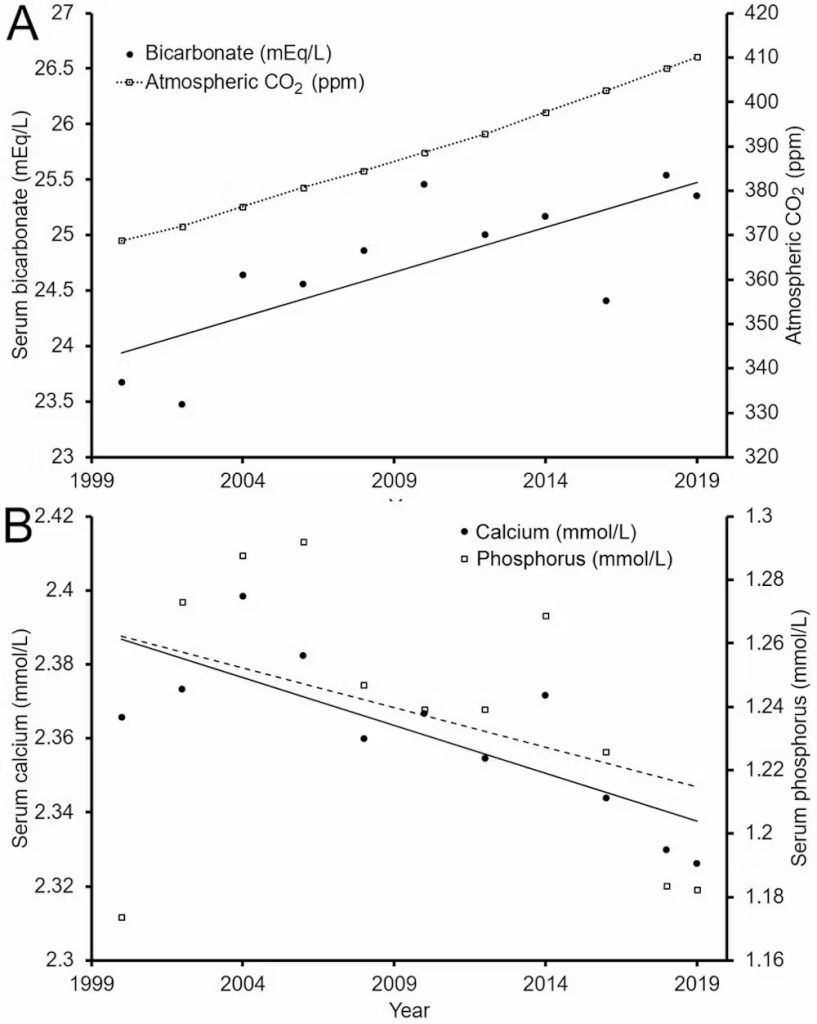
Atmospheric CO₂ has risen, along with increases in levels of carbonate in the blood and decreases in calcium and phosphorus. Larcombe & Bierwirth / Air Quality, Atmosphere & Health, CC BY

Meanwhile, blood calcium levels dropped by about 2% and phosphorus by around 7%.

If these trends continue, blood bicarbonate levels may exceed healthy levels in around 50 years. Calcium and phosphorus levels may fall below healthy levels, too, by the end of the century.

Our hypothesis is that rising CO₂ exposure could be contributing to these trends.

What’s causing the changes?

It’s important to be clear about what this study does and doesn’t show. It identifies population-level trends in blood chemistry that parallel rising atmospheric CO₂.

But correlation is not causation. The study does not adjust for factors such as diet, kidney function, diuretic use or obesity, which can influence the measurements and should be considered in future analyses.

There are other plausible contributors. One important consideration is indoor air.

Participants in the NHANES study likely spend most of their time indoors, where CO₂ concentrations often exceed 1000 ppm in poorly ventilated spaces. Other studies show time spent indoors has increased over the past two decades.

The NHANES dataset doesn’t capture this parameter, so we can’t directly assess this contribution. However, if more time indoors is contributing, it means total CO₂ exposure is rising even faster than atmospheric trends suggest. This arguably reinforces rather than alleviates the concern.

Other factors, such as shifting dietary patterns, changing rates of obesity, differences in physical activity and even variations in sample collection or processing across survey cycles, could also be important.

Can our bodies cope?

Some critics have argued that, based on what we know about how our bodies manage blood chemistry, we should have no trouble compensating for future increases in atmospheric CO₂, even under worst-case climate scenarios. For example, the lungs can increase ventilation and the kidneys can adjust to produce more bicarbonate.

For most healthy individuals, small long-term increases in outdoor CO₂ are not expected to meaningfully change the levels of bicarbonate, calcium or phosphorus in the blood.

This makes the population-level trends we observed puzzling. They could reflect a confounding rather than a direct CO₂ effect, but they do highlight how little data we have on long-term, real-world exposure.

A lack of long-term data

The argument that we can cope easily with higher CO₂ is based on short-term responses. Whether the same reasoning applies when CO₂ levels are higher across a person’s entire life remains largely untested.

There is, however, a growing body of evidence across many species which shows that even modest, environmentally relevant increases in CO₂ can produce subtle but measurable physiological effects.

In humans, short-term exposure at concentrations commonly found indoors (1000–2500 ppm) has been linked to reduced cognitive performance and changes in brain activity, though the mechanisms aren’t fully understood.

These new findings highlight a gap in evidence about long-term, real-world CO₂ exposure and human physiology. Unfortunately, there simply aren’t any studies assessing the physiological effects of breathing slightly elevated CO₂ over a lifetime.

This is particularly important for children, who will experience the longest cumulative exposure. And that’s why it’s vital to investigate this area further.

What this means

Our findings are not suggesting people will become suddenly unwell when atmospheric CO₂ reaches a certain level. What the data show is a signal that warrants attention.

If rising atmospheric CO₂ is contributing to gradual shifts in blood chemistry at a population level, then the composition of the atmosphere should be monitored alongside traditional climate indicators as a potential factor in long-term public health.

Reducing CO₂ emissions remains crucial for limiting global warming. Our findings suggest it may also be important for safeguarding aspects of human health that we’re only just beginning to understand.

Alexander Larcombe, Associate Professor and Head of Respiratory Environmental Health, The Kids Research Institute Australia; Curtin University and Philip Bierwirth, Emeritus Research Associate, Australian National University

This article is republished from The Conversation under a Creative Commons license. Read the original article.


Is It Time for the Gloves to Come off?

The indiscriminate use of non-sterile gloves in hospitals and clinics could be doing more harm than good, new research has found.

Photo by Anton on Unsplash

The indiscriminate use of non-sterile gloves in hospitals and clinics is significantly adding to environmental pollution, with little evidence to prove that there are substantial benefits.

New research from Edith Cowan University (ECU) has highlighted the lack of evidenced-based guidelines in the use of non-sterile gloves in healthcare nursing and other medical fields, which could be impacting patient outcomes, healthcare costs, and environmental sustainability in healthcare.

Lead author Dr Natasya Raja Azlan noted while non-sterile gloves are necessary when there is a risk of touching body fluids that could carry viruses or bacteria or hazardous medications, there is no evidence to support the use of gloves for activities like moving patients, feeding, or basic washing or preparing many medications.

In fact, unnecessary glove use can be harmful. Staff are less likely to wash their hands, even though handwashing remains the best way to stop infections spreading. The result can be increased spread of harmful disease between vulnerable patients as well as healthcare staff.

Dr Raja Azlan

Co-author Dr Lesley Andrew added that the abundant use of non-sterile gloves was also contributing to the cost of healthcare, pointing out that one New South Wales hospital’s decision to cut-back on the use of these gloves had saved $155 000 in a single year and reduced medical waste by 8 tonnes.

“The disposal of healthcare products represents 7% of Australia’s national total carbon emissions, only slightly less than the 10% attributed to all road vehicles. Manufacturing these gloves consumes fossil fuels, water, and energy, while their disposal if through incineration can degrade air quality and release harmful chemicals. If sent to landfill, they may leach microparticles and heavy metals into soil and water systems, posing risks to both human health and the environment,” she added.

Dr Raja Azlan noted that, despite non-sterile glove use being a common and routinely taught practice during intravenous antimicrobial preparation and administration, there are currently no evidence-based guidelines or protocols in place to support or standardise this aspect of nursing care.

This lack of evidence-based protocols has resulted in co-author Dr Carol Crevacore calling for a review into this practice.

Source: Edith Cowan University

Carbon Dioxide Protects Cells from Damage by Free Radicals

Photo by Matthias Heyde on Unsplash

A team of University of Utah chemists have found that carbon dioxide, well-known for being deadly at high concentrations, also has an important beneficial effect in preserving cell function. This is something not accounted for in most in vitro experiments of cell damage, and may have important consequences for understanding environments with high CO2 concentrations, like underground mines, submarines and spacecraft.

The cells in our bodies are like bustling cities, running on an iron-powered system that uses hydrogen peroxide (H₂O₂) not just for cleaning up messes but also for sending critical signals. Normally, this works fine, but under stress, such as inflammation or a burst of energy use, oxidative stress damages cells at the genetic level.

This is because iron and H₂O₂ react in what’s known as the Fenton reaction, producing hydroxyl radicals, destructive molecules that attack DNA and RNA indiscriminately. But there’s a catch. In the presence of carbon dioxide, our cells gain a secret weapon in the form of bicarbonate which helps keep pH levels balanced.

In this study, the researchers discovered that bicarbonate doesn’t just act as a pH buffer but also alters the Fenton reaction itself in cells. Instead of producing chaotic hydroxyl radicals, the reaction instead makes carbonate radicals, which affect DNA in a far less harmful way, according to Cynthia Burrows, a distinguished professor of chemistry and senior author of a study published this week in PNAS.

“So many diseases, so many conditions have oxidative stress as a component of disease. That would include many cancers, effectively all age-related diseases, a lot of neurological diseases,” Burrows said. “We’re trying to understand cells’ fundamental chemistry under oxidative stress. We have learned something about the protective effect of CO₂ that I think is really profound.”

Without bicarbonate or CO₂ present in experimental DNA oxidation reactions, the chemistry is also different. The free radical species generated, hydroxyl radical, is extremely reactive and hits DNA like a shotgun blast, causing damage everywhere, Burrows said.

In contrast, her team’s findings show that the presence of bicarbonate from dissolved CO₂ changes the reaction to make a milder radical striking only guanine, the G in our four-letter genetic code.

“Like throwing a dart at the bullseye where G is the center of the target,” Burrows said. “It turns out that bicarbonate is a major buffer inside your cells. Bicarbonate binds to iron, and it completely changes the Fenton reaction. You don’t make these super highly reactive radicals that everyone’s been studying for decades.”

What do these findings mean for science? Potentially a lot.

For starters, the team’s discovery shows cells are a lot smarter than previously imagined, which could reshape how we understand oxidative stress and its role in diseases like cancer or aging.

But it also raises the possibility that many scientists studying cell damage have been conducting laboratory experiments in ways that don’t reflect the real world, rendering their results suspect, Burrows said. Chemists and biologists everywhere grow cells in a tissue culture in an incubator set to 37°C. In these cultures, carbon dioxide levels are raised to 5%, or about 100 times more concentrated than what’s found in the atmosphere.

The elevated CO₂ recreates the environment the cells normally inhabit as they metabolise nutrients, however, it is lost when researchers start their experiments outside the incubator.

“Just like opening up a can of beer. You release the CO₂ when you take your cells out of the incubator. It’s like doing experiments with a day-old glass of beer. It’s pretty flat. It has lost the CO₂, its bicarbonate buffer,” Burrows said. “You no longer have the protection of CO₂ to modulate the iron-hydrogen peroxide reaction.”

She believes bicarbonate needs to be added to ensure reliable results from such experiments.

“Most people leave out bicarbonate/CO₂ when studying DNA oxidation because it is difficult to deal with the constant outgassing of CO₂,” Burrows said. “These studies suggest that to get an accurate picture of DNA damage that occurs from normal cellular processes like metabolism, researchers need to be careful to mimic the proper conditions of the cell and add bicarbonate, ie baking powder!”

Burrows anticipates her study could result in unintended outcomes that may someday benefit research in other areas. Her lab is seeking new funding from NASA, for example, to study the effect of CO₂ on people confined to enclosed spaces, such as inside of space capsules and submarines.

“You’ve got astronauts in a capsule living and breathing, and they are exhaling CO₂. The problem is how much CO₂ can they safely handle in their atmosphere? One of the things we found is that, at least in terms of tissue culture, CO₂ does have a protective effect from some of the radiation damage these astronauts might experience. So what you might want to do is push up that CO₂ level. You certainly don’t want to go very high, but having it slightly higher might actually have a protective effect against radiation, which generates hydroxyl radicals.”

Source: University of Utah

An Oral Drug for Sleep Apnoea

Sleeping man
Photo by Mert Kahveci on Unsplash

A new study published in the American Journal of Respiratory and Critical Care Medicine has tested a sleep apnoea treatment using a drug that inhibits carbonic anhydrase – an enzyme that balances carbonic acid and carbon dioxide in the body. The treatment reduced breathing pauses by more than 20 per hour for patients given the drug.

Several drugs with carbonic anhydrase (CA) inhibitory properties are already available on the market, and used for treatment of glaucoma, epilepsy and other disorders.

Previous research has not systematically tested whether CA inhibitors also might be used to treat obstructive sleep apnoea. A total of 59 patients with moderate or severe sleep apnoea completed the four-week trial, and were randomised to two groups receiving either 400 or 200 mg of the CA inhibitor, and a control group that received placebo.

The results show that, overall, the treatment reduced the number of breathing pauses and promoted oxygenation during the night. A few patients experienced side effects, such as headache and breathlessness, which were more common in those receiving the highest dose.

The study results together with established safety data of the drug sulthiame provide support for continued research on CA inhibition as a new potential treatment for obstructive sleep apnoea.

“Among the patients who received the higher dosage of the drug, the number of breathing pauses decreased by approximately 20 per hour. For just over a third of patients in the study, only half of their breathing pauses were left, and in one in five the number fell by at least 60 percent,” said first authpr Professor Jan Hedner.

The fact that several approved drugs in the CA inhibitor category are available on the market makes fast-tracking development of an approved drug for sleep apnoea practicable. The drug used in this clinical trial was sulthiame, which is sometimes used to treat epilepsy in children.

Current treatment for a patient with sleep apnoea is either an oral appliance therapy or a CPAP (Continuous Positive Airway Pressure) mask. Both help to maintain airway patency during sleep.

“These therapy options take time to get used to and, since they frequently are perceived as intrusive or bulky. Insufficient user time is therefore common. If we develop an effective drug, it will therefore make life easier for many patients and, in the long run, potentially also save more lives,” said senior author Ludger Grote.

Source: University of Gothenburg