People with good physical fitness in their 30s and 50s have more elastic arteries later in life. This is shown in a new study from Karolinska Institutet, published in the journal Scientific Reports. The association remains regardless of cholesterol levels and other risk factors.
Cardiovascular disease is the leading cause of death worldwide. One early sign of increased risk is stiffening of the arteries, which can contribute to heart attack and stroke. In the present study, researchers investigated whether physical fitness earlier in life can predict how elastic the blood vessels are in older age.
The study is based on data from the Swedish longitudinal study SPAF‑1958, led by Maria Westerståhl, senior lecturer at the Department of Laboratory Medicine, where 425 individuals were followed across adulthood. Participants were examined at ages 34, 52, and 63. The researchers assessed fitness using a cycle ergometer test, analysed blood samples to study lipids, and measured arterial stiffness at age 63 using a non-invasive method.
Fitness more important than blood lipids
The results show that individuals with higher fitness at ages 34 and 52 had more elastic arteries at age 63. The association remained even after accounting for factors such as blood pressure, body weight, smoking, and cholesterol levels. However, neither cholesterol nor more advanced measures of so-called “good” HDL cholesterol could predict arterial stiffness.
“Our findings show that good physical fitness early in life is linked to vascular health later in life, independently of traditional risk factors,” says Andrea Tryfonos, postdoctoral researcherat the Department of Laboratory Medicine, Karolinska Institutet.
According to the researchers, the results suggest that regular physical activity may have long-term effects on cardiovascular health that are not captured by blood lipids and other common risk markers alone.
“This highlights the importance of maintaining good fitness from early adulthood to reduce the risk of cardiovascular disease,” says Andrea Tryfonos.
Next step
The researchers are now planning a follow-up of the participants at age 68 to investigate how changes in fitness over time affect vascular health later in life.
The study was conducted in collaboration with the division of clinical physiology and the division of clinical chemistry at the department of laboratory medicine, as well as Karolinska University Hospital in Huddinge. Information on funding and potential conflicts of interest is not available in the provided material.
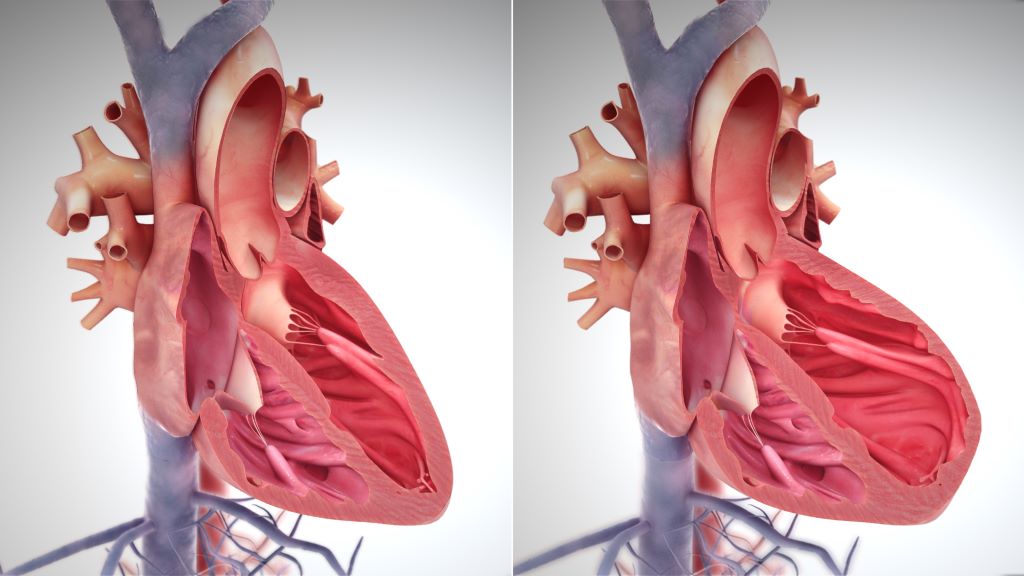
Right side heart failure. Credit: Scientific Animations CC4.0
A simple neck scan can identify men with double the risk of heart failure, according to a new study led by UCL researchers and funded by the British Heart Foundation and the National Institute for Health and Care Research.
A carotid ultrasound, like the ultrasound for pregnant women, is quick and painless, using a small handheld device moved gently over the neck to scan the arteries underneath.
When around 1600 men over the age of 70 received the scan, it showed the ‘flexibility’ of their carotid arteries – how much they stretch and expand with each heartbeat.
Researchers found that the quarter of men with the least flexible carotid arteries were 2.5 times more likely to develop heart failure than those with the most flexible carotid arteries.
These people could be encouraged by doctors to eat more healthily, do more exercise and take medications, if needed, to help reduce their risk of developing heart failure.
GPs do not currently routinely carry out the cheap and easy scan on healthy patients without symptoms. But, where GP surgeries have the capacity, offering a neck scan to older people to measure the flexibility of their arteries could help them better understand their risk of future heart failure, according to the researchers.
Having relied upon data from the British Regional Heart Study, which began in the 1970s and only involved men, researchers highlight that these findings next need to be looked at in women.
Dr Atinuke Akinmolayan (UCL Primary Care & Population Health), who is now a GP, said: “The carotid ultrasound is a safe, cheap and painless investigation, and our findings suggest it may be able to provide an early warning sign for heart failure.
“More research is needed, especially to see if this works for women, but this is something GPs could look at offering to people over the age of 60, where possible and believed needed.
“A patient who gets an ultrasound result indicating they may be at higher risk of future heart failure could have an important conversation with their doctor about lifestyle changes they could make to lower that risk.”
Doctors tend to scan the two carotid arteries, which run up either side of the neck, when someone has had a stroke or is at risk of a stroke following a transient ischaemic attack, known as a ‘mini-stroke’. A scan can identify carotid artery disease – a build-up of fatty material which can cause a stroke by breaking off and travelling into the brain or by narrowing the arteries and stopping blood reaching the brain.
However, the carotid arteries may be a red flag for heart failure also. This is because, when the carotid arteries become less flexible, they do not expand properly to let blood through. This can raise blood pressure, which forces the heart muscle to work harder. Over time, this can lead to heart failure.
The study, published in the Journal of the American Heart Association, looked at 1631 British men, aged 71 to 92, who had a carotid artery ultrasound between 2010 and 2012 as part of the British Regional Heart Study.
A carotid ultrasound, sometimes called a Doppler scan, takes an average of 15 to 30 minutes for most people, although this can vary.
A small handheld sensor is moved back and forth over the neck, generating sound waves which bounce off the arteries. That provides an echo which changes in frequency when blood flow is reduced in the blood vessels because they are narrowed by built-up fatty material.
The narrowing identified by a carotid scan can then be used to calculate the arteries’ flexibility, after factoring in other measures, including blood pressure. Researchers were able to identify the quarter of men with the least flexible carotid arteries, and the quarter of men whose carotid arteries were most flexible.
They then compared the rates of heart failure in each group over an average of six years after their neck scans.
Even after considering other causes of heart failure, like age, weight, smoking and whether people had previously suffered a heart attack, the quarter of men with the least flexible carotid arteries had 2.5 times the risk of developing heart failure, compared to the quarter with the most flexible carotid arteries.
In a separate finding, looking at the thickness of people’s carotid arteries rather than their flexibility, the study found that men with thicker carotid arteries were more likely to have a heart attack or die from one.
For every ‘unit’ increase in the thickness of the carotid artery wall – with a unit equalling 0.16 millimetres – the risk of having a heart attack increased by about 29 per cent, even after considering other relevant factors like age and weight.
However the thickness of the carotid arteries was not found to be significantly linked to future heart failure in the study.
There are around 200 000 new cases of heart failure diagnosed every year in the UK.
It occurs when the heart is not pumping blood around the body as well as it should, most commonly when the heart muscle has been damaged – for example, after a heart attack.
Heart failure can cause extreme fatigue, shortness of breath and fainting.
Professor Bryan Williams, chief scientific and medical officer at the British Heart Foundation (BHF), who is also Chair of Medicine at UCL Institute of Cardiovascular Science, said: “The findings of this study are interesting and show that stiffening of arteries is associated with increased risk of heart failure, most likely due to the heart having to work harder against the resistance caused by these stiffer arteries.
“It is an important signal that whenever we detect such changes in the carotid arteries, we should also be thinking of the potential impact on the heart and an increased risk of heart failure – which we have treatment strategies to prevent.”