Tag: 14/10/26

Pope Leo XIV’s Lung Cancer Highlights Growing Number of Nonsmokers Diagnosed with the Disease – And Younger People Too

By Edgar Beltrán, The Pillar – Own work, CC BY-SA 4.0, Link

Estelamari Rodriguez, University of Miami

When many people think of an average lung cancer patient, they often imagine an older man smoking. But the face of lung cancer has changed. Over the past 15 years, more women, never smokers and younger people are being diagnosed with lung cancer.

In fact, lung cancer is the leading cause of cancer death among women, and more women die from lung cancer than breast, ovarian and colorectal cancer each year. The American Lung Association reports that while lung cancer rates have risen by 79% for women over the last 44 years, they decreased by 43% for men. And for the first time in history, there are more young women than men diagnosed with lung cancer.

News about Pope Leo XIV’s lung cancer diagnosis on Oct. 13, 2026, sparked discussion about increasing rates of the disease among people who have never smoked. Leo reportedly is not a smoker. Potential causes for the disease include environmental exposures and genetics, and recognising the diverse factors that can increase someone’s risk of lung cancer – regardless of their smoking history – is essential for timely and appropriate screening and treatment.

Cancer that is found at the earliest stages, like that of the pope, can be treated with surgery and cured for both smokers and nonsmokers. The challenge is that people who have never smoked are not currently included in lung cancer screening guidelines, and tumours are often only found by chance.

As a thoracic oncologist, I have seen many younger women and never smokers walk into my clinic with a new diagnosis of lung cancer. Particularly for never smokers, lung cancer is unexpected for both patients and their doctors, which can often lead to delays in diagnosis. Researchers have described this trend of increasing lung cancer rates among women in different parts of the world and are starting to understand why cases are on the rise.

Lung cancer in women

The first explanation of why rates of lung cancer in women have increased is that many started smoking later than men, pushing back their peak in smoking-related lung cancer diagnoses.

Women also started smoking in the years when filtered cigarettes were most commonly used. This led to an increased risk of a type of cancer called adenocarcinoma due to the way cigarette filters distribute tobacco smoke to the outer parts of the lungs. Some studies suggest that women are more susceptible to the carcinogenic effects of exposure to tobacco and cigarette smoke, including second-hand smoke, and may develop lung cancer after fewer years of smoking compared to men.

However, it is important to note that most people diagnosed today with lung cancer are not active smokers. About 20% of women with lung cancer have never smoked – higher than for men with lung cancer who’ve never smoked. An increasing number of lung cancer diagnoses are among people who never smoked.

Lung cancer risk factors

Besides smoking and secondhand smoke, there are several other lung cancer risk factors. These include a family history of cancer and exposure to asbestos, radon and air pollution.

Exposure to carcinogens in the workplace in the form of inhaled chemicals such as arsenic, beryllium, cadmium, silica and nickel is still a concern in some parts of the world. The potential lung cancer risk of e-cigarette and marijuana smoke is still under study but of potential concern.

Recently, researchers have also found that genetics can play a role in lung cancer risk in some patients with a strong history of lung cancer. Studies of these families have helped identify potential susceptibility genes for lung cancer and environmental risk factors.

Like BRCA1 and BRCA2 in breast cancer, alterations in genes that promote or protect against tumour development can contribute to lung cancer development. Researchers have yet to identify specific mutations that may predispose individuals to lung cancer. However, studying familial genetic predispositions can help elucidate how lung cancer develops and lead to new biomarkers for early cancer detection in high-risk groups.

Lung cancer screening

In 2021, the United States Preventive Services Task Force updated its lung cancer screening guidelines to include younger patients with less smoking history. Now, lung cancer screening is recommended for adults ages 50 to 80 who have smoked at least one pack per day for 20 years, current smokers and former smokers who quit smoking within the last 15 years. Women at risk for lung cancer can talk to their doctors about ordering a low-dose CT scan for lung cancer screening.

Nationwide, more than 70% of eligible women undergo breast cancer screening but less than 6% of all eligible smokers pursue lung cancer screening. Researchers estimate that these new screening guidelines will increase the number of women eligible for lung cancer screening by 40% by including those at a younger age who have less smoking exposure.
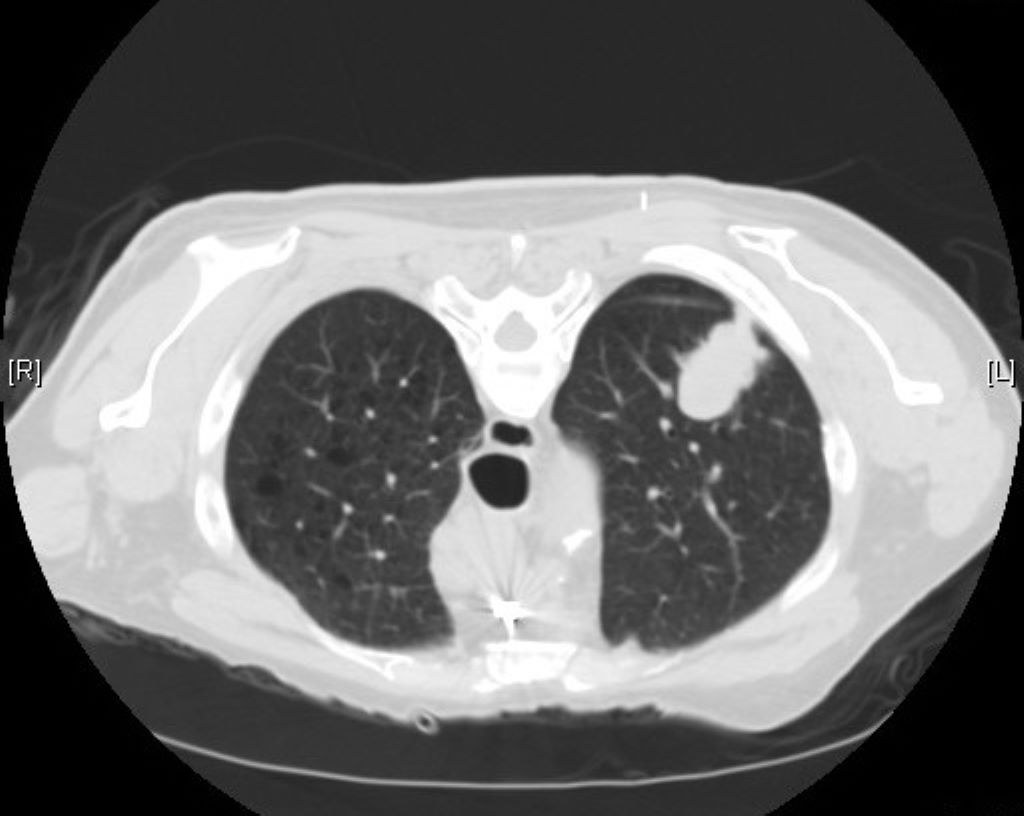
A low-dose CT scan can help with early detection of lung cancer. In this image, the tumour is the white nodule in the upper right corner of the black space. Atlas of Pulmonary Pathology/Flickr, CC BY-SA

Lung cancer diagnosis

In recent years, increasing understanding of the genetic changes that can lead to cancer and how to harness the immune system to treat cancer has led to new targeted therapies and immunotherapies that have improved the prognosis of patients with lung cancer. Women tend to have a better lung cancer prognosis than men, especially if they never smoked and have tumours with molecular changes that can be treated with targeted therapies.

However, lung cancer symptoms may go unrecognised in women. Symptoms of lung cancer can include coughing, shortness of breath, overwhelming fatigue and pain in the back, chest or shoulder, which could be confused for other ailments. Because women tend to be slightly younger when diagnosed than men, patients may be able to tolerate symptoms longer and delay seeking medical attention. Physicians also might not attribute these symptoms to lung cancer due to a patient’s younger age.

Recognising the early symptoms of lung cancer, expanding lung cancer screening eligibility and testing for genetic biomarkers to select the best therapy are some of the steps that could help address the global epidemic of lung cancer in women.

This is an updated version of an article published on Feb. 1, 2023.

Estelamari Rodriguez, Associate Director of Community Outreach in Thoracic Oncology, University of Miami

This article is republished from The Conversation under a Creative Commons license. Read the original article.


Researchers Explore Gut & Brain Health Link for People with HIV

Irritable bowel syndrome. Credit: Scientific Animations CC4.0

Oregon Health & Science University researchers have secured a $5.8 million, five-year federal award to investigate whether damage to the gastrointestinal tract contributes to neuroinflammation in people living with HIV – raising the potential for new treatments to preserve brain function in people with HIV and older adults.

“Even though antiretroviral drugs are very successful at suppressing the virus, we’ve seen people living with HIV have neurocognitive disorders similar to what happens when people age,” said co-lead investigator Afam Okoye PhD (professor, OHSU Vaccine & Gene Therapy Institute). “If we can show a dynamic relationship between inflammation in the gut and the brain, this line of research could then lead to new treatments to reduce neuroinflammation.”

The award from the National Institute of Mental Health of the National Institutes of Health will enable researchers to align nonhuman primate models with human autopsy tissues to better understand the interplay between inflammation in the gut and brain health among people living with HIV.

Scientists have long associated inflammation in the gastrointestinal tract with impaired cognition in the brain. People with inflammatory bowel disease are at increased risk for Parkinson’s and Alzheimer’s disease, for example.

This problem disproportionately affects people living with HIV.

Researchers surmise this may be related to the fact that the initial infection of the virus – even when it’s subsequently held in check by antiretroviral therapies – causes lasting damage to immune cells in the GI tract. The research team will include pathologists at OHSU and infectious disease specialists at the NIH to better characterise how exactly inflammation in the gut is linked to brain function.

The research also will involve nonhuman primates at OHSU’s Oregon National Primate Research Center.

“Neuroinflammation in people with HIV is very hard to study,” said Okoye (also Division of Pathobiology and Immunology, ONPRC). “These are very challenging studies to do, but we have expertise and experience in the nonhuman primate model. It’s high risk but also high reward.”

Ultimately, it may be possible to develop targeted therapies that tamp down harmful or runaway inflammation while retaining the beneficial effects of a strong immune system.

“Inflammation in and of itself is not bad,” said co-lead investigator Jacob Estes PhD (professor and director of the VGTI). “It’s part of the immune system’s response to mediate infection. Ultimately, this research could lead to precision targets that would limit pathology that harms brain function but doesn’t completely shut off the immune system’s ability to do the things it needs to do to promote health.”

Source: Oregon Health & Science University

New Research on Botticelli’s Venus Uncovers a Pituitary Tumour

By Sandro Botticelli – Adjusted levels from File:Sandro Botticelli – La nascita di Venere – Google Art Project.jpg, originally from Google Art Project. Compression Photoshop level 9., Public Domain, Link

New evidence supporting the theory that Botticelli’s Venus died from a pituitary tumour was published on Monday.

The Medical Humanities paper published by the BMJ is the third in a series of papers led by Professor Paolo Pozzilli, in which he has set out his research on the Renaissance aristocrat Simonetta Vespucci, Sandro Botticelli’s muse, who died at just 23 from suspected tuberculosis.

Simonetta Vespucci (c. 1453–1476), born Simonetta Cattaneo in Genoa, was a Renaissance beauty dubbed “La Bella Simonetta.” Married at 16 to Marco Vespucci, she captivated Florence’s elite, including the Medici family.

Botticelli painted her in both The Birth of Venus and Primavera, and was so devoted to her that he asked to be buried at her feet. The “Venus squint” made famous in her paintings was copied by other artists and became a hallmark of Renaissance beauty.

Professor Paolo Pozzilli’s previous examination of documents about her death, and of the portraits, suggested an expanding pituitary tumour led to pituitary apoplexy, an acute condition ending in bleeding and death. This may have been sparked by dancing, or a violent rape – both suggested by the historical record.

In the latest paper, Pozzilli’s team examines Botticelli’s depiction of Vespucci’s eyes in the famous Birth of Venus, and in other portraits of her.

The findings support the original hypothesis. They describe swelling around the woman’s eyes, particularly her left eye. The tissue covering the white part of the eye is loose or folded, and the tissue underneath is swollen with fluid.

These changes, together with a squint (where the eyes do not point in the same direction), may be associated with a large tumour of the pituitary gland. There is also some swelling around her right eye.

Paolo Pozzilli (Honorary Professor of Diabetes and Clinical Research, Queen Mary University of London) said: “Sandro Botticelli was a brilliant artist who depicted his subjects with great realism. So it is not surprising that he’s left medical evidence in his paintings that we are able to read centuries later. The squint (‘strabismus’) of Venus in Simonetta Vespucci’s portraits embodies a poignant paradox: once exalted as the epitome of divine allure in Renaissance art and copied by artists like Bronzino, it now reveals itself as a subtle harbinger of her doom.”

Source: Queen Mary University London

Prescriptions for Nature Could Fight the ‘Epidemic of Loneliness’

Photo by Henry Xu on Unsplash

About one in three Americans and one in six people worldwide feel lonely on a regular basis, a troubling reality that has prompted some public health officials to declare an ‘epidemic of loneliness’.

A new global study presents a novel remedy. It found that nature-based social prescribing – clinicians literally prescribing things like gardening, hiking or birdwatching – can significantly reduce loneliness. Spending time in nature with others works even better, particularly for the loneliest among us, the study found.

“There has been a lot of passion about nature-based prescriptions, but not a lot of evidence,” said corresponding author Jill Litt (professor of environmental health, CU Boulder; principal investigator, RECETAS project).

Thus far, all the trials have shown promising results. The latest findings, looking at 320 lonely adults in Barcelona, appear in the October issue of Lancet Regional Health.

“We now have randomised controlled trials showing this works and the impacts last,” said Litt.

Loneliness is not about being physically isolated. Rather, it is a “subjective disconnect between one’s expectations of their social relationships and one’s reality.”

“I’ve heard people describe it like a knot in their stomach, like something is just not right,” said Litt. “You could be in a room full of people and still feel lonely.”

Chronic loneliness can increase risk of cardiovascular disease, dementia, stroke, depression and anxiety. It can also burden the healthcare system, as people suffering from loneliness tend to visit their doctor more and are more likely to visit the emergency department with vague complaints on Friday afternoons – a phenomenon known as “Friday afternoon syndrome.”

Due to stigma, people are often reluctant to admit or don’t recognise they are lonely and assume the physical symptoms they feel are due to something else.

“Once clinicians really start to drill down to the root causes, they discover that loneliness is a big factor and the solutions may lie outside the traditional medical system,” said Litt (also a researcher with the Barcelona Institute for Global Health).

RECETAS (Re-imagining Environments for Connection and Engagement) was launched in 2021 with a $5.6 million grant from the European Union. It has since conducted randomised controlled trials in Barcelona, Spain; Prague, Czech Republic; and Helsinki, Finland; and quasi-experimental studies in Marseille, France; Cuenca, Ecuador; and Melbourne, Australia.

The newest findings centre around the site in Barcelona.

The study included 320 lonely older adults from 12 low-income neighbourhoods. Half were placed in a group of 8–10, which spent two hours weekly for nine weeks together doing things like gardening, birdwatching or nature-based art programmes along with two trained facilitators. The other half were provided the same menu of free, easily accessible nature-based activities that they could do on their own. Both strategies worked. Participants on average showed an 11% reduction in loneliness scores at three months; 12% at six months; and 17% at one year. For those who started with lower emotional wellbeing, the group intervention worked better.

Litt said that nature, with its vivid sounds, smells and sights, can act as an “additional facilitator,” augmenting therapeutic benefits.

Even being in nature alone can alleviate loneliness, the research suggests.

“Being out in nature forms this kind of reservoir of calm that we can return to later in life during stressful times,” said Louise Chawla (environmental psychologist and professor emerita, CU Boulder), who recently co-authored another paper with Litt about the role that nature can play in fostering social connections. “It’s not just restorative when you are in a place but also when you go back to it in memory.”

Public health agencies in Spain have already begun to recognise the Friends in Nature model as a best-practice for addressing the loneliness epidemic. Litt is now working to bring similar trials to the US in hopes that someday, insurers might cover things like a membership in a community garden or birdwatching club.

“We have nature in our cities and investment in our green infrastructure,” she said. “Now we need a mechanism to bridge these resources with our health systems to offer person-centred care that leverages the power of nature for healing and wellbeing.”

RECETAS project: https://www.recetasproject.eu/

Source: University of Boulder Colorado

Smoking May Affect Fertility in Both Men and Women, New Study Finds

Photo by Sara Kurfess on Unsplash

New research has shed light on how exposure to cigarette smoke could affect reproductive health in both men and women, identifying changes in biological processes involved in ovarian function and sperm production.

The study, led by researchers from the Universities of Nottingham and Sheffield and published in Frontiers, provides new insight into potential mechanisms linking smoking with reproductive health.

Infertility affects a significant proportion of people of reproductive age worldwide. According to the World Health Organization, approximately one in six people globally experience infertility at some point during their reproductive years.

In this study, researchers used a mouse model to examine the effects of different levels of cigarette-smoke exposure on the ovaries and testes, focusing on changes to reproductive tissues and the activity of genes involved in their normal function.

In females, the number and structure of ovarian follicles showed relatively little change following exposure, even at higher levels. However, researchers identified clear changes in the activity of numerous genes.

Genes involved in cell division and metabolism became less active, while genes associated with protein production became more active. The pattern of gene activity showed similarities with biological processes previously associated with ovarian ageing and reduced ovarian function.

In males, higher levels of smoke exposure were associated with changes to structures within the testes, including enlargement of the seminiferous tubules. Researchers also identified changes in the activity of genes involved in sperm production, immune responses and cell signalling.

Some genes associated with sperm production became more active, while others involved in immune function became less active. The findings suggest that cigarette-smoke exposure may alter biological processes important for normal testicular function and sperm development.

The researchers say the findings add to existing evidence about the potential impact of smoking on reproductive health and highlight the need to better understand the biological mechanisms involved.

Professor Lucy Fairclough (School of Life Sciences, University of Nottingham), co-author, said: “Our study has identified potential biological mechanisms that could help explain the link between smoking and reproductive health in both men and women.

“In females, we identified changes in gene activity associated with biological processes that have previously been linked to ovarian ageing and reduced ovarian function. In males, we found changes in genes involved in sperm production and testicular function.

“These findings are important because they help us understand how exposure to cigarette smoke could affect reproductive health. Further research will be needed to establish how these biological changes relate to fertility in humans.”

Dr Adam Watkins (University of Sheffield) said: “While it is well-established that smoking is harmful for your reproductive health, the exact mechanisms are not fully understood. Our mouse study has enabled us to explore how the ovaries and testes respond following exposure to cigarette smoke. Interestingly, our study shows that the ovary and testis respond differently to the cigarette smoke. We observed that while the structure of the ovary was unaltered, the testis showed measurable changes in its morphology. Within the ovary, we identified changes in genes that regulate cell proliferation and the synthesis of proteins, while in the testis, genes regulating sperm production were altered.

“While our study only assessed the effects of cigarette smoke on the ovaries and testes, it does provide new mechanistic insight into how parental smoking shapes their reproductive health.”

Source: University of Sheffield