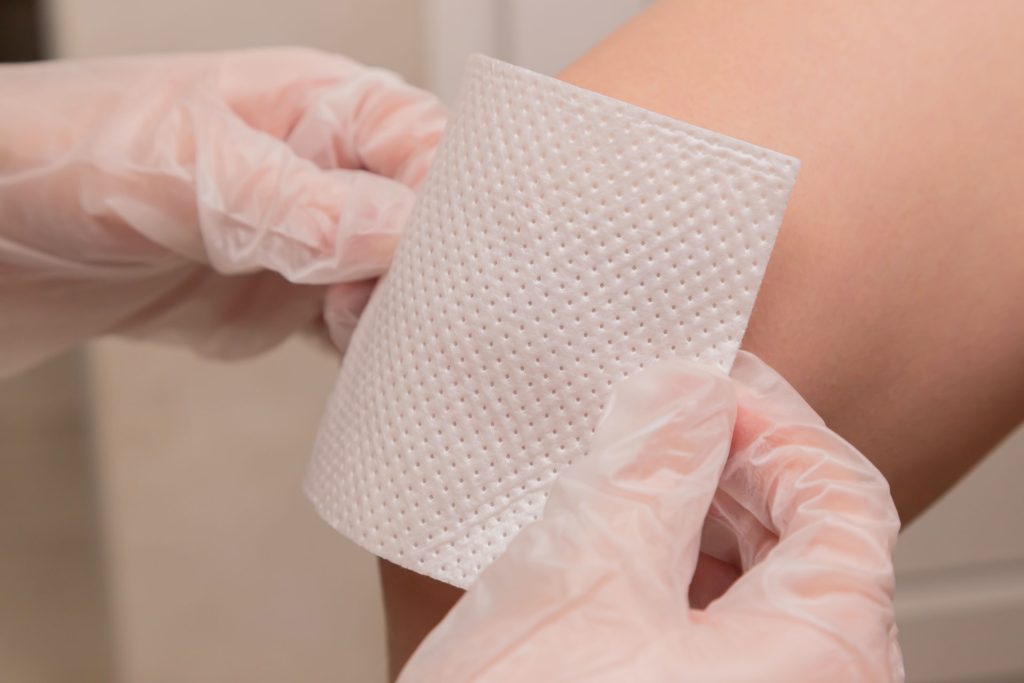
Haemostatic microneedle technology can be applied like a typical adhesive bandage to quickly stop bleeding. The biocompatible and biodegradable microneedle arrays (MNAs) on the patch increase its surface contact with blood to accelerate the clotting process and also increase the adhesive properties of the patch via mechanical interlocking to promote wound closure. Credit: Designed by Amir Sheikhi and Reihaneh Haghniaz/Executed by Natan Barros. All Rights Reserved.
In the US, secondary, uncontrolled bleeding from traumatic injury is the leading cause of death from ages one to 46. Amir Sheikhi, assistant professor of chemical engineering and of biomedical engineering at Penn State, has a plan to change that with a novel microneedle patch that can immediately stop bleeding after injury.
He described his technology in a new paper in the journal Bioactive Materials.
“Excessive bleeding is a serious challenge for human health,” Sheikhi said. “With haemorrhaging injuries, it is often the loss of blood – not the injury itself – that causes death. There is an unmet medical need for ready-to-use biomaterials that promote rapid blood coagulation.”
Sheikhi’s haemostatic microneedle technology can be applied like a typical adhesive bandage to quickly stop bleeding. The biocompatible and biodegradable microneedle arrays (MNAs) on the patch increase its surface contact with blood, accelerating the clotting process. The needles also increase the adhesive properties of the patch via mechanical interlocking to promote wound closure.
“In vitro, the engineered MNAs reduced clotting time from 11.5 minutes to 1.3 minutes; and in a rat liver bleeding model, they reduced bleeding by more than 90%,” Sheikhi said. “Those 10 minutes could be the difference between life and death.”
The MNA patch is comparable hydrogel technology that is currently used to treat bleeding wounds in hospitals, but hydrogel applications require preparation and medical expertise. The microneedle patch is pre-engineered for immediate application that anyone can use to stop bleeding, Sheikhi said, much like a typical over-the-counter adhesive bandage.
Microneedles – which are already in use to deliver biologics, such as cells or drugs, through the skin or for cosmetic procedures to stimulate collagen production – are tiny, making their application pain-free, according to Sheikhi.
The researchers are now working to commercialise the patch, with more testing plans.
Contrary to popular belief, rest may not always be the best treatment after a concussion, according to the results of a large multi-centre study published in JAMA Network Open. In fact, an early return to school may be associated with a lower symptom burden after suffering a concussion and, ultimately, faster recovery.
“We know that absence from school can be detrimental to youth in many ways and for many reasons,” says study lead author Christopher Vaughan, PsyD, neuropsychologist at Children’s National Hospital. “The results of this study found that, in general, an earlier return to school after a concussion was associated with better outcomes. This helps us feel reassured that returning to some normal activities after a concussion – like going to school – is ultimately beneficial.”
In this cohort study, data from over 1600 youths aged five to 18 were collected across nine paediatric emergency departments in Canada. Because of the large sample size, many factors associated with greater symptom burden and prolonged recovery were first accounted for through the complex statistical approach used to examine the data. The authors found that an early return to school was associated with a lower symptom burden 14 days post-injury in the 8 to 12 and 13 to 18-year-old age groups.
“Clinicians can now confidently inform families that missing at least some school after a concussion is common, often between 2 and 5 days, with older kids typically missing more school,” Dr Vaughan says. “But the earlier a child can return to school with good symptom management strategies and with appropriate academic supports, the better that we think that their recovery will be.”
The results suggest a possible mechanism of therapeutic benefit to the early return to school. This could be due to:
Socialisation (or avoiding the deleterious effects of isolation).
Reduced stress from not missing too much school.
Maintaining or returning to a normal sleep/wake schedule.
Returning to light-to-moderate physical activity sooner (also consistent with previous literature).
Patients hospitalised with fractures typically receive low-molecular-weight heparin to prevent life-threatening blood clots. A new clinical trial, however, found that inexpensive over-the-counter aspirin is just as effective. The findings, published today in the New England Journal of Medicine, may lead surgeons to change their practice and administer aspirin to these patients.
With more than 12 000 patients, the multi-centre randomised clinical trial is the largest trial ever conducted on orthopaedic trauma patients. This multidisciplinary collaboration between orthopaedic surgeons and trauma surgeons points to the importance of evaluating techniques used to prevent post-surgical complications, like blood clots and infections, through high-quality, head-to-head comparison studies.
“Many patients with fractures will likely strongly prefer to take a daily aspirin over receiving injections after we found that both give them similar outcomes for prevention of the most serious outcomes from blood clots,” said the study’s principal investigator Robert V. O’Toole, MD. “We expect our findings from this large-scale trial to have an important impact on clinical practice that may even alter the standard of care.”
Patients who experience fractures that require surgery are at increased risk of developing blood clots, including life-threatening pulmonary embolisms. Current guidelines recommend prescribing low-molecular-weight heparin (enoxaparin) to prevent these clots, although smaller clinical trials in total joint replacement surgery suggested a potential benefit of aspirin as a less-expensive, widely available option.
The study enrolled 12 211 patients with leg or arm fractures that necessitated surgery or pelvic fractures regardless of the treatment. Half were randomised to 30mg of injectable enoxaparin twice daily. The other half received 81mg of aspirin twice daily. Patients were followed for 90 days to measure health outcomes from the two treatments.
The main finding of the study was that aspirin was “non-inferior,” or no worse than low molecular-weight heparin in preventing death from any cause – 47 patients in the aspirin group died, compared with 45 patients in the heparin group. For other important complications, the researchers also found no differences in pulmonary embolisms between the two groups. The incidence of bleeding complications, infection, wound problems, and other adverse events from the treatments was also similar in both groups.
Of all the outcomes studied, the only potential difference noted was in deep vein thrombosis. This condition was relatively uncommon in both groups as it occurred in 2.5% of patients in the aspirin group, and in 1.7% of patients in the heparin group.
“This relatively small difference was driven by clots lower in the leg, which are thought to be of less clinical significance and often do not require treatment,” said study co-principal investigator Deborah Stein, MD, MPH.
“Many patients don’t like giving themselves injections. It’s not fun in terms of giving the actual injection because it burns, and your stomach tends to bruise more easily compared to aspirin,” said Debra Marvel, a 53-year-old from Columbia, MD, who served as a patient advisor on the study. She received Lovenox (low-molecular-weight heparin) after her legs were crushed in a 2015 pedestrian accident, requiring multiple surgeries at the University of Maryland Shock Trauma Center. “Patients also prefer aspirin because Lovenox can be expensive based on insurance.”
“An estimated one million Americans are hospitalised each year with extremity fractures, and this new finding could help prevent potentially fatal blood clots in these patients using a medication that is cheaper and far easier to administer,” said Mark T. Gladwin, MD, Vice President for Medical Affairs, University of Maryland, Baltimore, and the John Z. and Akiko K. Bowers Distinguished Professor and Dean, University of Maryland School of Medicine. “Given these important results, we can expect the guidelines for the prevention of blood clots to be revised to include the option of aspirin for patients with traumatic bone fractures.”
Athletes who recover more slowly from concussion may be able to return to play with an additional month of recovery beyond the typical recovery time, according to a new study published in the journal Neurology. Slow recovery was defined as taking more than 14 days for symptoms to resolve or taking more than 24 days to return to play, both of which are considered the typical recovery times for about 80% of athletes with concussion.
“Although an athlete may experience a slow or delayed recovery, there is reason to believe recovery is achievable with additional time and injury management,” said study author Thomas W. McAllister, MD, of the Indiana University School of Medicine in Indianapolis. “This is an encouraging message that may help to relieve some of the discouragement that athletes can feel when trying to return to their sport. While some athletes took longer than 24 days to return to play, we found that three-quarters of them were able to return to sports if given just one more month to recover.”
The study looked at 1751 American college athletes diagnosed with a concussion by a team physician. Of Male athletes (63%) participated primarily in football, soccer and basketball. Female athletes (37%) participated primarily in soccer, volleyball and basketball.
Participants were evaluated five times: within six hours after their injury, one to two days later, once free of symptoms, once cleared to return to play and at six months.
Participants reported symptoms daily to medical staff, up to 14 days following injury and then weekly if they had not yet returned to play.
A total of 399 athletes, or 23%, had a slow recovery.
Researchers found that of the athletes who took longer than 24 days to return to play, more than three-fourths, or 78%, were able to return to play within 60 days of injury, and four-fifths, or 83%, were able to return to play within 90 days of injury. Only 11% had not returned to play six months after injury.
For the slow recovery group, the average time for returning to play was 35 days after injury, compared to 13 days in the overall group.
“The results of this study provide helpful information for athletes and medical teams to consider in evaluating expectations and making difficult decisions about medical disqualification and the value of continuing in their sport,” McAllister said.
A limitation of the study is that participants were all collegiate varsity athletes and may not be representative of other age groups or levels of sport, and the results may not apply to other types of mild brain injuries.
By treating skin scars in three volunteers with hair follicle transplants, researchers found that the scarred skin began to behave more like uninjured skin. According to the results published in Nature Regenerative Medicine, the scarred skin harboured new cells and blood vessels, remodelled collagen to restore healthy patterns, and even expressed genes found in healthy unscarred skin.
The findings could lead to better treatments for scarring both on the skin and inside the body, leading to hope for patients with extensive scarring, which can impair organ function and cause disability.
Lead author Dr Claire Higgins, of Imperial’s Department of Bioengineering, said: “After scarring, the skin never truly regains its pre-wound functions, and until now all efforts to remodel scars have yielded poor results. Our findings lay the foundation for exciting new therapies that can rejuvenate even mature scars and restore the function of healthy skin.”
Hope in hair
Scar tissue in the skin lacks hair, sweat glands, blood vessels and nerves, impairing temperature regulation and sensation. Scarring can also hinder movement as well as potentially causing discomfort and emotional distress.
Compared to scar tissue, healthy skin undergoes constant remodelling by the hair follicle. Hairy skin heals faster and scars less than non-hairy skin- and hair transplants had previously been shown to aid wound healing. Inspired by this, the researchers hypothesised that transplanting growing hair follicles into scar tissue might induce scars to remodel themselves.
To test their hypothesis, Imperial researchers worked with Dr Francisco Jiménez, lead hair transplant surgeon at the Mediteknia Clinic and Associate Research Professor at University Fernando Pessoa Canarias, in Gran Canaria, Spain. They transplanted hair follicles into the mature scars on the scalp of three participants in 2017. The researchers selected the most common type of scar, called normotrophic scars, which usually form after surgery.
They took and microscope imaged 3mm-thick biopsies of the scars just before transplantation, and then again at two, four, and six months afterwards.
The researchers found that the follicles inspired profound architectural and genetic shifts in the scars towards a profile of healthy, uninjured skin.
Dr Jiménez said: “Around 100 million people per year acquire scars in high-income countries alone, primarily as a result of surgeries. The global incidence of scars is much higher and includes extensive scarring formed after burn and traumatic injuries. Our work opens new avenues for treating scars and could even change our approach to preventing them.”
Architects of skin
After transplantation, the follicles continued to produce hair and induced restoration across skin layers.
Scarring causes the epidermis to thin out, leaving it vulnerable to tears. At six months post-transplant, the epidermis had doubled in thickness alongside increased cell growth, bringing it to around the same thickness as uninjured skin.
The next skin layer down, the dermis, is populated with connective tissue, blood vessels, sweat glands, nerves, and hair follicles. Scar maturation leaves the dermis with fewer cells and blood vessels, but after transplantation the number of cells had doubled at six months, and the number of vessels had reached nearly healthy-skin levels by four months. This demonstrated that the follicles inspired the growth of new cells and blood vessels in the scars, which are unable to do this unaided.
Scarring also increases the density of collagen fibres, causing them to align and make the scar stiffer. The hair transplants reduced the fibre density, allowing them to form a healthier, ‘basket weave’ pattern, which reduced stiffness – a key factor in tears and discomfort.
The authors also found that after transplantation, the scars expressed 719 genes differently to before. Genes that promote cell and blood vessel growth were expressed more, while genes that promote scar-forming processes were expressed less.
Underling mechanism still unknown
It is not known how exactly the transplants brought about the change. Having of a hair follicle in the scar was cosmetically acceptable for the participants as the scars were on the scalp. The researchers are now working to uncover the underlying mechanisms so they can develop therapies that remodel scar tissue towards healthy skin, without the hair follicle transplant. They can then test their findings on non-hairy skin, or on organs like the heart, which can suffer scarring after heart attacks, and the liver, which can suffer scarring through fatty liver disease and cirrhosis.
Dr Higgins said: “This work has obvious applications in restoring people’s confidence, but our approach goes beyond the cosmetic as scar tissue can cause problems in all our organs.
“While current treatments for scars like growth factors focus on single contributors to scarring, our new approach tackles multiple aspects, as the hair follicle likely delivers multiple growth factors all at once that remodel scar tissue. This lends further support to the use of treatments like hair transplantation that alter the very architecture and genetic expression of scars to restore function.”
University of Nottingham researchers have discovered a new class of polymer that can aid healing in hard-to-treat diabetic wounds by providing instructions to both immune and non-immune cells. This new material that can be applied to diabetic wounds to accelerated healing with just one application. The findings have been published in Advanced Materials.
Wound healing is a complex biological process that involves various cell types working together, with a cell type called fibroblasts playing a critical role in forming new tissue required for healing. Diabetes can disrupt these processes in cells making wound healing slow and difficult to treat. This can lead to infection and in extreme cases the need for amputation.
Experts from the School of Life Sciences and Pharmacy screened 315 different polymer surfaces, examining the different chemical make-up of each until they identified a polymer type that actively drives fibroblasts and immune cells to promote healing. A team from the School of Engineering made small particles that are decorated with this polymer on their surface. These particles could be directly applied to the wound area.
The long, repeating chain structure of polymers gives them unique properties that can be tailored for different uses. Using polymer microparticles the team showed how this new material, when delivered to a wound on an animal model, produces three times more fibroblast activity over a period of up to 96 hours and achieved more than 80% wound closure.
This new polymer could be applied as a coating to standard wound dressings to provide a fast and effective treatment.
Elite retired sportspeople who had experienced a sports-related injury had a higher chance of knee and hip osteoarthritis when compared with the general population, according to a two-part study reported in the British Journal of Sports Medicine.
One in four retired Olympians reported a diagnosis of osteoarthritis, researchers have found. The athletes – who had competed at an Olympic level in 57 sports including athletics, rowing and skiing – also had an increased risk of lower back pain overall, and shoulder osteoarthritis after a shoulder injury.
Researchers hope the findings will help develop new approaches in injury prevention for the benefit of athletes now and in retirement.
The study is the largest international survey of its kind, and the first to observe the consequences of osteoarthritis and pain in different joints from retired elite athletes across different summer and winter Olympic sports.
Researchers surveyed 3357 retired Olympians aged around 45 on injuries and the health of their bones, joints, muscles and spine. They were also asked if they were currently experiencing joint pain, and if they had an osteoarthritis diagnosis. A comparison group of 1735 people aged around 41 from the general population completed the same survey.
Researchers used statistical models to compare the prevalence of spine, upper limb and lower limb osteoarthritis and pain in retired Olympians with the general population.
The team considered factors that could influence the risk of pain and osteoarthritis such as injury, recurrent injury, age, sex and obesity.
They found that the knee, lumbar spine and shoulder were the most injury prone areas for Olympians. These were also among the most common locations for osteoarthritis and pain.
After a joint injury the Olympians were more likely to develop osteoarthritis than someone sustaining a similar injury in the general population, the research found
The sportspeople also had an increased risk of shoulder, knee, hip and ankle and upper and lower spine pain after injury, although this did not differ with the general population.
Dr Debbie Palmer, of the University of Edinburgh’s Moray House School of Education and Sport, said: “High performance sport is associated with an increased risk of sport-related injury and there is emerging evidence suggesting retired elite athletes have high rates of post-traumatic osteoarthritis.
“This study provides new evidence for specific factors associated with pain and osteoarthritis in retired elite athletes across the knee, hip, ankle, lumbar and cervical spine, and shoulder, and identifies differences in their occurrence that are specific to Olympians.”
Researchers say the study may help people make decisions about recovery and rehabilitation from injuries in order to prevent recurrences, and to inform prevention strategies to reduce the risk and progression of pain and OA in retirement.
Every year around two million people die worldwide from haemorrhage, which accounts for more than 30% of trauma deaths. Medical glue, often used to stop the bleeding, is ineffective if the site is too wet or if the site can’t be compressed. But marine animals like mussels and flatworms are able to bond to surfaces underwater, inspiring researchers to develop a medical adhesive, which they describe in Nature Communications.
“When applied to the bleeding site, the new adhesive uses suction to absorb blood, clear the surface for adhesion, and bond to the tissue providing a physical seal. The entire application process is quick and pressure-free, which is suitable for non-compressible haemorrhage situations, which are often life-threatening,” says lead author Guangyu Bao, a recently graduated PhD student under the supervision of Professor Jianyu Li of Department of Mechanical Engineering.
Testing out the their new technology, the researchers found that the adhesive promotes blood coagulation. The adhesive can also be removed without causing re-bleeding or even left inside the body to be absorbed. “Our material showed much better-improved safety and bleeding control efficiency than other commercial products. Beyond bleeding control, our material could one day replace wound sutures or deliver drugs to provide therapeutic effects,” said senior author Professor Jianyu Li.
Standing electric scooters, typically termed e-scooters, have been increasing in popularity over the past decade. According to a new research abstract presented during the 2022 American Academy of Pediatrics National Conference & Exhibition, e-scooter injuries among children are becoming much more common and increasingly severe.
The authors found hundreds of e-scooter injuries in the US between 2011-2020. The rate of hospital admittance for patients increased from fewer than 1 out of every 20 e-scooter injuries in 2011 to 1 out of every 8 requiring admittance into a hospital for care in 2020.
“The number of annual e-scooter injuries has increased from 2011 to 2020, likely due in some part to the rise in popularity of rideshare e-scooter apps,” said lead author Harrison Hayward, MD, Emergency Medicine fellow at Children’s National Hospital. “Our study has characterised the spectrum of injuries that occur in children, which helps emergency room doctors prepare for taking care of them and helps parents and families to practice better safety.”
Researchers examined a national database of paediatric e-scooter injuries that were seen in emergency departments at over 100 US hospitals from 2011–2020 to find out what kinds of injuries children were sustaining and if any trends existed. Over 10% of all patients had a head injury, including a concussion, skull fractures, and internal bleeding. The most common injuries were arm fractures (27%), followed by minor abrasions (22%) and lacerations needing stitches (17%). The average age was 11.1 years and 59% of patients were male. Admittance to a hospital rose from 4.2% in 2011 to 12.9% in 2020.
“Parents whose children are riding e-scooters need to know how best to be safe. To that end, helmets are a must, since over 10% of the reported cases were head injuries,” said Dr Hayward. “Children should absolutely be wearing helmets while riding an e-scooter. Research has broadly demonstrated that helmets save lives for bicycle riders, and we should think similarly about e-scooters.”
Kids who experience a traumatic brain injury (TBI), even a mild one, have more emotional and behavioural problems than kids who do not, according to a study published in NeuroImage.
“These hits to the head are hard to study because much of it depends on recall of an injury since the impacts do not all require a visit to a doctor,” said study first author Daniel Lopez, a PhD candidate at Del Monte Institute for Neuroscience. “But being able to analyse longitudinal data from a large cohort and ask important questions like this gives us valuable information into how a TBI, even a mild one, impacts a developing brain.”
Researchers used MRI and behavioural data collected from thousands of children who participated in the Adolescence Brain Cognitive Development (ABCD) Study. They revealed children with a mild TBI experienced a 15-percent increased risk of an emotional or behavioural problem. The risk was the highest in children around ten years old. Researchers found that children who had a significant hit to the head but did not meet diagnostic criteria for a mild TBI also had an increased risk of these behavioural and emotional problems.
The University of Rochester Medical Center is one of 21 research sites collecting data for the National Institutes of Health ABCD Study. Since 2017, 340 children have been part of the 10-year study that is following 11 750 children through early adulthood. It looks at how biological development, behaviours, and experiences impact brain maturation and other aspects of their lives, including academic achievement, social development, and overall health.
Researchers hope future ABCD Study data will better reveal the impact these head hits have on mental health and psychiatric problems. “We know some of the brain regions associated with increased risk of mental health problems are impacted during a TBI,” said Ed Freedman, PhD, associate professor of Neuroscience and co-principal investigator of the ABCD Study at the University of Rochester. Freedman also led this study. “With more time and data, we hope to gain a better understanding of the long-term impact of even a mild TBI.”