The ASCERTAIN V clinical trial demonstrated that an all-oral drug combination for older patients with acute myeloid leukaemia (AML) is an effective alternative to the current standard, which requires repeated hospital or office visits for intravenous treatment. In the international phase 1/phase 2 trial, patients took a regimen of two pills, decitabine-cedazuridine and venetoclax, with strong response rates and survival outcomes. The study results were published in the New England Journal of Medicine.
Nearly half of patients (46.5%) achieved complete response, while 63% experienced either complete response or complete response with incomplete haematologic recovery, meaning cancer cells were undetectable, but the patient’s healthy blood cell counts had not yet returned to normal. The median overall survival reached 15.5 months – comparable to existing intravenous therapies.
The oral combination of decitabine-cedazuridine and venetoclax received U.S. Food and Drug Administration approval on May 13 for the treatment of AML in newly diagnosed adults 75 years or older and patients clinically unable to undergo traditional, intensive chemotherapy.
“Having received approval, we anticipate that this oral AML regimen will become the standard of care for patients who are older or more frail,” said lead author Dr Gail J. Roboz, professor of medicine and director of the Clinical and Translational Leukemia Program at Weill Cornell and a haematologist oncologist at NewYork-Presbyterian/Weill Cornell Medical Center. “We hope these results point to a future for AML patients where the treatment journey is less disruptive and less burdensome without sacrificing outcomes.”
Turning a Standard into an Oral Treatment
AML is an aggressive blood cancer that can be diagnosed at any age and is especially difficult to treat in older adults and patients with other serious health conditions. For these individuals, the current standard treatment combines venetoclax with a class of drugs known as hypomethylating agents, such as decitabine. Venetoclax inhibits Bcl-2, a protein that leukaemia cells overproduce to avoid cell death, while hypomethylating agents restore the activity of genes involved in cell growth and survival, helping slow leukaemia progression.
However, this regimen requires monthly treatment cycles that combine oral venetoclax with five to seven days of an injectable hypomethylating agent delivered in a clinic or hospital. These frequent visits create significant physical, logistical and emotional challenges for patients and families.
More recently, pharmacologists developed a pill version of decitabine by pairing it with another drug called cedazuridine that prevents decitabine from being broken down when ingested.
With the ASCERTAIN V trial, Dr Roboz and her colleagues tested whether decitabine’s oral version, combined with venetoclax, could match the efficacy of intravenous AML treatment.
The nonrandomised phase 1/phase 2 study enrolled 189 newly diagnosed AML patients at centres across the United States, Canada and Spain. The patients took a month of venetoclax, along with five days of decitabine-cedazuridine at the start of each treatment cycle.
The oral regimen demonstrated a safety profile consistent with what doctors already expect from standard AML therapies, which commonly deplete healthy blood cells alongside leukaemia cells. The most common serious side effects included anaemia, neutropenia and fever associated with low white blood cell numbers.
Tailoring Treatment to Reduce Side Effects
During the trial, researchers also investigated how to fine-tune the treatment schedule to optimise leukaemia control, while minimising side effects related to low blood counts.
The paper offers recommendations for physicians, including careful monitoring of leukaemia cells until they reach a certain threshold and then strategically pausing venetoclax to allow the body to replenish normal white blood cells, red blood cells and platelets.
“The goal of the all-oral therapy is to keep people out of the hospital, especially once they have achieved remission,” said Dr Roboz, who is also a member of the Sandra and Edward Meyer Cancer Center at Weill Cornell. “Patients are thrilled not to have to deal with monthly chemotherapy injections or infusions.”
Looking Ahead
For now, most patients taking the oral regimen must continue treatment to maintain remission, much like a chronic condition. “AML patients taking ongoing cycles of treatment require close monitoring but can still have an excellent quality of life,” Dr Roboz said.
In the future, the researchers hope that increasingly sensitive blood monitoring tests may identify when patients can safely stop treatment.
Dr Roboz and AML researchers worldwide are also exploring “triplet therapies,” which add additional targeted drugs to the decitabine-cedazuridine and venetoclax combination.
“The goal is to get away from treatment cycles that go on indefinitely,” said Dr Roboz. “We want to drive the leukaemic cells to such low levels that patients can discontinue therapy and be cured.”
A new study published in the journal Neuron shows for the first time that targeted control of human breathing rhythm can influence decision behaviour by modulating heart and brain function. The research team was able to demonstrate that prolonged exhalation increases heartrate variability and the brain’s reward sensitivity, thus enabling us to make bolder decisions.
Accelerated breathing and rapid heart rate often lead to quick decision–making. Judgements under these circumstances, can lead to a more cautious decisions to minimise potential loss – whether it is making investments under time pressure, during a critical employee meeting, or when quickly selecting a meal. In contrast, slow breathing and a calmer heart could presumably lead to assessing the situation more positively and making bolder decisions.
New Perspective: Body, Brain, and Decision in Harmony
Traditional theories assume that decisions arise in the brain. The present study investigated how the interplay of different organs can influence brain function and thereby control our decisions. It was spearheaded by Prof Soyoung Q Park in cooperation with institutions such as Neuroscience Research Center at Charité – Universitätsmedizin Berlin, Freie Universität Berlin, and German Naval Institute of Maritime Medicine.
“Our decisions are rarely determined solely by external information. Rather, our judgment emerges from the interplay between cognitive processes and our current bodily state. It was previously unknown how the conscious regulation of our body, for example through targeted breathing, could actively control our decision–making process. We wanted to create a physiological shift using slow breathing pattern to change the quality of our decisions,” explains Soyoung Q Park, head of the Department of Decision Neuroscience and Nutrition at DIfE, summarising the research question.
In the study, 41 healthy participants were observed in a state-of-the-art multi-methods research setting as they made risky decisions while adhering to specified breathing protocols. The participants followed visual breathing cues and breathed either in their individual natural rhythm or slower with an extended exhalation (2:8 inhale-exhale ratio). While they breathed, they were asked to make several risk decisions. Meanwhile, the researchers captured brain function using functional magnetic resonance imaging and simultaneously monitored breathing parameters, heart activity, skin conductance, and pupillary reactions. By combining these measurements, the researchers were able to investigate whether extended exhalation not only lowers heart rate but also leads causally to modulated reward processing in the brain.
The Body’s State Influences Our Decisions
The scientists found that extended exhalation led to riskier decisions by slowing down heart rate. Notably, the risky decisions were more guided by potential rewards, while the consideration of potential losses remained unchanged. Furthermore, there was increased activity in the ventromedial prefrontal cortex and the precuneus area. These two key brain regions influence both the time intervals between heartbeats – known as heart rate variability – and reward sensitivity. “Our study thus underscores the transformative role of breath–based interventions. The interplay between breathing and cardiac dynamics makes the brain more receptive to rewards,” explains lead author Wenhao Huang, interpreting the results.
The Practical Benefits of Breathing Techniques
The findings expand the field of body-brain interaction research and support so-called neurovisceral models, which posit that physical condition strongly influences cognitive processes. Park explains: “Breathing techniques have accompanied humanity for millennia across various religions and cultures. With this study, we provide scientific proof that it is a reliable and targeted method capable of controlling our decisions.”
Thus, breathing techniques represent a simple, inexpensive, and easy-to-learn option for everyday self-regulation. Moreover, they have immense potential value in clinical settings as an adjunctive, non-pharmacological strategy – for example, for conditions such as anxiety disorders or depression, which are characterised by autonomic dysregulation and altered reward perception.
The next step should be to investigate whether the observed effects can be generalised to a broader clinical population, such as people with overweight. “Since dietary decisions are strongly influenced by reward assessment and physical state, targeted breath regulation could also play a role in consciously perceiving and more effectively managing eating behavior,” Park summarises for future research activities.
Lenacapavir is injected just under the skin, typically in the stomach area, where it forms a small depot that very slowly releases the drug over time. Photo by Elen Sher on Unsplash
By Amy Green
With a new six-monthly injection, South Africa last week launched the most promising new HIV prevention tool in years, but much of the infrastructure that made HIV prevention services accessible to high-risk groups has been dismantled over the last year. Spotlight asks whether we can successfully deliver this breakthrough technology without the trusted pathways decimated by cuts to aid from the United States.
When 29-year-old Keegan Daniels* visited a public hospital outside Cape Town earlier this year to be placed on medication to prevent HIV infection, he says he wasn’t sure what to expect, but it definitely wasn’t to be reprimanded, lectured and told that anal sex “is abnormal”.
Oral pre-exposure prophylaxis (oral PrEP) refers to antiretroviral tablets taken to prevent HIV infection. When used as prescribed, oral PrEP has been shown to reduce the risk of HIV infection from sex, including in men who have sex with men (MSM), by approximately 99%, according to a 2022 meta-analysis.
During the short consultation, Keegan claims the doctor, who appeared unfamiliar with prescribing PrEP, chastised him for addressing him as “sir” rather than “doctor”, and made assumptions about his sexual orientation.
“I am gay, but when he told me I was ‘homosexual’ instead of asking me, I felt as if I was there to be shamed instead of helped,” says Keegan, who identifies as a gay man.
Keegan tells Spotlight that he sought out oral PrEP after an experience that left him worried about his HIV risk. As a man who has sex with other men, he is also part of a population disproportionately affected by HIV. According to the World Health Organisation (WHO), men who have sex with one another are up to 26 times more likely to acquire HIV than the general population. This is largely driven by biological risk factors associated with anal sex combined with other social and structural vulnerabilities faced by this group.
The consultation became increasingly uncomfortable, Keegan says, when the doctor began discussing the importance of marriage as a method to prevent HIV and the risks associated with anal sex.
“He may not have meant it that way, but it felt like a judgement,” Keegan says.
His experience highlights long-standing concerns from activists, researchers and healthcare providers about discrimination experienced by members of marginal groups at public sector clinics. One solution to such discrimination has been to create special clinics for groups like men who have sex with men where they could access HIV treatment, prevention, and other services without judgment. But this alternative was dealt a major blow last year with the closure of many such specialised programmes funded through the United States President’s Emergency Plan for AIDS Relief (PEPFAR).
There are now concerns that the destruction of such specialised services could limit the reach and impact of the latest addition to South Africa’s HIV prevention toolkit. Last Friday, South Africa officially launched its public sector rollout of an injection that provides six months of protection against HIV infection at a time. The jab, a form of injectable PrEP, contains the antiretroviral drug lenacapavir. (See Spotlight’s special briefing on lenacapavir for more detail.)
PrEP in South Africa
The recent history is worth revisiting. South Africa became the first country in Africa to start rolling out oral PrEP back in 2016. Initially, the strategic focus of the programme was on “key populations”, groups that bear a disproportionate burden of HIV infection and who are at the highest risk of new infections. Key populations include sex workers, men who have sex with men, transgender persons, people who inject drugs and people in prisons or other similarly closed settings.
UNAIDS estimates that in Sub-Saharan Africa, key populations and their sexual partners accounted for roughly 39% of new HIV infections in 2020, despite representing a much smaller proportion of the population.
“PrEP is central to South Africa’s HIV response because treatment alone will not end the epidemic,” says National Department of Health spokesperson Foster Mohale.
“South Africa still has a very large HIV burden, with millions living with HIV and substantial ongoing new infections, especially among adolescent girls and young women, key populations, and pregnant and postpartum women,” he adds.
“After a decade, South Africa is home to the largest and most successful PrEP programme in the world, even though it has not delivered the impact we wanted,” says Mitchell Warren. He is the executive director of AVAC, a US-based advocacy organisation, largely focussed on HIV prevention, that does extensive work in South Africa. Warren’s point about the impact not being what we wanted, refers to the fact that, comparatively large as our PrEP programme is, uptake has been much lower than what was hoped.
He says that the oral PrEP programme started to gain more traction around the time of the COVID-19 pandemic. “A lot of that was thanks to PEPFAR, through the support around programmatic delivery of PrEP and most notably the initiatives designed for key populations,” Warren says.
Making sense of the numbers
The most recent figures show that over 2.1 million individuals have been initiated on oral PrEP in South Africa, Mohale tells Spotlight.
However, most of these are considered to be people restarting PrEP and not new users, according to Professor Francois Venter, Executive Director of Ezintsha at Wits. He says that the real figure for overall PrEP users is closer to 500 000.
This view is roughly in line with estimates from Thembisa, the leading mathematical model of HIV in South Africa. The two types of indicators here are important to distinguish. Since many people start and then stop taking PrEP, looking just at PrEP initiations provides a very limited view. This is why Thembisa also includes estimates of the total number of people taking PrEP at specific points in time (technically the middle of each calendar year).
According to Thembisa, just over 350 000 people were taking PrEP as of mid-2025 – a slight decline compared to the 2024 number. Prior to this decline, the programme had been showing solid year-on-year growth.
Aid setback
When trying to understand why PrEP numbers stopped growing, and instead declined slightly in 2025, one very likely culprit stands out – aid cuts.
Venter argues that the relative success of South Africa’s PrEP programme was underpinned by an ecosystem of specialised key population services, most of which were funded by the United States Agency for International Development (USAID) under PEPFAR.
“Most of these 500 000 estimated PrEP users in South Africa started in these key populations programmes,” says Venter.
“But one sudden decision by the Trump administration essentially destroyed PrEP in South Africa, and because South Africa is so significant in terms of HIV incidence and prevalence, it also threw the global PrEP response into chaos.”
In February 2025, the Trump administration terminated large numbers of USAID-funded health projects and massively reduced funding for many HIV programmes. While a limited waiver allowed some treatment services to continue, HIV prevention activities were largely excluded. Programmes focussed on helping people avoid HIV infection, including many PrEP services, were among the hardest hit.
The cuts all but decimated specialised clinics and services for key populations in the country, according to Venter.
“The dismantling of the key population programme is an absolute disaster for PrEP. Clinics gone, just shut down. About 80% of the specialised key population services were funded by USAID,” says Venter.
Despite the health department’s assurances that these PrEP users from key populations will be integrated into the normal existing services in our healthcare system, he says “there is absolutely no evidence that this has happened”. Venter adds: “I suspect the vast majority stopped taking PrEP.”
Over 8 000 PEPFAR-funded staff involved in HIV programmes lost their jobs, important HIV prevention research projects were halted, civil society organisations were forced to retrench staff and attenuate their outreach programmes and, most alarmingly, thousands of PrEP users were lost in the system, according to Eugene van Rooyen, who is the Legal and Policy Advisor for the Sex Workers Education and Advocacy Taskforce (SWEAT).
“It is impossible to know exactly how many of these clients stopped taking PrEP. We did a survey late last year [2025] that showed that less than half of the former users of key populations services in Cape Town were still on treatment,” he says.
The SWEAT survey aimed to find out what happened to these individuals after the services stopped but did not disaggregate PrEP users from people on antiretroviral treatment.
“Regardless, the results are a tragedy. All those years of gaining trust in these communities, and all the millions invested in the PrEP programme, all down the drain,” Van Rooyen says.
The concerns raised by activists are echoed in findings from Ritshidze, South Africa’s largest community-led monitoring programme. Ritshidze, which surveys thousands of public healthcare users annually and monitors more than 400 healthcare facilities across the country, was established to track the quality of HIV and TB services from the perspective of people using them.
Its most recent report found early signs that the PEPFAR funding cuts may already be affecting access to HIV services. Approximately, 56% (189 out of 340) of facility staff surveyed reported reduced capacity after the PEPFAR withdrawal while reports of stigma and discrimination remained common.
Vertical services vs integration
While Keegan says he experienced stigma and challenges accessing PrEP through the general public sector, his older cousin Jason* describes an entirely different experience when he first started PrEP.
“I started PrEP three years ago at the Wits RHI Transgender Clinic in Bellville [Cape Town], it was easy, comfortable, safe. I felt empowered and had zero problems getting onto PrEP there,” says Jason, who is also a part of the MSM community. Although he doesn’t identify as a transgender person, he says the clinic staff welcomed him and his peers. It was a space that removed many of the barriers key populations face when accessing healthcare. But it was also one of the many clinics that ceased to exist after the funding cuts.
The National Department of Health maintains that “the PrEP programme has not collapsed, because it is anchored in the public health system”. Their argument has broadly been that people who went to specialist clinics should be redirected to public sector clinics. To address discrimination, provincial health departments have run several programmes aimed at sensitising clinic staff to the needs of key populations. This has included staff involved in administering the lenacapavir injection.
As for PrEP, Mohale says South Africa made “a deliberate decision to move PrEP out of the early pilots that commenced in 2016 into the broader public health system at scale”. Today, he says, “approximately 99% of public primary healthcare facilities offer oral PrEP”.
“The key success factor is that PrEP is not a vertical programme, it is integrated into primary healthcare and combination prevention,” says Mohale.
What all this means for lenacapavir
“This is not merely a medical advance. It is a practical intervention that can transform lives. It reduces barriers to adherence. It expands choice. It strengthens dignity. And it empowers people to take control of their health and their future,” President Cyril Ramaphosa said in a prepared speech at the launch of South Africa’s lenacapavir rollout last Friday.
The first phase of the rollout will see lenacapavir available in 360 health facilities across the country. This is roughly 10% of the country’s public sector clinics. While it remains to be seen how high demand will be, there are clearly limits to what level of demand can be accommodated. Initially, South Africa will only have enough lenacapavir for around half-a-million people. This is partly why specific groups like young women and girls, MSM, and sex workers are being prioritised.
Thus, in the fact that there is some prioritisation of specific groups the lenacapavir rollout partially mirrors the rollout of oral PrEP a decade ago. But unlike the initial oral PrEP rollout, specialised key population clinics will play little part.
Mohale explains that the integration of services is the philosophy underlining the rollout of the lenacapavir programme, a philosophy he says is fundamental to the success of PrEP in South Africa.
Venter disagrees: “Key population programmes exist for a reason – they work. People need verticalised services.”
Meanwhile, a statement released by a coalition of several civil society groups criticised the rollout plan of being “unambitious, low-scale, and in danger of being more about pomp than public health impact”.
“A programme that does not adequately prioritise key and vulnerable populations such as sex workers, outside of clinics, will leave those most in need of HIV prevention services, even more vulnerable,” Katlego Rasebitse, from SISONKE Movement, says in the statement.
A rollout beyond clinics?
The introduction of lenacapavir has mostly been received with resounding optimism. But some have also raised concerns and have cautioned that the rollout won’t be without obstacles.
“Getting hundreds of thousands of otherwise healthy individuals to come to public health facilities to get lenacapavir is not a likely pathway to scale. We have got to be very clear, dropping lenacapavir into clinics is not a pathway to success,” says Warren, who has also praised South Africa and the National Department of Health for launching the national injectable PrEP programme.
“There are many innovative ways to deliver PrEP outside of facilities, like mobile clinics, outreach services, among others. There is a lot of work around implementation science being done in South Africa that can be used to make this programme ambitious enough to be a global PrEP success story,” he says.
There are several implementation science research projects underway looking at innovative ways of delivering PrEP, including lenacapavir, outside of traditional settings.
Unitaid has launched a project, valued at US$22.5 million, that “will support South Africa to expand access to lenacapavir through innovative, community-based delivery and demand-generation approaches that complement national rollout through public health facilities”.
Largely focussed on reaching key populations, the project aims to generate real-word evidence on these innovative delivery models, evidence that “will help inform national scale-up”. It is exploring a range of delivery settings including pharmacies, mobile clinics and even hair salons.
‘I was trying to do the right thing’
When Keegan walked out of the doctor’s consultation room that day in April, he says that he felt angry, self-conscious and deeply uncomfortable. Instead of continuing the process to get onto PrEP, he left the hospital.
“I have been through a lot of trauma in my life, a lot of stigma because of my orientation. It took a lot for me to start healing. This experience brought me back to that space of self-doubt. I left there feeling like I’m nothing. I’m a piece of dirt,” he says.
His cousin, Jason, had an appointment the next day, at the same place for the same reason. Since the closure of the clinic in Belville, Jason had chosen to pay for his monthly PrEP pills himself, instead of facing the challenges anticipated in a regular public health facility, but he says this route had stopped being financially feasible.
“By that time, I had cooled down and Jason convinced me to go back to the hospital with him,” says Keegan.
After the mandatory blood draws and HIV testing, he filled his prescription at the hospital pharmacy.
As Keegan sat down, he says he showed Jason the box.
“That isn’t PrEP Keegan, those are pills for HIV positive people,” said Jason. He had experience with oral PrEP and recognised the ARVs by the packaging. His partner, living with HIV, uses the same medication.
After a protracted process, several conversations with nurses and the doctor. Keegan says he eventually received the correct medication. He told Spotlight that, even though he is educated and informed, he only started PrEP “through luck”. There are many other people from marginalised groups “who probably won’t have my luck”.
“What will they do?” he asked.
“I was trying to do the right thing. The responsible thing for my health. In the end, I didn’t feel like I was doing the right thing. I felt like I was being punished.”
Despite this experience, both Keegan and Jason are excited at the prospect of the twice-yearly injectable PrEP.
“You won’t catch me coming back to this hospital, but I would find a clinic that treats people well. Even if I have to drive for hours, I would, just to have this injection every six months, instead of drinking pills every day,” Keegan says.
* Names have been changed to protect the identity of sources
Republished from Spotlight under a Creative Commons licence.
Study shows that mechanical contraction by an app-controlled electrical device enhances wound healing
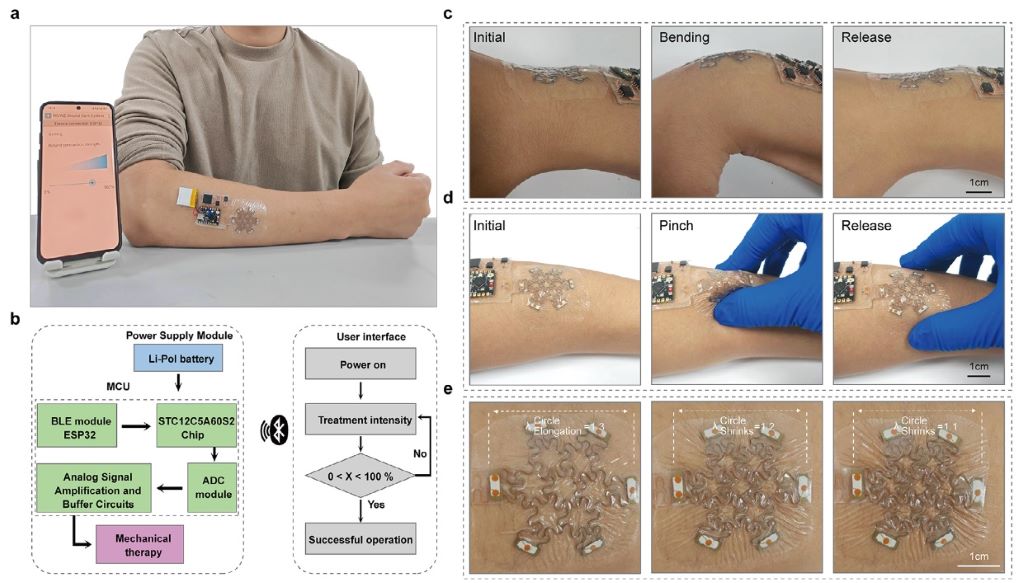
Application demonstration of MSWZ. (a) The flexible MCU of MSWZ integrates BLE communication and can be controlled by mobile terminal applications. (b) The core components of MSWZ and its manipulation logic. (c) MSWZ can work stably in high-strain areas such as wrist joints. (d) The MSWZ maintains a seamless fit to the skin. (e) The MSWZ achieves programmable mechanical contraction against human skin tension. Source: Cai et al., Advanced Science, 2026.
Skin is our protective barrier from the outside world, and it is highly susceptible to damage. To prevent infection, restore protective skin cells, and reduce scarring, it is essential to quickly and robustly close a wound. A new study, published by Wiley in Advanced Science, showed that a multi-axis stretchable wound zipper (MSWZ) is effective in closing complex wounds quickly, improving wound healing. The MSWZ uses programmable force that can be personalised via mobile application, enhancing patient comfort and compliance.
Current conventional approaches, such as sutures, cannot adapt to complex wound shapes and require healthcare professionals for their application. New alternatives, like temperature-responsive contractile dressings, are promising, yet can be unpredictable, compromised by environmental factors, and insufficient in their force to close a wound. Flexible bioelectronic systems enable precise control of mechanical contraction, though they have not yet been used in wound healing.
To utilise flexible bioelectronic systems for wound healing, researchers designed the MSWZ. The MSWZ is made up of a mechanical metamaterial in a lattice structure that shrinks and responds like human skin, a reliable conductive layer, and a breathable, flexible encapsulation material. Biocompatible and comfortable, the MSWZ stretches in six directions to accommodate complex wound morphologies, is wearable even on high-strain areas of the skin, and can be controlled through an app.
In rats, the pre-stretched MSWZ outperformed surgical suturing in the repair of linear wounds. For circular wounds, the pre-stretched MSWZ restored the epithelial barrier, decreased the wound width, and enhanced reconstruction of the collagen matrix. The MSWZ was effective in healing spindle- and oval-shaped wounds, which are most common in the clinic. Using immunohistochemistry, the researchers showed that pre-stretched MSWZ promotes blood flow to supply energy and nutrients for wound healing and supports matrix remodeling to reduce scar formation.
These findings suggest that the MSWZ enables rapid and robust wound healing at a molecular level. The MSWZ is easy to use, personalized, and programmable, adapting to complex wound types and the patient’s comfort level.
“Traditional wound closure methods, such as sutures or skin staples, not only contract in a single direction—making them unsuitable for complex wound shapes—but also fail to allow for quantification of the applied closure force. Our novel ‘multi-axis stretchable zipper’ addresses these limitations. Constructed from shape-memory alloy metamaterials, it can freely stretch in six directions to conform to any complex wound and enables precise, programmable mechanical contraction via a smartphone. We believe this technology offers an innovative solution for future wound care, ultimately alleviating patient suffering and significantly accelerating the healing process,” said senior author Yiming Zhang, PhD, of Xinqiao Hospital at Army Medical University in Chongqing, China.
Additional information NOTE: The information contained in this release is protected by copyright. Please include journal attribution in all coverage. For more information or to obtain a PDF of any study, please contact: Sara Henning-Stout, newsroom@wiley.com
Full Citation: “Multi-axis stretchable zippers for personalized wound healing.” Siyuan Cai, Guang Yao, Zijian Chen, Shiqi Zhou, Peisi Li, Liheng Lin, Huake Yang, Ziyi Zhou, Linbo Jin, Xingyi Gan, Chenzheng Zhou, Zhen Cai, Taisong Pan, Min Gao, Dongli Fan, Yuan Lin, and Yiming Zhang. Advanced Science; Published Online: June 11, 2026 (DOI: 10.1002/advs.75744). URL: http://doi.wiley.com/10.1002/advs.75744
Gut Microbiome. Credit Darryl Leja National Human Genome Research Institute National Institutes Of Health
In a pilot clinical trial published in the Journal of the American Geriatrics Society that included older adults with depression receiving standard care, adding probiotic therapy produced modest but meaningful reductions in depressive and anxiety symptoms compared with adding a placebo. However, both groups demonstrated substantial overall improvements during follow-up.
For the trial, 58 participants in India aged ≥ 60 years with moderate depression were randomised 1:1 to receive daily probiotics or a placebo for 12 weeks, alongside standard antidepressant care. They were followed up for another 12 weeks.
Based on validated psychological scores, biomarker (serum brain-derived neurotropic factor level), and faecal microbiota profiling, investigators found that probiotics helped improve patients’ symptoms but did not confer clear additional gains in quality of life compared with placebo. The findings support probiotics as a safe, biologically plausible adjunct to standard care, but larger trials are needed.
“The results of our study are novel, and we are now planning a follow-up, larger-scale clinical trial due to the encouraging findings,” said co-corresponding author Dr. Saibal Das, MBBS, MD, DM, PhD, of the Indian Council of Medical Research – National Institute for Research in Bacterial Infections, Kolkata. “My vision is to develop affordable healthcare solutions and make them available to the larger population for meaningful public health impact,” added co–corresponding author Abhinaba Ghosh, MBBS, MSc, PhD, a physician-neuroscientist from Tata Medical Center, Kolkata.
New research has found an association between taking glucosamine, a popular over-the-counter supplement used for joint pain, and a higher likelihood of progressing from mild cognitive impairment to Alzheimer’s disease.
The finding by researchers at University of Florida’s McKnight Brain Institute is based on a large retrospective analysis of patients’ records as well as supporting data from advanced imaging technology used to scan human brain specimens and Alzheimer’s disease mouse models.
While the results are preliminary and require validation in a human clinical trial, they provide yet another piece of a much bigger mechanistic picture involving metabolic dysregulation and neurodegeneration, according to the study published in Nature Metabolism.
“In the United States, there are about 7 million people living with Alzheimer’s and millions more with related dementias such as Lewy body or frontotemporal dementia,” said senior author Ramon Sun, PhD, director of the Center for Advanced Spatial Biomolecule Research and associate director for innovation of UF’s McKnight Brain Institute. “A lot of these people actively take an over-the-counter supplement that could be making their disease progression worse.”
The team used artificial intelligence to comb deidentified UF Health records from 2012 to 2024 for patients diagnosed with either ADRD or mild cognitive impairment, or MCI. They found that a significant proportion (8%) of both types of patients reported taking glucosamine: 1896 with ADRD and 2750 with MCI.
After controlling for age, sex and demographics, the analysis showed that glucosamine use was associated with a 25% higher likelihood of progression from mild cognitive impairment to dementia.
In addition, researchers found that taking glucosamine was associated with a 25% increase in mortality risk, or the likelihood of death within a specified time frame, among ADRD patients. For the MCI group, there was no such impact, suggesting the impact of glucosamine may be greater in patients with established dementia.
Notably, said Sun, researchers revealed that a metabolic process in which a protein and sugar-tagging pathway is overactive in Alzheimer’s could be a new target for intervention.
“Our results suggest that altered metabolism is a significant contributor to Alzheimer’s progression and, in addition, addressing the metabolic defect could be an important complement to approaches focused on Alzheimer’s plaques and tangles,” Sun said.
Study finds the link between genetics and BMI has become stronger since the rise in obesity rates
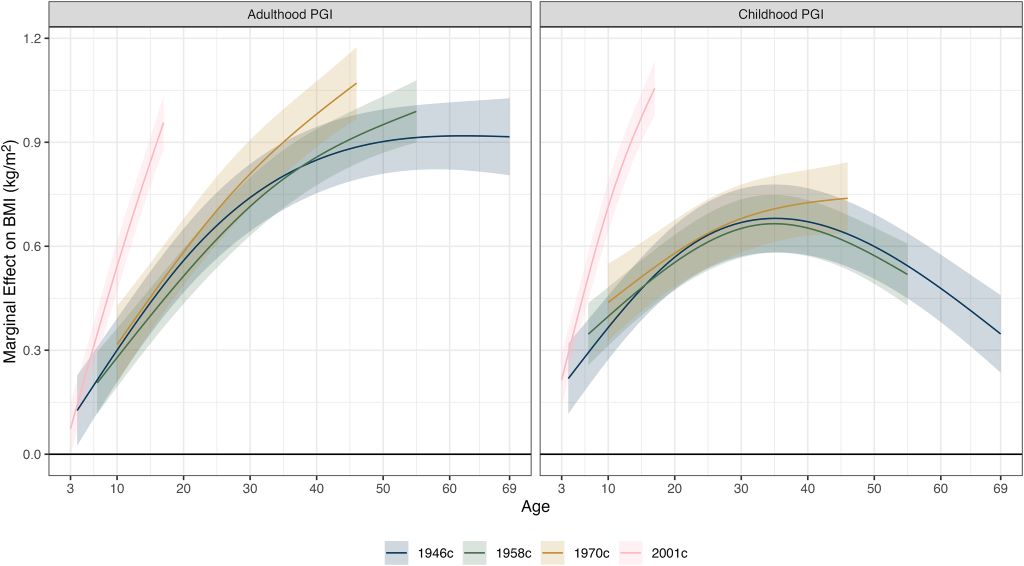
Association (+ 95% CIs) between PGI and BMI (kg/m2) by cohort, age, and PGI (adulthood or childhood). Derived from separate linear mixed effects models with the association between PGI and BMI allowed to vary by age (two natural splines). Adjustment was made for age (two natural splines), sex, first 10 genetic principal components, and a person-specific random intercept. Estimates were weighted using recruitment weights. Image Credit: Wright et al., 2026, PLOS Genetics, CC-BY 4.0
People who carry genetic variations linked to obesity are more likely to be heavier now than individuals with the same variants who were born before the recent obesity epidemic. Liam Wright of University College London, and colleagues, report these findings June 19 in the journal PLOS Genetics.
Over the past five decades, obesity rates have risen sharply for both children and adults. But strangely, rates of extreme obesity have increased faster than the overall increase in body mass index (BMI), an estimate of body fat based on a person’s height and weight. This trend suggests that some individuals are especially susceptible to environmental factors that encourage weight gain, such as the increasing availability of processed foods and decreasing amounts of physical activity. One cause of this susceptibility may be genetics.
To investigate this trend, researchers compared the BMIs and the presence or absence of multiple genetic variations previously linked to obesity in people from four British birth cohorts, born before or during the rise in obesity rates. The study included BMI data from early adolescence to adulthood for individuals born in 1946, 1958, 1970 and 2001 in Great Britain. Their analyses showed that these genetic variations were more strongly linked with having a high BMI in the two more recent cohorts, and were even more pronounced as people became older and among individuals with a higher BMI. These findings suggest that people with a genetic predisposition to having a higher BMI are likely more susceptible than others to changes in their environment that encourage obesity.
The researchers point out that the reason for the stronger association between genetics and BMI in the younger cohorts is unclear. However, they suspect that as the environment changed – with a rise in fast food restaurants and processed food – it may have enabled greater expression of genetic variants that encourage higher calorie consumption and, thus, higher BMI. They conclude that further work will be required to identify the specific environmental factors responsible for strengthening the link between genetics and BMI.
The authors add: “The obesity epidemic has increased BMI regardless of genotype, but it’s those most genetically predisposed to high BMI that have been most affected.”
Specially trained pharmacists will soon be allowed to dispense antiretrovirals without a doctor’s script. Photo by National Cancer Institute on Unsplash
By Catherine Tomlinson
A Supreme Court of Appeal ruling in October 2025 cleared the way for specially trained and permitted pharmacists to dispense antiretroviral medicines without a doctor’s script. Seven months later, no pharmacists are yet providing these services. Spotlight explores the reasons for the delay.
After a three-and a half year court battle between a group of private doctors and the South African Pharmacy Council (SAPC), the Supreme Court of Appeal (SCA) cleared the way for the SAPC to implement pharmacist-initiated management of antiretroviral treatment (PIMART) in October 2025.
The SAPC welcomed the ruling with a bullish press conference promising rapid implementation of PIMART. “The South African Pharmacy Council, together with stakeholders and the Department of Health, will work with speed to ensure that PIMART-trained pharmacists join other primary healthcare practitioners in providing primary care in relation to HIV and Aids,” said Mogologolo Phasha, president of the SAPC, at the time.
Vincent Tlala, CEO and Registrar of the SAPC, also in October 2025, said that the SAPC aimed to issue an e-note inviting pharmacists to apply for the PIMART permits in November. However, seven months later, this has still not happened and no pharmacists in the country are yet permitted to provide PIMART services.
What is PIMART?
PIMART stands for pharmacist-initiated management of antiretroviral treatment. It is a form of task-shifting that allows pharmacists to provide some limited HIV services that are currently only provided by doctors and nurses. The programme seeks to better utilise pharmacists in the country’s HIV response and relieve some of the burden on overcrowded and under resourced public clinics. It will also offer a route into treatment for people who are not willing or able to visit clinics.
It is intended that, under the PIMART programme, pharmacists that have completed a dedicated training programme and have received a special permit from the Director-General of Health will be authorised to provide first-line antiretroviral treatment to people with uncomplicated HIV without a doctor’s script. They will also be allowed to dispense HIV prevention medicines without a doctor’s script – this includes both pre-exposure prophylaxis (PrEP) and post-exposure prophylaxis (PEP). PrEP is taken prior to sex to prevent potential infection while PEP is taken shortly after a possible HIV exposure to prevent infection.
Why is PIMART needed?
PIMART was proposed by the SAPC in response to a request from the health department for the SAPC to design an intervention to enable pharmacists to take on a greater role in the country’s HIV response.
South Africa has adopted the UNAIDS 95-95-95 targets that aim to ensure that 95% of people living with HIV know their status, 95% of people diagnosed with HIV are on treatment, and 95% of people on treatment are virally suppressed (and therefore cannot transmit HIV onwards).
According to new estimates from Thembisa, the leading mathematical model of South Africa’s HIV epidemic, 7.9 million people are living with HIV in South Africa. Ninety six percent of people living with HIV know their status, yet only 82% of people who know they are HIV positive are on antiretroviral treatment.
While South Africa’s health system should be commended for the fact that around 6.2 million people are taking HIV treatment, it is concerning that 1.7 million people living with HIV are not yet on treatment. In recognition of this problem, the health department has launched the “Close the Gap” campaign.
The thinking behind PIMART is that pharmacies can help close the gap by providing an important third option to people who are disinclined or unable to access HIV treatment from public clinics or private sector doctors.
More urgent than ever following US funding cuts
While PIMART was always intended to help identify patients falling through the gaps between South Africa’s public and private health sectors and to link them to care, the need for this third option is now more urgent than ever. US funding cuts over the last 15 months or so have led to the closure of many NGO-run clinics that previously provided HIV treatment and prevention services to populations at high risk of HIV who often face stigma at traditional health facilities. These groups include sex workers, men who have sex with men, and people who inject drugs.
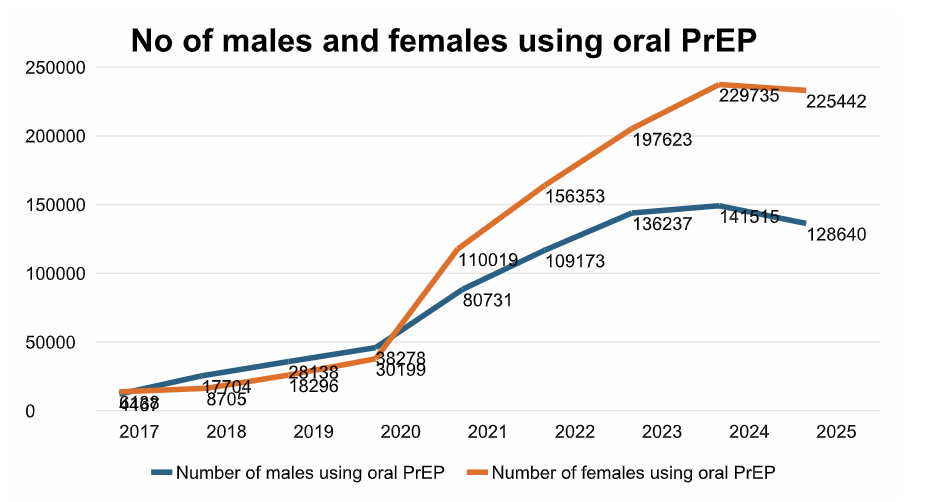
In addition to expanding access to HIV treatment, PIMART aims to increase access to PrEP and PEP to prevent new HIV infections. While the full impact of US funding cuts on these services remains unclear, the cuts likely contributed to the slight decline in PrEP use in South Africa seen in 2025, following seven years of steady growth in PrEP uptake.
Graph by Spotlight. Data courtesy of the Thembisa model.
Finger pointing and lack of accountability
Seven months after the Supreme Court of Appeal ruled that the SAPC could implement PIMART and the SAPC promised to move rapidly in implementing PIMART, pharmacists have still not been invited to apply for permits and no PIMART permits have yet been issued to pharmacists.
When asked why the programme remains unimplemented, the SAPC pointed to the Southern African HIV Clinicians Society’s (SAHCS) PIMART training course as the cause of the delay.
SAHCS is the only entity in the country providing PIMART training to pharmacists. In October 2025, Mokoena said several groups had expressed interest in becoming accredited to provide PIMART training. However, on 14 May 2026, Tlala told Spotlight: “While we have invited existing providers of pharmacy education in South Africa to offer (the course), the South African Pharmacy Council is yet to receive applications for the accreditation of the PIMART supplementary training course.”
He added: “Currently, the Southern African HIV Clinicians Society are the only approved provider for the PIMART short course.”
So, what’s going on with SAHCS’ PIMART training?
PIMART used to be on a very different timeline before it got tangled up in the court processes that led to the October 2025 SCA judgment. Back in July 2021, Spotlight reported that the launch of PIMART was imminent, and indeed, that was roughly the timeline the SAHCS training had been working toward.
In fact, the SAHCS has offered a PIMART training course for pharmacists that want to provide PIMART services since 2019. Professor Natalie Shellack, chairperson of the SAPC Education Committee, said in October 2025 that this course was developed jointly by SAHCS and SAPC.
Over a thousand pharmacists have completed SAHCS’s original PIMART training course as continuous professional development (CPD) training. But after the October 2025 SCA ruling, Lizeth Kruger, Dischem’s Clinical Executive, told Spotlight that due to the time lapse between the initial training and court ruling, Dischem pharmacists “will need to do a refresher course to ensure compliance and up-to-date knowledge”.
While SAHCS’s PIMART course has not yet been accredited by the SAPC as a PIMART course, it is accredited as a CPD course for pharmacists. Tlala told Spotlight in May that it has not been accredited as a PIMART course because of an identified “gap” in the course.
“The gap identified between the short course and the approved qualification standard meant that the approved provider of the short course, the Southern African HIV Clinicians Society, had to conduct a gap analysis and develop a bridging course to enable pharmacists trained in the short course to access the full PIMART scope of services,” said Tlala.
In response to questions about the “gap” in their training course identified by the SAPC, SAHCS’s CEO Dr Fiona Storie told Spotlight on 19 May: “SAHCS has completed a full review and update of the PIMART training course in line with the requirements for accreditation as a supplementary training course (i.e. not just a CPD accredited course).”
“As PIMART training was originally provided from 2019, there is a need for pharmacists to undergo refresher training since the field of HIV medicine is evolving and clinical recommendations change over time,” said Storie. She added: “SAHCS’ recommendation is that pharmacists undertake the newly updated PIMART training course as either a refresher/bridging course or, if not previously trained, as a new course.”
“SAHCS is engaging with SAPC to finalise the accreditation of the updated PIMART course as a refresher course and a new supplementary training course to make it available as soon as possible,” Storie said.
Limiting PIMART’s scope
Tlala told Spotlight that because of the “gap” in SAHCS’s training course, the SAPC has asked the Director-General of Health to grant limited scope PIMART permits.
“The Director-General: Health has been requested to issue a limited scope permit granting PIMART-trained pharmacists’ access to those services fully addressed in the short course previously delivered by the South African HIV Clinicians Society,” he said.
The health department confirmed to Spotlight that this request was received on 23 April 2026.
Neither the SAPC nor the Department of Health responded to Spotlight’s requests for clarification on which PIMART services the SAPC had proposed for inclusion in the limited-scope permits.
Angela Tembo, director of pharmacy health at the research centre Ezintsha, told Spotlight that she understands that the limited scope permits that the SAPC has requested the Director-General of Health to grant “will be limited to HIV prevention (PrEP and PEP) and not treatment”.
“Our understanding is that the delays [in implementing PIMART] relate to ongoing discussions around training requirements, accreditation processes, and the practical implementation pathway following the SCA ruling,” she added.
Tlala said as soon as the Director-General of Health approves the limited-scope permits, the SAPC will publicly communicate the launch of the PIMART programme and the services that may be accessed under such a permit.
“The full PIMART scope of services will only be available once the Southern African HIV Clinicians Society has finalised and submitted a bridging course following gap analysis or, alternatively, once another training provider is accredited to provide the PIMART Supplementary Training course,” he added.
Black women experience disproportionately elevated risks of developing and dying from early-onset breast cancer. New research published by Wiley online in CANCER, a peer-reviewed journal of the American Cancer Society, reveals the genes that are most likely to be mutated to contribute to these increased risks.
In the study of 686 young Black women diagnosed in Florida and Tennessee with invasive breast cancer at age 50 or younger in 2005–2018, genetic testing showed that 15.3% of the women carried a gene variant with a suspected link to breast and/or ovarian cancer, with most occurring in the BRCA1 and BRCA2 genes and fewer in PALB2, ATM, and other genes. A family history of breast cancer was common in women with mutations in BRCA1, BRCA2, and PALB2. Triple-negative breast cancers (one of the most aggressive forms) were most often seen in women with BRCA1 mutations. Also, most of the women with BRCA1 mutations were diagnosed at or below age 40, whereas the age at diagnosis was more evenly distributed up to age 50 for women with variants in the other genes.
The study’s findings point to the importance of breast cancer genetic testing for young Black women, a group that is less likely to receive such screening compared with other racial and ethnic groups. Such tests could identify women most likely to benefit from more frequent screening and preventive measures to safeguard their health.
“We must test at-risk women across all populations – testing is essential to personalise treatment strategies and enable life-saving prevention for future cancers, and it may empower at-risk family members to get tested so they too can benefit from this information,” said senior author Tuya Pal, MD, of Vanderbilt University Medical Center. “Equitable access to inherited cancer testing ensures that all women, regardless of race, can benefit from precision medicine and take control of their genetic health.”
The findings build on decades of scientific understanding by revealing an additional pathway the kidney uses to control water balance. Until now, the body’s ability to concentrate urine – and prevent dehydration – has been thought to depend primarily on the hormone vasopressin. Dr Chebib’s team discovered an alternative mechanism that operates independently of that system.
“The kidney’s ability to regulate water is one of the most fundamental processes in the body,” Dr Chebib says. “It’s not every day that you uncover a new way it carries out that function.”
Polycystic kidney disease is a common inherited condition that causes fluid-filled cysts to grow in the kidneys over time, gradually reducing kidney function and often leading to kidney failure. It affects millions of people worldwide, including an estimated 140 000 people in the US with the most common form, autosomal dominant PKD (ADPKD). Many patients eventually require dialysis or a kidney transplant.
Dr Chebib’s team studies how kidney cysts grow in PKD using lab-grown cell models. As part of that work, they tested compounds expected to worsen the disease process by increasing cellular signals linked to cyst growth. One of those compounds was probenecid, a drug first used in the 1940s to conserve limited supplies of penicillin by reducing its urinary excretion.
“We thought this drug would make the disease process worse,” Dr Chebib says. “Instead, it did the opposite.”
Rather than promoting cyst growth, the drug slowed it. After repeating the experiments multiple times, the team realised they had uncovered something important.
Further investigation revealed that probenecid affects how kidney cells handle urate, a molecule commonly associated with gout. Inside the cell, urate acts as a signal – triggering a chain of events that helps move water channels to the cell surface. This allows the kidney to reabsorb water and concentrate urine without relying on vasopressin, the hormone traditionally thought to control this process.
“This represents a distinct pathway from what is described in traditional physiology models,” Dr Chebib says. “It demonstrates that the kidney has an additional mechanism to preserve water.”
For patients with PKD, the discovery could address one of the biggest challenges of current treatment. The only approved therapy, tolvaptan, works by blocking vasopressin, which slows cyst growth but causes patients to produce very large amounts of urine – often 6 to 7 litres a day. That side effect can be difficult to live with and leads some patients to stop treatment.
In preclinical studies and a small clinical trial, adding probenecid reduced urine volume and nighttime urination while preserving the treatment’s effectiveness.
After taking probenecid, patients’ urine volume dropped by about 30% on average, and they went from waking up several times a night to urinate to about once per night. Many also reported improved quality of life.
“The goal is to preserve the therapeutic benefit of tolvaptan while reducing its burden,” Dr. Chebib says.
Despite these promising results, researchers are not planning to rely on probenecid as a long-term solution. The drug is decades old, affects multiple systems in the body and is not widely available today. Instead, the team is using what they learned to design more targeted therapies.
“Probenecid helped us uncover the mechanism,” Dr Chebib says. “Our goal is to take this insight and develop therapies designed specifically for this pathway.”
For Dr Chebib, the work is rooted in early inspiration. He was drawn to kidney research after his father developed PKD.
“This has been a long and deeply purposeful journey,” he says. “It started with a personal motivation and led to something that could ultimately benefit patients.”
For a complete list of authors, disclosures and funding, see the study.