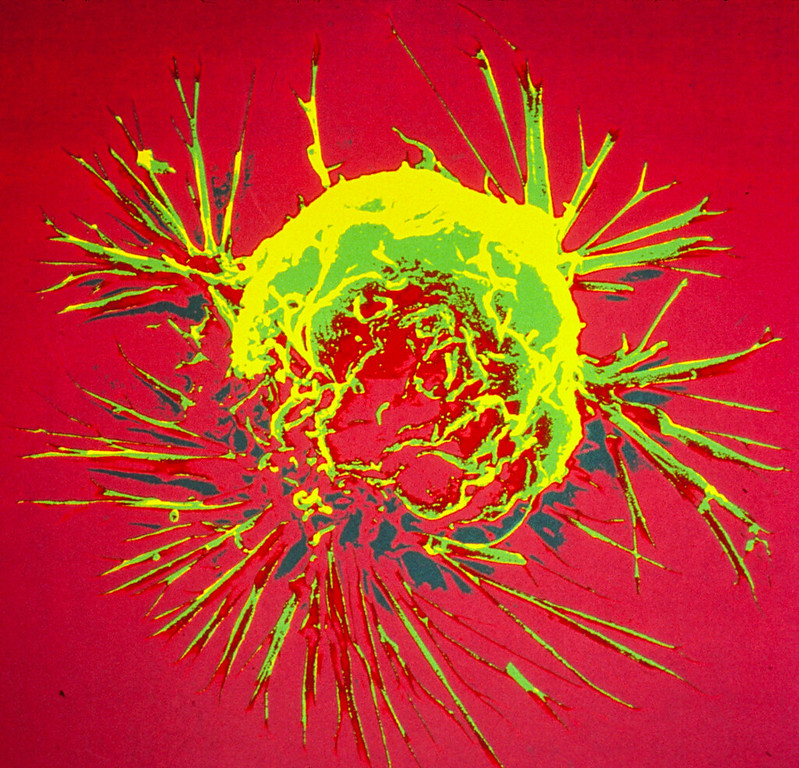
Colourised scanning electron micrograph of a breast cancer cell. Credit: NIH
Metastatic cancer cells, which cause 90% of cancer-related deaths, must overcome numerous hurdles to spread from a primary tumour through the bloodstream. Now, a new study led by investigators from the Mass General Cancer Center has identified a gene whose expression confers a growth advantage to these cells.
Mechanistically, the gene’s expression allows metastatic cancer cells to cause changes to their surrounding environment so that they can grow in new locations in the body. The findings are published in Nature Cell Biology.
“Our results point to potentially novel therapeutic avenues to specifically target metastatic cancer,” said senior author Raul Mostoslavsky, MD, PhD, who is the scientific director of the Krantz Family Center for Cancer Research at the Mass General Cancer Center.
Mostoslavsky and colleagues first compared gene expression patterns in primary versus metastatic tumours in mice with pancreatic cancer or breast cancer. After identifying various genes whose expression increased in metastatic tumour cells, the researchers silenced each gene individually.
In these experiments, silencing the Gstt1 gene had no effect on primary tumour cells from mice, but it stripped metastatic cancer cells of their ability to grow and spread. It also blocked cell growth in two metastatic-derived human pancreatic cancer cell lines.
Gstt1 encodes an enzyme that is a member of a superfamily of proteins involved with protecting cells from toxins, among other functions. Mechanistic studies indicated that the Gstt1 enzyme causes metastatic cancer cells to modify and secrete a protein called fibronectin, which is important for helping cells to attach themselves to the extracellular matrix, a large network of proteins and other molecules that surround, support, and give structure to cells and tissues in the body.
“Gstt1 alters the matrix surrounding the metastatic cells so they can grow in these foreign niches,” said Mostoslavsky. “Our results could lead to new strategies for the treatment of metastatic disease. This would be especially impactful for pancreatic cancer, in which most patients present with metastases when initially diagnosed.”
Tumours arising in the base of the skull are among the most difficult to remove in neurosurgery. The current treatment method is to perform surgical removal by what is known as the microscopic anterior transpetrosal approach (ATPA). Seeking to lessen the risk of damage and postoperative complications, as the skull base is densely packed with nerves, blood vessels, and other tissues, not to mention the brain stem, an Osaka Metropolitan University medical research team is taking a new approach.
Led by Dr Hiroki Morisako, a lecturer in the Graduate School of Medicine’s Department of Neurosurgery, and its department head Professor Takeo Goto, the team has developed a minimally invasive surgical technique called a purely endoscopic subtemporal keyhole ATPA. The team members write in The Journal of Neurosurgery that this is, to their knowledge, the first time this procedure to remove lesions in the skull base region known as the petrous apex has been described in an article.
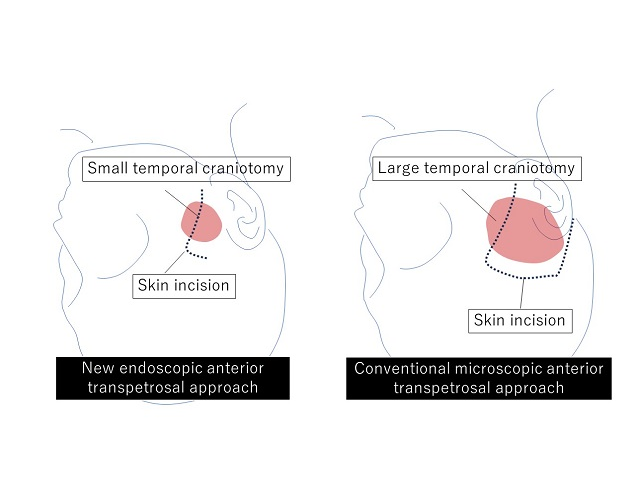
Diagram of skin incision and extent of craniotomy. New endoscopic neurosurgery approach does not require a large craniotomy, so the result is a smaller scar. Credit: Osaka Metropolitan University
The endoscopic technique means a smaller area of the skull needs to be surgically opened compared to the microscopic approach, an average of only 11.2 cm² versus 33.9 cm². The risk of damage to the brain is also reduced.
The team performed 10 neurosurgeries using their method from 2022 to 2023 at Osaka Metropolitan University Hospital and compared the results to 13 surgeries using the microscopic ATPA from 2014 to 2021. In terms of operative time, the endoscopic approach reduced it noticeably, from an average of 410.9 minutes to 252.9 minutes. Similarly, blood loss lessened from a mean of 193 ml to 90 ml. The degree of tumour resection (surgical removal) was just as high as the microscopic method, while neurological functions were preserved at a rate equal to or higher than with the conventional approach.
“Comparison of the new endoscopic method and the conventional microscopic method showed no significant difference in tumour resection rate or in the ability to perform daily activities before and after surgery, with the new endoscopic approach resulting in shorter operative times and less blood loss,” Professor Goto stated. “The widespread use of this surgical procedure is expected to improve the treatment results of brain tumours in the base of the skull, not only in Japan but also worldwide.”
Report shows the alarming global rise of cyberattacks on the healthcare sector and the urgent need to prioritise cybersecurity
Photo by Nahel Abdul on Unsplash
KnowBe4 (www.KnowBe4.com), the provider of the world’s largest security awareness training and simulated phishing platform, released its International Healthcare Report. The report takes a closer look at the cybersecurity crisis currently experienced by the healthcare sector, in particular hospital groups, across the world.
Africa was the global region with the highest average number of weekly cyberattacks per organisation in 2023. One in every 19 organisations on the continent experienced an attempted attack every week. Although South Africa’s healthcare sector has managed to avoid a major attack since 2020, the alarming escalation of attacks in other sectors within the country suggests that it’s only a matter of time before the next attack strikes, making it a question of “when” rather than “if”.
Hospitals have become increasingly attractive targets for ransomware attacks due to their comprehensive patient databases, sensitive information, and their interconnectedness between systems and equipment. Moreover, poor security measures have made hospitals vulnerable to cyber threats. When attacked, cybercriminals can potentially take control of entire hospital systems, and gain access not only to patients’ health information but also their financial and insurance data.
Hospitals are severely impacted by cyberattacks (https://apo-opa.co/4csCXH4), which can lead to a reduction in patient care, loss of access to electronic systems, and a reliance on incomplete paper records. This can also result in the cancellation of surgeries, tests, appointments, and, in some cases, even loss of life.
Some shocking facts discussed in the report include:
In the first three quarters of 2023, the global healthcare sector experienced a staggering 1,613 cyberattacks per week, nearly four times the global average, and a significant increase from the same period the previous year.
The healthcare sector has seen a dramatic surge in cyberattack costs over the past three years, with the average cost of a breach reaching nearly $11 million, more than three times the global average. This makes healthcare the costliest sector for cyberattacks.
Ransomware attacks have been the most prevalent type of cyberattack on healthcare organisations, accounting for over 70% of successful attacks in the past two years.
The majority of cyberattacks (between 79% and 91%), across sectors, begin with phishing or social engineering tactics, which allow cybercriminals to gain access to accounts or servers.
According to KnowBe4’s 2024 Phishing by Industry Benchmarking Report (https://apo-opa.co/4csuiEB), healthcare and pharmaceutical organisations are among the most vulnerable to phishing attacks, with employees in large organisations in the sector having a 51.4% likelihood of falling victim to a phishing email. This means that cybercriminals have a better than 50/50 chance of successfully phishing an employee in the sector.
“The healthcare sector remains a prime target for cybercriminals looking to capitalise on the life-or-death situations hospitals face,” says Stu Sjouwerman, CEO of KnowBe4. “With patient data and critical systems held hostage, many hospitals feel like they are left with no choice but to pay exorbitant ransoms. This vicious cycle can be broken by prioritising comprehensive security awareness training to empower employees and cultivate a positive security culture as a strong defence against phishing and social engineering attacks.”
The report examines the state of cybersecurity in the healthcare sector in North America, Europe, the United Kingdom, Asia-Pacific, Africa, and Latin America. In addition it also highlights some of the most prolific global ransomware attacks that occurred between December 2023 and May 2024, the aftermath thereof and what healthcare organisations can do to protect themselves from cyberattacks.
To download a copy of KnowBe4’s International Healthcare Report, click here (https://apo-opa.co/3xIjjaY).
New study also uncovers short-term links with sleep disorders
Photo by Ekamelev on Unsplash
Analysis of the medical records of nearly 50 000 people who experienced dengue fever in Taiwan suggests that this disease is associated with elevated short- and long-term risk of depression. Hsin-I Shih and colleagues of National Cheng Kung University and National Health Research Institutes, Taiwan present these findings in the open-access journal PLOS Neglected Tropical Diseases.
People may develop dengue fever after being bitten by a mosquito carrying the dengue virus. Dengue fever can be mild, but it can also progress to life-threatening severity, and some people may have long-term health effects. Prior research has uncovered links between active dengue fever and psychiatric disorders, such as depression and anxiety. However, few studies have examined the long-term risk of such disorders after a dengue infection.
To address this knowledge gap, Shih and colleagues analysed the medical records of 45 334 dengue patients in Taiwan and, for comparison, 226 670 patients who did not experience dengue. Covering the years 2002 to 2015, the researchers examined whether dengue patients were more likely to develop anxiety, depressive disorders, and sleep disorders at various time points after infection. To help account for other factors that could influence mental health, the dengue patients were grouped with demographically similar non-dengue patients for statistical analysis.
The researchers found that the dengue patients had a greater likelihood of developing a depressive order across all timeframes, including less than three months, three to 12 months, and more than 12 months after their infection. Sleep disorders were only elevated within three to 12 months post-infection, and there was no observable elevated risk of anxiety.
Taking a closer look at patients whose dengue was severe enough for them to be hospitalized, the researchers found an elevated risk of anxiety disorders within the first three months of infection, as well as elevated risk of sleep disorders in the first 12 months. This subgroup also had elevated risk of depression across timeframes.
These findings suggest a potential link between dengue fever and subsequent depressive disorder. However, further research is needed to determine whether dengue contributes directly to development of depression, or if the association is due to some indirect mechanism.
The authors add: “This study highlights a significant association between dengue fever and an elevated risk of depression in both the short and long term, underscoring the need for further research into the mental health impacts of dengue infection.”
Smokers are on average more extraverted, but less conscientious and agreeable
Cigarette smokers, cigar smokers, and non-smokers each have distinct personality profiles, according to a study published July 3, 2024 in the open-access journal PLOS ONE by Dritjon Gruda from Universidade Catolica Portuguesa, Portugal, and Jim McCleskey from Western Governors University, USA.
Tobacco use remains a formidable global public health challenge, responsible for more than 8 million deaths annually, including those attributed to second-hand smoke exposure. Emerging research underscores the critical role of psychological factors, including personality traits, in shaping tobacco consumption patterns. To further explore this issue, Gruda and McCleskey examined the association between Big Five personality traits (openness, conscientiousness, extraversion, agreeableness, and neuroticism) and cigar or cigarette smoking in a sample of 9918 older adults across 11 European countries.
Photo by Sara Kurfess on Unsplash
The results showed that smoking is associated with lower scores in conscientiousness and agreeableness and higher extraversion scores than not smoking. The authors speculate that relatively low conscientiousness among smokers may reflect a lack of self-discipline and disregard for long-term health risks, characteristic of more impulsive behaviours, while reduced agreeableness could help explain why smokers often persist despite societal disapproval. They also suggest that the higher extraversion observed may suggest that these individuals enjoy the social nature of smoking.
The analysis also determined personality differences between types of smokers, finding that cigar smokers tend to exhibit lower neuroticism and higher openness compared to both cigarette smokers and non-smokers, underlining that the motivations and contexts of tobacco use are varied.
These findings suggest that personality traits are antecedents of smoking behaviour, with implications for targeted public health interventions and social policies aimed at combating the global tobacco epidemic. According to the authors, future research should explore these relationships in younger cohorts, potentially informing early intervention strategies that preempt the onset of smoking based on predisposition to certain personality types. Further studies could also expand the scope to include other forms of tobacco products such as chewing tobacco or more recent smoking trends such as e-cigarettes and vaping.
The authors add: “Basically what we found is: ‘tell me what you smoke, and I’ll tell you who you are.’”
Obesity is a well-known cancer risk – but is also known to increase the likelihood of immunotherapy success. A new discovery from Vanderbilt University Medical Center-led research team may explain why – and how this could lead to improved treatment for non-obese patients as well. The findings, published in Nature, reveal that obesity increases the frequency of macrophages in tumours and induces their expression of the immune checkpoint protein PD-1 – a target of cancer immunotherapies.
“Obesity is the second leading modifiable risk factor for cancer, behind only smoking, and obese individuals have a greater risk for worse outcomes. But they also can respond better to immunotherapy,” said Jeffrey Rathmell, PhD, Cornelius Vanderbilt Professor of Immunobiology and director of the Vanderbilt Center for Immunobiology. “How is it that there can be this worse outcome on one hand, but better outcome on another? That’s an interesting question.”
Postdoctoral fellow Jackie Bader, PhD, led the studies to examine the influence of obesity on cancer and to explore this “obesity paradox” – that obesity can contribute to cancer progression but also improve response to immunotherapy.
In a mouse model, the researchers found striking differences between the macrophages isolated from tumours in obese versus lean mice. While the protein PD-1 is an immunotherapy target normally thought to act on T cells, they discovered that the macrophages in tumours from obese mice expressed higher levels of PD-1, and that PD-1 acted directly on the macrophages to suppress their function.
In tumour samples from patients with kidney cancer, the researchers also found PD-1-expressing macrophages, and in human endometrial tumour biopsies from patients before and after 10% weight loss, they showed that PD-1 expression on tumour-associated macrophages decreased following weight loss.
“We were very fortunate to have collaborators that provided us with samples from the same patients before and after weight loss that reinforced the findings from our mouse models,” Bader said.
Blocking PD-1 with an immunotherapy drug in the mouse models increased tumour-associated macrophage activity, including their ability to stimulate T cells.
‘Team macrophage’
Cancer immunotherapy studies have largely focused on T cells, because they are the immune cells that can kill cancer cells, Bader and Rathmell said. But macrophages play important roles in influencing what T cells do.
“I’ve always been ‘team macrophage,’” Bader said. “Macrophages are thought of as being like a garbage truck: They clean up the mess. But they have a huge spectrum of activity to enhance the immune response, and they’re more plastic and manipulatable than other immune cells, which makes them really interesting.”
The presence of more macrophages expressing PD-1 in tumours in an obese setting provides a mechanistic explanation for the obesity paradox, Bader and Rathmell said. Increased PD-1 expression suppresses immune surveillance by macrophages, subsequently suppressing the killer T cells and allowing tumours to grow (the increased cancer risk of obesity). PD-1 blockade with immunotherapy allows the increased number of PD-1-expressing macrophages to act (the enhanced response to immunotherapy).
Currently, immune checkpoint inhibitors work in only 20–30% of patients.
“We clearly want to find ways to make immunotherapies work better, and in the obese setting, they naturally work better,” Rathmell said. “Understanding how these processes are working biologically may give us clues about how to improve immunotherapy in general.”
The findings also suggest that examining levels of PD-1-expressing tumour macrophages may help identify patients who will respond better to immunotherapy.
“It could be that the greater the proportion of PD-1-expressing macrophages a tumour has, the better the response to immunotherapy will be,” Rathmell said.
A large analysis of data from nearly 400 000 healthy US adults followed for more than 20 years has found no association between regular multivitamin use and lower risk of death. The study, led by researchers at the National Institutes of Health’s National Cancer Institute, was published in JAMA Network Open.
Many adults in the United States take multivitamins with the hope of improving their health. However, the benefits and harms of regular multivitamin use remain unclear. Previous studies of multivitamin use and mortality have yielded mixed results and been limited by short follow-up times.
To more deeply explore the relationship between long-term regular multivitamin use and overall mortality and death from cardiovascular disease and cancer, the researchers analysed data from three large, geographically diverse prospective studies involving a total of 390 124 US adults who were followed for more than 20 years. The participants included in this analysis were generally healthy, with no history of cancer or other chronic diseases.
Because the study population was so large and included lengthy follow-up and extensive information on demographics and lifestyle factors, the researchers were able to mitigate the effects of possible biases that may have influenced the findings of other studies. For example, people who use multivitamins may have healthier lifestyles in general, and sicker patients may be more likely to increase their use of multivitamins.
The analysis showed that people who took daily multivitamins did not have a lower risk of death from any cause than people who took no multivitamins. There were also no differences in mortality from cancer, heart disease, or cerebrovascular diseases. The results were adjusted for factors such as race and ethnicity, education, and diet quality.
The researchers noted that it is important to evaluate multivitamin use and risk of death among different kinds of populations, such as those with documented nutritional deficiencies, as well as the potential impact of regular multivitamin use on other health conditions associated with aging.
In some respects, Dr Aaron Motsoaledi was the right person for the job when he was appointed as South Africa’s Minister of Health in 2009. But in 2024, the healthcare context in the country looks very different. Spotlight editor Marcus Low asks what we might expect from this new chapter with Motsoaledi in the top health job.
When Dr Aaron Motsoaledi first became South Africa’s Minister of Health in 2009, the number one task in front of him was clear. He had to rapidly expand the country’s HIV testing and treatment programme.
Over the next decade, he did exactly that. When he left the health portfolio in 2019, there were around 5.1 million people on HIV treatment in the country – roughly six times the 850 000 there were in 2009. Driven largely by this expansion in the HIV treatment programme, life expectancy in the country increased from 58.4 years when he started to 64.9 when he left.
But while Motsoaledi largely succeeded on HIV and tuberculosis, there was a sense that he was not a details man and struggled to see through important health system reforms. He never got on top of fundamental challenges like healthcare worker shortages and poor governance in provincial health departments. That is why we were cautiously optimistic when Motsoaledi was replaced by Dr Zweli Mkhize in 2019. We thought it likely that Mkhize would be better at turning rhetoric into actual reform. As it turned out, any hopes of that happening were derailed first by the COVID-19 pandemic, and then more definitively by the Digital Vibes scandal.
The return
In a recent editorial considering possible health ministers after South Africa’s 2024 national elections, we argued that President Cyril Ramaphosa might feel that he can get more out of Motsoaledi back in the health portfolio than at home affairs, where we think it is fair to say he struggled. Even so, hearing Ramaphosa read out Motsoaledi’s name on Sunday night came as a surprise. Our money was on Dr Joe Phaahla staying in the job – as it turns out, he was demoted to again serve as Deputy Minister of Health.
What to make of all of it?
From one perspective, Motsoaledi’s return is understandable. He is a close and loyal ally of Ramaphosa and therefore someone the President would want to keep in his Cabinet. He is a medical doctor who knows the health portfolio. He is a staunch supporter of National Health Insurance (NHI) and his impassioned leadership style is probably considered an asset by the President.
If one considers the Health Minister’s number one task to be the implementation of NHI, and if one sees the implementation of NHI to be an essentially political process, then you can see a case for Motsoaledi’s return.
But even if one accepts this line of argument, it does come with some kinks that are hard to straighten out. For one, the NHI Act is now law and the political battle has thus, to some extent, already been won, and it is time to move from the broad strokes of political rhetoric, that Motsoaledi excels at, to the detail of implementation, which hasn’t been his strong point. And, to the extent that the political battle surrounding NHI has been reopened due to the ANC losing its parliamentary majority, the type of leadership required now will involve building consensus beyond just the ANC, and arguably more challenging for Motsoaledi, making strategic concessions such as allowing a greater role for medical schemes than envisaged in the NHI Act.
But all that only really matters if one accepts the premise that implementing NHI should be the top priority for the Minister of Health.
There is an argument that implementing NHI will take many years and there are much more urgent healthcare issues that need to be dealt with right away. The harsh reality is that provincial health budgets have been shrinking, healthcare worker shortages remain acute, governance in provincial health departments is often a disgrace, and health sector corruption remains a far from solved problem.
During his previous stint as health minister, Motsoaledi faced many of these problems and, while he often said the right things, the bluster wasn’t ever really backed up with a sustained programme of reform. To be sure, there were important successes like the establishment of the Office of Health Standards Compliance and attempts to revitalise health facilities, but when it comes to the fundamentals of having a well-managed healthcare system with enough healthcare workers, the picture was bleak when he left the health ministry in 2019 and it remains so today. In short, there is a view, only reinforced by his struggles at home affairs, that Motsoaledi is not the right person to have in charge if you want to implement the complex, systemic reforms required to sustainably address South Africa’s urgent healthcare problems.
That may be a bit harsh. Ministers are after all politicians and their roles are meant to be political. While it certainly helps to have ministers who are serious about, and committed to the details of implementation, they should be working in conjunction with government departments and directors-general (DGs) in particular. It certainly hasn’t helped our Health Ministers that our National Department of Health has often been overstretched and arguably lacking in strong leadership.
One underlying problem here is that over the last two decades, South Africa’s DGs and heads of provincial government departments for that matter, have too often been yes-men or people appointed as a political favour. While that may in some ways make a minister or MEC’s life easier, it does not make for good governance when a DG or a head of department is a walk-over. Ministers need to lead on policy, but have DGs and deputy DGs who are trusted and empowered to get on with implementation.
One criticism of Motsoaledi’s previous stint in the job is that even though he had a good DG in Precious Matsoso and a few decent deputy DGs, rather than shield them from the political crises of the day, he drew them into those crises. One expert we spoke to this week suggests that Motsoaledi loved the limelight and wouldn’t let others lead while another charged him with not being hands-on enough – maybe the key insight is that those things might all have been true to some extent.
Either way, given Motsoaledi’s strengths and weaknesses and the very complex health challenges South Africa faces, it is now more important than ever that as Minister he leads on political and policy matters, but gives the actual administration the space to lead on implementation. For that to work, he will need a DG who is not just another politician or cadre, but one who is an excellent manager and implementer, and maybe above all, who has the guts to say “no minister” when he or she needs to.
*Low is editor of Spotlight.
Note: Spotlight is editorially independent and is not affiliated with, nor does it endorse any political parties. Spotlight is a member of the South African Press Council.
People with prediabetes are advised to reduce their weight in order to prevent the development of diabetes. For the first time, new research shows that people achieve the best diabetes protection when they reduce their weight and at the same time normalise blood sugar regulation with lifestyle changes and medication. In an article published in Diabetologia, the authors argue that the normalisation of blood sugar levels in prediabetes should be included as a therapeutic goal in the guidelines in order to improve the prevention of type 2 diabetes.
Diabetes is widespread and is associated with an increased risk of a number of life-threatening complications such as stroke, heart attack and kidney failure. “In order to prevent the development of the disease, early therapies are already important in the prediabetes stage, a preliminary stage of type 2 diabetes. Our results can be used to change the goals of these early lifestyle interventions in order to reduce the overall development rates of diabetes,” explains first author Reiner Jumpertz-von Schwartzenberg.
Prediabetes drastically increases the risk of diabetes
Prediabetes is diagnosed when there is no manifest type 2 diabetes yet, but the fasting blood sugar is already elevated and glucose tolerance is impaired. To prevent prediabetes from becoming diabetes, affected patients are advised to reduce their weight. US guidelines from the American Diabetes Association (ADA), for example, recommend reducing body weight by at least 7%. This recommendation is based on the DPP study.
The research team from the University Tübingen and the National Institute of Diabetes and Digestive and Kidney Diseases in the US, investigated whether this weight loss is sufficient, or whether it is not better to prevent diabetes by also reducing blood sugar levels such that prediabetes goes into remission.
Prevention through one-year lifestyle intervention
They analysed data from 480 people with prediabetes who participated in the US Diabetes Prevention Program (DPP) and had lost at least 7% of their body weight through a one-year lifestyle intervention. In 114 of them, prediabetes also went into remission during the intervention, meaning that their fasting blood sugar, glucose tolerance and HbA1c had normalised. However, the majority of the 366 study participants had not managed to significantly improve their blood sugar regulation despite successfully losing weight. Their prediabetes was not in remission at the end of the intervention.
The researchers found that significantly fewer people in the group that had lost weight and achieved prediabetes remission developed manifest diabetes thereafter. The additional remission of prediabetes resulted in a relative risk reduction for the development of diabetes of 76% compared to those who had not achieved normalisation of their blood sugar levels. The absolute risk reduction was higher than 10%.
“In the group with additional remission of prediabetes, there was even no type 2 diabetes at all in the first 4 years after the lifestyle intervention,” reports last author Andreas Birkenfeld. “In the group that had ‘only’ lost weight, however, some study participants did develop manifest diabetes during that period.”
Jumpertz-von Schwartzenberg and Birkenfeld draw a clear conclusion: “Our results show that remission of prediabetes brings a further significant benefit in addition to weight reduction. We therefore advocate that the goal of prediabetes remission should be included in the objectives of the practice guidelines in order to significantly improve the prevention of type 2 diabetes.”
The study was conducted by researchers from the Institute for Diabetes Research and Metabolic Diseases of Helmholtz Munich at the University of Tübingen, a partner in the German Center for Diabetes Research (DZD), together with US colleagues in the renowned “Diabetes Prevention Program (DPP)”.
Pseudomonas exposed to mixtures instead of single peptides did not gain resistance
A common infection-causing bacteria was much less likely to evolve antibiotic resistance when treated with a mixture of antimicrobial peptides rather than a single peptide, making these mixtures a viable strategy for developing new antibiotic treatments. Jens Rolff of the Freie Universitat Berlin, Germany, and colleagues report these findings in a new study publishing July 2nd in the open-access journal PLOS Biology.
Antibiotic-resistant bacteria have become a major threat to public health. The World Health Organization estimates that 1.27 million people died directly from drug-resistant strains in 2019 and these strains contributed to 4.95 million deaths. While bacteria naturally evolve resistance to antibiotics, misuse and overuse of these drugs has accelerated the problem, rendering many antibiotics ineffective. One emerging strategy to combat antibiotic resistance is the use of antimicrobial peptides, which are chains of amino acids that function as broad-spectrum antimicrobial compounds and are key components of the innate immune system in animals, fungi and plants.
In the new study, researchers investigated whether antimicrobial peptide mixtures synthesised in the lab could reduce the risk of the pathogen Pseudomonas aeruginosa from evolving antimicrobial resistance, compared to exposure to a single antimicrobial peptide. They found that using antimicrobial peptide mixtures carried a much lower risk of the bacteria developing resistance. The mixtures also helped prevent the bacteria from developing cross-resistance to other antimicrobial drugs, while maintaining – or even improving – drug sensitivity.
Overall, the findings suggest that the use of antimicrobial peptide mixtures is a strategy worth pursuing in the search for new, longer-lasting treatments for bacteria. The researchers suspect that using a cocktail of multiple antimicrobial peptides creates a larger set of challenges for bacteria to overcome, which can potentially delay the evolution of resistance, compared to traditional antibiotics. Furthermore, these cocktails can be synthesized affordably, and previous studies have shown them to be non-toxic in mice.
Lead author Bernardo Antunes adds, “Even after four weeks of exposure, a usual treatment duration for Pseudomonas infections, we could not find resistance against our new random peptide, but against other antimicrobials.”