
By Elna Schütz for Spotlight
South Africa’s first set of clinical guidelines focused on older people living with HIV has been released. They offer practical steps in a resource-strained health system to take care of an ageing patient population.
The guidelines from the Southern African HIV Clinicians Society were published in the Southern African Journal of HIV Medicine. A dozen experts from institutions around the country gave input from disciplines like infectious diseases and palliative care.
The guidelines are particularly important in South Africa since the country has an ageing population of people living with HIV. Many of these people would only have started treatment relatively long after they contracted the virus, largely because of the government’s reluctance to make antiretroviral treatment available in the early 2000s. The sooner people start treatment after infection, the better their long-term prognosis tends to be.
In 2025, there were around 1.9 million people over the age of 50 living with HIV in South Africa, according to Thembisa, the leading mathematical model of HIV in the country. This is 24% of the estimated 7.9 million HIV positive people in the country. The 1.9 million figure is more than double the 800 000 people over 50 who were living with HIV in 2015. This number is projected to rise to over 3.6 million by 2035.
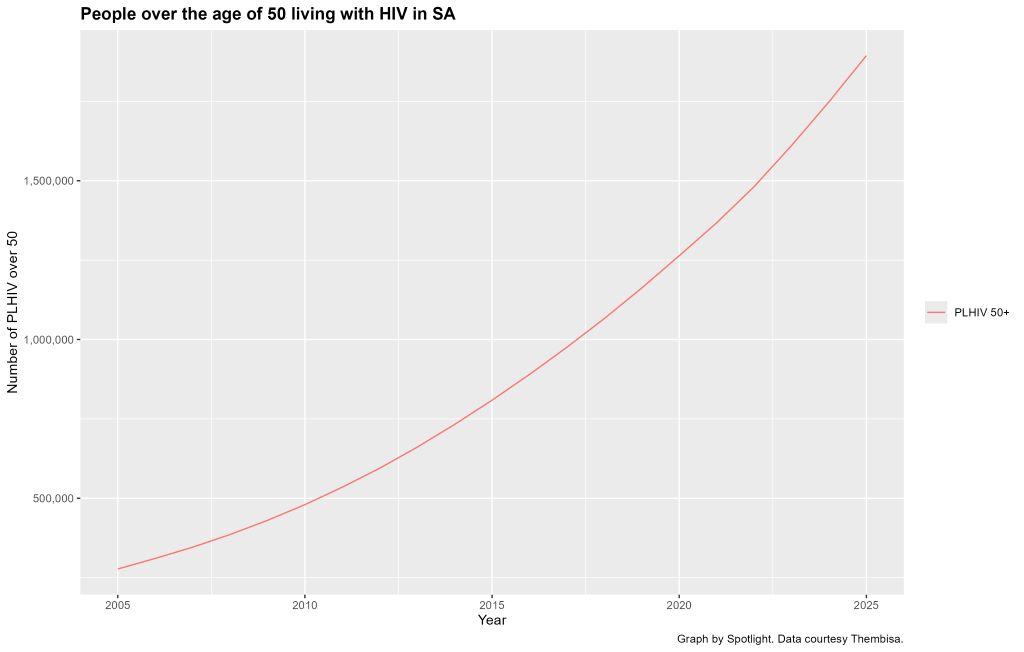
The changing make-up of the population of people living with HIV, coupled with the fact that antiretroviral therapy has been crucial for clearing and suppressing HIV in the body was a core driver for developing the new guidelines, Dr Camilla Wattrus, the Clinical Director at the Southern African HIV Clinicians Society, tells Spotlight. She is one of the guidelines’ authors.
“Antiretroviral therapy has expanded the lifespan of people with HIV, but we must now also consider how to preserve the ‘health span’ in this group,” says Wattrus.
She explains that this means increasing the years that are spent in good health with a good quality of life.
Another co-author of the guidelines, Nomathemba Chandiwana, Chief Scientific Officer at the Desmond Tutu Health Foundation, points out that after antiretroviral treatment was introduced in South Africa, the life expectancy of people living with HIV increased dramatically. “We didn’t think people would live as long as they have now, so that’s been a big success,” she says. “But now we have new problems.”
Chandiwana says that older people living with HIV have around 16 fewer years in good health than people without HIV. The 16-year figure (technically 15.3) seems to originate in a study published in 2020 in the JAMA medical journal that compared the health and lifespans of insured people with and without HIV in the United States. For people with HIV who started antiretroviral treatment when they were still healthy (CD4 countes above 500), the difference in healthy years was 9.5 years.
Another broad concern is that clinicians may be focused on HIV-related issues like viral suppression for these patients and not be sufficiently aware of other ageing-related developments. People with HIV get the same ageing related diseases as other people, but there is evidence that they tend to get them earlier.
We know from Thembisa model outputs that on average, people living with HIV today are slightly more likely to die of non-HIV-related causes than AIDS. According to the model, there were 53 000 HIV-related deaths in the year from mid-2024 to mid-2025. This is a thousand fewer than the 54 000 people with HIV who died of non-HIV-related causes over the same period.
What is in the new guidelines
The new guidance states that it is designed to:
- Raise healthcare workers’ awareness of the needs and concerns of the population of people living with HIV who are 50 years and older.
- Inform healthcare workers about an ageing-related approach to older people with HIV.
- Highlight good practices to help healthcare workers provide optimal care for this population.
- Provide resources about ageing with HIV for healthcare workers, their patients and their patients’ carers.
- Guide clinical settings in implementing geriatric care into HIV clinical practice.
The clinical advice in the guidelines follow the World Health Organisation’s (WHO) principles for Integrated Care for Older People (ICOPE), which emphasises prevention prior to frailty, person-centred assessment, and the involvement of healthcare workers other than doctors.
The guidelines cover a thorough list of challenges faced by older people with HIV that need to be monitored and addressed. For instance, physiologically, there is a risk of comorbid conditions like hypertension and cancer, and an increased risk of complications from polypharmacy, when more than five medicines are used concurrently. Social and behavioural challenges include that older people are perceived to be less likely to get infected with HIV and therefore have lower rates of HIV testing and use of HIV prevention tools.
This population is also at risk of being disregarded or not fully cared for in the healthcare system. The guidelines give examples such as restricted mobility access to health facilities and healthcare workers being unaware of the HIV-related risks in older people. “The health system needs to be equipped to manage their needs in a holistic and integrated way, and that is what this guideline aims to support,” says Wattrus.
The guidelines include a comprehensive schedule of what need to be assessed and screened and at what regularity. There is a particular focus on geriatric syndromes like frailty, cognitive impairment, and managing comorbid non-communicable diseases.
“The idea is that every visit with an older patient involves more than just routine HIV care and that it becomes a conversation about how that person is functioning and living,” says Wattrus.
The guidelines also emphasise how care can be offered by a variety of healthcare providers, depending on the resources available. “Recommendations enable task-shifting, which is a practical necessity in a country where specialists such as geriatricians are scarce, and the bulk of HIV routine care is delivered by healthcare workers at primary care level,” says Wattrus.
Even though the guidelines focus on overall health in older people living with HIV, managing HIV is, of course, a part of this. It cautions that “CD4 recovery may be slower and blunter compared to younger individuals,” but viral suppression is still the primary treatment goal.
The crucial factor here is to choose the correct antiretroviral treatment regimen for the patient. For instance, popular tenofovir disoproxil fumarate (TDF) combinations should be avoided in people at risk of or with osteoporosis, bone fractures, or renal impairment. Regimens with tenofovir-alafenamide or abacavir may be better, though the latter is contraindicated if there is high cardiovascular risk.
The new local guidelines hit largely the same notes as a major commission on HIV and ageing that was published by the journal Lancet HIV to coincide with the AIDS 2026 conference taking place in Rio de Janeiro, Brazil.
“Supporting healthy ageing requires more than sustained viral suppression; it requires care that is informed by what matters most to the individual, with attention to maintaining physical and mental function, minimising healthcare complexity, and addressing multimorbidity, polypharmacy, stigma, and social determinants of health,” the commission found.
Simple systems, big change
Apart from giving healthcare workers a framework for giving better care to older people living with HIV, the guidelines advise how this larger change in the health system can happen for this growing older population. “What is great is that most of the recommendations are not complicated or expensive,” says Wattrus.
She explains that the sensitisation and training of healthcare workers, especially in primary care, is a crucial first step. If they know how to, they can easily incorporate brief screenings, such as those for frailty, into normal appointments. For example, as Chandiwana points out, several geriatric tests need only a chair for the patient to sit down on and get up from. She says it is easier to do these things for people with HIV during their existing appointments, compared to people without HIV who may not be visiting health facilities for regular screenings.
Another relatively easy adaptation is to simply make healthcare services easier to access. “This can be done by having appointments aligned across conditions, fewer unnecessary referrals and genuine attention to broader aspects of their health such as poverty, isolation and limited mobility,” she says.
Chandiwana also suggests that one could consider rolling out geriatric care health cards to track screening, as is often done with children. She would also like to see more community buy-in, in a similar way as there was during the earlier part of the HIV treatment roll-out. For instance, she suggests community health clubs and increased health literacy efforts around ageing.
Avoiding problematic polypharmacy, says Wattrus, is another low-cost, high-yield strategy that does not require specialist input. “Routinely reviewing medication lists, identifying unnecessary drugs, and checking for interactions is straightforward and can make a significant difference,” she says.
More specialists would of course help. Chandiwana says there are fewer than 50 geriatric specialists in the country. She says there is also a much wider need for geriatric-specific training across the healthcare system, including for primary care nurses and community healthcare workers.
Lastly, Chandiwana says the guidelines offer a much-needed look into the unique challenges and needs of older people with HIV as an opportunity for the government to act to prevent a future problem. “So that investment in having scalable, simple systems for people who are ageing, both with HIV and without, I think, would be fantastic, but that needs money,” she says.
*This story was published by Spotlight – health journalism in the public interest. Sign up to the Spotlight newsletter.