By Biénne Huisman for Spotlight
From counselling about small nodules to overcoming people’s fears of needles, Spotlight takes the pulse of a new HIV prevention injection’s rollout in the Western Cape.
At Cape Town’s Philippi Village, beside a rainbow-emblazoned mobile clinic, Olwam Plaatjie says she switched from the two-monthly cabotegravir HIV prevention injection to the six-monthly injectable lenacapavir. Despite small nodules forming at the two jab sites on her abdomen, the 20-year-old is delighted with the new HIV prevention medicine.
Plaatjie, who is from Crossroads and who started taking cabotegravir injections three years ago, says: “I see many people who are HIV positive. Many of them are girls. Guys often don’t even want to be tested; my boyfriend didn’t want to go for HIV tests. So that’s why I started to have a fear. I was like, you know, maybe there is something he is hiding.”
Plaatjie is one of a stream of young women now taking their health in their own hands as they personally implement HIV prevention strategies, thanks to national government and research campaigns aimed at this vulnerable group.
According to Foster Mohale, spokesperson for the National Department of Health, as of 23 August, there have been 3 641 initiations of lenacapavir, or LEN for short, across the 22 government clinics in the province that are offering the injection. Nationally, the number stood at 47 934.
Due to severely constrained supply, lenacapavir is for now only being rolled out to 360 health facilities across six provinces (Free State, Limpopo, and Northern Cape are not currently included). Gauteng accounts for over a third of facilities and KwaZulu-Natal for around a quarter. The Western Cape’s 22 facilities makes up only around 6% of the total. The selection of facilities was in part informed by how well facilities had been doing in the provision of HIV prevention pills, currently available in almost all the country’s public sector health facilities.
Mohale said the three clinics with the highest administrations in the Western Cape as of August 26, were the Khayelitsha Community Health Centre, Michael Mapongwana Community Health Centre, in Khayelitsha, and Nolungile Community Health Centre, also in Khayelitsha.
Uptake in adolescent girls and young women
Asked about the high uptake in this area, Director of Service Priorities Coordination for the Western Cape Government Department of Health and Wellness, Hilary Goeiman, pointed out the community’s large population of adolescent girls and young women, who are being targeted in the medicine’s roll-out strategy.
“Nolungile Community Day Centre has demonstrated strong clinical leadership and effective implementation of the programme, successfully integrating lenacapavir into routine HIV prevention services,” she said.
On the demographics of the administrations, Goeiman said: “Most recipients are women, in line with the initial rollout focus on adolescent girls and young women, women of reproductive age, and pregnant and breastfeeding women who are at substantial risk of HIV acquisition.”
Mohale said 258 pregnant women had been initiated on lenacapavir at the 22 clinics across the Western Cape, since June.
Science in tandem with government
Meanwhile, Plaatjie was part of an initial cohort of 15- to 35-year-olds who received lenacapavir jabs in February, as part of a study spearheaded in the area by the Desmond Tutu Health Foundation. The study, called ALIGN, will evaluate implementation strategies for lenacapavir and how to encourage continued use.
The research is unfolding in collaboration with the Western Cape Department of Health and Wellness and the National Department of Health, but with a separate stock of the drug, independently sourced by the scientists. Social behavioural expert at the foundation, Elzette Rousseau, says their goal is to enrol at least 1 500 people on lenacapavir and to follow them for 18 months. She adds that at this stage, their data is still too limited to have any clear findings.
Cool, but a fear of needles
At Philippi Village, next to Plaatjie, Lutho Windvoel reflects on lenacapavir. He says that to his knowledge, men can be afraid of injections, and thus of HIV prevention through jabs. But, to him the benefit of protection over six months outweighs a fear of needles. “It’s just cool,” says Windvoel, who is wearing a black T-shirt with a pink teddy bear graphic.

“LEN makes life easier. People are excited. Before, I took PrEP tablets daily but I worried that I would forget.”
Also in the conversation is Sive Mphambaniso, youth reference engagement facilitator at the Desmond Tutu Health Foundation. On a fear of injections, particularly among men, Mphambaniso agrees: “Most of them [men], when we talk about injections, they’re like, ‘nah.’ Many men are afraid of needles. Especially when we talked about cabotegravir when it arrived. So many of them preferred to take the oral PrEP, actually. Until the six month injection came in. Now people are saying, ‘it’s better for me to just have the guts to take the injection, rather than taking pills every day’. It’s the promise of six months that makes you just say, ‘Now let me have the guts to do this thing’.”
On some men being resistant to HIV testing or prevention, he says: “To be honest, it’s a struggle. And talking to men about HIV prevention, it’s quite a challenge, but it is happening. And I would say it is better for them to come to the mobile clinic rather than to go to a traditional clinic. Sometimes men don’t like people to think that they are sick. So they come here, it’s quite quick and it’s efficient.”
From the researchers’ side, Rousseau pointed out that one in four of their clients for lenacapavir had been men, “similar numbers to those accessing oral PrEP,” she says.
Small nodules that disappear
Speaking to Spotlight, Plaatjie and Windvoel, along with Sinovuyo Plaatjie, 22, and Okuhle Potelwa, 19, who were also in the initial cohort in the study led by the Desmond Tutu Health Foundation, agree that small nodules formed under the skin where the lenacapavir was injected. “It was like small bumps,” said Plaatjie. “It’s not even visible, but you can just feel it when you touch yourself. And it’s not sore.”
Lenacapavir is administered via two injections of 1.5ml each in the buttocks, thigh, abdomen or upper arm. Speaking to Spotlight, the four recipients say the nodules had not been painful, and that the bumps started growing smaller after about a month and eventually disappeared. They did not experience any other side effects.
Inside the “Tutu teen truck” mobile clinic parked at Philippi Village, nurse Zimasa Zwide elaborates on the nodules. “Most of the time they form immediately, especially on the slimmer people,” she says. “So what I normally do when I’m injecting people, I ask them to feel the nodules so that they won’t be surprised at home later. They get smaller with time and they disappear depending on the body of each participant. And most of them are not reporting any pains.”
However, at a workshop hosted by the Bhekisisa Centre for Health Journalism at the end of August, Spotlight heard from two lenacapavir users, who did report initial pain along with “bumps” at the injection sites – for a few weeks following administration. At some facilities, icepacks are used to numb the injection site, either before or after the injection is administered, or both.
Glass vials of pale yellow liquid
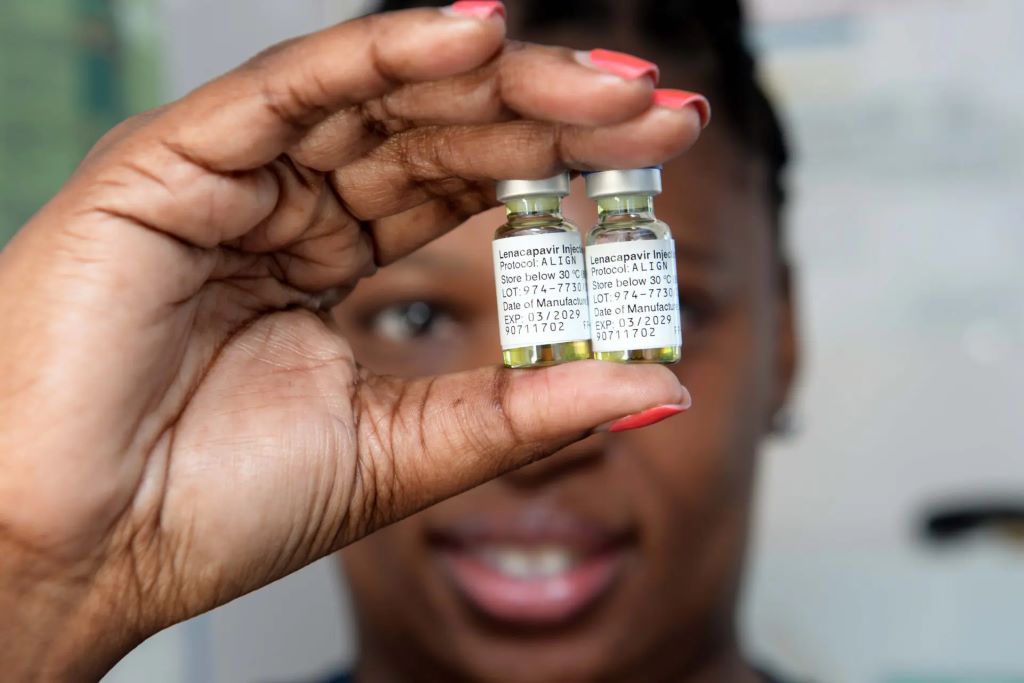
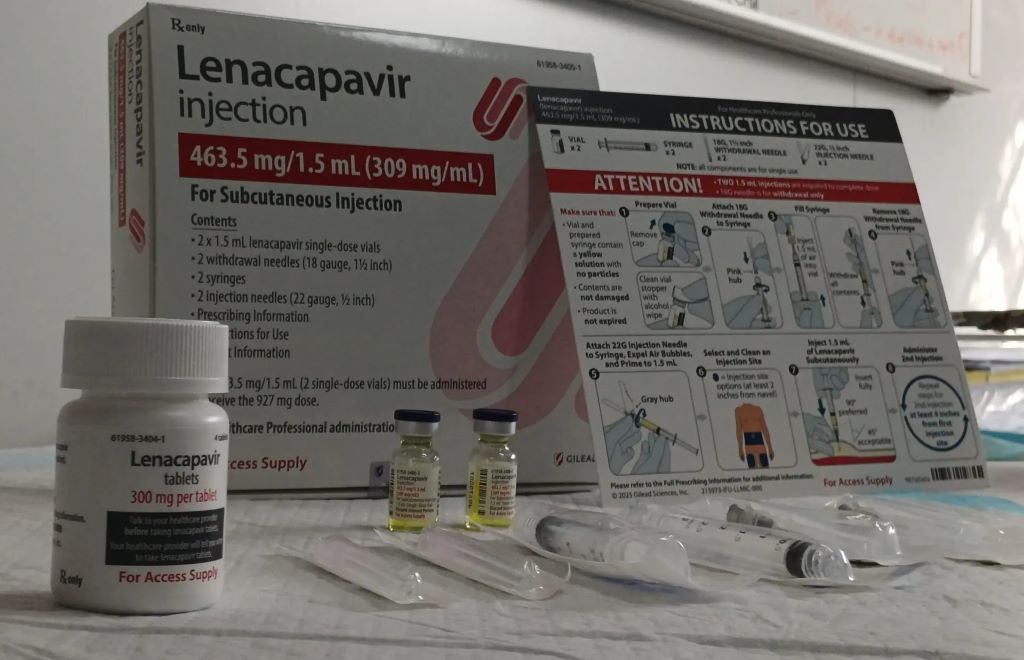
During our conversation, Zwide opens a lenacapavir dosing kit. Inside there are two syringes, two glass vials of pale yellow liquid, and a plastic container with tablets.
She says: “It’s two injections. One on each side of the abdomen, well depending on the injection site that they are choosing. And two tablets which are taken on the day of the injection, plus two tablets that I give them to take home, and which needs to be taken exactly 24 hours later. The tablets, it’s a form of speeding up the absorption process of the lenacapavir.”
If these steps are followed, she says, a recipient is fully protected against HIV three days later. The recipient needs to visit the clinic a month later for an HIV test and follow-up treatment. Zwide says the most patients she have injected with lenacapavir in her mobile clinic in a day were around six or seven people. This is her maximum capacity, she says, as the required administration takes around two hours per person.
Demand for the jab
On demand for the jab, Zwide says: “On a daily basis, there are a lot of people who are interested in lenacapavir. When we started rolling out LEN, there were a couple of participants who were coming in, even ones who were older than 35. Unfortunately, in our service, we take from 15 to 35 years, so we couldn’t give them. But luckily as it was now rolled out at the local clinics, we can refer them to Phumlani Clinic [three kilometres away].” Phumlani Clinic is one of the 22 facilities in the Western Cape offering the injection.
Responding to Spotlight’s questions around education on lenacapavir and demand creation in South Africa, Rousseau spoke highly of government’s rollout efforts.
“The national launch of lenacapavir in early June has created great demand and awareness of lenacapavir,” she says.
In addition, Mphambaniso points out the value of creating awareness about HIV prevention strategies and lenacapavir on channels that reach young people, specifically social media like TikTok.
Goeiman explained distribution of the medicine around the country. “Lenacapavir is procured centrally by the National Department of Health and distributed to provinces through phased deliveries. The Department continues to actively manage available stock to ensure equitable access throughout the phased rollout.” Technically, the department is procuring the medicines from the pharmaceutical company Gilead Sciences using money from the Global Fund (a large multinational donor).
For now, lenacapavir supply in South Africa remains highly constrained. That is expected to change once generic versions of the drug are registered and marketed in South Africa. Gilead have granted several companies licenses to produce generics. One of those, the Indian pharmaceutical company Hetero, has already filed a lenacapavir generic with the South African Health Products Regulatory Authority.
It seems plausible that the first lenacapavir generics will be approved in the first half of 2027 and indications are that the Department of Health will be quick to move to procuring lenacapavir generics on tender. Once that happens, the programme should expand rapidly with the aim of eventually covering all public healthcare facilities in the country.
This article was first published by Spotlight – health journalism in the public interest. Sign up to the Spotlight newsletter.