A comprehensive new study published in The Lancet provides a global assessment of road traffic injuries from 1990 to 2023.
Analysing data across 204 countries and various income groups, researchers found that while global mortality and incidence rates have generally decreased, progress is dangerously uneven and heavily influenced by a nation’s wealth. Low-income countries face a death rate nearly six times higher than high-income nations, despite often having lower overall case numbers. The report identifies road injuries as the leading cause of death for males aged 10–39, highlighting a major public health crisis for young people. Beyond fatalities, the study quantifies the massive burden of long-term disability, frequently caused by severe head injuries and fractures. A separate study in South African Family Practice explored the local challenges in reducing road traffic mortality.
Ultimately, the authors argue that meeting international safety targets requires urgent structural reform and significantly increased investment in poorer regions.
Click on the player below to listen to our podcast!
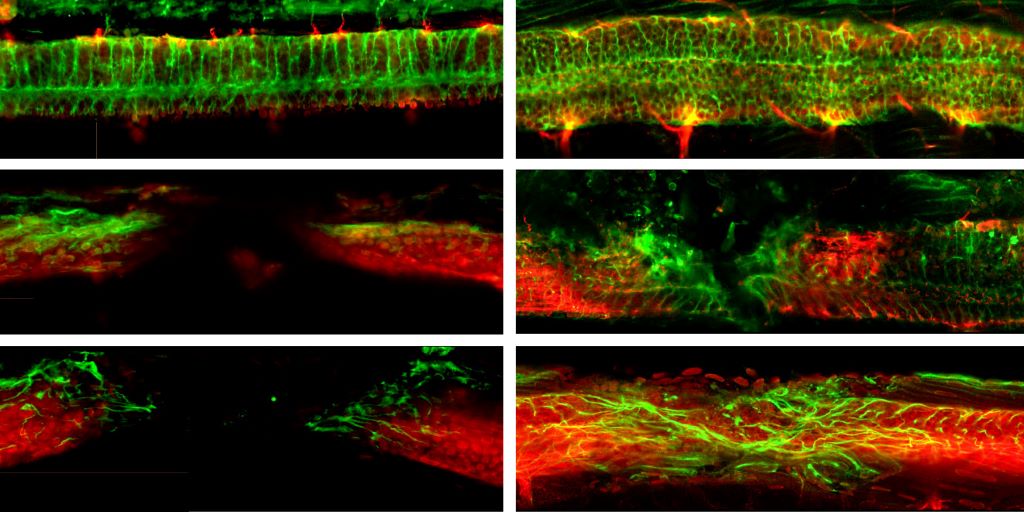
At the start and after three days: the top images show the uninjured spinal cord of a zebrafish; those in the middle show the injured spinal cord; and those at the bottom illustrate how the nerve cells grow thanks to the microrobots. (Image: ETH Zurich)
A research team from ETH Zurich and the University of Zurich (UZH) has developed a novel approach to treating spinal cord injuries: controllable microrobots deliver stem cells directly to the site of an injury, where they promote nerve cell regeneration. In animal experiments, this approach significantly improved mobility.
Spinal cord injuries can have devastating consequences for those affected. Nerve cells in the spinal cord rarely regenerate naturally, while scarring often prevents the regrowth of nerve fibres. Modern therapies attempt to influence implanted stem cells using electrical stimulation to promote the growth of new nerve cells. This approach has several drawbacks: it requires implanted electrodes, and the transplanted cells do not always survive or integrate properly into the existing tissue.
Cells and nanoparticles cleverly combined
Researchers in Zurich are pursuing a new approach, which they have published in the journal Nature Materials. This involves combining therapeutic stem cells with magnetoelectric nanoparticles in such a way that the cells can be guided magnetically to the precise site of an injury and stimulate the stem cells to accelerate repair.
To achieve this, the researchers created a biohybrid microrobot, which combines living neural progenitor cells (NPCs) with a technical component in the form of specially engineered nanoparticles. The NPCs are derived from induced pluripotent stem cells (iPS cells), which are regular body cells reprogrammed in the laboratory to regain stem cell properties. These iPS cells have the potential to differentiate into various types of nervous system cells.
The nanoparticles consist of two layers: an inner layer that responds to magnetic fields and an outer layer that converts this response into electrical signals. By combining these special nanoparticles with the progenitor cells, the researchers fabricate what are known as NPCbots.
A lab the size of a chip
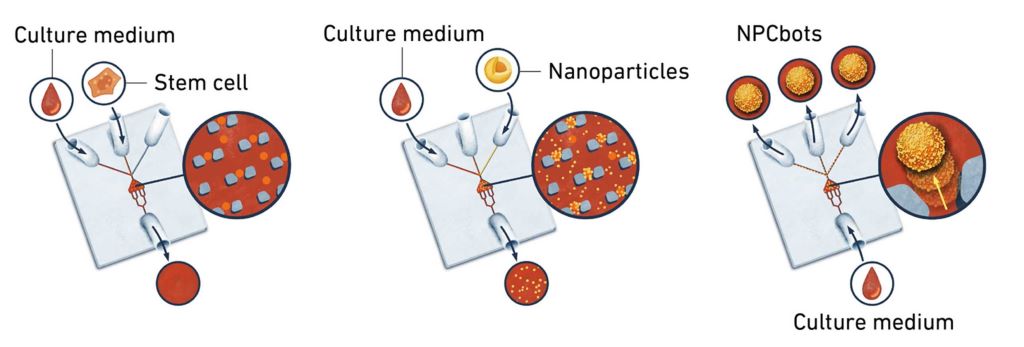
The researchers create the NPCbots in specialised labs on a surface measuring one square centimetre. This process can be illustrated graphically. “We place a reservoir in the centre where we trap the cells. Then we inject the nanoparticles and wait for the two components to bind,” explains Professor Salvador Pané i Vidal of the Multi-Scale Robotics Lab at ETH Zurich.
Illustration of how microrobots are fabricated on a lab-on-a-chip (LoC). (Image: ETH Zurich)
After just thirty minutes, the NPCbots – each around six micrometres in size – are ready for use. “To scale up fabrication, we operate several lab-on-chip systems in parallel,” explains Hao Ye, senior scientist and the study’s first author. Depending on the test in question, the ETH researchers need hundreds of thousands of microrobots for cell-based studies and several million for animal experiments.
Injured zebrafish swim again
The team tested the NPCbots on zebrafish larvae with spinal cord injuries. The microrobots were injected precisely into the site of the fish’s injury, and electromagnetic fields were generated. For Pané Vidal, teamwork was vital to the experiment’s success: “Stephan Neuhauss and Jingjing Zang at the University of Zurich did extremely valuable work. They enabled us to demonstrate, in a well-characterised regenerative model system, how quickly cells differentiate using our method and how our bots repair the spinal cord.” In just three days, the zebrafish exhibited nearly normal swimming and exploratory behaviour.
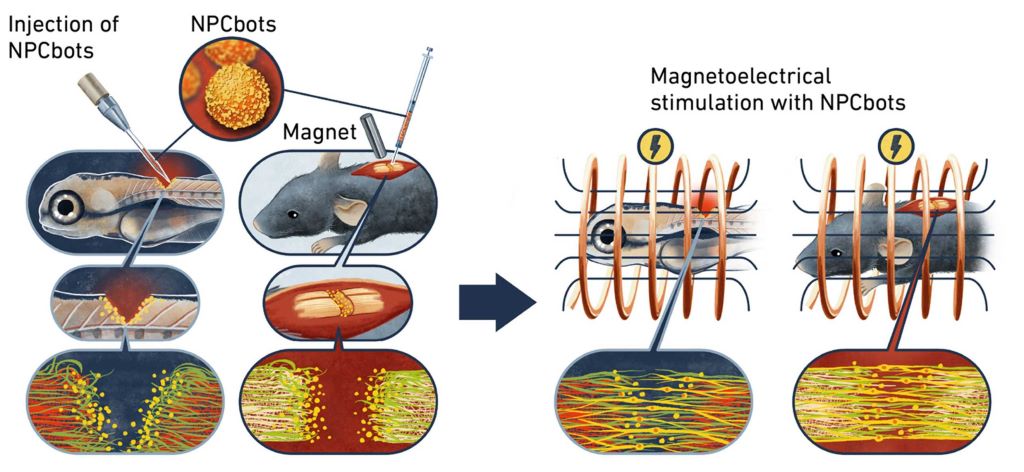
Schematic illustration of nerve cell recovery in zebrafish and mice. (Image: ETH Zurich)
The researchers also tested the NPCbots on mice with completely severed spinal cords. Here, too, the results were very promising: after 28 days, the animals’ nerve cells had reconnected at the site of the injury. During this period, the treated mice exhibited increasingly normal movement patterns – their gait, stride length, coordination and exploratory behaviour improved significantly.
This result is particularly significant because, unlike in zebrafish, the mouse spinal cord does not normally regenerate. The treatment was well tolerated by the animals, with no evidence of any adverse effects or immune reactions.
Success through minimally invasive stimulation
These successes were made possible through electrical stimulation of stem cells, greatly enhancing their differentiation after transplantation. In this process, nanoparticles convert magnetic signals directly into electrical impulses that stimulate specific stem cells. When employing NPCbots, researchers need only apply external magnetic fields around the injury site, eliminating the need for implanted electrodes or cables in previous approaches. This is crucial because the spinal cord is extremely sensitive. “Microrobotic guidance makes the treatment more precise and minimally invasive,” Hao explains.
Magnetic fields are particularly well-suited for stimulating stem cells because they can penetrate tissue easily, and their frequency and field strength can be flexibly adjusted to the specific application. Once the progenitor cells have been stimulated and differentiated into nerve cells, the NPCbots essentially dissolve within the tissue. The researchers expect the nanoparticles to be stable and minimally reactive due to their barium titanate coating. Further studies will determine whether and how the particles are degraded or excreted over the long term.
The idea can be expanded as required
The results from animal experiments are extremely promising, but further research will be needed before NPCbots can be tested in humans. “In addition to many clinical aspects, we first need to test which magnetic fields work best in humans and determine the optimal stimulation duration,” Hao explains. Nevertheless, the researchers are already considering further applications: “The reproducible and scalable production of microrobots using our lab-on-a-chip system demonstrates that the platform’s application potential extends beyond basic research,” explains Professor Pané i Vidal. It could also be adapted for other biomedical applications – for example, in cardiology, oncology, wound healing and other targeted regenerative therapies. This could make these treatments safer, more controllable and more effective.
By Dr Gerhard Vosloo, Founder and Head Consulting Practitioner at Dr GL Vosloo Medical Practice, managed by BioWell
Prescription-based weight management treatment has surged into the mainstream, giving more people with genuine clinical needs access to potentially life-changing care. However, the market’s growth has not been matched by consistently high standards of care. This Women’s Month, we must confront the fact that many women remain particularly vulnerable to inadequate clinical oversight, inappropriate prescribing practices, and black-market products that operate outside established medical safeguards.
Nearly seven in ten adult South African women are obese, compared to four in ten men. Women therefore account for a significant share of the weight-management market and, as a result, may face greater exposure to irresponsible medical practices and unregulated black-market options, where proper clinical support and control are virtually non-existent.
At Dr GL Vosloo Medical Practice, managed by BioWell, women make up the majority of patients seeking a holistic weight-loss and metabolic management programme, which may include prescription treatment where clinically justified. Concerningly, some patients arriving from other programmes report excessively high dosages of treatments, with scarce oversight or guidance. Others have used black-market products and later sought professional medical help after struggling to manage their treatment safely and effectively.
These experiences demonstrate exactly why prescription treatment should form part of a broader, medically-supervised programme rather than a medication-only approach. As more women seek treatment, the industry has a duty to help them understand what good clinical care and appropriate dosing practices involve, as well as how to distinguish a medically grounded programme from those built primarily around access to medication.
Not all weight-management programmes are created equal. Patients should look for a few key indicators that suggest a provider is delivering safe, responsible care:
Screening should begin before the consultation
Before the first appointment is even scheduled, a reputable practice or physician should gather sufficient information to understand a patient’s medical history, current health status, and potential risk factors. For example, intake forms may ask about previous weight-loss treatments, allergies, pregnancy or breastfeeding status, eating habits, goals, and other information that may help the practitioner identify contraindications early.
Patients should expect this information to be reviewed before they proceed. Any omissions or concerns should be raised, while patients with possible contraindications, urgent medical issues, or conditions outside the programme’s scope should be informed and referred where necessary.
The consultation should establish clinical need and risk
Patients should expect a thorough consultation that explores their concerns, goals, medical and treatment history, symptoms, and relevant lifestyle or health factors. It should also give the doctor an opportunity to clarify uncertainties, identify undisclosed contraindications, and assess appetite, eating behaviour, level of activity, sleep quality, and mental health.
For women, this may include menstrual health, contraceptive use, pregnancy plans, breastfeeding, menopause, polycystic ovary syndrome, hormone treatment, and previous gestational diabetes.
A medical assessment should establish whether prescription treatment is clinically appropriate, rather than being prescribed simply because a patient wants to lose weight. Relevant considerations may include body measurements, blood pressure, glucose, cholesterol, organ and thyroid function, vitamin and hormone levels, and pregnancy screening where relevant.
Treatment decisions should be fully explained before consent
Doctors should provide a clear explanation of whether prescription therapy is appropriate, whether it should be delayed or avoided, or whether another treatment approach may be more suitable. Prescription-based medication should not be framed as the primary intervention, although it may form part of a broader programme covering nutrition, exercise, behaviour, supplementation, metabolic support, clinical monitoring, and guidance on how these elements work together.
Before written consent is given, patients should be informed about the expected benefits, potential side effects, serious risks, contraindications, alternatives, monitoring requirements, and circumstances under which treatment may be stopped. Women should also be informed about how pregnancy plans, breastfeeding, hormonal treatment, or changing health circumstances may affect whether treatment can begin or continue.
Prescriptions should be individualised and closely monitored
Patients should be cautious of one-size-fits-all prescribing practices. Treatment should reflect the individual’s clinical needs and risk profile, using a conservative approach rather than a standard dose or automatic escalation schedule.
Ongoing follow-up is equally important. Regular check-ins should track progress, side effects, relevant eating and lifestyle factors, and any changes in health or medication use, with treatment adjusted accordingly. For women, this continuity is particularly important because hormonal, reproductive, and life-stage circumstances may change during treatment and affect how care is managed.
Women should not have to navigate a fast-moving treatment market through trial and error. By understanding the characteristics of safe, medically supervised care, patients are better equipped to make informed choices. Ultimately, however, the responsibility rests with practitioners and clinics to make ethical, medically-grounded care easy to recognise from the outset. Public trust in this treatment category will depend on how consistently the industry meets that standard.
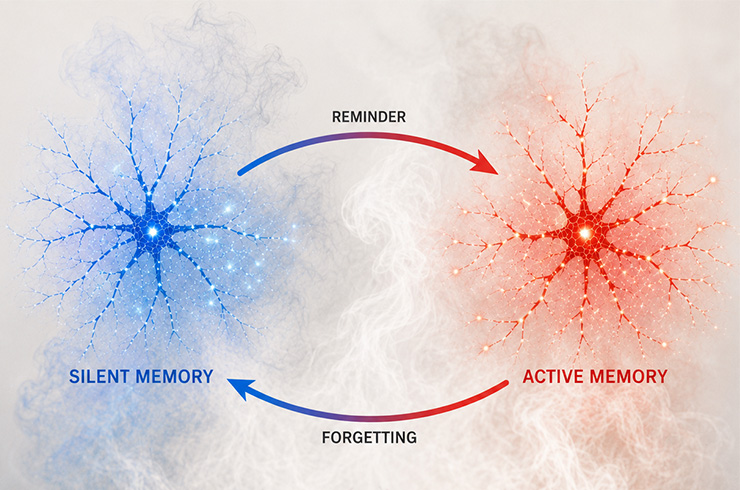
Inaccessible memories can leave silent traces that reminders may revive or distort. Image generated by Johannes Felsenberg with the assistance of ChatGPT.
A forgotten memory is not always a vanished one. FMI neuroscientists investigating the fruit fly brain found that some memories become inaccessible while leaving a silent trace behind. The right reminder can bring them back, but misleading reminders can distort their recovery, producing false memories. The findings show how memories can be rebuilt from stored information and current clues, which may help explain why recall can sometimes alter what we remember.
Memory is not a perfect record. Some memories fade, while others remain hidden and can be brought back by reminders. But reminders can also distort what is remembered, and scientists still know little about how the brain accurately recovers memories or forms false ones.
In a new study, researchers in the group of Johannes Felsenberg trained fruit flies to associate one odour with mild electric shocks. Soon after training, the flies avoided that odour, but by 24 hours later the learned avoidance had faded. When the researchers later exposed the flies to the same odour as a reminder, the aversive memory was recovered, and the flies avoided the odour again.
The reminder only worked when key parts of the original setting, such as the chamber’s texture and lighting, were unchanged, suggesting that the fly brain used both the odour and its context to bring the memory back.
When the researchers looked inside the flies’ brain, they found that the original pattern of neural activity linked to the memory faded over time. At the same time, the memory left a silent trace in a different group of neurons. A specific reminder could reactivate this silent trace, restoring the brain activity that guides behaviour. These findings suggest that some forgotten memories are not erased but persist in the brain in a silent form that can later be recovered.
The team also showed how memory recovery can go wrong. During training, the flies had experienced a second odour that was not paired with shock. When researchers later used that harmless odour as the reminder, the flies began avoiding it too, as if it had predicted danger.
The neuronal pathways involved in forming the false memory were different from those used to recover the true memory. This suggests that, at least in flies, the brain may process recovered and distorted memories through distinct circuits.
This work does not show that fly memory is the same as human recollection, but it offers a circuit-level example of how remembering can depend on stored information, current cues and context, and why that process can sometimes distort past memories, the researchers say.
Johannesburg, 30 July 2026: The Wits University Liver Transplant Programme has reached its 1000th liver transplant, marking a defining milestone for South African medicine and for one of Africa’s most comprehensive transplant programmes.
A collaboration between Wits Donald Gordon Medical Centre and Charlotte Maxeke Johannesburg Academic Hospital, the liver transplant programme has become a national and regional referral hub for patients across the healthcare system.
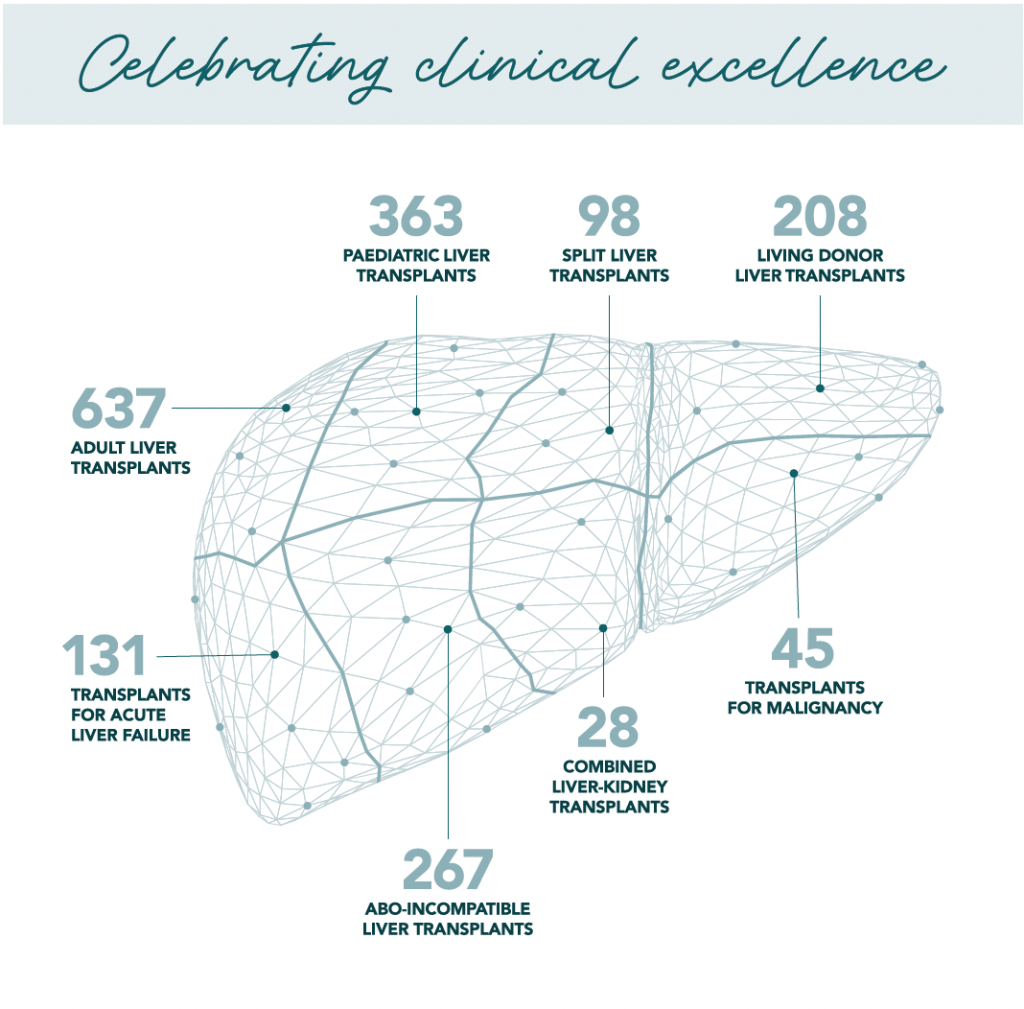
Of the 1000 liver transplants, 637 were performed in adults and 363 in children.
Since performing its first liver transplant in 2004, the programme has introduced living donor liver transplantation for both adults and children, expanded expertise in split liver transplantation and ABO (blood group)-incompatible transplantation, pioneered HIV-positive donor liver transplantation, performed monosegment liver transplantation and, most recently, introduced liver machine perfusion technology to help maximise the use of scarce donor organs.
The 1 000th transplant milestone demonstrates what is possible when academic medicine, scientific research, education and healthcare partners work together in pursuit of a common purpose, increasing access to healthcare for all.
Professor Jerome Loveland, Academic Head of Transplantation at Wits, says the programme has continually expanded the boundaries of what is possible through clinical innovation, multidisciplinary expertise, research and academic training in a country facing a severe shortage of donor organs.
“People often see the transplant operation as the defining moment. In reality, it is the culmination of years of expertise and systems development across highly specialised teams. The 1000th transplants reflect the legacy handed to us by those who built the programme, past and present, the extraordinary multidisciplinary expertise that sustains it today and our responsibility to train the people who will carry it forward.”
While the programme celebrates its 1000th transplant, it also highlights one of South Africa’s greatest ongoing healthcare challenges. Many patients continue to wait for life-saving donor organs. Advances such as living donor transplantation, split liver transplantation and liver machine perfusion are helping to expand access to transplantation, but increasing awareness of organ donation remains essential if more patients are to receive the chance of a longer, healthier life.