

Tag: soleus

Managing Stiffness in Deep Calf Muscles Using Ultrasound Stimulation

Research shows ultrasound stimulation can reduce passive stiffness in the soleus, suggesting potential for non-invasive management of deep muscle stiffness
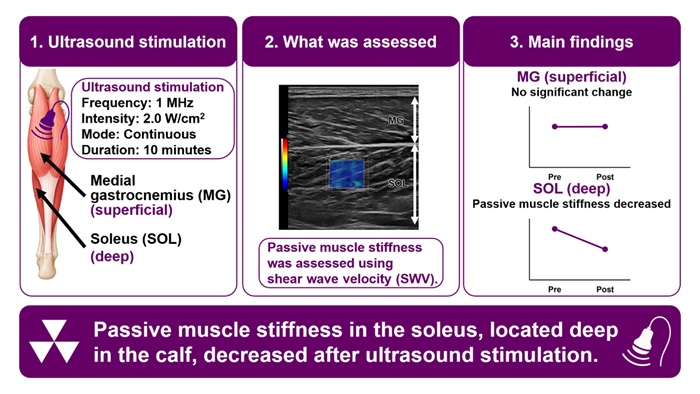
Ultrasound stimulation was applied to the calf for 10 minutes, and passive muscle stiffness was assessed using shear wave velocity. The study compared the superficial medial gastrocnemius (MG) and deeper soleus (SOL) muscles. Passive muscle stiffness decreased in the SOL after ultrasound stimulation, while no significant change was observed in the MG. Image credit: Mr Tomohiro Umeda from Doshisha University, Japan

Passive muscle stiffness is a risk factor for muscle strain injuries. Stretching, heat, and vibration have been evaluated on superficial muscles, but approaches for decreasing stiffness in deeper muscles remain unclear. In a recent study, researchers from Japan showed that 10 minutes of ultrasound stimulation can reduce stiffness in a deep calf muscle called the soleus, hinting at a promising non-invasive strategy for managing deep muscle stiffness, with potential future application in sports injury prevention.

Muscle strain injuries are a common problem in sports, and injuries to the triceps surae, the calf muscle group that includes the gastrocnemius and soleus, can significantly affect athletic performance and return to play. One factor that is thought to influence a muscle’s susceptibility to strain is passive muscle stiffness, which refers to the resistance of a relaxed muscle to being stretched. A recent genetic study has strengthened the idea that stiffer muscles are more prone to injury, suggesting that passive muscle stiffness is an important risk factor. Thus, finding safe and feasible ways to reduce this stiffness might help prevent associated injuries.

Several strategies, including stretching, heat, and vibration, can significantly reduce passive muscle stiffness. However, research on these approaches has focused on muscles located close to the skin. The soleus, one of the main muscles of the triceps surae, sits deep underneath the medial and lateral gastrocnemius, which makes it a difficult target. Ultrasound stimulation is used in sports and rehabilitation and produces both heating and mechanical effects in biological tissue. As lower-frequency ultrasound can penetrate relatively deep into tissue, it raises the question: Could ultrasound actually reduce the stiffness of a deep muscle like the soleus?

To this end, a research team including Ph.D. student Tomohiro Umeda, Professor Tatsuya Hojo, and Professor Taku Wakahara from the Graduate School of Health and Sports Science at Doshisha University, Japan, examined the effects of ultrasound stimulation on calf muscle stiffness in 20 healthy adults. Their work was published in the Journal of Biomechanics.

A randomly selected leg of each participant received 10 minutes of continuous ultrasound stimulation at a frequency of 1 megahertz (MHz) and an intensity of 2.0 W/cm², while the other leg served as an untreated control. The researchers then used shear wave elastography, an imaging technique that measures how quickly mechanical waves travel through tissue, to assess muscle stiffness before and immediately after the ultrasound stimulation. Faster shear waves generally indicate stiffer tissue, so a decrease in shear wave velocity (SWV) was interpreted as a decrease in passive muscle stiffness.

The results showed a clear difference between the soleus and the medial gastrocnemius. SWV, an indicator of passive muscle stiffness, decreased significantly in the soleus after the ultrasound stimulation, while no significant change was observed in the untreated leg. In contrast, no significant change in SWV was observed in the more superficial medial gastrocnemius. Interestingly, participants who initially had stiffer soleus muscles tended to show greater reductions in stiffness following ultrasound stimulation. “Our findings suggest that ultrasound stimulation may have the potential to non-invasively decrease passive stiffness in deep muscles such as the soleus,” remarks Mr Umeda, “In the future, this approach may contribute to the development of conditioning and rehabilitation strategies for the prevention of sports-related muscle injuries.”

The different responses of the soleus and medial gastrocnemius may be related partly to their anatomical locations. The soleus is located about 2.44cm below the skin, whereas the gastrocnemius is much closer to the surface at just about 0.53cm. Moreover, differences in the muscles’ tissue composition may also contribute to their different responses, although the underlying mechanisms remain unclear. “Future research could clarify the optimal ultrasound parameters for different muscles and identify which individuals respond most effectively to ultrasound stimulation. Such knowledge could lead to more individualised conditioning and rehabilitation strategies for athletes,” concludes Mr Umeda.

Overall, the results highlight the potential of ultrasound stimulation as a non-invasive approach for managing stiffness in deep muscles that can be difficult to target with other methods. Further research will be needed to determine whether this approach can be incorporated into individualised conditioning and rehabilitation strategies and ultimately contribute to the prevention of sports-related muscle injuries.

Source: Doshisha University

A New Seated Exercise Using the Calf Muscle Boosts Metabolism

Photo by TheStandingDesk on Unsplash

A simple, groundbreaking exercise developed by researchers at the University at Houston can help boost metabolism in the sedentary office-based lifestyle that causes so many health problems. By using the soleus muscle in the calf, though accounting for only 1% of the body’s weight, the metabolic health of the rest of the body can be boosted – if this muscle activated in a very specific way.

Marc Hamilton, professor of Health and Human Performance at the University of Houston, has discovered such an approach for optimal activation: the “soleus pushup” (SPU) which effectively elevates muscle metabolism for hours, even while sitting. The soleus, one of the human body’s 600 muscles, is a posterior leg muscle that runs from just below the knee to the heel.

Prof Hamilton’s research, published in the journal iScience, suggests the soleus pushup’s ability to sustain an elevated oxidative metabolism to improve the regulation of blood glucose is more effective than any popular methods currently touted as a solution including exercise, weight loss and intermittent fasting. Oxidative metabolism burns metabolites like blood glucose or fats, but it partly depends on the immediate energy needs of the muscle when it’s working.

“We never dreamed that this muscle has this type of capacity. It’s been inside our bodies all along, but no one ever investigated how to use it to optimise our health, until now,” said Prof Hamilton. “When activated correctly, the soleus muscle can raise local oxidative metabolism to high levels for hours, not just minutes, and does so by using a different fuel mixture.”

Muscle biopsies had revealed that the soleus used minimal glycogen – the predominant carbohydrate for fuelling muscular exercise. Instead of breaking down glycogen, the soleus can use blood glucose and fats.

“The soleus’s lower-than-normal reliance on glycogen helps it work for hours effortlessly without fatiguing during this type of muscle activity, because there is a definite limit to muscular endurance caused by glycogen depletion,” he added. “As far as we know, this is the first concerted effort to develop a specialised type of contractile activity centred around optimising human metabolic processes.”

When the SPU was tested, the whole-body effects on blood chemistry included a 52% improvement in the excursion of blood glucose and 60% less insulin requirement over three hours after ingesting a glucose drink.

This new approach of keeping the soleus muscle metabolism going also doubles the normal rate of fat metabolism in the fasting period, reducing levels of VLDL triglyceride.

The soleus pushup

Building on years of research, Hamilton and his colleagues developed the soleus pushup, which activates the soleus muscle in a different way than standing or walking does. The SPU targets the soleus to increase oxygen consumption more than what’s possible with these other types of soleus activities, while also being resistant to fatigue.

While seated with feet flat on the floor and muscles relaxed, a soleus pushup is performed by the heel rising while the front of the foot stays put. When the heel gets to the top of its range of motion, the foot is passively released to come back down. The aim is to simultaneously shorten the calf muscle while the soleus is naturally activated by its motor neurons.

While the SPU movement might look like walking (though performed while seated) it is the exact opposite, the researchers say. The body is designed to minimise the amount of energy used in walking, because of how the soleus moves. Prof Hamilton’s method reverses that and makes the soleus use as much energy as possible for a long duration.

However, the method is very specific, and if you are trying this while seated at your desk right now, you may not be doing it in the right way.

“The soleus pushup looks simple from the outside, but sometimes what we see with our naked eye isn’t the whole story. It’s a very specific movement that right now requires wearable technology and experience to optimise the health benefits,” said Prof Hamilton.

Additional publications are in the works focused on how to instruct people to properly learn this singular movement, but without the sophisticated laboratory equipment used in this latest study.

The researchers are quick to point out that this is not some new fitness tip or diet of the month. It’s a potent physiological movement that capitalises on the unique features of the soleus.

Potential first step toward a health care breakthrough

Prof Hamilton said it is the “most important study” ever completed at his lab, and could be a solution to a variety of health problems caused by spending hours each day living with insufficient muscle metabolism caused by inactivity. The average American sits about 10 hours a day.

Inactivity is a major health risk, and a low low metabolic rate while seated is especially troublesome for people who are at high risk for age-associated metabolic diseases such as metabolic syndrome and type 2 diabetes.

Prof Hamilton said inactive muscles require less energy than most people seem to understand, saying it’s “one of the most fundamental, yet overlooked issues” guiding the way toward discovering metabolic solutions to assist in preventing some age associated chronic diseases.

“All of the 600 muscles combined normally contribute only about 15% of the whole-body oxidative metabolism in the three hours after ingesting carbohydrate. Despite the fact that the soleus is only 1% the body weight, it is capable of raising its metabolic rate during SPU contractions to easily double, even sometimes triple, the whole-body carbohydrate oxidation.

“We are unaware of any existing or promising pharmaceuticals that come close to raising and sustaining whole-body oxidative metabolism at this magnitude.”

Source: University of Houston