This Specialist Forensic Nurse in Germiston Helped Put a Serial Rapist Behind Bars
By Elna Schütz for Spotlight
In a country like South Africa which grapples with a high prevalence of gender-based violence, forensic nursing unfortunately remains a largely overlooked specialisation, with little incentive for remuneration. One nurse tells Spotlight every flicker of hope a patient carries home is a reminder of why she chose this path.
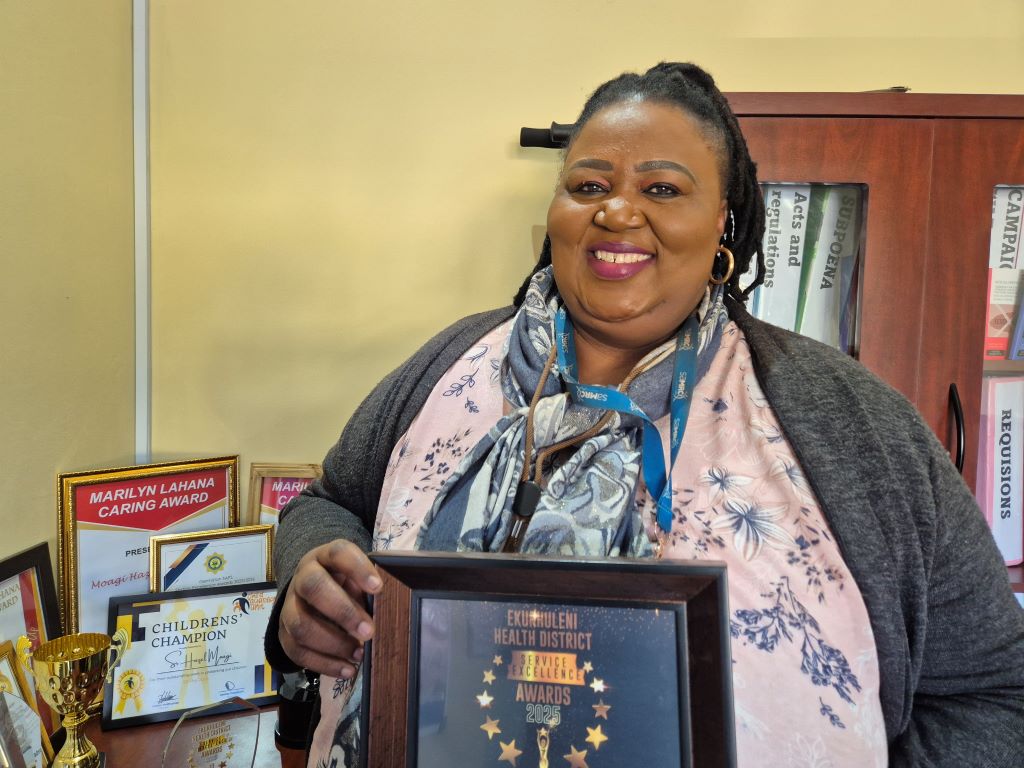
Sister Hazel Moagi has won quite a few accolades as a forensic specialist nurse. These certificates and trophies are displayed on a table in one corner of her office at the Bertha Gxowa Care Centre in Germiston on the East Rand of Gauteng.
To Moagi, this small table carries tremendous weight. It motivates her to keep pushing in a career that is much needed but often soft-pedalled in both recognition and remuneration. “I call it my place of safety,” she says. “Whenever I feel down or that I’m not okay, I look at the achievements, and I say, you need to stand up, pick up the pieces, and try to do more for the community because they need me to.”
She lets out a giggle as she shares that colleagues would fondly call her ‘Nurse Hero’ after she scooped a 2023 Nurse Hero award. “It’s so fulfilling, more than monetary remuneration,” she says, adding that it also brings a sense of pride to those who know her “because you know small things make people happy.”
Those who know her well enough may notice an absence of yellow merchandise among the trophies in her office. As a long-time supporter of the Kaizer Chiefs football club, it wouldn’t be amiss in the forensic nurse’s office. She says she makes sure to catch every game in person or on television to decompress, given the heavy and sensitive nature of her work.
As operational manager of the Care Centre, Moagi runs a forensic medical service that she says many do not know is available when they need it. The Centre, on the grounds of the Bertha Gxowa Hospital, provides inclusive and comprehensive patient management of people who experience gender-based violence, including vulnerable populations such as children and people with disabilities as well as cases linked to trauma and driving under the influence of alcohol.
Both suspected perpetrators and victims of crimes are helped in the building, but the sections are separate, with the entrances out of sight of each other. Inside, there are rooms for various parts of the investigative and medical process. There’s a swing set, playroom, and colourful doctor’s room meant to make children feel more comfortable.
From victim to survivor
“We are turning victims into survivors,” Moagi says. It is particularly important to her that all her clients are treated with dignity and respect, for instance, by offering them bathing facilities, fresh clothes, and food. Safe lodging, such as access to shelters is arranged if needed.
Moagi says that a lot of patients arrive scared, traumatised, and often in the same clothes they were wearing during the crime. But after testing, treatment and brief recovery, the physical and emotional change is so different that she says even police staff fetching patients are regularly surprised that this is the same person they dropped off earlier.
Moagi says she finds cases involving children, especially those abused by a family member, especially difficult to handle.
“It’s so painful to see … abuse that happened within a space where it’s supposed to be a safe environment, and somebody you trusted with your child.”
The specialised unit’s work includes collecting forensic samples and offering support in cases of gender-based violence. She explains that it usually starts with the gathering of DNA and other samples into a Sexual Assault Evidence Collection Kit if a person reports sexual assault within 72 hours.
“Then the history that the patient gives us also guides us in terms of where to collect,” Moagi says. She explains that carefully asking patients to detail what happened will help her know where on the body it’s best to swab. The whole process may take over three hours, and the DNA is particularly important in forensic cases where the perpetrator was unknown to the victim.
Sometimes Moagi says she and her team notices commonalities between patients, which she then relays to her supervisor and the police. For instance, there may be multiple people who have been raped describing similar perpetrators and circumstances in the same geographical area, even if they have gone to different police stations or places for help. “If there’s a specific trend that is currently happening, then we escalate to say we have noted that this and this is happening around the specific area,” she says.
When forensic samples are collected properly and each case is understood in its wider context, it can make the difference in helping police identify a serial rapist and build a case. Moagi says she has testified in court in several such cases.
While being mindful of sharing confidential details, she does remember one case in particular. “He’s currently serving more than 200 years,” she says. “It makes you feel good that at least we have saved more women from becoming his victims.”
Memory of a neat white dress
Moagi says her passion for nursing comes from her early childhood in a small village near Bushbuckridge.
“There was a nurse that I used to see wearing her uniform, going to work, and coming back, and that’s when I said I also want to be a nurse,” she recalls. She smiles at the memory of the neat white dress the nurse wore, and how competent she seemed whenever Moagi saw her. She says she held on tight to that vision throughout her school years.
Indeed, she studied nursing and a few years later the dream was fulfilled. She started working as a general nurse.
A few years later she attended a three-day workshop on forensic medicine organised by several government departments. It was there, listening to forensic nurses speak about their work, that something new clicked for her. She says during the break, she felt compelled to speak to them and learn more about the work they did. “Since that day, I started to fall in love with managing gender-based violence cases,” she says. Around a year later, she started studying forensic nursing at the University of the Free State.
Passion over money
In specialising in forensic nursing, Moagi chose her passion over the potentially higher salary she could potentially get with other nursing specialisations. This is because, unlike nephrology or orthopaedics, forensic nursing is not recognised by the South African Nursing Council (SANC) as a professional specialisation. The SANC’s website does list forensic nursing as a nursing competency, but it does not include it in the list of specialised nursing competencies, which would make someone an Advanced Practice Nurse, with greater recognition and higher renumeration.
A June 2026 parliamentary reply to a question to the Minister of Health alludes to the fact that this is due to the educational programmes used in the past, including the one Moagi studied, not being recognised in regulations. It notes that future qualified forensic nurses would likely be recognised. However, no current educational programmes appear to be approved for this yet.
The parliamentary answer indicates that even if newer qualification lists are recognised in the future, Moagi’s previous diploma will continue not to be recognised.
Moagi says she knew about this from the start and admits that it can be difficult with the current cost of living to see other nursing fields being paid more. She says she may see job posts with salaries posted for other specialties and feel a tinge of jealousy.
She says she knows of nurses who were eager to specialise in forensic nursing but have been unable to because the additional recognition and remuneration do not reflect the demands of the role. “I think as soon as the nursing council recognises it, then more nurses will join,” she says.
Doing this work for years to come
It has now been a decade since Moagi moved to Germiston and started managing the 24-hour clinical forensic medical care facility located on the corner of Hospital and Cross Streets. She says she loves working with her team and the various stakeholders, such as the police and the Department of Social Development.
If it is up to her, she will keep doing this work for many more years to come. She says that every patient who walks away with a little more hope after facing some of their darkest moments is a reminder of why she chose this path.
“It’s seeing victims of gender-based violence walking out with hope that there is still life, and they can still pick up the pieces and try to move on with their lives,” she says.
Meanwhile, another shiny trophy has been added to that table in the corner of her office. The Gauteng Department of Health’s Ekurhuleni Health District Services recently named her best female gender-based violence activist at their Annual Gender-Based Violence Awards.
The awards are nice, but speaking to Moagi it is clear that they, like the higher salaries she may have had with another specialisation, are secondary. What drives her is a deep passion to help and serve others.
“There are those days where you feel like no matter how bad the situation was, I did my best to make sure that the patient is managed,” Moagi says. “And by the time you go home, you know you have done something good for the patients.”
*This article is part of Spotlight’s 2026 Women in Health series, featuring the remarkable contributions of women to healthcare and science. Sign up to the Spotlight newsletter.