

Tag: heart muscle cells

The Heart’s Unusual Carbohydrate Metabolism Helps It Stay Strong
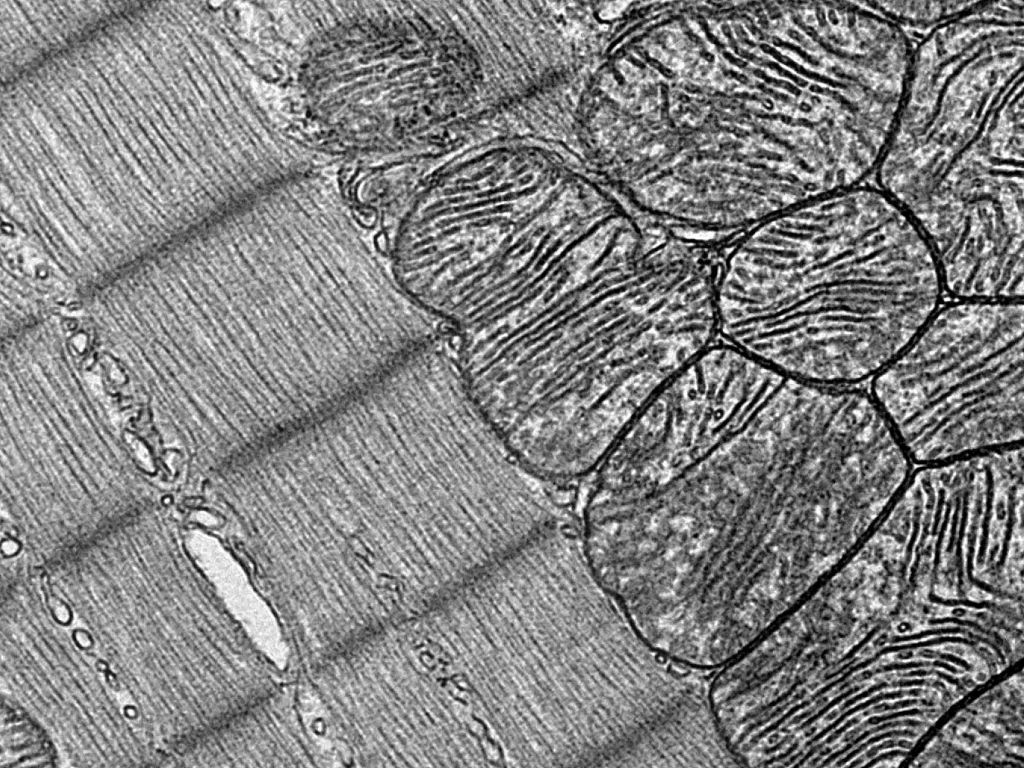
Microscope image of heart tissue showing mitochondria (striped oblongs in top right corner). Image credit: Gregory Ducker, PhD.

The heart is the hardest-working muscle in the body, beating constantly no matter what the body’s energy reserves look like. Maintaining energy flow to the heart is a complex process that can break down during common but severe cardiovascular disease conditions like heart failure. 

Researchers previously knew that heart muscle seems to do an unusual metabolic trick to always get enough energy: using two carbohydrate energy sources, glucose and lactate, at the same time. In most human tissues, using more glucose makes it harder to use lactate, and vice versa, but the heart is different.

Now, researchers have found a unique cell-level difference that helps keep heart muscle fuelled up: the ability to burn glucose in the cytosol while burning lactate in the mitochondria. This spatial separation allows both energy-generating reactions to happen simultaneously, helping keep the heart fuelled up no matter the energy source. While mostly dispensable to daily life, this process is crucial to preventing heart failure when the heart is stressed.

The results are published in Nature.

“This appears to be a critical backup system for heart function,” says Gregory Ducker, PhD, assistant professor of biochemistry at University of Utah Health and senior author on a paper describing the results. “In an emergency, we would really, really rely on this.”

The researchers found that the separation between glucose and lactate metabolism depends on a molecule called MCT1, which moves lactate to the inside of the mitochondria. Genetic mutations in MCT1 prevent lactate from entering the mitochondria and disrupt the heart’s energy balance, leading to heart failure when stressed. These results uncover a new requirement for lactate to fuel the injured heart and suggest new therapeutic targets to re-energise the heart during heart failure.   

“Our findings help point to new areas in which we could target the heart muscle to benefit and repair itself by allowing it to use lactate better. That’s the long-term goal: to help the heart muscle heal.”

Gregory Ducker, PhD

The discovery of a new pathway through which the heart muscle can use lactate to generate energy opens promising opportunities for developing new treatments for serious heart conditions, including heart failure and heart attacks.

“Rather than simply releasing lactate into the bloodstream as a waste product, we may be able to enhance the heart’s ability to use it as a valuable source of energy,” says Stavros Drakos, MD, PhD, professor of medicine at University of Utah Health and co-senior author of the study. “By optimising this process, we could potentially improve heart muscle function in patients suffering from heart failure or heart attacks.”

Source: University of Utah Health

Human Heart Regrows Muscle Cells After Heart Attack, World-first Study Shows

New research paves way for novel therapies to reverse heart failure

Human heart. Credit: Scientific Animations CC4.0

Pioneering research by experts at the University of Sydney, the Baird Institute and the Royal Prince Alfred Hospital in Sydney has shown that heart muscle cells regrow after a heart attack, opening up the possibility of new regenerative treatments for cardiovascular disease.

Following the publication of the study in Circulation Research, first author Dr Robert Hume, from the Faculty of Medicine and Health and Charles Perkins Centre, and Lead of Translational Research at the Baird Institute for Applied Heart and Lung Research, explained the significance of the finding:

“Until now we’ve thought that, because heart cells die after a heart attack, those areas of the heart were irreparably damaged, leaving the heart less able to pump blood to the body’s organs.

“Our research shows that while the heart is left scarred after a heart attack, it produces new muscle cells, which opens up new possibilities.

“Although this new discovery of regrowing muscle cells is exciting, it isn’t enough to prevent the devastating effects of a heart attack. Therefore, in time, we hope to develop therapies that can amplify the heart’s natural ability to produce new cells and regenerate the heart after an attack.”

Though increased mitosis (a process in which cells divide and reproduce) after a heart attack has been observed in the heart muscles of mice, this is the first time the phenomenon has been demonstrated in humans.

Heart disease in Australia and the world

Cardiovascular disease is the leading cause of death globally, and is responsible for nearly a quarter (24 percent) of all deaths in Australia.

Heart attacks can eliminate a third of the cells in the human heart and, though survival rates have improved dramatically over the last decade thanks to therapeutic advancements, many patients still go on to develop heart failure, which can only be cured with a transplant. With approximately 144 000 heart failure patients in Australia and only 115 heart transplants per year, there is a huge disparity in what these patients need and the treatment that can be offered.

Pioneering techniques made research possible

The study is also the first in the world to use tissue samples taken from living patients during bypass surgery. These “pre-mortem” tissue samples were taken from consenting patients undergoing heart bypass surgery at the Royal Prince Alfred Hospital in Sydney.

The samples were collected from diseased and non-diseased parts of the heart using a method developed by Professor Paul Bannon and Professor Sean Lal, who work jointly at the University of Sydney, Royal Prince Alfred Hospital and The Baird Institute.

New therapies to regenerate the heart

Developing a technique to collect living tissue samples means the research team now has a laboratory model which they hope to use to unlock new treatments to regenerate the human heart.

Professor Sean Lal, senior author of the study from the School of Medical Sciences and heart failure cardiologist at the Royal Prince Alfred hospital, said: “Ultimately, the goal is to use this discovery to make new heart cells that can reverse heart failure.

“Using living human heart tissue models in our work means that we will have more accurate and reliable data to develop new therapies for heart disease.

“Already, our research using these samples has identified several proteins that have previously been shown to be involved in the regeneration of the heart in mice – which is a very exciting prospect to now translate to humans.”

The research was published in Circulation Research.

Source: The University of Sydney