

Tag: cryogenic preservation

Patient Cryopreservation Given a One in Four Chance of Working

Opinions ranged widely, with some physicians concerned that preparation for preservation could interfere with best practices for a patient’s care.
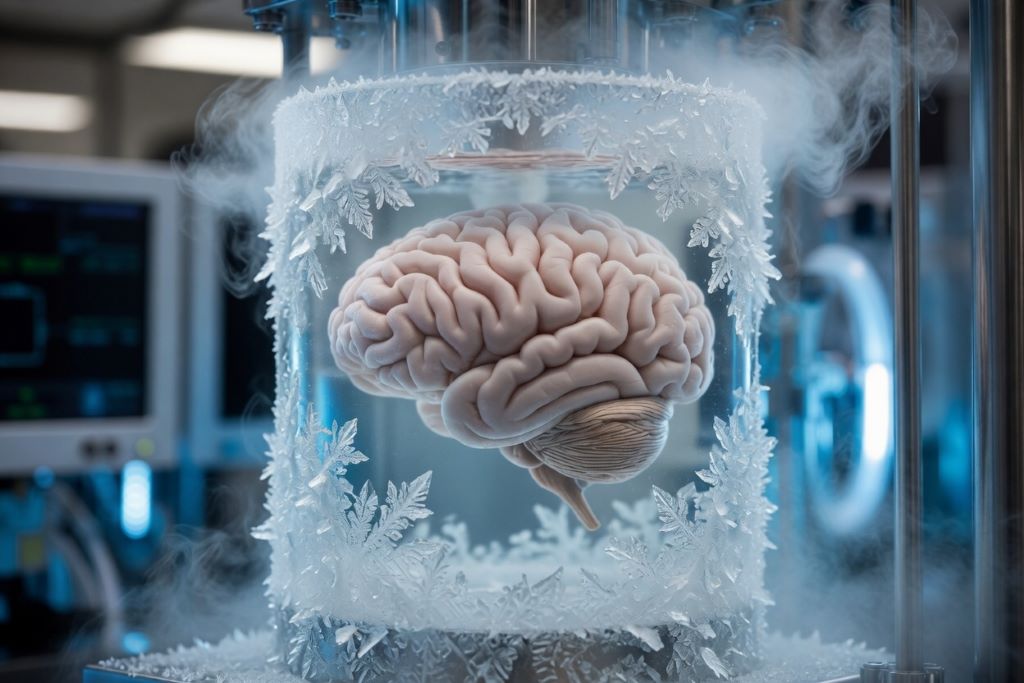
AI image of a brain being cryogenically preserved. [Ed: The patient better have some hefty medical aid to pay for a new body in the year 3000…]

Surveyed US physicians believed preservation has a one in four chance of working, though opinions amongst physicians varied. Ariel Zeleznikow-Johnston of Monash University, Australia, and colleagues present their findings in the study, published on May 20, 2026 in the open-access journal PLOS One.

It’s unclear whether there is a consensus amongst doctors regarding preservation – the storing of bodies at extremely low temperatures, or using preservative chemicals, in the hopes of future revival. Preservation is not the only way in which physicians have to balance concerns about unproven treatments with patients’ preferences, but it is one with high stakes as it pertains to the end of someone’s life. The technologies necessary to revive someone have not yet been realised, though current preservation organisations report several hundred patients preserved globally, with thousands more signed up for future preservation.

In this study, Zeleznikow-Johnston and colleagues conducted a survey of over 300 physicians, nearly half of whom were primary care providers, the rest being various kinds of specialists including neurologists, intensive care doctors, anaesthesiologists, and doctors who specialise in palliative care. The survey was designed to address three main themes: the perceived feasibility of preservation procedures, clinical interventions that could improve preservation outcomes, and the ethical and legal standing of preservation as an end-of-life option.

About one in four of the physicians said they believed it was plausible, or even very plausible, that someone could be revived in the future after preservation. Just under half said it was unlikely. Neurosurgeons, on average, rated the possibility of revival highest, though most of the other specialties showed a wide spread of opinions that slanted more towards scepticism.

The way doctors are most likely to interact with preservation in their professional capacity is in the choices a patient may make for end-of-life care. A majority of physicians supported prescribing anti-coagulants to dying patients, which could help with the quality of preservation. However, fewer respondents were comfortable with more extreme procedures, such as patients going through medically assisted death and opting to begin the preservation before cardiac arrest. The doctors who most commonly have conversations about end-of-life care were overall more supportive of this kind of choice. About one in five doctors were concerned that decisions to increase the odds of successful cryopreservation would clash with providing the best standards of care.

Currently, pre-cardiac arrest preservation in humans is, to the best of our knowledge, not legally permitted anywhere in the world, but if the technology develops further, may become an issue healthcare professionals must grapple with. The authors emphasise that clarifying the clinical, legal, and ethical frameworks for use of preservation as an end-of life procedure is important, and note that the speculative nature of the findings should be carefully considered.

Zeleznikow-Johnston adds: “A lot of physician hesitancy may come from simple unfamiliarity with the scientific basis of modern preservation methods. The doctors who have actually thought about this – and who regularly sit with dying patients – tend to be more receptive, not less.”

Provided by PLOS
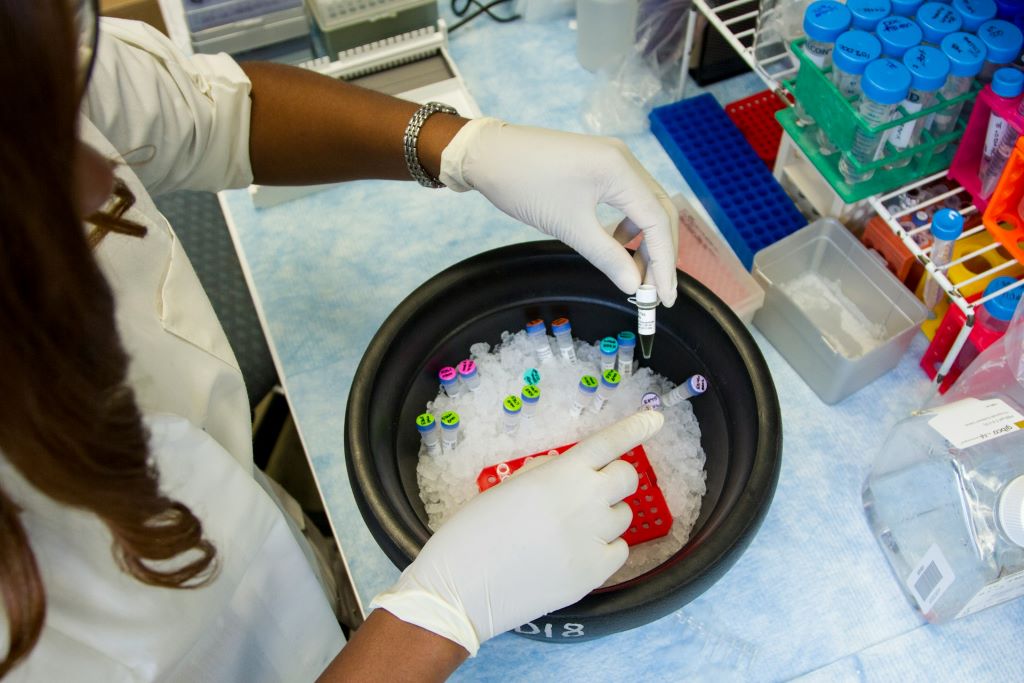
Freezer Failure Ruins Decades of Medical Samples in Sweden

Photo by National Cancer Institute on Unsplash

During the 2023 Christmas holidays, a freezer failure occurred at the Karolinska Institutet’s Neo building, where the automatic refilling of cryotanks with liquid nitrogen was interrupted for some reason. As a result, the temperature in 16 of 19 cryogenic tanks rose and large amounts of biological research material have been destroyed, including medical research samples which stretch back for decades.

An investigation with internal and external experts is now underway to find out how this failure could have happened, although there are no signs of sabotage. On the evening of 22 December, the level of liquid nitrogen in the Neo building’s cryo tanks, which contain biomaterial and cell lines from multiple departments, was due to be routinely topped up from an external tank.   

The automatic refilling of nitrogen ensures that the correct temperature of -190°C can be maintained in the isothermal (cryo) tanks. 

However, for reasons unknown, the flow of nitrogen from the external storage tank malfunctioned that evening, and the temperature in 16 of the tanks rose. 

Automatic alarm 

The cryotanks are able to maintain a sufficiently low temperature for up to 96 hours without refilling. During the Christmas break, they remained un-refilled for around 120 hours, and their internal temperature increased.

“When the flow of nitrogen ceased on 22 December, an automatic alert was supposed to be sent out, both by email and SMS, to registered owners of material in the freezers. However, a malfunction in the alarm unit meant that the alerts did not work properly. The email reached the recipients, but the texts got stuck in the server and never arrived,” explains Elisabeth Raschperger, researcher and senior lab manager at Neo. 

According to Dr Raschperger, there has been a history of false alarms from freezers and cryotanks at Neo, partly caused by overly sensitive settings for when alarms should go off.

The alarm supplier inspected the system in 2023 and gave approval for its continued use in November. 

Troubleshooting by the suppliers

Five days after the incident when the Neo service team found out what had happened, they called in the suppliers to make an initial check of the valves, pipes and pressure regulation tanks. The alarm was also tested.

“The companies went through every part of the system and found no faults or indications that any piece of equipment was faulty or broken, with the exception of the SMS alarm,” says Dr Raschperger. “We also looked through the operational logbook for the external nitrogen tank for October, November and December, and the refilling system had been working perfectly.”

The affected departments

From a research perspective, the Department of Medicine, Huddinge (MedH), was most affected, but so too were researchers at the Department of Biosciences and Nutrition (BioNut).

“At MedH, the research areas of haematology, endocrinology and cardiology have been particularly affected by the crash. It involves a very large amount of irreplaceable research material with samples, cell lines and biomaterials collected over decades,” says Professor Petter Höglund, head of MedH. He continues:

“The affected research teams are now working to take stock of the full extent of the losses. The analyses made so far speak for themselves: the malfunction will have far-reaching consequences for the department’s research in the affected areas.”

The staff at Neo, BioNut and MedH receive regular updates on the incident and the steps being taken to investigate the cause. They are also receiving crisis support from HR. 

Expert inquiry

An inquiry to ensure that the incident never happens again is now underway. The inquiry will take a technical and procedural – rather than a personal – approach to chart and analyse the incident and look into how KI can build sustainable, robust systems going forward. Pending the inquiry’s report, it is important not to make a bad situation worse. 

“Rumours are circulating that the malfunction was an act of sabotage,” says Dr Raschperger. “I would like to emphasise that there are at the present no such indications, and urge everyone to wait for the experts’ conclusions.”

Source: Karolinska Institutet