Tag: cholesterol

An Egg a Day Keeps the Cardiologist Away

Photo by Annie Spratt on Unsplash

Research published in eLife has shown how moderate egg consumption can increase the amount of heart-healthy metabolites in the blood. The findings suggest that eating up to one egg per day may help lower the risk of developing cardiovascular disease.

A rich source of dietary cholesterol, eggs also contain a variety of essential nutrients. Eggs have long had a bad rap when it comes to cardiovascular health, with conflicting evidence as to whether egg consumption is beneficial or harmful to heart health. A large study in China showed that those who ate one egg a day had a lower cardiovascular disease risk than those who ate eggs occasionally. To explore this, researchers carried out a population-based study exploring how egg consumption affects markers of cardiovascular health in the blood.

“Few studies have looked at the role that plasma cholesterol metabolism plays in the association between egg consumption and the risk of cardiovascular diseases, so we wanted to help address this gap,” explained first author Lang Pan, MSc at the Department of Epidemiology and Biostatistics, Peking University, Beijing, China.

Pan and the team selected 4778 participants from the China Kadoorie Biobank, 3401 of whom had a cardiovascular disease and 1377 did not. Measuring 225 metabolites in plasma samples taken from the participants’ blood, they identified 24 that were associated with self-reported levels of egg consumption.

Their analyses showed that individuals who ate a moderate amount of eggs had higher levels of a protein in their blood called apolipoprotein A1- a building-block of high-density lipoprotein (HDL). These individuals especially had more large, protective HDL molecules in their blood.

The researchers further identified 14 metabolites linked to heart disease, and participants who ate fewer eggs had lower levels of beneficial metabolites and higher levels of harmful ones in their blood, compared to regular egg eaters.

“Together, our results provide a potential explanation for how eating a moderate amount of eggs can help protect against heart disease,” says author Canqing Yu, Associate Professor at the Department of Epidemiology and Biostatistics, Peking University. “More studies are needed to verify the causal roles that lipid metabolites play in the association between egg consumption and the risk of cardiovascular disease.”

“This study may also have implications for Chinese national dietary guidelines,” adds senior author Liming Li, Boya Distinguished Professor at the Department of Epidemiology and Biostatistics, Peking University. “Current health guidelines in China suggest eating one egg a day, but data indicate that the average consumption is lower than this. Our work highlights the need for more strategies to encourage moderate egg consumption among the population, to help lower the overall risk of cardiovascular disease.”

Source: eLife

Cholesterol Screening Recommended for Children with Autism

Phot by Ben Wicks on Unsplash

Physicians have recommended that children with autism spectrum disorder (ASD) receive screening for abnormally high or low cholesterol levels at least once during their childhood, since ASD is a risk factor for cardiovascular disease in both children and adults.

The recommendation stemmed from a recent study, published in Translational Psychiatry, that found reduced levels of high density lipoprotein cholesterol (HDL-C) in individuals from families with two or more children with ASD. Additionally, they found reduced or elevated levels of other lipids, apolipoprotein A1 (ApoA1) and apolipoprotein B (ApoB). Individuals with low HDL-C levels or ApoA1 levels had lower adaptive functioning than other individuals with ASD.

“This latest research is part of our ongoing work to understand some of the co-occurring conditions with ASD,” said Elaine Tierney, MD, a child and adolescent psychiatrist with Kennedy Krieger Institute. “Our work indicates that lipids are abnormal in many individuals with ASD. Our findings, in addition to studies that show an increase in heart disease in individuals with ASD, lead us to recommend that children with ASD be screened for abnormal total and HDL cholesterol levels. We hope our work underscores the importance of cholesterol screening and raises awareness for families in the ASD community.”

Previously, Dr Tierney and colleagues identified that Smith-Lemli-Opitz Syndrome (SLOS), a genetic condition of impaired cholesterol biosynthesis, is associated with autism. This led to a recommendation that all children with ASD be screened for SLOS if they exhibit some of its characteristics, such as slow growth, microcephaly, mental retardation and other birth defects, although the severity of this rare disease can vary.

Source: Kennedy Krieger Institute

New Easy Biomarker for Cardiovascular Risk

Image by Landon Arnold on Unsplash

A large study has shown that apolipoproteins apoB and apoA-1 together provide early and reliable cardiovascular risk information as well as levels of low-density lipoprotein (LDL) cholesterol. The researchers advocate introducing new guidelines for detecting cardiac risk and say the results, published in PLOS Medicine, may pave the way for early treatment, which could help lower morbidity and mortality rates.

Cardiovascular disease is the most common cause of death globally and includes a wide range of conditions, such as stroke and myocardial infarction with atherosclerosis in different organs of the body. In many cases the disease can be prevented and arrested with lifestyle changes and lipid-lowering treatments using statins and other methods.

The cardiac risk assessment usually uses reference values for the LDL cholesterol. Other types of fat particles can also be measured along with apolipoproteins, which transport cholesterol in the blood. International guidelines for cardiovascular disease recommend using apolipoprotein apoB, which transports LDL cholesterol, as an alternative risk marker for people with type 2 diabetes, overweight and very high levels of blood lipids.

Recent research has, however, indicated the importance of also factoring in the apolipoprotein apoA-1, which transports the protective and anti-inflammatory HDL cholesterol. Calculating the apoB/apoA-1 ratio gives a risk quotient reflecting the balance between the fat particles that expedite atherosclerosis and the “good” protective apoA-1 particles that arrest the process.

In this present study, the researchers have analysed the link between cardiovascular disease and apoB/apoA-1 values in more than 137 000 Swedish adults between the ages of 25 and 84. The individuals were followed for 30 years, during which time 22 000 suffered some form of cardiovascular event. The analysis methods are simple, inexpensive and safe, and do not require pre-test fasting, as is the case with LDL and non-HDL tests. Basing their study on a large database, the researchers linked the laboratory analyses to several clinical diagnosis registers.

“The results show that the higher the apoB/apoA-1 value, the greater the risk of myocardial infarction, stroke and need for coronary surgery,” says Göran Walldius, senior author and professor emeritus at the Institute of Environmental Medicine, Unit of Epidemiology, Karolinska Institutet. “The study also showed that the risk was amplified in the presence of low protective levels of apoA-1.”

Individuals with the highest apoB/apoA-1 values had a 70% higher risk of severe cardiovascular disease and almost triple the risk of non-fatal myocardial infarction compared with those with the lowest apoB/apoA-1 values. Individuals with the highest risk quotient were also more affected by severe cardiovascular diseases many years earlier than individuals with the lowest apoB/apoA-1 values.

The relationship was observed in both men and women and the elevated levels could be detected as early as 20 years before the onset of cardiovascular disease.

“Early preventive treatment and information about cardiovascular risk is, of course, important in enabling individuals to manage their risk situation,” Walldius says. “Early treatment can also reduce the cost burden on the public health services.”

Taken together, the results suggest that the apoB/apoA-1 ratio is a better marker for identifying at-risk individuals for cardiovascular disease compared to the apoB method alone.

“It should be possible to introduce cut-values for apoB, apoA-1 and the apoB/apoA-1 ratio into new guidelines as a complement to current guidance on the detection and treatment of dyslipidaemia,” said Walldius.

Source: Karolinska Institutet

Link Between High Cholesterol and Breast Cancer Explained

Source: National Cancer Institute

While chronically high cholesterol levels are linked to increased risks of breast cancer and worse outcomes in most cancers, the link had not been fully understood until now.

In a study published in Nature Communications, researchers identify the mechanisms at work, describing how breast cancer cells utilise cholesterol to develop stress tolerance, preventing them from dying as they migrate from the original tumour site.

“Most cancer cells die as they try to metastasise – it’s a very stressful process,” said senior author Donald P. McDonnell, Ph.D., professor in the departments of Pharmacology and Cancer Biology and Medicine at Duke University School of Medicine. “The few that don’t die have this ability to overcome the cell’s stress-induced death mechanism. We found that cholesterol was integral in fueling this ability.”

McDonnell and colleagues built on earlier research in their lab focusing on the link between high cholesterol and oestrogen-positive breast and gynaecological cancers. Those studies found that cancers fueled by the oestrogen hormone benefitted from derivatives of cholesterol that act like oestrogen, stoking cancer growth.

But a paradox emerged for estrogen-negative breast cancers. These cancers are not oestrogen dependent, but high cholesterol is still associated with worse disease, which indicates the possible effect of a different mechanism.

In the current study using cancer cell lines and mouse models, the Duke researchers found that migrating cancer cells gobble cholesterol in response to stress. Most die.

However, those that live emerge with a super-power that makes them able to withstand ferroptosis, a natural process in which cells succumb to stress. These stress-impervious cancer cells then proliferate and readily metastasise.

Other tumours beside ER-negative breast cancer cells use this process. including melanoma. And the mechanisms identified could be targeted by therapies.

“Unraveling this pathway has highlighted new approaches that may be useful for the treatment of advanced disease,” McDonnell said. “There are contemporary therapies under development that inhibit the pathway we’ve described. Importantly, these findings yet again highlight why lowering cholesterol — either using drugs or by dietary modification — is a good idea for better health.”

Source: Duke University

Brain Cholesterol Production Linked to Alzehimer’s

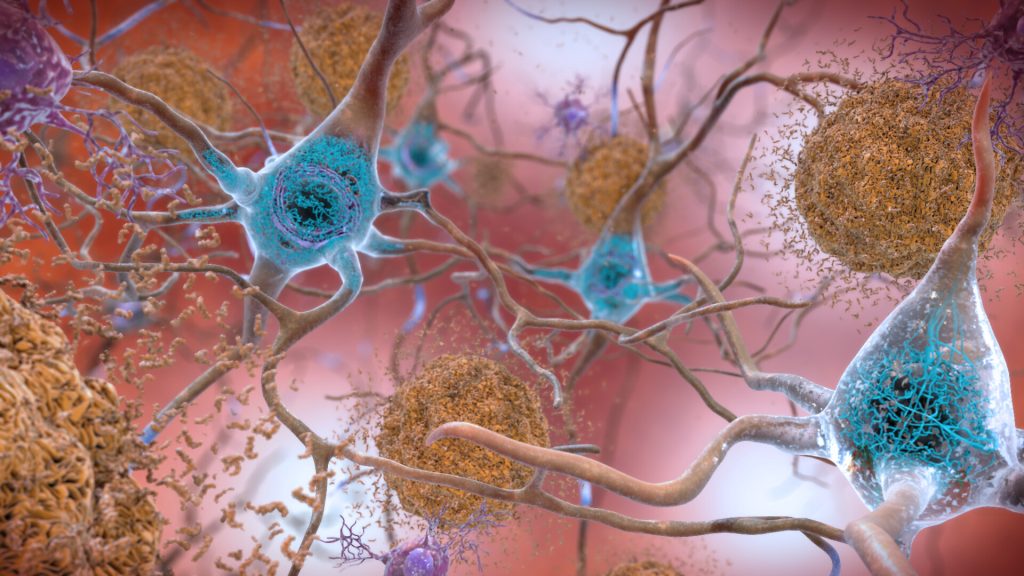
Amyloid plaques and neurons. Source: NIAH

Cholesterol manufactured in the brain appears to play a key role in the development of Alzheimer’s disease, new research indicates.

Scientists found that cholesterol produced by cells called astrocytes is required for controlling the production of amyloid beta, a sticky protein which forms the characteristic plaques in patients with Alzheimer’s. These plaques have been the target of efforts to remove or prevent them  in the hopes that this could treat or prevent Alzheimer’s.

The new findings offer important insights into how and why the plaques form and may explain why genes associated with cholesterol have been linked to increased risk for Alzheimer’s. The results also provide scientists with important direction as they seek to prevent Alzheimer’s.

“This study helps us to understand why genes linked to cholesterol are so important to the development of Alzheimer’s disease,” Heather Ferris, MD, PhD, Researcher, UVA’s Division of Endocrinology and Metabolism. “Our data point to the importance of focusing on the production of cholesterol in astrocytes and the transport to neurons as a way to reduce amyloid beta and prevent plaques from ever being formed.”

The work sheds light on the role of astrocytes in Alzheimer’s disease. Scientists have known that these common brain cells undergo dramatic changes in Alzheimer’s, but they have been uncertain if the cells were suffering from the disease or contributing to it. The new results suggest the latter.

The scientists found that astrocytes help drive the progression of Alzheimer’s by making and distributing cholesterol to brain cells called neurons. This cholesterol buildup increases amyloid beta production and, in turn, fuels plaque accumulation.

Normally, the buildup of amyloid beta is limited because cholesterol is kept quite low in neurons. But in Alzheimer’s, the neurons are no longer able to regulate amyloid beta, leading to plaque formation.
Blocking the astrocytes’ cholesterol manufacturing “robustly” decreased amyloid beta production in lab mice, the researchers reported. While it is presently unknown whether this could be applied in people to prevent plaque formation, the researchers believe that further research is likely to yield important insights that will benefit the battle against Alzheimer’s.

The fact that amyloid beta production is normally tightly controlled suggests an important role in brain cells, the researchers said. Doctors may therefore need to be cautious about blockage or removal of amyloid beta. Additional research into the discovery could shed light on how to prevent the over-production of amyloid beta as a strategy against Alzheimer’s, the researchers believe.

“If we can find strategies to prevent astrocytes from over-producing cholesterol, we might make a real impact on the development of Alzheimer’s disease,” Dr Ferris said. “Once people start having memory problems from Alzheimer’s disease, countless neurons have already died. We hope that targeting cholesterol can prevent that death from ever occurring in the first place.”

Source: University of Virginia Health System

Only Smaller ‘Good’ Cholesterol Particles Reduce Heart Risk

New research on cholesterol shows that ‘good cholesterol’ is not all good for the heart – only smaller particles reduce heart risk.

Higher levels of ‘good cholesterol’ or high-density lipoprotein cholesterol (HDL-c ) have been associated with better cardiovascular outcomes. In contrast, ‘bad cholesterol’ or low-density lipoprotein cholesterol (LDL-c ), deposits cholesterol on artery walls, increasing the risk of cardiovascular disease.

Medications that lowers LDL-c  also reduce cardiovascular risk, but medication that increases HDL-c does not decrease cardiovascular risk. This paradox calls into question the assumption that HDL-c is protective against cardiovascular risk.

Researchers analysed the size of HDL-c particles, which is determined by genetic characteristics, and compared this to the risk of myocardial infarction. The results showed that genetic characteristics for having large HDL-c particles were associated with increased heart attack risk. Characteristics for smaller HDL-c particles were linked to reduced heart attack risk.

“There is a positive causal relationship between the size of HDL cholesterol particles and the risk of heart attack, so although we have to increase the levels of good cholesterol in the blood, they must always be small particles,” explains the study’s principal investigator, Dr Robert Elosua, a researcher at the Hospital del Mar-IMIM, CIBERCV, and the University of Vic-Central University of Catalonia.

The HDL-c particles are more effective in transferring cholesterol to the liver for subsequent elimination. “If we need to do something in relation to HDL, it is to increase the number of small particles, which are those that adequately perform the function of eliminating cholesterol, those that really move it to the liver for removal, and do not allow it to accumulate in the arteries and cause cardiovascular disease,” said Dr Álvaro Hernáez.
There are currently no drugs that increase HDL-c and also reduce cardiovascular risk. “This study highlights new and potential therapeutic targets in the field of cardiovascular diseases, including several genes related to the qualitative aspects of HDL particles, which may contribute to cardiovascular prevention,” concluded first author Dr Albert Prats.

Source: Medical Xpress

Journal information: Albert Prats-Uribe et al, High-density lipoprotein characteristics and coronary artery disease: a Mendelian randomization study, Metabolism (2020). DOI: 10.1016/j.metabol.2020.154351