Rates of multiple myeloma (MM), the second most common blood cancer in the United States, are increasing and are twice as high in men than in women. A new study published by Wiley online in CANCER, a peer-reviewed journal of the American Cancer Society, provides insights that may help to explain this disparity.
To investigate the sex difference in MM, researchers analyzed data on 850 patients with newly diagnosed MM enrolled in the Integrative Molecular And Genetic Epidemiology (IMAGE) study at the University of Alabama at Birmingham.
Compared with female patients, male patients were more likely to have advanced (International Staging System stage III) disease at the time of diagnosis. Males were also more likely to have high myeloma load—serum monoclonal protein (an abnormal protein produced by cancerous blood cells), more organ failure (especially kidney failure), and bone damage. Men were less likely than women to have low bone mineral density, and myeloma-defining features tended to differ between the two sexes. These differences were apparent even after taking numerous factors into account – including race, age, body mass index, education, income, smoking, and alcohol use.
Analyses suggested that certain chromosomal abnormalities that lead to initiation of myeloma occurring more often in younger males may help to explain some of the differences seen in this study.
“This research suggests that sex-specific mechanisms promote multiple myeloma pathogenesis, which may account for the excess risk seen in men,” said lead author Krystle L. Ong, PhD, of the O’Neal Comprehensive Cancer Center at the University of Alabama at Birmingham. “These findings may be used to improve risk stratification, diagnosis, and tailored treatments for both men and women with newly diagnosed multiple myeloma or related early precursor conditions.”
A groundbreaking new treatment using genome-edited immune cells, developed by scientists at University College London and Great Ormond Street Hospital (GOSH), has shown promising results in helping children and adults fight a rare and aggressive form of blood cancer.
Using base-editing technology, the pioneering gene therapy (BE-CAR7), has been used to treat a previously untreatable type of blood cancer called T-cell acute lymphoblastic leukaemia (T-ALL). Base-editing is an advanced version of CRISPR technology, that can precisely change single letters of DNA code inside living cells.
BE-CAR7 was designed and developed by a team of researchers, led by Professor Waseem Qasim (UCL Great Ormond Street Institute of Child Health), who is also an Honorary Consultant at Great Ormond Street Hospital (GOSH), and the treatment is the first in-human application of base-edited cells.
In 2022, Alyssa Tapley, from Leicestershire, (then aged 13) became the first person in the world to receive the treatment as part of a clinical trial at GOSH. Doctors had exhausted all other treatments for her and she and her family say the innovative therapy saved her life.
Now, a further eight children and two adults have undergone the treatment as part of the trial.
82% of patients achieved very deep remissions after BE-CAR7, enabling them to proceed to stem cell transplant without disease
64% remain disease-free, with the first patients now three years disease-free and off treatment
Anticipated side effects including low blood counts, cytokine release syndrome and rashes were tolerable, with the greatest risks arising from virus infections until immunity recovered
Professor Qasim, a Professor of Cell and Gene Therapy at UCL, who led the research, said: “A few years ago this would have been science fiction. Now we can take white blood cells from a healthy donor and change a single letter of DNA code in those cells and given them back to patients to try to tackle this hard-to-treat leukaemia.
“We designed and developed the treatment from lab to clinic and are now trialling it on children from across the UK – in a unique bench-to-bedside approach.”
Alyssa, now aged 16, who has a brother, said: “It is incredible how much my life has changed. I went from four months straight in GOSH to now only coming back for medical appointments once a year. It is amazing how much freedom I have now.
“I am really grateful for all the opportunities the gene therapy treatment has given me. I feel like I have been able to help everyone else who went on the clinical trial after me.
“I’ve now been able to do some of the things I thought earlier in my life it would be impossible for me to do. I really did think I was going to die and that I wouldn’t be able to grow up and do everything that every child deserves to be able to do.”
That has included going sailing and spending time away from home doing her Duke of Edinburgh Award.
Her dad, James, said: “We are eternally grateful. We’ve gone from being completely hopeless to where we are now. We could never have imagined that then.
“Back then we were at the point where we thought we were going to be a three-person family. Now we’re all making the most of family life. It is the little things you don’t take for granted anymore. Alyssa is amazing.
“The scientists at UCL and GOSH have been incredible. It has been really powerful seeing them in the laboratory developing the treatment and hearing the stories including about the difficulties they faced in getting this far.
“In terms of the timing of the trial, it aligned perfectly for us. Other families weren’t so lucky.”
New technology
Immunotherapy using CAR-T cells has recently become available to treat several types of blood cancer. This therapy uses immune cells, called T-cells, and modifies them to have specific proteins on their surface called chimeric antigen receptors (CARs).
The CARs can recognise and target specific ‘flags’ on the surface of cancer cells, and the T-cell can then destroy that cancer cell. Developing CAR T-cell therapy for leukaemia which itself has arisen from abnormal T-cells has been challenging.
BE-CAR7 T-cells are engineered using base editing, a new-generation of genome editing that avoids cutting DNA, reducing the risk of chromosomal damage.
Very precise chemical reactions were carried out using CRISPR guidance systems to change single letters of DNA code in order to modify the T cells. These complex DNA changes generate storable banks of ‘universal’ CAR T-cells that can find and attack T-cell leukaemia when given to patients.
The ‘universal’ CAR T-cells in this study were made from healthy donor white blood cells and engineering steps were undertaken in a clean room facility using custom made RNA, mRNA and a lentiviral vector in an automated process previously developed by the research team.
These steps were: 1. Removing existing receptors so that T-cells from a donor can be banked and used without matching the recipient– making them ‘universal’. 2. Removing a ‘flag’ called CD7 that identifies them as T-cells (CD7 T-cell marker). Without this step, T-cells programmed to kill T-cells would simply end up destroying the product through ‘friendly-fire’. 3. Removing a second ‘flag’ called CD52. This makes the edited cells invisible to one of the strong antibody drugs given to patients to subdue their immune system. 4. Adding a Chimeric Antigen Receptor (CAR) which recognises the CD7 T-cell flag on leukemic T-cells. A disabled virus added extra DNA code into the cells so they become armed against CD7 and recognise and fight T-cell leukaemia.
When base-edited CAR T-cells are given to the patient they rapidly find and destroy all T-cells in the body, including leukemic T-cells. If the leukaemia is eradicated within four weeks, the patient’s immune system is then rebuilt from a bone marrow transplant over a period of several months.
Professor Qasim added: “Many teams were involved across the hospital & university and everyone is delighted for patients clearing their disease, but at the same time, deeply mindful that outcomes were not as hoped for some children. These are intense and difficult treatments – patients and families have been generous in recognising the importance of learning as much as possible from each experience.”
Dr Rob Chiesa, Study investigator and Bone Marrow Transplant consultant at GOSH said: “Although most children with T-cell leukaemia will respond well to standard treatments, around 20% may not. It’s these patients who desperately need better options and this research provides hope for a better prognosis for everyone diagnosed with this rare but aggressive form of blood cancer.
“Seeing Alyssa go from strength-to-strength is incredible and a testament to her tenacity and the dedication of an array of small army of people at GOSH. Team working between bone marrow transplant, haematology, ward staff, teachers, play workers, physiotherapists, lab and research teams, among others, is essential for supporting our patients.”
Dr Deborah Yallop, consultant Haematologist at KCH said “We’ve seen impressive responses in clearing leukaemia that seemed incurable – it’s a very powerful approach.”
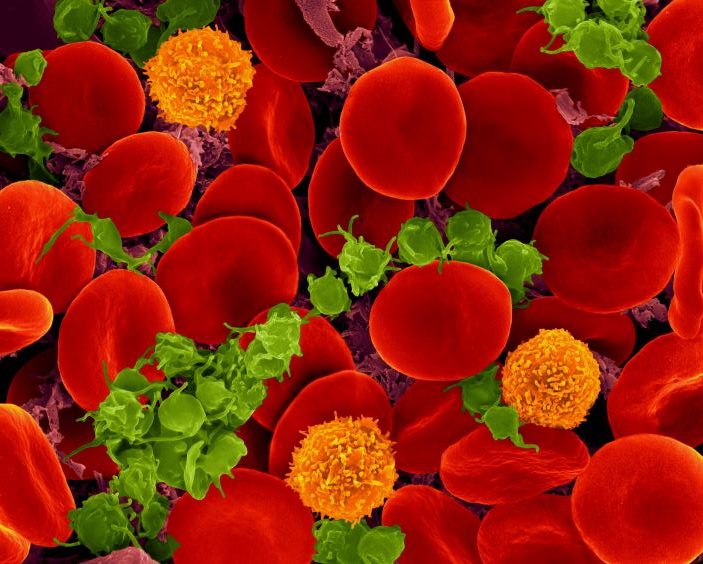
Scanning electron micrograph of red blood cells, T cells (orange) and platelets (green). Source: Wikimedia CC0
Northwestern Medicine scientists have uncovered key details about a group of rare but serious blood disorders, which may help inform potential treatments, according to a study published in the Journal of Clinical Investigation.
Myeloproliferative neoplasms (MPNs) are rare blood cancers characterised by the abnormal growth of blood cells. They have long been linked to a key signalling pathway called JAK2/STAT, but the specific details of how they develop have remained unclear.
“These diseases are often driven by abnormal activation of a protein called JAK2,” said Peng Ji, MD, PhD, ‘15 GME, Professor of Pathology and senior author of the study. “In earlier research, we discovered that another protein, PLEK2, acts downstream of JAK2 and plays a critical role in mediating JAK2’s effects, helping to drive the progression of MPNs.”
In the current study, Ji and his collaborators aimed to better understand the proteins that work alongside PLEK2, also known as the PLEK2 “signalosome.”
By analysing protein expression in cultured human blood stem cells, the investigators identified a new contributor, PPIL2, that appears to help cancer cells grow by disabling the tumour suppressor protein p53.
Under normal conditions, p53 works as a tumour suppressor protein that prevents excessive cell growth. PPIL2 effectively marks p53 for degradation, weakening its ability to control cell growth and allowing the disease to advance, according to the findings.
Investigators found that blocking PPIL2 using cyclosporin A, an immunosuppressant drug commonly used for organ transplant patients, led to an increase in p53 levels, restoring its ability to regulate cell growth. In experiments using MPN models — including mice with a mutated JAK2 gene and lab-grown human bone marrow — cyclosporin A significantly reduced the abnormal proliferation of blood cells, according to the findings.
“Even better results were seen when cyclosporin A was combined with another type of drug that also boosts p53,” said Ji. “This shows that targeting PPIL2 might be a powerful new way to treat MPNs using drugs that are already available.”
While more research is needed to fully understand how cyclosporin A works in MPN patients, this study highlights a promising new target for treatment, Ji said.
Now, Ji and his laboratory are planning to work on developing drugs that more specifically block PPIL2, since cyclosporin A affects many proteins and can have unwanted effects.
“Clinical studies will be needed to test whether this approach works in people, possibly starting by looking at how MPN patients respond to cyclosporin A if they’ve already been treated with it,” Ji said.
Finance Minister Enoch Godongwana holding a copy of the 2025 Budget Speech. (Photo: Parliament of RSA via X)
The Department of Health’s 2025/26 Budget Vote is expected to focus on addressing the shortfall caused by the withdrawal of international funding from programmes combating communicable diseases such as HIV and TB. But as non-communicable diseases like blood cancer surpass infectious diseases, redirecting resources could further cripple screening, diagnosis, and treatment – putting more lives at risk.
Too Few Resources, Too Many Lives Lost
Palesa Mokomele, Head of Community Engagement and Communications at DKMS Africa, highlights the difficulties faced by blood cancer patients within the country’s healthcare system. “Nearly 80% of South Africans rely on a system already operating at full capacity, with many left with little more than hope due to limited access to care. Even before these new funding shifts, resources for blood cancer detection and treatment were critically scarce, contributing to the loss of more than 4000 lives each year.”
Illustrating how a lack of medical infrastructure creates additional barriers to life-saving care, she says, “The survival rate for a stem cell transplant is up to 50% with a matched unrelated donor and 61% with a matched related donor. Yet many healthcare facilities simply don’t have the resources to perform these procedures. As a result, most patients receive only medical management, which may not be enough to ensure survival. Given our population size, transplant activity remains critically low – only 139 of the required 600 transplants are performed on adults annually, and just 18 of the 250 needed for children.”
Finances Dictate Healthcare Choices
Beyond the overstretched and under-resourced public health sector, the financial burden on patients remains a major obstacle. “One in five South African households delays seeking healthcare simply because they cannot afford it,” notes Mokomele. “While the state covers the cost of a stem cell transplant from a matching donor, other essential expenses such as tissue typing, donor searches, and stem cell procurement are not covered. These out-of-pocket costs place treatment out of reach for many, leading to heartbreaking decisions and poorer outcomes.”
She adds that socio-economic challenges often make accessing care even harder for patients. “Being the sole breadwinner means some individuals struggle to take time off work for necessary treatment. In other cases, mothers face the impossible choice between continuing their own treatment or staying home to care for their children when no other support is available.”
Post-transplant Survival Challenges
Even for patients who manage to undergo a transplant, their survival remains at risk due to conditions in some public healthcare facilities. “Overcrowding and poor sanitation create dangerous environments for these highly immunocompromised patients,” warns Mokomele. “To safeguard their fragile health, they need access to clean water, proper sanitation, isolation, and balanced nutrition.”
She stresses that long recovery periods make it difficult for patients from distant areas to complete their care without proper housing at treating hospitals. “Without these accommodations, many are forced to abandon treatment, putting their survival at risk.”
“No patient should be denied life-saving treatment due to funding constraints. We urge government and the private sector to collaborate in strengthening blood cancer care, and we encourage the public to play their part by supporting fundraising initiatives that help bridge critical gaps in treatment access,” concludes Mokomele.
Blood cancer, a term covering several malignant diseases of the bone marrow or blood-forming system, accounts for 33% of all childhood cancers in South Africa. Currently, nearly 5000 children are living with the condition. For parents and caregivers, the emotional and financial strain can be overwhelming, often leaving them struggling to cope.
Ahead of International Childhood Cancer Day, on the 15th of February, Palesa Mokomele, Head of Community Engagement and Communications at DKMS Africa, explains that with the childhood cancer survival rate as low as 20%, a diagnosis is often a devastating blow for families.
“One thousand four hundred South African children are diagnosed with blood cancer annually,” she continues. “While the diagnosis is traumatic for the child, caregivers experience immense psychological distress which can severely impact their quality of life.”
A Mother’s Story
Elizabeth, whose son Ntsako was diagnosed with blood cancer in August 2024, describes the experience as “a bolt of lightning” that turned her world upside down. “I try not to cry in front of my son, even when I feel like I am falling apart. The treatment phase has been brutal. I want to stay strong for him but knowing there’s only so much I can do is heartbreaking.”
Mokomele notes that Elizabeth’s experience is shared by many. “Prolonged treatment, high stress, sleep deprivation, and financial strain take a heavy toll. Many caregivers struggle with anxiety, depression, and burnout, affecting their well-being, family dynamics, and social lives.”
Coping With the Emotional Impact
While every parent handles these challenges differently, there are ways to manage the emotional burden:
· Fear and anxiety: The unknown can be debilitating. Engaging with doctors and learning about the treatment and outcomes, which, while still stressful, can remove much of the uncertainty. Your child’s care team is not only there for your child but also to help you; enlist their support and lean on them.
· Denial and anger: In the short term, denial may help you adjust to the reality of your child’s diagnosis, but staying in denial for too long can cause isolation and delay treatment. Once this wears off, it can give way to anger, and without a proper outlet, it may build up inside. This can lead to you misdirecting it toward other loved ones, co-workers, and even doctors. Look for support from other parents who are going through the same process. Communicate your feelings with those close to you and explore ways to help you cope, like exercise, journaling, mindful meditation, or even just giving yourself private time to vent your feelings.
· Guilt and blame: It is natural to look for someone or something to blame. You may look inward to find something you think you did wrong; maybe you feel you didn’t act soon enough, or you’re angry that you didn’t get to the doctor earlier. Acknowledging these feelings and allowing yourself to process them is important. If these feelings become too overwhelming, seek support from a professional or even from your child’s care team.
· Sadness and loss: Give yourself the space to acknowledge grief and adapt to your new reality. If these feelings start to impact your ability to function, get support to work through them because they will affect your ability to help your child and other family members cope.
A Life-Saving Solution
More than 500 South African children die from blood cancer annually – a number that can be reduced with early detection and timely intervention.
“Blood cancer patients can often overcome the disease with the help of a stem cell transplant from a suitable donor,” highlights Mokomele. “DKMS provides a second chance at life for more than 22 patients every day, but doctors still struggle to find matches. Registering as a donor takes just five minutes but could save a child’s life and offer some much-needed relief for those caregivers who are doing their best to hold their families together.”
While cancer survivors are increasing in countries like the United States, South Africa faces a different reality, with 4000 people dying from blood cancer every year. Dr Sharlene Parasnath, Head of the Department of Clinical Haematology and Stem Cell Transplant Unit at Inkosi Albert Luthuli Central Hospital and DKMS Africa board member, believes that this discrepancy is largely due to the quality of care provided to patients who rely on the state healthcare system.
Counting the costs
She explains that South Africa’s state sector relies predominantly on conventional chemotherapy to treat patients as opposed to newer targeted immunotherapies. “These may be accessible to some patients in the private sector and standard care in developed countries but are out of reach for public healthcare due to their unaffordability. Countries that use more targeted therapies not only improve overall survival but also decrease the undesirable adverse effects of cancer treatments. These therapies may be given with chemotherapy or on their own and work by attacking specific genetic mutations in cancer cells. Examples include monoclonal antibodies (MABs) and Bispecific T cell engagers (BiTES), which mimic the immune system to destroy cancer cells. There are also tyrosine kinase inhibitors (TKIs) which block the signals that promote cancer cell growth.”
“The prohibitive costs of these treatments are why stem cell transplants are being encouraged in South Africa since they offer those with blood cancers a chance of a cure,” points out Dr Parasnath. “However, this approach comes with challenges. For instance, the state will not pay for a transplant from an unrelated donor, despite two thirds of patients in need of a transplant being unable to find a suitable donor from within their family.”
Fewer nurses, fewer transplants
“Human resource constraints, particularly the shortage of specialist nurses, is another factor hindering more stem cell transplants from being carried out,” she notes. “Currently, there is no formalised training for nurses in haematology in South Africa. So, what tends to happen is that the majority of blood cancer patients end up being cared for either by oncology-trained nurses or registered general nurses with limited practical education and training in the kind of care they require. Important aspects of nursing which can improve patient outcomes include dietary restrictions, visitor guidelines, decreasing bleeding risk, infection control and early detection of potential complications such as graft rejection, graft vs. host disease and veno-occlusive disease that can develop following a stem cell transplant.”
She stresses that human resource constraints in terms of mental health support is also detrimental to patients with blood cancers. “Unfortunately, this tends to be the case both in the public and private sectors, as one out of three people diagnosed with cancer ends up struggling with a mental health disorder such as anxiety or depression as well, yet less than 10% of patients are referred to seek help. The South African Society of Psychiatrists has even warned that if left untreated or undiagnosed, this could impact the patient’s ability to function on a daily basis, including undergoing treatment.”
Dr Parasnath emphasises another glaring gap in mental health support. “NGOs offer on-site social workers for hospitalised children with blood cancer, but adults, especially those who are not members of medical aid schemes, often have no options available to them. Not only do they grapple with the emotional toll of their diagnosis and treatment side effects, but this is further complicated by anxieties around their finances and the wellbeing of their children.”
The Cancer Association of South Africa’s (CANSA) Fact Sheet on Cancer and Mental Health highlights that there remains a huge unmet need for mental health in cancer care, calling for more effective clinical integration of relevant services, which must be informed by patient choice and clinical need, and accessible throughout the patient’s whole cancer journey. It also stresses the need for measurement of patient quality of life as a marker of treatment effectiveness.
“The Department of Health must recognise clinical haematology as a discipline in its own right with its own unique needs. For too long, it has had to feed off of the limited oncology budget. But if we are to up the blood cancer survival rate, funding must be provided for necessities such as more modern treatments, unrelated stem cell transplantation and formalised training of nurses,” says Dr Parasnath.
She also urges South Africans to increase the pool of available stem cell donors either by registering themselves or supporting organisations like DKMS Africa which connects patients with potential matches by providing access to a global registry of over 12 million donors. Financial donations directly address two critical needs: funding the registration of new donors and assisting patients facing financial challenges as a result of the transplant process.”
“With focused efforts, South Africa can join the global trend of increasing blood cancer survival rates, offering a brighter future for patients and their families,” concludes Dr Parasnath.
Depiction of multiple myeloma. Credit: Scientific Animations
People who use metformin are less likely to develop a myeloproliferative neoplasm (MPN) over time, indicating that the treatment may help prevent the development of certain types of cancers, according to a study published in Blood Advances.
Metformin is a therapy used to treat high blood sugar in people with type 2 diabetes that increases the effect of insulin, reduces how much glucose is released from the liver and helps the body absorb glucose. A meta-analysis of previous studies connected the therapy with a reduction in the risk of gastrointestinal, breast, and urologic cancers, while a retrospective study of US veterans found that metformin users have a reduced risk for solid and haematological cancers.
Metformin’s anti-inflammatory properties in focus
“Our team was interested in understanding what other effects we see with commonly prescribed treatments like metformin,” said Anne Stidsholt Roug, MD, PhD, chief physician at Aarhus University Hospital and clinical associate professor at Aalborg University Hospital in Denmark. “The anti-inflammatory effect of metformin interested us, as MPNs are very inflammatory diseases. This is the first study to investigate the association between metformin use and risk of MPN.”
MPNs are a group of diseases that affect how bone marrow produces blood cells, resulting in an overproduction of red blood cells, white blood cells, or platelets that can lead to bleeding problems, a greater risk of stroke or heart attack, and organ damage.
Surprisingly strong association
The researchers compared metformin use among patients diagnosed with MPNs and a matched population from the Danish general population between 2010 and 2018. Of the 3816 MPN cases identified from the sample, a total of 268 (7.0%) individuals with MPN had taken metformin as compared to 8.2% (1573 out of 19 080) of the control group of people who had taken metformin but were not diagnosed with MPN. Just 1.1% of MPN cases had taken metformin for more than five years, as compared to 2.0% of controls. The protective effect of metformin was seen in all subtypes of MPN when adjusting for potential confounders.
“We were surprised by the magnitude of the association we saw in the data,” said Daniel Tuyet Kristensen, MD, PhD student, at Aalborg University Hospital and lead author of the study. “We saw the strongest effect in people who had taken metformin for more than five years as compared to those who had taken the treatment for less than a year.” Dr Kristensen added that this makes clinical sense, as MPNs are diseases that develop over a long period of time, like other types of cancer.
The researchers noted that while the protective effect of long-term metformin use was seen in all subtypes of MPN, the study was limited by its registry-based retrospective design. Further, they could not account for risk-modifying lifestyle factors, such as smoking, obesity, and dietary habits.
Dr Roug noted that while the study team were unable to assess exactly why metformin seems to protect against the development of MPN, they hope additional research will be conducted to better understand why this may be. Moving forward, the researchers aim to identify any similar trends with myelodysplastic syndromes and acute myeloid leukaemia in population-level data for future study.