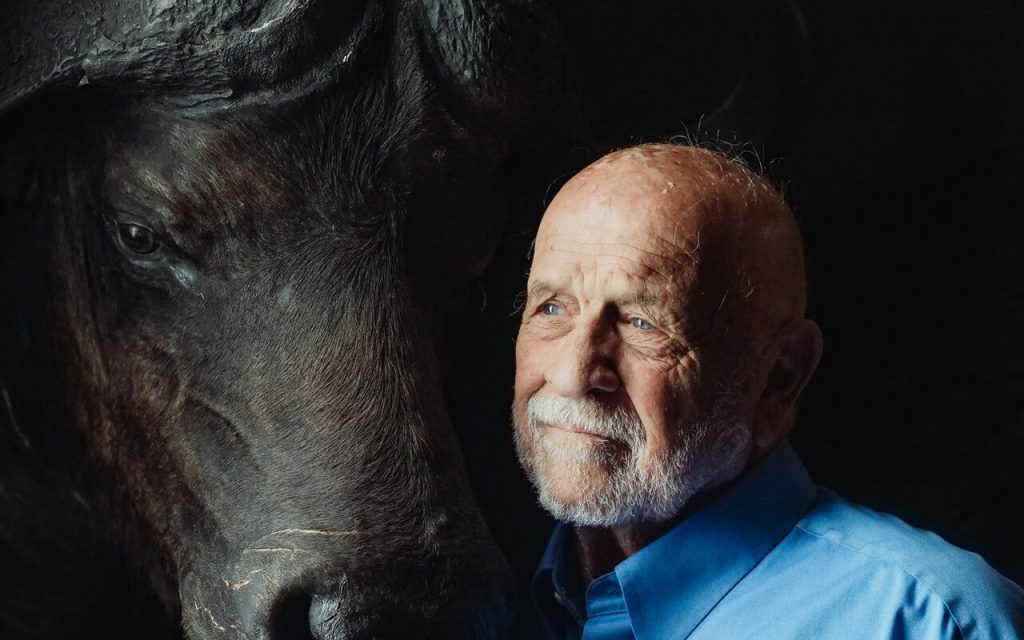
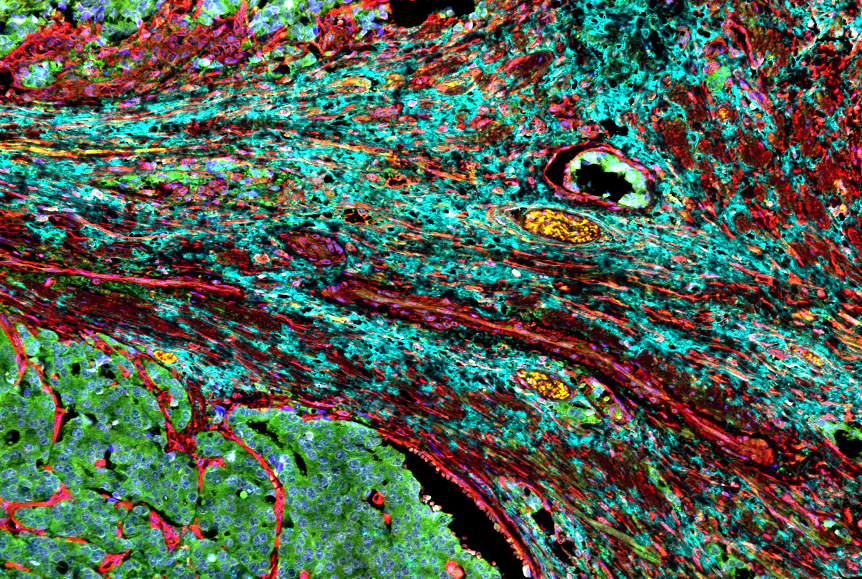
Cancer-associated fibroplasts surrounding a prostate tumour. Credit: Moscat and Diaz Meco labs
Prostate cancer is the second most common cancer and the second leading cause of cancer death among American men. Now, researchers have discovered key molecular players that drive prostate cancer to progress into a highly aggressive form of the disease called neuroendocrine prostate cancer that currently has no effective treatment. The finding, published in in the journal Scientific Reports, opens new avenues to therapeutics to treat neuroendocrine prostate cancer.
“We have found novel pathways that promote neuroendocrine prostate cancer,” says senior author Lucia R. Languino, PhD, a professor in the department of Pharmacology, Physiology and Cancer Biology and director of the Genetics, Genomics, and Cancer Biology PhD Program at Thomas Jefferson University.
Most prostate cancers are a type of disease called prostate adenocarcinoma. Other types of prostate cancer, including neuroendocrine tumours, are rare. However, unlike prostate adenocarcinoma, neuroendocrine prostate cancer is very aggressive and can quickly spread to other parts of the body. Treatments that are effective for adenocarcinomas in the prostate do not work against neuroendocrine prostate cancers.
Adenocarcinoma prostate cancers can progress into neuroendocrine prostate cancer. Until now, how this transition occurs has been a mystery.
To better understand how neuroendocrine prostate cancer develops, Dr Languino and colleagues looked for biomarkers of the disease. In previous work, they discovered that a molecule known as aVb3 integrin is abundant in mice and humans with neuroendocrine prostate cancer, but missing in prostate adenocarcinoma.
To look for molecules unique to neuroendocrine prostate cancer, the researchers found that aVb3 integrin expression in prostate cancer cells bumped up the expression of a known marker of neuroendocrine prostate cancer and significantly increased the expression of a molecule called Nogo receptor 2 (NgR2).
The finding “was a big discovery,” Dr Languino says. That’s because NgR2 is a protein found in nerve cells, where it contributes to neuronal functions. It has never before been studied in cancer, of any kind.
Dr Languino and her colleagues wanted to find out what this molecule, a neuronal protein, is doing in cancer.
An initial experiment revealed that NgR2 binds the aVb3 integrin. The scientists also saw that in mice with neuroendocrine prostate tumors, aVb3 integrin and NgR2 were both present in the primary tumor and in cancerous lesions that had formed in the lungs of the animals. A follow-up experiment made it clear that both aVb3 integrin and NgR2 are necessary for neuroendocrine prostate cancers.
When Dr Languino and her team lowered the amount of NgR2 in neuroendocrine prostate cancer cells, neuroendocrine markers also decreased. The results suggest that NgR2 plays a role in the development of neuroendocrine prostate cancer. Lowering the amount of NgR2 also reduced the ability of cancer cells to grow and move, indicating that NgR2 may have a hand in cancer spreading to other parts of the body, in a process known as metastasis. Metastases are often what makes cancers fatal.
“These two molecules, aVb3 integrin and NgR2, seem to create a combination that is lethal,” Dr Languino says.
She and her colleagues are now looking for a molecule or antibody that would block the effect of NgR2, or the aVb3 integrin/NgR2 complex, to inhibit their ability to promote neuroendocrine prostate cancer growth and development, and make the cancer more susceptible to therapy.
The chemical DEET has proven effective at keeping disease-carrying mosquitoes at bay, but the repellent is smelly and its protection is short-lived. Now, researchers report in the Journal of Agricultural and Food Chemistry that they have designed safe alternatives with some advantages over DEET, including a nice smell and much longer protection.
DEET disrupts a mosquito’s ability to locate humans. Until recently, it was considered the gold standard among topical repellents, but some find its strong odor offensive. It has to be reapplied frequently, and at high concentrations, it can damage synthetic fabrics and plastics. Another popular repellent known as picaridin is now regarded as a better alternative, since its protective effect lasts longer, and it doesn’t have an odor or damage items. However, like DEET, it has to be reapplied after swimming or sweating.
So, Francesca Dani and colleagues wanted to look for alternatives to these established products. In prior work, the team used as starting materials two plant-based natural repellents that offered only short-term protection from mosquitoes. The researchers converted these terpenoids into cyclic acetals and hydroxyacetals, thereby extending their protective timespan beyond that of DEET. But the researchers wanted to improve on these initial products.
In the current work, the team synthesised additional cyclic hydroxyacetals from inexpensive, commercially available carbonyls. The new cyclic compounds had pleasant, much fainter odors and were easier to dissolve in water, meaning they can be formulated without high concentrations of alcohol. Some were as effective as DEET and picaridin at repelling Asian tiger mosquitoes, which have spread widely in the U.S. and carry diseases, including encephalitis, dengue and dog heartworm. And like picaridin, they provided human volunteers more than 95% protection from bites for at least eight hours, while DEET’s protection rapidly declined below that level after just two hours.
Toxicity of some of the most active new compounds was comparable to or lower than the traditional repellents. Two hydroxyacetals were also less likely to cause immune reactions or to penetrate cell layers than picaridin. The researchers conclude that their compounds represent a new class of promising mosquito repellents that can compete favorably with DEET and picaridin in terms of efficacy and safety.
While chemotherapy is highly effective at killing cancer cells, it also kills healthy cells, something which medical research is trying minimise. Recently, ‘chronochemotherapy’ has garnered growing attention in the research community. As the name suggests, the aim is timing the delivery of the drug when the body is least vulnerable to the harmful effects of the drug, while the cancer cells are at their most vulnerable.
Chronochemotherapy exploits the fact that human physiological processes, including cell proliferation and differentiation, are regulated by the circadian clock. However, it is not yet widely exploited in real-world clinical settings because there at present is no systematic method to find the optimal chemotherapy delivery time.
This problem was tackled by an interdisciplinary team of researchers from the Institute for Basic Science (IBS), South Korea. They were led by the principal investigators, mathematician Kim Jae Kyoung at IBS and oncologist Koh Youngil at Seoul National University Hospital. The researchers studied a group of patients suffering from diffuse large B-cell lymphoma (DLBCL), which accounts for about 30 to 40% of non-Hodgkin’s lymphoma. Their findings are published in the journal JCI Insights.
The research team noticed that DLBCL patients at Seoul National University Hospital received chemotherapy at two different schedules, with some patients receiving morning treatment (8:30), while others taking the drugs in the afternoon (14:30). All patients received R-CHOP, which is a combination of targeted therapy and chemotherapy, 4 to 6 times in the morning or afternoon at intervals of about 3 weeks.
Figure 1. Chemotherapy in the afternoon can improve treatment outcomes The daily fluctuation of proliferative activity of bone marrow is larger in females than in males, and it becomes higher in the morning (left). Thus, chemotherapy in the morning strongly inhibits proliferative activity in female lymphoma patients, resulting in a higher incidence of adverse events such as neutropenia and infections. This forces the clinicians to reduce the dose intensity (center). Consequently, female patients undergoing the morning treatment show a lower survival probability than those undergoing the afternoon treatment (right). Specifically, only ~13% of female patients treated in the afternoon had a worse outcome and ~2% of them died while ~37% of female patients treated in the morning had a worse outcome and ~25% of them died. Male patients did not show any difference in treatment outcomes depending on the chemotherapy delivery time.
They analysed 210 patients to investigate differences between morning and afternoon treatment. They found that female patients who received afternoon treatment had 12.5 times reduced mortality rate (25% to 2%), while the cancer recurrence after 60 months was decreased by 2.8 times (37% to 13%). In addition, chemotherapy side effects such as neutropenia were more common in female patients who received morning treatment.
Surprisingly, there was no difference in treatment efficiency depending on the treatment schedule in the case of male patients.
To understand the cause of gender differences, the research team analysed ~14 000 blood samples from the Seoul National University Hospital Health Examination Center. It was found that in females, white blood cell count tends to decrease in the morning and increase in the afternoon. This indicates that the bone marrow proliferation rate is higher in the morning than in the afternoon because there is a ~12hr delay between the bone marrow proliferation and blood cell production.
This means that if a female patient receives chemotherapy in the morning when bone marrow is actively producing blood cells, the possibility of adverse side effects becomes greater. These results are consistent with the findings from recent randomised clinical trials that showed female colorectal cancer patients treated with irinotecan in the morning suffered from higher drug toxicities.
One confounding variable was the drug dose. Since the morning female patients suffered from greater adverse side effects, oftentimes the dose had to be reduced in these patients. On average, the drug dose was reduced by ~10% compared to the dose intensity given to female patients receiving the afternoon treatment.
Unlike female patients, it was found that male patients did not show a significant difference in white blood cell count and bone marrow cell proliferation activity throughout the day, which is the reason why the timing of the treatment had no impact.
Professor Koh Young-il said, “We plan to verify the conclusions of this study again with a large-scale follow-up study that completely controls confounding variables, and to confirm whether chemotherapy has similar effects in other cancers.”
Ci Kim Jae Kyung said, “Because the time of the internal circadian clock can vary greatly depending on the individual’s sleep-wake patterns, we are currently developing a technology to estimate the time of the circadian clock from the patient’s sleep pattern. We hope that it can be used to develop an individualised anti-cancer chronotherapy.”
Haemostatic microneedle technology can be applied like a typical adhesive bandage to quickly stop bleeding. The biocompatible and biodegradable microneedle arrays (MNAs) on the patch increase its surface contact with blood to accelerate the clotting process and also increase the adhesive properties of the patch via mechanical interlocking to promote wound closure. Credit: Designed by Amir Sheikhi and Reihaneh Haghniaz/Executed by Natan Barros. All Rights Reserved.
In the US, secondary, uncontrolled bleeding from traumatic injury is the leading cause of death from ages one to 46. Amir Sheikhi, assistant professor of chemical engineering and of biomedical engineering at Penn State, has a plan to change that with a novel microneedle patch that can immediately stop bleeding after injury.
He described his technology in a new paper in the journal Bioactive Materials.
“Excessive bleeding is a serious challenge for human health,” Sheikhi said. “With haemorrhaging injuries, it is often the loss of blood – not the injury itself – that causes death. There is an unmet medical need for ready-to-use biomaterials that promote rapid blood coagulation.”
Sheikhi’s haemostatic microneedle technology can be applied like a typical adhesive bandage to quickly stop bleeding. The biocompatible and biodegradable microneedle arrays (MNAs) on the patch increase its surface contact with blood, accelerating the clotting process. The needles also increase the adhesive properties of the patch via mechanical interlocking to promote wound closure.
“In vitro, the engineered MNAs reduced clotting time from 11.5 minutes to 1.3 minutes; and in a rat liver bleeding model, they reduced bleeding by more than 90%,” Sheikhi said. “Those 10 minutes could be the difference between life and death.”
The MNA patch is comparable hydrogel technology that is currently used to treat bleeding wounds in hospitals, but hydrogel applications require preparation and medical expertise. The microneedle patch is pre-engineered for immediate application that anyone can use to stop bleeding, Sheikhi said, much like a typical over-the-counter adhesive bandage.
Microneedles – which are already in use to deliver biologics, such as cells or drugs, through the skin or for cosmetic procedures to stimulate collagen production – are tiny, making their application pain-free, according to Sheikhi.
The researchers are now working to commercialise the patch, with more testing plans.
In October last year, the National Institute for Communicable Diseases (NICD) alerted the public to a measles outbreak in Limpopo. Since then, four more provinces have reported outbreaks, and the number of positive cases in the country has climbed rapidly.
Last week’s measles report from the NICD indicated that between the first week of October 2022 and mid-week in the second week of January 2023, a total of 397 cases of measles were identified across the country. Of those, 382 cases were detected in five provinces – Limpopo 145, North West 125, Mpumalanga 79, Gauteng 18, and the Free State 15. These five provinces have all met the criteria for a measles outbreak (three or more cases in a district within a month).
The remaining 15 cases are spread around KwaZulu-Natal, Northern Cape, the Eastern Cape, and the Western Cape – none of which have so far met the criteria for an outbreak.
‘Biggest outbreak in 11 years’
Dr Kerrigan McCarthy, a pathologist from the Centre for Vaccines and Immunology at the NICD, tells Spotlight that this is the biggest outbreak in 11 years, surpassing the outbreak in 2017 when around 280 cases of measles were identified.
According to the NICD report, the total number of laboratory-confirmed measles cases and the total number of samples submitted for testing has decreased for the third consecutive week. However, McCarthy cautions that this apparent decline might actually be due to a decrease in the number of specimens sent to the NICD for testing, and not to the outbreak actually slowing down.
“The fact that we have seen a decrease in the number of positive cases could be attributed to the decrease in number of specimens that have been submitted, but there is a small possibility that it could represent a turnaround in the outbreak. However, a consensus amongst us in public health is that it is the former problem,” says McCarthy.
She adds that the true extent of this outbreak – and whether new cases have really declined or not – may only become clear in the next few weeks, as schools across the country resume activities.
While it isn’t possible to predict exactly where the outbreak is going, McCarthy says at the moment it is following a similar trend to the widespread measles outbreak that occurred just over a decade ago. “In 2009 to 2011 we had an outbreak of over 22 000 measles cases… and in fact, in that outbreak, we saw a similar pattern. The outbreak was declared in late 2009 and cases started increasing into December and then when the schools closed and December holidays happened, there was a lull in cases and then when the schools returned there was a massive increase in cases,” she says.
Fears of much larger outbreaks
In a Spotlight article published in July last year, Dr Haroon Saloojee, Professor and Head of the Division of Community Paediatrics at the University of the Witwatersrand, and other experts warned that low vaccination rates may lead to measles outbreaks of the type we are now seeing. Now they are concerned that things might get worse.
Saloojee agrees that it isn’t possible to predict exactly how this outbreak will behave. “There are obviously three possible outcomes,” he says, “An increase, levelling off, or decline. My fear and expectation [are] that the outbreak will continue to expand. There are more than a million unvaccinated children under five, and possibly about 2.5 million unvaccinated under 15 years.
“We should be greatly concerned. It is highly likely that the outbreak will extend beyond the five provinces and affect all provinces in the country,” he says.
He adds that children are protected from measles through vaccination and if 95% of children are vaccinated against measles, then this herd immunity will protect the 5% who are not vaccinated. But in South Africa, measles coverage is not at 95%.
“In South Africa, at best, about 80% of children are vaccinated [against measles]. The proportion is lower in some provinces. Thus, all children, but particularly unvaccinated children, are at risk of acquiring measles,” he says. “We haven’t had a serious problem [with] measles in South Africa for at least the last 20 years. But in other low- and middle-income countries, it is still one of the five major causes of child mortality.”
Mass measles immunisation campaign needed
Saloojee tells Spotlight the only way to curtail the outbreak at this point is through a national supplementary mass measles immunisation campaign.
“There is only one option at this stage, as we are facing a crisis. A national supplementary immunisation campaign is warranted, despite its high cost and resource demands,” he says. “Such activities have already commenced in the affected provinces and will be extended to other provinces if the outbreak continues to spread. The aim of the campaign is to boost measles vaccine coverage to the 95% mark in the short term, so that herd immunity can kick in.”
How did we get here?
While such an immunisation campaign should help mitigate the current spread of measles, the question remains how a widespread outbreak could occur in the first place given South Africa’s well-established childhood immunisation programme.
“The outbreak was entirely predictable and preventable,” says Saloojee. “We have had similar outbreaks [about] every five years since 2000. Paradoxically, COVID delayed this outbreak, which should have happened in 2020 because the isolation measures protected against measles spread too.”
“However, we cannot run away from the fact that too few children receive all their routine vaccinations, and there is little being done to systematically change this such as stopping vaccine stockouts, and clinics and hospitals reducing missed opportunities to vaccinate eligible children,” he says. “If nothing is done, we can count on another outbreak in 2028.”
Countries across the world are reporting measles outbreaks, according to the CDC, which is being attributed to a disruption in services like routine immunisation because of the COVID pandemic. However, according to Saloojee, South Africa’s outbreak cannot be attributed exclusively to the pandemic disrupting services, instead, it is also due to years of suboptimal measles vaccine coverage.
Spotlight previously reported in-depth on results from the 2019 Expanded Programme on Immunisation (EPI) National Coverage survey, which showed that only around 77% (76.8%) of the children surveyed had received all fourteen age-appropriate vaccines from birth to 18 months. This includes the two doses of the measles vaccine.
Dr Lesley Bamford, a child health specialist in youth and school health at the National Department of Health, provided Spotlight with a table showing measles vaccination coverage per province between 2017 and 2022.
Note that the data only includes vaccinations provided in the public sector, whilst the denominator includes all children in South Africa. Graph courtesy of Dr Lesley Bamford, National Department of Health
According to the figures provided by Bamford, national coverage for the first dose of the measles vaccine has improved from 80% in 2017-2018 to 88% in 2021-2022. However, coverage for the second measles dose remained stuck in a narrow band from 77% to 80%, until 2021-2022, when it improved to 84% – still well below the 95% coverage required for herd immunity.
Expanded vaccination campaign
The NICD report shows the highest number of measles cases so far have been in the five to nine-year age group, which represents 40% of cases. 29% of cases were in the one to four age group and 17% in the 10 to 14-year age group. The remaining cases occurred in children younger than one year and those aged 15 and older.
According to McCarthy, based on the distribution of cases in these age groups, the NICD recommended to the National Department of Health that it extend its planned mass measles vaccination campaign to include children between six months and 15 years of age – which the Department has agreed to do.
Bamford tells Spotlight that a mass measles immunisation campaign had already been planned across all provinces for February 2023. But for the five provinces experiencing outbreaks, the timeline has since moved up. The four remaining provinces will still start their campaigns in February as planned.
“The target age group for that campaign has been extended. So, the initial plan was targeting children under 5 years of age and now in most provinces, it has been extended to include all children six months to 15 years of age,” she says.
Spokesperson for the National Department of Health, Foster Mohale confirms that all children between the ages of six months and 15 years, regardless of documentation, are eligible to receive their measles vaccination in the catch-up drive. “Most provinces have been vaccinating all children between 6 months and 15 years, with [or] without documents because diseases have no discrimination. So, we haven’t received any concern or report about non-vaccination of children without documentation,” he says.
Bamford adds that a measles incident management team has been established by the National Department of Health, which meets with the NICD and the provinces on a weekly basis.
She says Limpopo started its campaign in November, Mpumalanga and North West started in December, and Gauteng and the Free State started in January. The campaigns have so far been conducted mainly at primary healthcare clinics and outreach to ECD centres but now that the school year has resumed, children will also be vaccinated at schools.
Because the provinces all started at different times, there is no specific timeline for the vaccination campaign to be completed, according to Bamford, but the expectation from the National Department is that all provinces will wrap up their campaigns by mid-February when the HPV vaccination campaign kicks off.
“We know that measles coverage is suboptimal, and that is why we were planning to run a campaign, but of course, that is the single biggest reason why we are now experiencing these outbreaks,” she says. “The only way really to stop measles outbreaks is to improve immunisation coverage.”
In recent times, new drug discoveries by independent large pharmaceutical companies have become increasingly rare, with almost 60% of new drugs discovered through mergers and acquisitions and drug licensing. Fortunately, an emerging trend of spinouts from academia and R&D investments heralds a promising shift in the industry’s interorganisational deal networks to improve research and development in the future. Researchers explore this new trend in Drug Discovery Today.
Launching a new drug in the market is risky, thanks to a low probability of success during the research and development (R&D) phase and the high costs involved. But through an improved understanding of disease biology, decision-making can be more streamlined through the effective use of scientific information.
With this in mind, researchers from Ritsumeikan University, Japan, led by Associate Professor Kota Kodama are uncovering how the trends in interorganisational deals in the pharmaceutical industry are changing to improve R&D productivity and drug discovery. “The network structure of innovation creation in the pharmaceutical industry has changed with the increasing emergence of start-up companies spinning out from academia and research institutions as players in the source of innovation,” explains Dr Kodama.
Their research suggests that the knowledge necessary for breakthrough innovation in drug discovery is more often than not obtained through alliance networks. Over the past decade, large research-based pharmaceutical companies have used research collaborations, innovation incubators, academic centres of excellence, public-private partnerships, mergers and acquisitions (M&As), drug licensing, and corporate venture capital funds as typical methods for external innovation. The researchers now aim to define the changes in the network structure and nature of such alliances that have occurred over the past decade to provide future strategic insights for industry and academic players involved in drug discovery.
Using data from the Cortellis Competitive Intelligence database, the researchers identified nearly 50 000 deals of various kinds related to pharmaceutical R&D across pharmaceutical, digital health software, animal drug, and medical device companies to uncover trends in the creation of new drugs for human use. They also studied the trends of 13 of the largest pharmaceutical companies with annual revenues of more than US$10 billion, who saw an improvement in their CAGR (compound annual growth rate) since 2015. The researchers noticed that the rising CAGR correlated to a significant change in M&A-related deals after 2015, indicating that M&A-related deals drive revenue growth for large pharmaceutical companies.
Furthermore, the number of organisations involved in interorganisational deals has been increasing yearly from 2012 to 2021. Although the number of organisations involved and the number of deals may be increasing, the density of the deal networks is decreasing annually, suggesting that networks are becoming more non-cohesive. The concentration of business relationships between organisations of certain areas in the network changed to dispersion around 2015, and new networks connecting different groups started to form after 2017. These trends are an important illustration of how the industry landscape is gradually evolving away from the traditional network in which large pharmaceutical companies drove drug discovery output. Now, interorganisational deals among more diverse players have become active and are driving R&D productivity for startups in biotechnology and pharmaceuticals.
A clear increase in the number of academia-owned spinouts of advanced technology and expansion of investment in start-ups is a positive sign. The emergence of new chemical modalities, such as biologics, oligonucleotides, and peptides that differ from traditional small molecule drug discovery indicate remarkable changes that have taken place over the past two decades. The trend of increased financing for start-up companies in personalised drug development is beneficial for patent creation and will positively impact innovation creation in the coming years.
“The presence of academia to support the technologies of these start-ups is becoming very important, and government and private support and investment in this area is boosting innovation. Our study shows that such medium- and long-term support may ultimately benefit the health and well-being of humankind,” concludes an optimistic Dr Kodama.
Recreational running offers a lot of physical and mental health benefits – but some people can develop exercise dependence, a form of addiction to physical activity which can cause health issues. Shockingly, signs of exercise dependence are common even in recreational runners. A study published in Frontiers in Psychology investigated whether the concept of escapism can help us understand the relationship between running, well-being, and exercise dependence.
“Escapism is an everyday phenomenon among humans, but little is known regarding its motivational underpinnings, how it affects experiences, and the psychological outcomes from it,” said Dr Frode Stenseng of the Norwegian University of Science and Technology, lead author of the paper.
Running to explore or to evade?
“Escapism is often defined as ‘an activity, a form of entertainment, etc. that helps you avoid or forget unpleasant or boring things.” In other words, many of our everyday activities may be interpreted as escapism,” said Stenseng. “The psychological reward from escapism is reduced self-awareness, less rumination, and a relief from one’s most pressing, or stressing, thoughts and emotions.”
Escapism can restore perspective, or it can act as a distraction from problems that need to be tackled. Escapism which is adaptive, seeking out positive experiences, is referred to as self-expansion. Meanwhile maladaptive escapism, avoiding negative experiences, is called self-suppression. Effectively, running as exploration or as evasion.
“These two forms of escapism are stemming from two different mindsets, to promote a positive mood, or prevent a negative mood,” said Stenseng.
Escapist activities used for self-expansion have more positive effects but also more long-term benefits. Self-suppression, by contrast, tends to suppress positive feelings as well as negative ones and lead to avoidance.
Self-suppression associated with exercise dependence
The team recruited 227 recreational runners, half men and half women, with widely varying running practices. They were asked to fill out questionnaires which investigated three different aspects of escapism and exercise dependence: an escapism scale which measured preference for self-expansion or self-suppression, an exercise dependence scale, and a satisfaction with life scale designed to measure the participants’ subjective well-being.
The scientists found that there was very little overlap between runners who favoured self-expansion and runners who preferred self-suppression modes of escapism. Self-expansion was positively related with well-being, while self-suppression was negatively related to well-being. Self-suppression and self-expansion were both linked to exercise dependence, but self-suppression was much more strongly linked to it. Neither escapism mode was linked to age, gender, or amount of time a person spent running, but both affected the relationship between well-being and exercise dependence. Whether or not a person fulfilled criteria for exercise dependence, a preference for self-expansion would still be linked to a more positive sense of their own well-being.
Although exercise dependence corrodes the potential well-being gains from exercise, it seems that perceiving lower well-being may be both a cause and an outcome of exercise dependency: the dependency might be driven by lower well-being as well as promoting it.
Similarly, experiencing positive self-expansion might be a psychological motive that promotes exercise dependence.
“More studies using longitudinal research designs are necessary to unravel more of the motivational dynamics and outcomes in escapism,” said Stenseng. “But these findings may enlighten people in understanding their own motivation, and be used for therapeutic reasons for individuals striving with a maladaptive engagement in their activity.”
Sleep deprivation is bad for memorisation, something which still doesn’t deter many med students from late night cramming. Researchers however have discovered that memories learned during sleep deprivation is not necessarily lost, it is just difficult to recall. Publishing in the journal Current Biology, the researchers have found a way to make this ‘hidden knowledge’ accessible again days after studying whilst sleep-deprived using optogenetic approaches and the asthma drug roflumilast.
University of Groningen neuroscientist Robbert Havekes and his team have extensively studied how sleep deprivation affects memory processes. “We previously focused on finding ways to support memory processes during a sleep deprivation episode,” says Havekes. However, in his latest study, his team examined whether amnesia as a result of sleep deprivation was a direct result of information loss, or merely caused by difficulties retrieving information. “Sleep deprivation undermines memory processes, but every student knows that an answer that eluded them during the exam might pop up hours afterwards. In that case, the information was, in fact, stored in the brain, but just difficult to retrieve.”
Priming the hippocampus
To find out, the researchers selectively introduced optogenetic proteins into neurons that are activated during a learning experience, enabling recall of a specific experience by shining a light on the cells. “In our sleep deprivation studies, we applied this approach to neurons in the hippocampus, the area in the brain where spatial information and factual knowledge are stored,” says Havekes.
First, the genetically engineered mice were given a spatial learning task in which they had to learn the location of individual objects, a process heavily reliant on neurons in the hippocampus. The mice then had to perform this same task days later, but this time with one object moved to a new location. The mice that were deprived of sleep for a few hours before the first session failed to detect this spatial change, which suggests that they cannot recall the original object locations. “However, when we reintroduced them to the task after reactivating the hippocampal neurons that initially stored this information with light, they did successfully remember the original locations,” says Havekes. “This shows that the information was stored in the hippocampus during sleep deprivation, but couldn’t be retrieved without the stimulation.”
Memory problems
The molecular pathway set off during the reactivation is also targeted by the drug roflumilast, which is used by patients with asthma or COPD. Havekes says: “When we gave mice that were trained while being sleep deprived roflumilast just before the second test, they remembered, exactly as happened with the direct stimulation of the neurons.” Since roflumilast is approved for use in humans and can enter the brain, this may lead to testing to see if it can recover ‘lost’ memories for humans..
It might be possible to stimulate the memory accessibility in people with age-induced memory problems or early-stage Alzheimer’s disease with roflumilast,” says Havekes. “And maybe we could reactivate specific memories to make them permanently retrievable again, as we successfully did in mice.” If a subject’s neurons are stimulated with the drug while they try and ‘relive’ a memory, or revise information for an exam, this information might be reconsolidated more firmly in the brain. “For now, this is all speculation of course, but time will tell.”
Researchers have found that, in animal studies, the hypertension drug rilmenidine can extend lifespan and slow ageing. Published in Aging Cell, the findings show that animals treated with rilmenidine at young and older ages increases lifespan and improves health markers by mimicking the effects of caloric restriction.
They also demonstrate that the healthspan and lifespan benefits of rilmenidine treatment in the roundworm C. elegans are mediated by the I1-imidazoline receptor nish-1, identifying this receptor as a potential longevity target.
With side-effects being rare and non-severe, unlike other drugs previously studied for this purpose by the researchers, the widely-prescribed antihypertensive has potential for future translatability.
A caloric restriction diet has thus far proved to be the most robust anti-ageing intervention, promoting longevity across species. However, studies of caloric restriction in humans have had mixed results and side effects, meaning finding medications like rilmenidine that can mimic the benefits of caloric restriction is the most reasonable anti-ageing strategy.
Professor João Pedro Magalhães, who led the research whilst at the University of Liverpool and is now based at the University of Birmingham, said: “With a global ageing population, the benefits of delaying ageing, even if slightly, are immense. Repurposing drugs capable of extending lifespan and healthspan has a huge untapped potential in translational geroscience. For the first time, we have been able to show in animals that rilmenidine can increase lifespan. We are now keen to explore if rilmenidine may have other clinical applications.”
Over the past few decades, health care integration has absorbed physician practices and hospitals into large health systems, a practice which was heralded as the way to cut health care costs and boosting quality of care.
But integrated health systems appear to be failing on both fronts, according to the results of a new US study published in JAMA. For patients in health systems, care is only marginally improved while costs are significantly higher compared to those at independent practices or hospitals.
In the US, health systems have grown exponentially in size and market share through mergers and acquisitions of physician practices and hospitals and the joining of separate health systems.
Proponents of consolidation have argued over the years that physicians and hospitals working together in integrated, coordinated systems provide better patients care while being more efficient than independent physician practices and hospitals. This would drive quality of care up while keeping spending steady and even driving costs down.
“One of the key arguments for hospital mergers and practice acquisition was that health systems would deliver better-value care for patients. This study provides the most comprehensive evidence yet that this isn’t happening,” said study first author Nancy Beaulieu at Harvard Medical School.
Today, these systems are responsible for a large proportion of the medical care delivered in the US, some employing thousands of physicians. But despite their impact on population health and the economy, little is known about the actual performance of integrated health organisations, the study authors noted.
A lack of detailed data on performance and scale is a key obstacle. The current analysis is believed to be the first comprehensive national study to compare outcomes between patients receiving care within health systems and outside of them, including patients with private insurance as well as traditional Medicare, which is the US health insurance system for those over 65 or which certain disabilities or conditions.
The analysis included a total of 580 health systems, accounting 40% of physicians and 84% of general acute care hospital beds. Academic and large nonprofit systems accounted for a majority of system physicians (80%) and system hospital beds (64%).
System hospitals were larger than hospitals than nonsystem ones, with 67% of system hospitals having more than 100 beds, while only 23% of nonsystem hospitals having more than 100 beds. System physician practices were also more likely to have more than 100 physicians compared with nonsystem practices (74% vs 12%). Integrated systems delivered primary care to 41% of traditional Medicare beneficiaries.
As for quality and cost of care delivered within systems, patients with primary care physicians in health systems reported slightly better satisfaction and overall care experience than patients of independent physicians.
This is the case even though many patients with nonsystem primary care providers also receive some of their care in hospitals or specialist practices that are part of a health system. However, care in systems came at a much higher price, contributing to higher overall spending on health care, the research showed.
Prices for services from physicians and hospitals within health systems were significantly higher than for independent healthcare, the study found. Physician services delivered within health systems cost between 12% and 26% more, compared with independent practices. System-based hospital services cost an average of 31% more than care delivered by independent hospitals.
Small differences in quality combined with large differences in cost of care suggests that health systems have not, on average, realised their potential for better care at equal or lower cost, the researchers said.
Members of the research team have compiled a database from various sources to help characterise these health systems and to link claims data with information on health care providers in and out of health systems. The database, housed at NEBR, will be made available for free to other researchers in the near future.
“There’s no question that large, sophisticated health systems have benefits over independent systems,” said study author David Cutler, Harvard economic professor. “Big systems tend to be less vulnerable to economic downturns and they can provide specialised care that would be difficult to maintain in smaller systems. But the hoped-for cost savings benefits of integrated health systems have not yet materialised.”




 Note that the data only includes vaccinations provided in the public sector, whilst the denominator includes all children in South Africa. Graph courtesy of Dr Lesley Bamford, National Department of Health