In a study published in the International Journal of Gynecology & Obstetrics, UK researchers have uncovered an association between the rate of eclampsia and the number of deaths caused by indoor household pollution, mostly from cooking and heating fires.
More commonly seen in low- and middle-income countries commonly using solid fuels, such as wood and charcoal, indoor household pollution has been proven to increase the risk of adverse birth outcomes, including placental hypoxia.
The researchers evaluated more than 2690 cases of eclampsia in Ethiopia, Haiti, India, Malawi, Sierra Leone, Uganda, Zambia and Zimbabwe, and found a significant correlation between deaths due to indoor household pollution and eclampsia rates – and the correlation was even more prominent when eclampsia occurred at home.
King’s College London’s Professor Andrew Shennan, one of the lead authors on the paper, said the findings demonstrate how air pollution can impact vulnerable populations the most.
“In-house cooking and household pollution may increase the risk of seizures. We believe that less oxygen will get to the mother’s brain, and this may trigger a fit in women who already have pre-eclampsia” he said.
“We are lucky to have such a large dataset of women with eclampsia, as it only occurs in 1% of women with pre-eclampsia. This has allowed us to uncover this new finding.
“This could help explain observed inequalities in maternal healthcare in low- and middle-income countries.”
In a previous study by King’s College London, scientists found that 94% of maternal deaths occur in low- and middle-income countries, with 22% due to hypertensive disorders like eclampsia.
Professor Shennan added: “Knowing why women have these severe outcomes allows us to reduce the risk of eclampsia and work out how to save lives.
“We have large programmes of work in India, Sierra Leone and Zambia where many women have complications related to high blood pressure. Our current research is aimed at identifying the women at risk but now we are looking at ways to reduce risk, including earlier delivery. This data will help us to give advice about avoiding risk at home.”
The researchers next plan to explore whether climate change increases the prevalence of pre-eclampsia or increases the morbidity from serious manifestations such as eclampsia.
For the first time, a study published Proceedings of the National Academy of Sciences (PNAS) has shown a causal association between environmental phthalates and the increased growth of uterine fibroids, the most common tumours among women.
Manufacturers use environmental phthalates in numerous industrial and consumer products, and they’ve also been detected in medical supplies and food. Although they are known to be toxic, they are currently unbanned in the US.
“These toxic pollutants are everywhere, including food packaging, hair and makeup products, and more, and their usage is not banned,” said corresponding study author Dr Serdar Bulun at Northwestern University. “These are more than simply environmental pollutants. They can cause specific harm to human tissues.”
Up to 80% of all women may develop a fibroid tumour during their lifetime, Bulun said. One-quarter of these women become symptomatic with excessive and uncontrolled uterine bleeding, anaemia, miscarriages, infertility and large abdominal tumours necessitating technically difficult surgeries.
The new study found women with a high exposure to certain phthalates such as DEHP (used as a plasticiser to increase the durability of products such as shower curtains, car upholstery, lunchboxes, shoes and more) and its metabolites have a high risk for having a symptomatic fibroid.
Prior epidemiological studies have consistently indicated an association between phthalate exposure and uterine fibroid growth, but this study explains the mechanisms behind that link. The scientists discovered exposure to DEHP may activate a hormonal pathway that activates an environmentally responsive receptor (AHR) to bind to DNA and cause increased growth of fibroid tumors.
“Interestingly, AHR was cloned in the early ’90s as the receptor for dioxin, the key toxin in the agent orange,” Bulun said. “The use of agent orange during the Vietnam war caused significant reproductive abnormalities in the exposed populations; and dioxin and AHR were thought to be responsible for this.”
This new study, Bulun said, provides further evidence to support these theories.
As climate change continues to increase the severity, frequency and duration of heat wave, prisoners and prison workers are at greater mortality risk if their environment is not air conditioned, according to a new study on Texas prisons published in JAMA Network Open.
The study examined the relationship between heat exposure and mortality risks in Texas prisons, focusing on how these risks vary between prisons with air conditioning and those without it.
The researchers analysed data gathered between 2001 and 2019 showing that 271 people died due to extreme heat exposure during that timeframe.
Even a 1° Fahrenheit (0.56°C) increase above 85°F (29.4°C) can increase the daily mortality risk by 0.7%, the researchers found.
The research team combined data from the US Bureau of Justice Statistics on mortality in Texas prisons with temperature data from NASA and used a novel epidemiologic analysis to arrive at its findings. About 13% of mortality during warm months may be attributable to extreme heat in Texas prison facilities without air conditioning.
It is important to note that while an average of 14 people died each year from heat-related causes in Texas prisons without air conditioning, not a single heat-related death occurred in climate-controlled prisons, said lead study author Julie Skarha, recent PhD graduate.
“The majority of Texas prisons do not have universal air conditioning,” Skarha said. “And in these settings, we found a 30-fold increase in heat-related mortality when compared to estimates of heat-related mortality in the general US population.”
Study co-author Dr David Dosa, an associate professor of medicine at Brown, pointed out that heat is often a silent killer.
“We have seen similar situations in nursing homes, where heat isn’t reported on the death certificate,” said Dosa. “It’s only after we run these analyses that we can determine how much of a role heat played in someone’s death.”
The findings, the researchers said, suggest that an air conditioning policy for Texas prisons may be an important part of protecting the health of people living and working in these facilities.
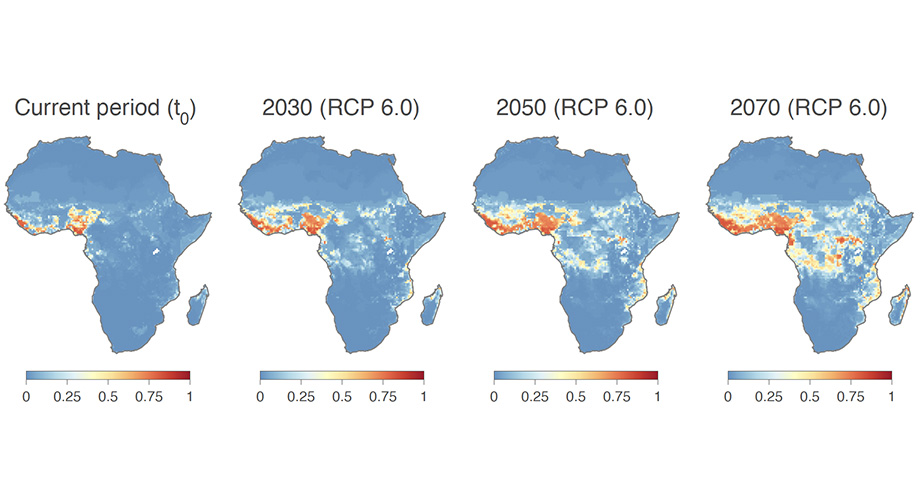
Pictured are projections of the ecological niche suitability for Lassa virus based on climate models and other data. Credit: Scripps Research and University of Brussels
Analysing decades of environmental data associated with Lassa virus outbreaks, researchers projected that areas hospitable to Lassa virus spread may extend from West Africa into Central and East Africa in the next several decades. With this expansion and expected African population growth, the human population living in the areas where the virus should theoretically be able to circulate may rise by more than 600 million.
“Our analysis shows how climate, land use, and population changes in the next 50 years could dramatically increase the risk of Lassa fever in Africa,” says first author Raphaëlle Klitting, PhD, a postdoctoral researcher at Scripps Research during the study, which is published in Nature Communications.
Lassa virus is a zoonotic pathogen found in the Natal multimammate rat (Mastomys natalensis), most likely transmitted to humans via its droppings. While an estimated 80% of infections are mild or asymptomatic, the remaining cases are more severe, with signs and symptoms that can include haemorrhaging from the mouth and gut, hypotension, and potentially permanent hearing loss. Mortality rate in hospitalised patients can be up to 80%.
An estimated several hundred thousand infections occur each year, chiefly in Nigeria and several other West African countries. So far there is no approved vaccine or highly effective drug treatment.
Although the primary animal reservoir for Lassa virus is known, the virus spreads in only a subset of the areas where the animal is found. Thus, it is possible that environmental factors also help determine whether and where significant viral transmission can occur. In the study, the researchers developed an ‘ecological niche’ model of Lassa virus transmission, using environmental data at sites of known spread.
Combining the model with projections of climate and land-use changes in Africa in the next several decades, as well as the known range of the Natal multimammate rat, the researchers estimated the areas of Africa that could support Lassa virus transmission currently, and in the years 2030, 2050, and 2070. The projected current areas corresponded well to known endemic areas in West Africa, but the estimates for future decades suggested a vast expansion within and beyond West Africa.
“We found that several regions will likely become ecologically suitable for virus spread in Central Africa, including in Cameroon and the Democratic Republic of the Congo, and even in East Africa, in Uganda,” Klitting said.
Currently Africa’s population is undergoing rapid growth; the researchers therefore considered projections of this population growth for the areas of current and potential future Lassa virus circulation. They found that the number of people potentially exposed to the virus could increase from about 92 million today to 453 million by 2050, and 700 million by 2070 – an increase of over 600%.
More hopefully, the researchers examined the dynamics of the spread of Lassa virus using data on sequenced viral genomes sampled at various locations in West Africa and found that virus dispersal appeared to be slow. They concluded that, unless transmission dynamics change drastically in the new location where the virus circulates, the virus’s spread into new ecologically suitable areas in the coming decades may also be slow.
The authors say that the findings should inform African public health policies, for example, by encouraging officials to add Lassa virus to lists of viruses under epidemiologic surveillance in parts of Central and East Africa.
“With the ongoing climate change and increasing impact of human activities on the environment, further comprehensive studies of the ecology and spread of zoonotic and vector-borne diseases are needed to anticipate possible future changes in their distribution as well as their impact on public health,” said senior author Simon Dellicour, PhD, of the University of Brussels.
People typically spend 90% of their lives indoors or in vehicles, exposed to a multitude of chemicals from various sources, from vehicle exhausts to fumes from cooking and cleaning. The human body is also a potent emitter of chemicals from its own breath and skin. One of nature’s cleaners for these chemicals is hydroxyl (OH) radicals, primarily formed when UV radiation in sunlight interacts with ozone and water vapour. However, glass windows filter out UV radiation, lowering the indoor concentration of OH radicals.
Indoors, on the other hand, the air is of course far less affected by direct sunlight and rain. Since UV rays are largely filtered out by glass windows it has been generally assumed that the concentration of OH radicals is substantially lower indoors than outdoors and that ozone, leaking in from outdoors, is the major oxidant of indoor airborne chemical pollutants.
OH radicals are formed from ozone and skin oils
However, now it has been discovered that high levels of OH radicals can be generated indoors, simply due to the presence of people and ozone. This has been shown by a team led by the Max Planck Institute for Chemistry in cooperation with researchers from the USA and Denmark.
“The discovery that we humans are not only a source of reactive chemicals, but we are also able to transform these chemicals ourselves was very surprising to us,” said Nora Zannoni, first author of the study, now at the Institute of Atmospheric Sciences and Climate in Bologna, Italy. “The strength and shape of the oxidation field are determined by how much ozone is present, where it infiltrates, and how the ventilation of the indoor space is configured,” adds the scientist from Jonathan Williams’ team. The levels the scientists found were even comparable to outside daytime OH concentrations levels.
The oxidation field is generated by the reaction of ozone with oils and fats on the skin, especially the unsaturated triterpene squalene, which constitutes about 10% of the skin lipids that protect the skin and keep it supple. The reaction releases a host of gas phase chemicals with double bonds that further react with ozone to generate OH radicals. These squalene degradation products were characterised and quantified, with the total OH reactivity determined in parallel enabling the OH levels to be quantified empirically.
The experiments were conducted at the Technical University of Denmark (DTU) in Copenhagen. Four test subjects stayed in a special climate-controlled chamber under standardized conditions. Ozone was added to the chamber air inflow in a quantity that was not harmful to humans but representative of higher indoor levels. The team determined the OH values before and during the volunteers’ stay both with and without ozone present.
In order to understand how the human-generated OH field looked like in space and time during the experiments, results from a detailed multiphase chemical kinetic model from the University of California, Irvine were combined with a computational fluid dynamics model from Pennsylvania State University, both based in the USA. After validating the models against the experimental results, the modeling team examined how the human-generated OH field varied under different conditions of ventilation and ozone, beyond those tested in the laboratory. From the results, it was clear that the OH radicals were present, abundant, and forming strong spatial gradients.
“Our modeling team is the first and currently the only group that can integrate chemical processes between the skin and indoor air, from molecular scales to room scales,” said Manabu Shiraiwa, a professor at UC Irvine who led the modeling part of the new work. “The model makes sense of the measurements — why OH is generated from the reaction with the skin.”
Shiraiwa added that there remain unanswered questions, like the way humidity levels impact the reactions the team traced. “I think this study opens up a new avenue for indoor air research,” he said.
Adapt test methods for furniture and building materials
“We need to rethink indoor chemistry in occupied spaces because the oxidation field we create will transform many of the chemicals in our immediate vicinity. OH can oxidise many more species than ozone, creating a multitude of products directly in our breathing zone with as yet unknown health impacts. This oxidation field will also impact the chemical signals we emit and receive,” said project leader Jonathan Williams, “and possibly help explain the recent finding that our sense of smell is generally more sensitive to molecules that react faster with OH.”
The new finding also has implications for our health: Currently, chemical emissions of many materials and furnishings are being tested in isolation before they are approved for sale. However, it would be advisable to also conduct tests in the presence of people and ozone, says atmospheric chemist Williams. This is because oxidation processes can lead to the generation of respiratory irritants such as 4-oxopentanal (4-OPA) and other OH radical-generated oxygenated species, and small particles in the immediate vicinity of the respiratory tract. These can have adverse effects, especially in children and the infirm.
In addition to the skin-related impacts of climate change, the field of dermatology also has to address its own contribution to global warming. A commentary in the International Journal of Dermatology stresses the need for dermatologists to engage more meaningfully on key climate issues and to move beyond discussions of the skin-related impacts of climate change.
The article follows a 2021 editorial published en masse by 233 international medical journals that called for emergency action to limit global warming and adverse health effects related to climate change.
The authors of this new commentary note that they and other dermatologists are professionally charged with diagnosing, treating, researching, and mitigating the health harms from climate change but also must consider that healthcare is among the most carbon-intensive service sectors worldwide.
They point out that significant reductions in carbon emissions are readily achieved in dermatology by increased use of telehealth services and virtual medical meetings and residency interviews. Also, dermatologists should prioritise funding for climate-health research to improve healthcare sustainability and decarbonise the profession.
“Our research, advocacy, and policies must be ambitious in scope, reaching beyond cutaneous disease to integrate the impact of climate change on social determinants of health and support resiliency and social justice invulnerable populations,” the authors wrote. “We have an ethical imperative to act. The time is now for dermatologists and our medical societies to collectively rise to meet this crisis.”
With heatwaves becoming increasingly common around the world, researchers examined how outdoor nighttime temperature changes affect body temperature and sleep quality. Their literature review published in the Journal of Sleep Research, the researchers suggest that high, uncomfortable temperatures can disrupt sleep by interfering with the body’s normal thermoregulation ability.
A recent study found that on average in Europe, the number of days with extreme heat (ie >99% percenticle) has tripled since 1950. Even temperatures on extremely hot days have increased by 2.3 °C throughout the same period. In the future, these heatwaves will be more frequent and of longer duration. Of particular concern is that nighttime temperatures will increase more than daytime ones – and high nighttime temperatures are associated with increased mortality risk.
The authors, from the European Insomnia Network, note that there are certain groups such as older adults, children, pregnant women, and individuals with psychiatric conditions, who may be especially vulnerable to the sleep disruptive effects of heatwaves. They also offer several coping methods adapted from elements of cognitive behavioural therapy for insomnia.
“This paper is considered to be important and timely to disseminate expert recommendations to the research and clinical community as well as to the general population,” the authors wrote. “Nevertheless, it points out several areas of research which are still lacking, especially for specific populations. Even more important, literature evidence is still scarce.”
For the first time, researchers have demonstrated the low environmental footprint of water fluoridation compared to other preventive measures for tooth decay while still retaining effectiveness. The study is published in the British Dental Journal.
Water fluoridation is regarded as one of the most significant public health interventions of the twentieth century. But as the climate crisis worsens, the contribution of healthcare and the prevention of disease to the crisis must be considered.
Influenced by this urgency, Trinity College Dublin researchers collaborating with University College London quantified the environmental impact of water fluoridation for an individual five year-old child over a one-year period and compared this to the traditional use of fluoride varnish and toothbrushing programmes, which take place in selected schools across the UK, and internationally.
Over 35% of the world’s population has access to water fluoridation, with studies showing significant reductions in dental caries. Whilst data on the clinical effectiveness and cost analysis of water fluoridation are available, there has been no data regarding its environmental impact up to now.
To quantify this impact, the research team performed a Life Cycle Assessment by carefully measuring the combined travel, the weight and amounts of all products and the processes involved in all three preventive programmes (toothbrushing, fluoride varnish programmes and water fluoridation). Data was inputted into specialised environmental software and the team used the Ecoinvent database, enabling them to calculate environmental outputs, including the carbon footprint, the amount of water used for each product and the amount of land use.
The results of the study, led by Brett Duane, Associate Professor in Dental Public Health at Trinity College, concluded that water fluoridation had the lowest environmental impact in all categories studied, and had the lowest disability-adjusted life years impact when compared to all other community-level caries prevention programmes. The study also found that water fluoridation gives the greatest return on investment.
Considering the balance between clinical effectiveness, cost effectiveness and environmental sustainability, researchers believe that water fluoridation should be the preventive intervention of choice.
This research strengthens the case internationally for water fluoridation programmes to reduce dental decay, especially in the most vulnerable populations.
Assoc Prof Duane said: “As the climate crisis starts to worsen, we need to find ways of preventing disease to reduce the environmental impact of our health systems. This research clearly demonstrates the low carbon impact of water fluoridation as an effective prevention tool.”
Differences in vitamin D exposure have been thought to explain why people who live farther from the equator are more likely to develop multiple sclerosis (MS). But countries farther from the equator are also more likely to be wealthier. A new analysis published in Neurology shows that the amount a country spends on health care may help explain this relationship between MS and latitude.
According to study author Deanna Saylor, MD, MHS, the results suggest that MS rates may be greatly underestimated in low-income countries with lower health care spending, which means that people have less access to neurologists who have the expertise to diagnose MS and MRI scanners that are needed to make the diagnosis.
Researchers analysed data from scientific studies and databases to determine current rates of MS in 203 countries and territories. Countries were then grouped into world regions and by income levels.
Rates of MS varied by region and income level. For example, in high-income countries an average of 46 of every 100 000 people had MS, compared to 10 people per 100 000 in low-income countries. Health care spending per capita was $2805 for high-income countries, compared to $45 in low-income countries.
For each location, researchers examined gross domestic product per capita, current health expenditure per capita, income levels, the availability of brain scans to diagnose MS, the number of neurologists per capita and universal health care. They also reviewed lifestyle factors such as obesity and tobacco use.
Once the researchers adjusted the data for other factors that could affect the risk of MS, such as age and sex, they found that health care spending and latitude were strongly associated with MS rates. The research showed that, with every increase of one standard deviation in health expenditure per capita, a country’s MS prevalence increased by 0.49. Alternatively, with every increase of one standard deviation in latitude, a country’s MS prevalence increased by 0.65.
Researchers also found that health care spending explained some, but not all, of the link between latitude and MS. After adjusting for other factors, the link between latitude and MS decreased by more than 20% when health care expenditure per capita was considered.
The availability of universal health care was associated with rates of MS in all world regions, except Southeast Asia, with universal health care tied to higher rates of MS.
In high-income countries, rates of MS were linked to most factors, including gross domestic product per capita, current health expenditure per capita, and the number of neurologists, but not tobacco use and obesity or the number of MRI units per capita. However, in low-income countries, there were no associations with any of these factors, which may be explained by a lack of significant variation in data from these countries, Saylor said.
According to Dr Saylor, the finding that current health expenditure per capita was very strongly linked with national rates of MS further supports the hypothesis that greater investment in health care leads to more robust reporting of rates of MS. She also said the minimal links between rates of MS and lifestyle factors such as tobacco use and obesity run counter to prior assumptions that lifestyle and consumption behaviours explain the large portions of regional differences in reported rates of MS.
Dr Saylor said strategies are urgently needed for the accurate assessment of the burden of MS in low-income countries, and these lower reported MS can obscure the need for training and funding regarding MS.
A limitation of the study is that different data sources may have collected information during different time periods or used different methods, which could affect the accuracy of estimates.
A recent report by the US Centers for Disease Control and Prevention found more than 80% of urine samples from children and adults in the US contained the herbicide glyphosate. A study published in Scientific Reports takes this research one step further and is the first to link the use of the herbicide Roundup®, a widely used weed killer, to convulsions in animals.
Glyphosate, the weed killer component in Roundup®, is the world’s most commonly used herbicide by volume and by land-area treated. Glyphosate-resistant crops account for almost 80% of transgenic crop cultivated land, which has resulted in an estimated 6.1 billion kg of glyphosate sprayed across the world from 2005 to 2014. Roundup® is used at both industrial and consumer levels, and its use is projected to dramatically increase over the coming years. A major question, yet to be fully understood, is the potential impact of glyphosate on the nervous system.
“It is concerning how little we understand the impact of glyphosate on the nervous system,” said project leader Akshay S. Naraine, a PhD student at FAU and the International Max Planck Research School for Synapses and Circuits. “More evidence is mounting for how prevalent exposure to glyphosate is, so this work hopefully pushes other researchers to expand on these findings and solidify where our concerns should be.”
Resultsshowed that glyphosate and Roundup® increased seizure-like behaviour in soil-dwelling roundworms and provides significant evidence that glyphosate targets GABA-A receptors. These communication points are essential for locomotion and are heavily involved in regulating sleep and mood in humans. What truly sets this research apart is that it was done at significantly lower levels than recommended by the EPA and those used in past studies.
“The concentration listed for best results on the Roundup® Super Concentrate label is 0.98% glyphosate, which is about 5 tablespoons of Roundup® in 1 gallon [3.8 litres] of water,” said Naraine. “A significant finding from our study reveals that just 0.002% glyphosate, a difference of about 300 times less herbicide than the lowest concentration recommended for consumer use, had concerning effects on the nervous system.”
Using C. elegans, a soil-dwelling roundworm, researchers first tested glyphosate alone and then both the US and UK formulations of Roundup® from two distinct time periods – before and after the UK’s 2016 ban on polyethoxylated tallowamine (POEAs). These conditions were selected to pinpoint which effects are specific to the active ingredient glyphosate, Roundup® formulations in general, the POEAs surfactants, or any combination of these.
The study found that the active ingredient glyphosate exacerbated convulsions in C. elegans and suggest the GABA-A receptor as a neurological target for the observed physiological changes. The data also indicate that there is an important distinction between exposure to glyphosate and Roundup®, with Roundup® exposure increasing the percentage of C. elegans that did not recover from seizure activity. The non-recovery phenotype and prolonged convulsions in C. elegans from this study have helped to set a foundation for understanding nuanced physiological effects of herbicide that occur at concentrations exponentially below neurotoxic levels.
“Given how widespread the use of these products is, we must learn as much as we can about the potential negative impacts that may exist,” said lab head Ken Dawson-Scully, PhD, professor at Nova Southeastern University. “There have been studies done in the past that showed the potential dangers, and our study takes that one step further with some pretty dramatic results.”
Findings also generate concern over how herbicide use might affect soil-dwelling organisms like C. elegans.
“These roundworms undergo convulsions under thermal stress, and our data strongly implicates glyphosate and Roundup® exposure in exacerbating convulsive effects. This could prove vital as we experience the effects of climate change,” said Naraine.
This study provides evidence to further investigate how chronic exposure and accumulation may lead to neurodegenerative diseases such as Parkinson’s disease. Importantly, there also is a sub-neurodegenerative threshold that may dramatically impact dysregulation of neurotransmission.
“As of now, there is no information for how exposure to glyphosate and Roundup® may affect humans diagnosed with epilepsy or other seizure disorders,” said Dawson-Scully. “Our study indicates that there is significant disruption in locomotion and should prompt further vertebrate studies.”