

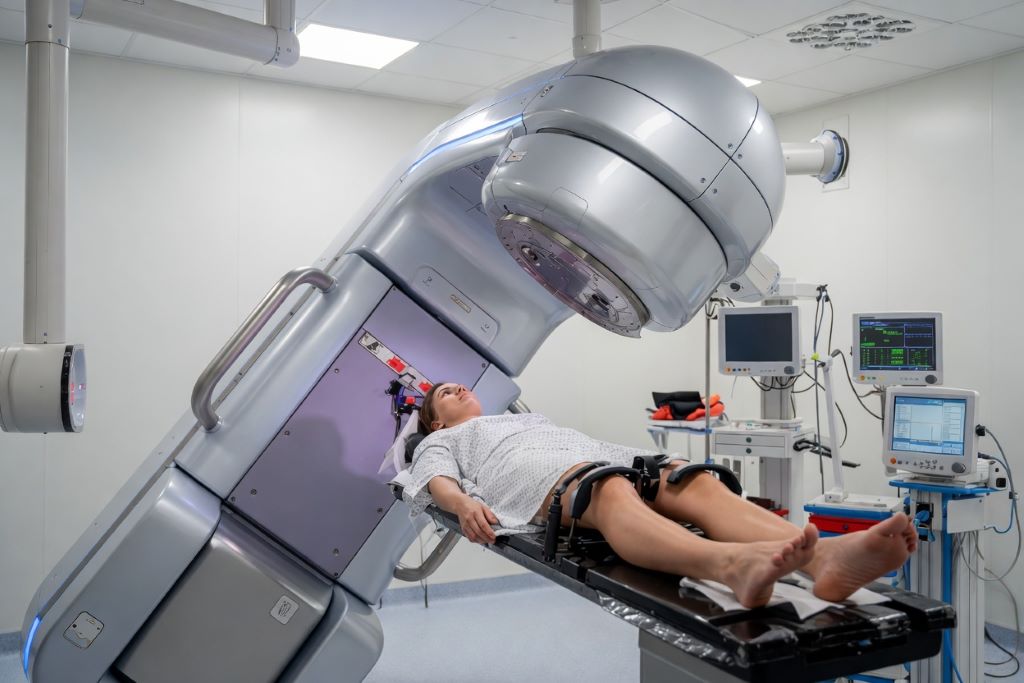
Two cancer patients can receive exactly the same amount of a radioactive medicine, yet their bodies may absorb very different radiation doses.
University of Pretoria (UP) nuclear medicine researchers argue that this is one of the next big challenges precision cancer treatment needs to address.
In a paper published in the inaugural volume of The Lancet Medical Imaging & Theranostics, Prof Mike Sathekge and Dr Kamo Ramonaheng call for greater use of patient-specific dosimetry, which measures how much radiation actually reaches a patient’s tumour and healthy organs.
Radiopharmaceutical therapy uses medicines containing small amounts of radioactive material to seek out and attack cancer cells. But treatment is still commonly based on a standard amount of radioactivity, sometimes adjusted for factors such as body weight.
The researchers argue that knowing how much is given is not the same as knowing how much radiation the cancerous cell actually receives.
“Two patients can receive the same treatment, but their bodies may handle it very differently,” explains Prof Sathekge, Head of Nuclear Medicine at UP and Steve Biko Academic Hospital and CEO of the Nuclear Medicine Research Infrastructure (NuMeRI).
“Precision medicine should ultimately mean precision for the individual patient. If we can measure how much radiation reaches the cancer and how much reaches healthy tissue, we have much better information to guide treatment.”
From standard treatment to individual treatment
This measurement is known as dosimetry. The principle is similar to asking not only how much medicine was prescribed, but how much of the treatment reached its intended target.
The researchers propose a practical first step which is to measure the radiation absorbed by the tumour and healthy organs after treatment. This could help doctors understand whether the cancer received enough radiation while limiting unnecessary exposure to healthy tissue.
For patients receiving several treatment cycles, information from the first cycle could eventually help doctors decide whether later treatment should be adjusted or whether continuing the therapy is likely to benefit the patient.
Dr Kamo Ramonaheng elaborates that, “The question should not only be, ‘How much did we give the patient?’ It should also be, ‘How much did this patient actually receive where it mattered?’ Dosimetry brings us much closer to answering that question.”
This could become increasingly important as these therapies are used earlier in cancer care, where patients may live for many years after treatment and reducing long-term side effects becomes particularly important.
New technology is opening the door
Sathekge and Ramonaheng say advances in medical imaging and artificial intelligence are making personalised dosimetry increasingly practical.
More sensitive scanners can provide better information about where radioactive medicines travel in the body, while AI could eventually help analyse images faster and predict how individual patients may respond. The researchers stress that these technologies must be carefully tested before becoming part of routine clinical decision-making.
The ultimate possibility is to use imaging before treatment to predict the radiation dose a patient’s tumour and organs are likely to receive, allowing doctors to plan treatment more precisely before it begins.
Why NuMeRI matters
Much of the infrastructure needed to investigate these approaches already exists at NuMeRI, based at Steve Biko Academic Hospital.
The national research facility brings together advanced PET and SPECT imaging, radiopharmaceutical development, medical physics, radiobiology and clinical research. It is designed to help move discoveries from the laboratory into patient care and to strengthen research and training in personalised nuclear medicine.
Dr Ramonaheng is Head of Medical Physics and Radiobiology at NuMeRI and winner of the prestigious Saul Hertz Award at the Theranostics World Congress 2026. Her research includes patient-specific dosimetry.
Prof Sathekge explains that, “NuMeRI gives us a place where we can develop the science, test it, image patients and build the evidence needed to improve treatment. That is important for dosimetry because personalised treatment depends not only on an idea, but on having the technology, expertise and clinical environment to make it possible.”
The researchers caution that technology alone will not be enough. Wider use of personalised dosimetry will require trained specialists, consistent standards, appropriate funding and stronger clinical evidence.
Their paper describes dosimetry as the “compass” that could guide radiopharmaceutical therapy towards truly personalised cancer treatment.
For Prof Sathekge, the destination is clear, “We want to get closer to giving the right treatment, at the right radiation dose, to the right patient at the right time.”
