

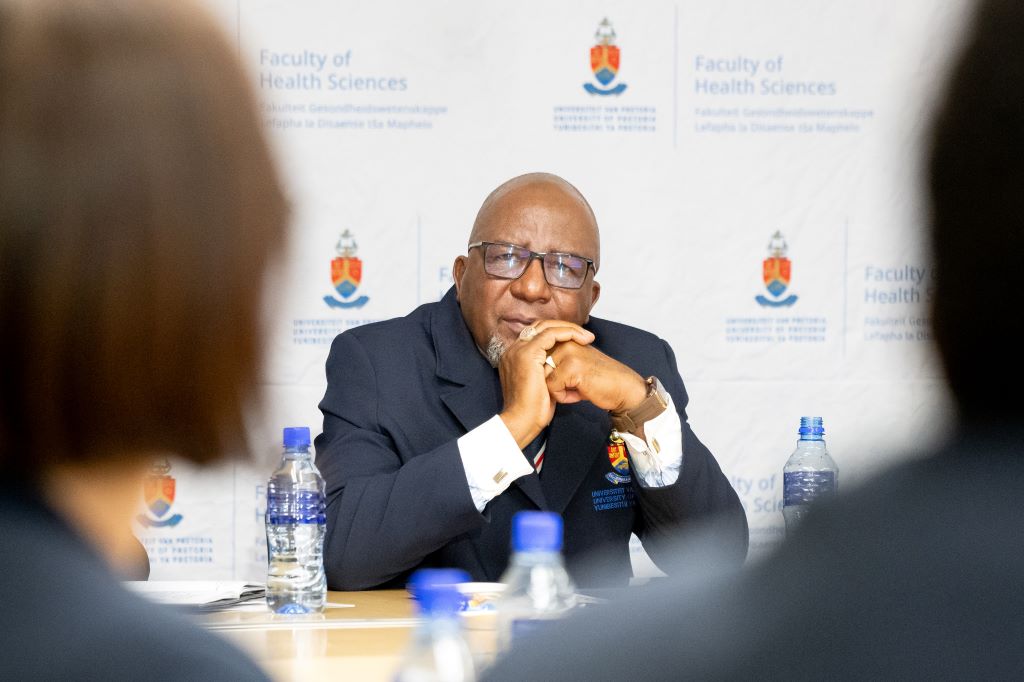
Forty-five patients with conductive hearing loss from middle-ear damage are eagerly awaiting the start of clinical trials, led by University of Pretoria’s Professor Mashudu Tshifularo, on a ground-breaking procedure to restore hearing.
The trials, due to begin within weeks at Steve Biko Academic Hospital in Pretoria, come seven long years after Prof Tshifularo successfully performed the world’s first middle-ear transplant using 3D-printed bones made from titanium. The patient was Thabo ***, whose middle-ear bones – the ossicles – had been injured in an accident, causing almost total hearing loss until he had the transplant in March 2019.
In a video screened at a UP Roundtable event held in April this year to announce the launch of the upcoming clinical trials, a beaming Thabo *** confirmed he had regained his hearing after the transplant and had continued to enjoy excellent hearing ever since.
While this procedure was hailed as a surgical breakthrough at the time, its full acceptance by the South African and global ear, nose and throat (ENT) community depends on formal clinical validation. Despite the many obstacles he knew would lie ahead, Prof Tshifularo, joint head of UP’s Department of Otorhinolaryngology, was determined to take his innovation through clinical trials.
“Today is a culmination that I never thought would come. There was a time when I cried, there was a time when I was very depressed, there was a time when I nearly gave up, but something inside me told me to remain steady,” he said at the Roundtable, where the announcement was made that clinical trials could finally move ahead now that all the necessary regulatory, ethical and licensing clearances have been obtained, including from the South African Health Products Regulatory Authority (SAHPRA).
The years since Prof Tshifularo performed that first transplant have also been spent developing, perfecting, testing and patenting a prototype of the titanium material and implants for the clinical trials. UP’s engineering partner on this project, the Council for Scientific and Industrial Research (CSIR), was responsible for the materials and prototype development, while HH Industries manufactures the implants, using 3D printing technology, and Marcus Medical is providing the robotic technology to be used during the surgery. Seed funding was provided by the Motsepe Foundation.
Ready to transform lives
Now that it is all-systems-go for this all-South African collaborative effort, Prof Tshifularo and his team aim to perform this life-changing surgery in the next 12 months on all 45 patients who have expressed interest in participating in the clinical trials.
The team will then focus on publishing their research and training future researchers and medical teams so that the work can be amplified far and wide for the benefit of humanity.
“My dream is to make deafness history,” Prof Tshifularo said, noting that an estimated two billion youth are living with undiagnosed, mostly noise-induced hearing loss, which would become a severe problem in the next 20 to 25 years. Hearing loss is also common among the world’s rapidly ageing population.
The procedure itself takes about three hours and uses advanced robotics to remove the damaged middle-ear bones and replace them with the 3D printed titanium bones. This is minimally invasive, carries significantly less risk than conventional procedures and leaves minimal scarring. The titanium used to manufacture the ossicles is biocompatible, meaning it can be introduced into the ear without causing harmful reactions.
“This innovation will ultimately transform the lives of many people, including newborn babies born with congenital middle-ear defects,” said Prof Themba Mosia, Vice-Principal: Student Life, who gave the opening address at the Roundtable. “It exemplifies the spirit of innovation and collaboration at the university, combined with the deep medical expertise needed to restore hearing.”
UP at the forefront of healthcare advancements
Prof Flavia Senkubuge, Dean of UP’s Faculty of Health Sciences, said innovations such as Prof Tshifularo’s middleear surgical procedure place the university “front and centre” of healthcare advancements on the African continent and the world stage.
She reiterated UP’s commitment to deploying its innovations for the benefit of local communities, such as by establishing a “one-stop shop” – most likely in the form of a private day hospital – where community members could benefit from advanced clinical technologies and the expertise of its researchers.
Paying tribute to Prof Tshifularo, long-time colleague Dr Christian Quitter thanked Prof Tshifularo “for having the guts” to persevere with his innovation, even when it was not always supported by the ENT establishment.
He also thanked the university for supporting researchers who “think out of the box in seeking to improve the lives of all humanity”.
Provided by the University of Pretoria
