

By Elna Schutz
Professor Shahida Moosa, who is one of about a dozen medical geneticists in South Africa, helps families around the country discover their rare genetic diseases. She tells Spotlight about the first genetic condition she diagnosed, the lack of basic genetic testing in the public service, and furthering the field through teaching and research.
While most doctors are busy, few have as big a smile while juggling several positions as Shahida Moosa. The medical geneticist, lecturer and researcher jokes that she has three jobs but only gets paid for one.
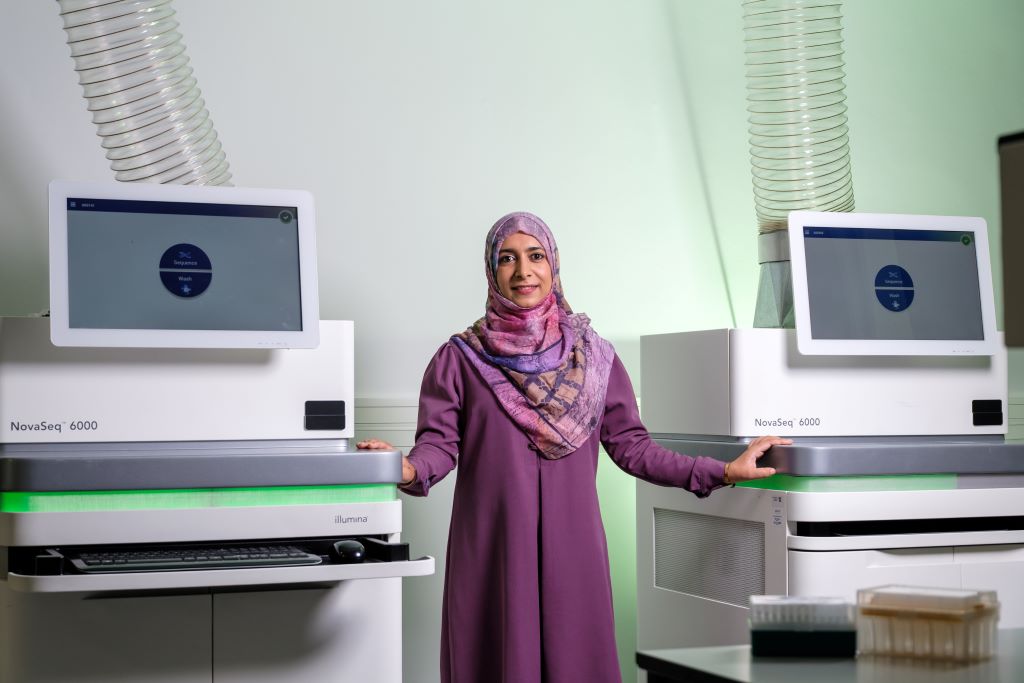
Officially, she is the Head of Medical Genetics at Tygerberg Hospital, and Professor of Medical Genetics at Stellenbosch University, as well as co-lead of the cluster of research excellence called Genomics for Health in Africa. In essence, Moosa helped pioneer human genomics – the study of the entire genome – in South Africa, and is one of its premier rare disease specialists.
“A lot of my friends, even those I studied with at medical school, still don’t know what a medical geneticist does because there are only about 12 or 13 of us in the country, and it’s a relatively new specialisation,” she says.
Moosa jokes that her colleagues might imagine that she spends most of her time holed up in a lab, but that is far from her reality. Her “real” job, she quips, is to be a full-time clinician as a medical geneticist.
That means she sees everyone from pregnant women and their unborn babies all the way through to elderly patients, including whole families. She helps them identify rare or genetic diseases and sets them up on a treatment plan. She works on both genetics, meaning specific parts of the DNA, and genomics, which refers to the DNA as a whole.
Living with a “secret” for 20 years
For instance, she remembers a teenage boy being one of the first patients she encountered at Tygerberg. His mother had been looking for answers about her child his entire life, about why he had dysmorphic features and significant developmental delays, such as not having learned to speak. Moosa ran a whole-exome sequencing, which tests the parts of the human genome that hold a lot of the disease-forming variants, and was able to give a clear diagnosis. She recalls this distinctly, not because of the variant of disease, but because the mother suddenly broke down in tears, much later in the appointment.
“She told me that she really believed for the last 19 or 20 years that her son had all of these medical issues and developmental problems, because she had eaten stinky French cheese during the pregnancy,” Moosa says.
The woman had kept this firm belief completely secret, and only felt safe to tell Moosa once she realised she had not caused the illness. “That kind of information was transformative to her, and freed her from the guilt that she carried for 20 years.”
It’s this power of genomics and genetics to impact people that Moosa loves, and that drives her to research. For instance, she was recently involved in a project with the Bonn University in Germany, called GestaltMatcher. Her human expertise was used as a benchmark for an AI tool to detect disease characteristics in facial features, which will help triage patients, establish referral pathways, and improve the patient journey for people with rare genetic disorders.
Moosa added her unique understanding of birth defects and body differences, called dysmorphology, to the project. “The reason I was interested in this project is because we are never going to be able to train as many medical geneticists with dysmorphology expertise that are needed for the country or for the continent, and so we need to find innovative and other ways to be able to serve our patients better,” Moosa says.
She says her involvement in the project has contributed to the diversity of patients that the tool is able to process correctly. While it was originally trained mostly on European populations, Moosa has helped add more African and diverse examples. Now she’s noticed that it works more effectively for her own patients.
No more six hours of genetics in six years
In the third realm of her work, academics, Moosa teaches a wide spectrum of students. She is particularly proud to have been part of a curriculum overhaul around 2022 that included genetics and genomics throughout the years of study at Stellenbosch University. The first group of students on this new curriculum will graduate in the next few years.
“It cannot be that medical students only have six hours of genetics in the six years,” she says. “Medicine is also changing, and genetics is becoming a lot more integrated into every single speciality and sub-speciality.”
She says she loves seeing how medical genetics is changing “in leaps and bounds, not baby steps”.
“I think I’m somebody who needs novelty and for every day to be different, and that really is something that I found in medical genetics,” she says. “Each of my patients is different, even if they have the same condition.”
A path into genetics
Moosa’s discovery of genetics took a few twists and turns. At first, as a medical student at Wits University, she didn’t find a particular speciality that spoke to her, but this changed after her first day of fifth year was in the paediatric rotation at Rahima Moosa Mother and Child Hospital in Johannesburg. “I walked in there, and I just felt instantly at home,” she recalls.
She found herself gravitating towards complex patients that needed deeper digging and investigating to find a diagnosis.
For instance, she describes a moment where she was the most junior person on a ward round, and was scared to bring up her observations. Eventually, she told the professor in charge that she had noticed that the baby being discussed was crying differently. “I described it as the other babies crying more like sheep, and this baby cried more like a cat,” she says. Moosa laughs, remembering how the neonate was suspiciously silent in this moment, when she wanted to demonstrate it.
Her instincts proved to be right and led to a positive genetic test for the chromosomal disorder Cri du chat syndrome, meaning ‘cry of the cat’. “That was my first genetic condition that I diagnosed,” Moosa says.
She says the professor then encouraged her to consider the genetic aspects of patients more and would make sure to discuss interesting cases with her during ward rounds.
The timing was perfect. From 2008, South African doctors no longer had to become a paediatrician, internal medicine specialist or obstetrician before doing a two-year fellowship in medical genetics.
It now became a primary speciality of its own, and Moosa nabbed one of the three positions in the first group. She calls herself one of “the first guinea pigs to train in this new programme.
She later had to leave the country to complete her PhD at the University of Cologne, Germany. But Moosa is thrilled that she is now able to supervise local PhD students in Cape Town.
The challenges of a nascent field
Being a medical genetics pioneer comes with challenges.
Firstly, patients themselves may not understand the discipline and its helpfulness. “We have a lot of patients who still have a very cultural understanding of what the condition is in the family,” Moosa says.
She says she has worked with a family in Limpopo for several decades, whom she met during an outreach as a registrar. Multiple women across generations had a particularly short stature, and Moosa helped diagnose skeletal dysplasia, which is a group of rare genetic conditions affecting bone development.
Several family members still believe the symptoms are because a curse was placed on the great-grandmother during her pregnancy. They hold on to this belief even while accepting medical interventions like surgery or orthopaedic aids.
“It’s really gratifying for me to find a genetic answer so that I can go back to them and say no, it definitely isn’t something that mom did during the pregnancy or that granny said about the pregnancy. This is genetic,” Moosa says. At the same time, she says she does not fight against patients’ interpretations if they do not directly hinder the process.
Unfortunately, the field’s challenges are systematic, not just individual. Moosa laments the lack of basic genetic testing in the public service, even where it was previously available. For instance, she says she has not had access to a basic test like chromosomal microarray- a high-resolution scan for missing or duplicated parts of someone’s DNA to determine genetic causes of illness and developmental problems – for almost three years and does not know when it will be available again.
In the public sector, these tests are done through the National Health Laboratory Service (NHLS). The NHLS told Spotlight that this testing was interrupted from November 2023 at its Groote Schuur Hospital branch due to problems with the external processing platform the laboratory uses. They say a new service provider started during 2025, while the NHLS works on long-term solutions. However, the reality on the ground has not changed for Moosa. She says microarrays are not available to her despite communication with the NHLS.
“We also have not had access to any of what we call the next-generation sequencing (NGS) type techniques,” she says. She explains that only limited ‘in-house’ tests are available for certain local institutions, and that they are mostly not diagnostic, therefore not particularly helpful for identifying genetic diseases. “So, a lot of the tests that are available to us in the public service are still based on work that was done in the ’90s and on specific populations.”
The NHLS maintains that only some NGS technologies are available within their network and associated academic laboratories for “selected clinical indications”, particularly for cancer and public health surveillance purposes. They also say that they have established a national working group to focus on NGS.
The lack of testing frustrates Moosa not only for her own service, but because it limits the wider medical community’s use of genomic testing, including for diseases like TB and HIV. Spotlight previously reported on how whole genome sequencing might be used to determine which medicines someone’s specific strain of TB is sensitive to. Moosa says these structural problems go beyond restricted budget to a lack of understanding of the power of genomic testing and what it could do for a patient and their family.
“I would love for us to have the policy change in place that would make it possible for us also to bring those tests into public service; genetics and genomics cannot be sort of like a fringe science or a fringe area of medicine.”
Standing strong
Despite these challenges, Moosa would not want to work in a different field and already has more planned for the future. “My next adventure is trying to see how we can use this really new technology called long-read whole genome sequencing in a meaningful clinical way within our undiagnosed disease programme,” she says.
Moosa explains that they have been trying to solve undiagnosed patient cases using long-read sequencing methods, which look at a particularly long piece of DNA in one pass. She is utilising methods called PacBio and Oxford Nanopore Technologies (ONT).
Moosa knows that she takes on a lot. She jokes that some colleagues call her very enthusiastic. “That’s code for them thinking I’m dreaming too big,” she says with a laugh. “But you need to have enthusiasm and dream big if you want to make change and so that’s just how I live my life and how I approach every day.”
Regardless, the professor does joke that her future includes a vacation. When not at work, she enjoys arts and crafts to recharge and, if possible, relaxing on a beach.
“Sometimes it feels like we need three or four people to do this one job. But I really think that when I decided to come back to South Africa, I made the right choice to come back to this particular hospital and this particular university.”
*This article was first published by Spotlight – health journalism in the public interest. Sign up to the Spotlight newsletter.