
By Sue Segar for Spotlight
They are qualified, ready, and willing to serve their communities. But scores of these doctors in KwaZulu-Natal, are becoming increasingly desperate because of a lack of posts in government hospitals and clinics.
Dr Tholumusa Sibiya remembers, as if it were yesterday, the day, in 2015, when a group of young doctors visited his school in Ingwavuma, KwaZulu-Natal to urge talented pupils to apply to university to study medicine and other health disciplines.
The doctors were from Mosvold Hospital where manager, Dr Andrew Ross, had started a fund to encourage local pupils to train in medicine and return to serve in their communities.
“The message from these young professionals was, ‘yeah, it’s doable. You can also study medicine. And you’re needed.’ That really inspired me,” says Sibiya, who was the top pupil in matric at Nansindlela Combined School.
He knew about Mosvold Hospital because his father worked in the mortuary, and his mother in the laundry services there. But, till then, it hadn’t occurred to him he could be a doctor there some day.
“One of the doctors said something that knocked sense into me. He said as rural kids, we need to work twice as hard to have half of what guys in other schools have,” he recalls.
Sibiya and other pupils from the area then formed a study group, to “share information and support each other”. “It helped a lot working together … especially with mathematics and physics,” he says.
Against the odds
Sibiya’s hard work paid off, and armed with an Umthombo bursary, he was accepted at the University of KwaZulu-Natal to study dental therapy. A year later, he transferred to the university’s medical school, and qualified as a doctor in 2022.
“My parents were ecstatic,” he says.
Straight after qualifying, he did two years of internship at Empangeni’s Ngwelezana Hospital, followed by community service at Manguzi Hospital in northern KwaZulu-Natal. “I rotated from one department to the next – paediatrics, maternity, the emergency unit – and learnt so much. It was the best,” he says.
He was geared up and ready to return home to serve his rural community as a doctor. His long-term dream was to work as an emergency physician in a hospital in rural KZN; maybe to specialise as an anaesthesiologist. But to specialise, you need to work in a public facility.
That was 2025. Since then, Sibiya has not been able to find a job as a doctor in the public healthcare sector. “I started applying in October last year,” he says. “But, so far, nothing.”
Many unemployed doctors
Sibiya is not alone. Spotlight has spoken to several other young doctors who are in the same boat. He reckons there are well over a hundred recently qualified doctors looking for work just in KwaZulu-Natal, others put the number at closer to 200. Even this may be an undercount since it doesn’t fully account for doctors who are still unemployed from previous years, or who have stopped looking for work. Some recent reporting suggests that the National Department of Health does not have a reliable count of how many unemployed doctors there are who are looking for work in the country.
Those who have received government bursaries, cannot fathom “why the government invests in us, then dumps us”. “Even now, they’re sending a new batch to study overseas, but where will they work?” says one doctor, who suggests that Cuban-trained doctors are prioritised for jobs because the government allegedly has a contractual obligation to give them jobs.
Currently, Sibiya and others have few alternatives but to try and do locums in private practises or in private hospitals.
“We’ve worked hard, done all that’s necessary to qualify and completed our internships and community service in preparation for careers in service to others, but we cannot find jobs,” says Sibiya.
Scrambling to make ends meet
We are meeting Sibiya on a Sunday at a coffee shop in Pietermaritzburg. He is currently living in Margate on the KwaZulu-Natal south coast and has come to Pietermaritzburg to do a locum shift for a private GP.
“I do shifts wherever I can find them. Primarily, I’m working in the emergency unit at the Shelly Beach (private) Hospital on the south coast. They call me whenever they need me, but I have no contract. That’s how I’ve been paying bills,” he says.
He keeps up with scores of other unemployed doctors on three different WhatsApp groups where, among others, they share job and locum opportunities, advise and support each other, and coordinate some of their interactions with the provincial health department.
“There are many people on the group(s) who aren’t able to get locum posts,” he says, “and they are really struggling. Some have depression. Sometimes it boils down to cars being repossessed, people going back home. Some people say, ‘I can’t put bread on the table, I’m selling my stuff because I can’t make ends meet’.”
“The mother of a friend of mine, also an unemployed doctor, called me recently and told me he’s drinking every day because the stress has been too much,” says Sibiya. “Some of the stories will make you cry.”
The situation is particularly tough on young doctors from poor backgrounds who do not have the funds to sustain themselves without work for extended periods.
‘I can feel I’m going into a depression’
Dr Raeesa Kathrada says she has sent her CV “to every doctor I know and to every private hospital and applied for every locum position.
“I can feel I’m going into a depression … as are my colleagues. Many people reach out to me, saying they don’t know how to survive,” she says.
Kathrada says some doctors have been waiting up to three years to find jobs.
Dr Lawrence Khoza from Osizweni, near Newcastle, is also struggling to find a position in the public sector. He started a private general practice, but he says he wants to work for the government and to see patients for free. “My passion is to help poor patients … but now I can only help those in the middle class who can afford medical aid,” he says.
Dr Nazo Nxumalo, originally from Mtubatuba, qualified in medicine at UKZN in 2022, did a two-year internship at Empangeni’s Ngwelezane Hospital and her community service at the Nseleni Community Health Centre in 2025. “After that, it was unemployment,” says Nxumalo. “It was like being dropped in the middle of the ocean.”
“I really thought that, after my community service, employment in the public health system would follow,” she says. “Basically, the department has left us stranded. We went into medicine, a very important job in society, believing we were entering a profession where our skills would always be needed.”
Understaffing in public health facilities
The unemployed doctors say that, while they are struggling to find work, the province at the same time desperately needs more doctors if it is to improve the quality and availability of healthcare services. “There is a big shortage; doctors are suffering in silence. The demand is there but the government is turning a blind eye,” says Khoza.
Several doctors who are currently employed at public sector hospitals in the province agree that they need help. One doctor, from a rural hospital speaks about “long lines of patients, late into the day” and doctors often working overtime and never taking a lunch break because “we can’t afford the 15 or 30 minutes of having no doctor on duty”. We are not naming the employed doctors quoted in this story since they could potentially suffer repercussions for speaking out.
“Whenever people leave our hospital, the posts are not filled because of budget cuts,” says another employed doctor. “Several departments here are severely short staffed.”
A recent report from South Africa’s Health Ombud paints a similarly grim picture. Following an investigation into the deaths of six healthcare workers at six public health establishments in KwaZulu-Natal, the Ombud found that while their deaths were not a result of workplace bullying, victimisation, or adverse working conditions in the hospitals under investigation, there were “significant” systemic challenges affecting healthcare professionals in the health establishments. These included “persistent staffing shortages, frozen vacant posts, rising workloads, shortages of medical equipment and supplies, inadequate employee wellness support services, infrastructure challenges, and security concerns affecting healthcare workers”.
A rough benchmark is that 1 doctor is needed for every 1 000 people, although experts stress that target ratios may differ based on factors like disease profile and population density. According to a 2025 parliamentary answer, the ratio in KwaZulu-Natal stood at around 0.38 doctors per 1 000 people – according to the District Health Barometer it was at just under 0.4 in 2024.
Though the KwaZulu-Natal Department of Health does not describe the situation as a crisis anywhere we could find, they do acknowledge shortages. Their 2025-2026 annual report largely blames a budget crunch. “The ongoing budget cuts due to implementation of austerity measures have had a significant impact on the ability of the department to fill vacant critical posts especially among clinical specialists (nurses and doctors), allied health professionals including in finance and human resource administrative posts,” the report reads.
Protests in Pietermaritzburg
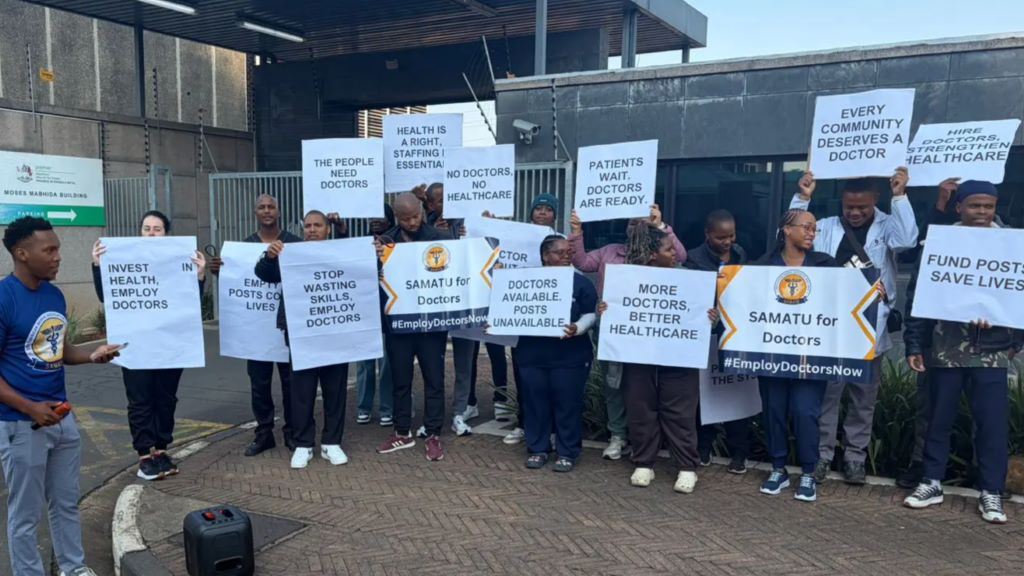
On 17 June this year, a large group of unemployed doctors protested outside Natalia, which houses the KZN Department of Health and the Office of the Premier, to call on the provincial government to act urgently to create jobs for the numerous unemployed medical professionals.
With many wearing scrubs and holding placards, the doctors voiced their willingness to serve their communities. They highlighted the shortage of qualified doctors, the systemic strain in provincial hospitals and clinics, and a poor doctor-to-patient ratio in the province.
The protesters also pointed out that some doctors have been waiting for years for jobs; and that their ambitions to specialise in various medical areas were being severely hindered because of the lack of government posts.
They submitted a memorandum addressed to KZN Premier, Thami Ntuli, Health MEC Nomagugu Simelane, and head of the health department, Penny Msimango. Among others, the protestors demanded that the provincial health department advertise all the vacant medical officer positions at various public healthcare institutions within 14 days and that it develops a sustainable long-term plan to provide posts annually and address doctor unemployment beyond 2026.
Not enough money
In a written response to the protestors, the department said: “A filling of vacant posts is dependent on the availability of funds to compensate employees. The department is underfunded for 2026/7 financial year, therefore not all vacant posts can be filled.” They said that, due to the budgetary constraints, they could not commit to timelines for filling posts.
Spotlight sent the KwaZulu-Natal Department of Health a detailed set of questions (which you can read here) on the afternoon of Thursday15 October. We gave them a deadline of end of business on Tuesday 20 October. While the department acknowledged that they received our questions, they did not provide responses by the deadline.
On July 6, Simelane met with representatives of the unemployed doctors and representatives from the South African Medical Association Trade Union (SAMATU) (the unemployed doctors say that SAMATU had to be present since the department does not recognise the group of unemployed doctors).
According to Sibiya, the meeting did not go well. “Their clear message was that the department has enforced austerity measures and they do not have money to fund posts. They committed to try and look for 20 posts but that was all they could promise,” he says. In his view, 20 is not nearly enough. The department later upped the number of newly released posts to 50. The unemployed doctors say that while these jobs have been advertised, there have been no further movement.
But what stung Sibiya more was the sense he got that the department had accepted the situation and given up. “What was really astonishing was that they said they are comfortable with the numbers of doctors in the province on paper,” he says. Spotlight asked the department whether this characterisation is accurate, but did not receive an answer.
“Our response is that …. if something’s declared a crisis, finances are moved to meet that crisis, be it at provincial or national level,” Sibiya says. “I’m sure the public feels the same way: the doctors on the ground by no means meet the demand. They could hire all the unemployed doctors in the province, and still the demand wouldn’t be met.”
“We are not trying to fight”
As the 2026 convenor of the KZN Unemployed Doctors group, Sibiya has been in the middle of much of these developments. The group was formed a few years back with the goal of communicating with the provincial health department to raise doctors’ concerns about unemployment. It was only after several other efforts at engaging the department had not gone anywhere that they decided to protest.
In the meeting, he says they stressed “that we’re not here to fight”. “We understand the department has financial constraints. But we’re talking about the health of the entire province resting on a few shoulders who are really tired; and people ready to work cannot be integrated into the system because of austerity measures”, he says.
“I think we must all agree it’s a crisis. Once we do this, I’m certain funds can be mobilised from somewhere,” he says. “Alternatively, we could expand the system of employing sessional medical officers, where doctors work for a certain number of hours in clinics and hospitals, and earn less.”
But, says Sibiya, “it’s almost as though they’ve given up”.
That sense that those in power are not hearing them was recently reinforced when premier Ntuli reportedly called on doctors who have left the province to return home and help strengthen the health system. More than one unemployed doctor told Spotlight that they were enraged by the comments in the context of their struggle to get jobs. “It’s ridiculous,” says Sibiya. “After all our efforts to speak to the government, and being ignored, now this.”
“Just go private!”
Meanwhile, Sibiya and scores of other young, unemployed doctors are still having to scramble to make ends meet.
Sibiya says people often say to unemployed doctors that they should go private. “Yes, that’s an option, but from the point of view of specialising, it destroys the pipeline. And if all of us go private, then in upcoming years, we will be talking about a shortage. And, in a time of NHI, why are doctors having to work in private”, he asks.
“It’s worse for us coming from Ingwavuma, funded by Umthombo, where when we signed the contract, we were told, ‘You’re going to come back and serve your community’. I was happy to do that,” he says. Umthombo is a scheme that supports young people from rural KwaZulu-Natal to study medicine and then to return to serve their communities once qualified.
Despite all the setbacks, the dream of serving his community remains alive for Sibiya. His eyes light up when he talks of his dream to work rurally, preferably at the hospital he loves, Manguzi.
But, right now, that dream seems far away. He says his main focus at the moment is just to survive.
*This article was first published by Spotlight – health journalism in the public interest. Sign up to the Spotlight newsletter.