

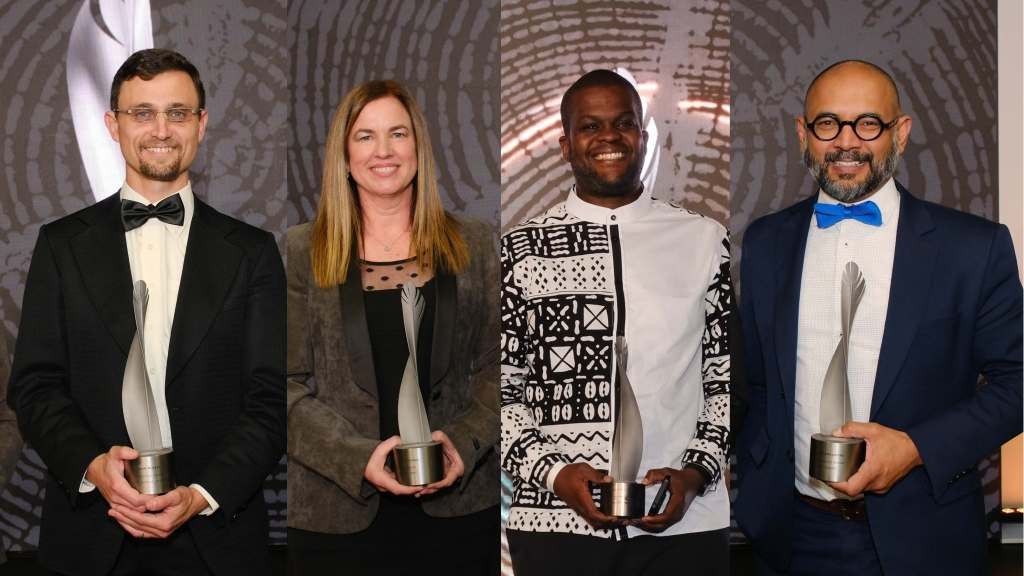
Four University of Pretoria (UP) staff members came out tops at the 2025/2026 National Science and Technology Forum (NSTF)-South32 Awards, South Africa’s premier science and innovation awards. Commonly known as the “Science Oscars”, the awards recognise exceptional contributions by individuals, teams, partnerships and organisations across a range of categories within South Africa’s science, engineering and technology sectors.
The 28th annual NSTF-South32 Awards gala event was held on 16 July 2026 simultaneously in Cape Town and Johannesburg, with a live broadcast online. This year’s awards were themed ‘Healthy Ageing’ – in line with the United Nations Decade of Healthy Ageing (2021 to 2030), a global collaboration to recognise the contribution of science, engineering and technology in improving the health and well-being of older people.
“This recognition speaks to the strength and breadth of the University of Pretoria’s research and innovation, and to our commitment to excellence across disciplines,” said Professor Sunil Maharaj, Vice-Principal: Research, Innovation and Postgraduate Education at UP. “The achievements of our researchers reflect the ambitions of our ThriveUP 2038 strategy, demonstrating how research and innovation can generate knowledge, develop solutions and create meaningful societal impact.”
This year’s recipients from UP are:
- Prof Vukosi Marivate, Director of the African Institute for Data Science and Artificial Intelligence and ABSA-UP Chair in Data Science, together with the TextAugment team and the Vuk’uzenzele Multilingual Corpus project, won the inaugural NSTF-SADiLaR Research Software: Human Language Technologies Award. This category recognises the development of open-source tools that help address data scarcity in under-resourced African languages, supporting advances in artificial intelligence and linguistic equity.
Prof Marivate and the TextAugment team’s work to develop open-source language technologies for under-resourced African languages speaks to the strategy’s ‘Digital Futures and Inclusive AI’ research theme, which focuses on building trustworthy artificial intelligence (AI), strengthening data infrastructures and advancing digital inclusion. - Prof Patricia Forbes of UP’s Department of Chemistry and editor-in-chief of the American Chemical Society’s (ACS) journal ACS Earth and Space Chemistry won the NSTF-Water Research Commission Award. She was recognised for developing analytical methods for detecting trace environmental pollutants and addressing long-standing monitoring challenges.
Prof Forbes’ pioneering work in detecting trace environmental pollutants aligns with the ‘Climate, Land, Water and Sustainability Transitions’ theme by supporting improved environmental monitoring and the sustainable management of natural resources. - In the health sciences, Prof Llewellyn Padayachy, Head of Neurosurgery and Director of UP’s Brain Tumour and Translational Neuroscience Centre (BTC@UP), won the NSTF-SAMRC Clinician-Scientist Award for developing point-of-care diagnostic tools for the early detection of brain tumours.
Prof Padayachy’s development of non-invasive diagnostic tools for the early detection of brain tumours speaks to the ‘Planetary and One Health Horizons’ research theme, which advances precision health, health system innovation and improved health outcomes. - Prof Tjaart Krüger of UP’s Department of Physics was a joint winner of the TW Kambule-NSTF Researcher Award, along with Prof Musa Manzi, Director of the Seismic Research Centre at the University of the Witwatersrand. Prof Krüger was recognised for developing ultra-sensitive single-molecule instruments that help reveal how nature converts sunlight into energy, with potential applications for cleaner, more efficient energy technologies.
Prof Krüger’s work on ultra-sensitive instruments that deepen our understanding of how nature converts sunlight into energy contributes to the scientific foundations needed for cleaner, more efficient energy technologies, reinforcing the University’s commitment to research that supports sustainable futures.
In addition to staff members, first-year student Christene Beukes, who is studying applied plant and soil sciences within UP’s Faculty of Natural and Agricultural Sciences, was among the 22 students selected for the NSTF Brilliants Programme. The programme recognises top first-year students in the science, medicine and engineering fields from each of South Africa’s nine provinces. Beukes is also a recipient of the Vice-Chancellor’s Distinguished Merit Award.
The UP researchers who were nominated as finalists for the 2025/2026 NSTF-South32 Awards are:
- Prof Brenda Wingfield – Department of Science, Technology and Innovation-National Research Foundation SARChI Chairholder: Fungal Genomics in UP’s Department of Biochemistry, Genetics and Microbiology and the Forestry and Agricultural Biotechnology Institute – was a finalist in the Lifetime Award category for her contributions to understanding the genetics and genomics of fungal plant pathogens and for her role in educating and mentoring generations of researchers.
- Prof Hendrik Brink of the Department of Chemical Engineering received recognition in two categories. He was a finalist in both the Engineering Research Capacity Development Award and the NSTF-TIA Green Economy Award for building South Africa’s engineering research capacity through postgraduate training focused on scalable water treatment solutions.
- Prof Rebecca Garland of the Department of Geography, Geoinformatics and Meteorology was acknowledged in the NSTF-TIA Green Economy Award category for research that strengthens the evidence base for air quality management in South Africa through an integrated approach.
- The Department of Animal Science, led by Prof Carina Visser, was a finalist for the NSTF-Agricultural Research Council Award. The department was recognised for its interdisciplinary research on low-emissions sustainable livestock production, the genetic improvement of local breeds for adaptation, and the delivery of safe, welfare-friendly animal protein.
- Shakira Hoosain, campaign strategist and senior copywriter, and editor of UP science platform Research Matters and RE.SEARCH magazine was a finalist in the Communication Award category. She was recognised for developing a multimedia science communication platform that translates academic research into accessible public knowledge through storytelling, media engagement and digital content.
“Every one of these accolades represents years of rigorous dedication,” Prof Maharaj said. “While we celebrate the individual achievements, they also reflect the collective effort of colleagues, students and partners across the University. We congratulate all our winners and finalists for the well-deserved recognition.”
