

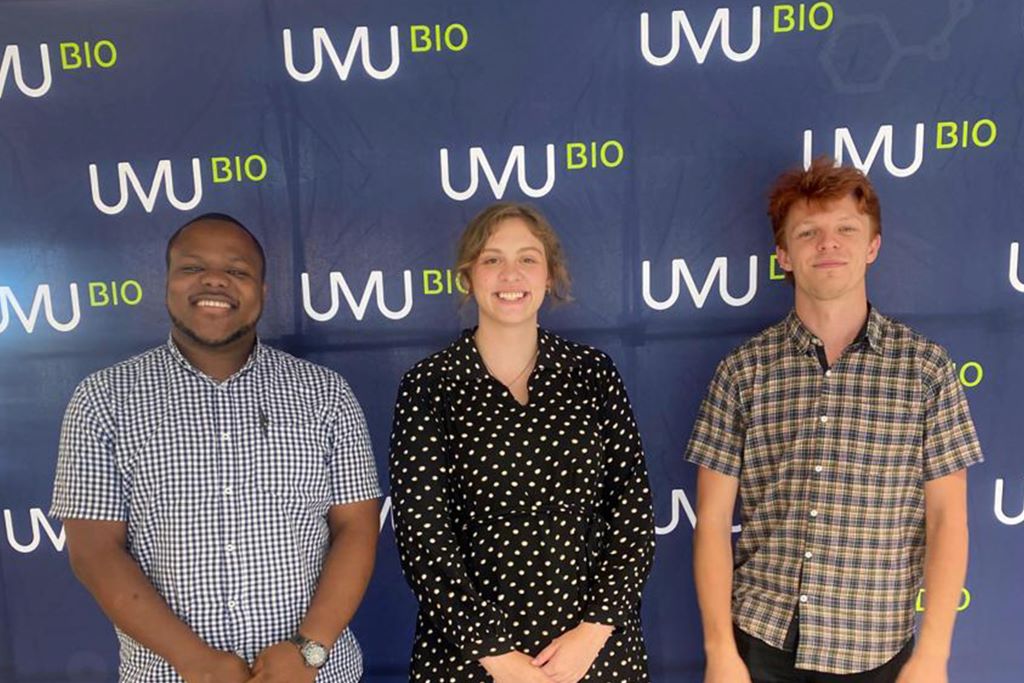
A team of young researchers at the University of Pretoria (UP) is developing an innovative health supplement that transforms citrus peel waste into a potentially powerful tool against lifestyle diseases such as diabetes, obesity and high cholesterol, while also improving the affordability and accessibility of preventative health products for low-income communities.
The NutraPectin project is led by postdoctoral research fellow Dr Kadima Tshiyoyo, alongside recent Master of Science in Biochemistry graduates Ryan Bosch and Marni Oberholzer. Together, the team from UP’s Faculty of Natural and Agricultural Sciences (NAS) is converting citrus processing waste into a pectin-rich nutraceutical using green extraction technology. When consumed with food, pectin can help slow sugar absorption, reduce cholesterol levels and support gut health.
“South Africa’s growing burden of lifestyle diseases and abundance of agricultural waste inspired our work,” Dr Tshiyoyo said. “NutraPectin uses sustainable green methods to extract bioactive compounds from waste, which are valuable and essential in the management of lifestyle diseases such as diabetes and obesity.”
Turning science into solutions
The development of NutraPectin addresses two growing challenges: the rising prevalence of lifestyle-related diseases and the environmental cost of agricultural and food processing waste. Citrus peel, which is typically discarded in large volumes by the citrus industry, is rich in pectin and other bioactive compounds that can be recovered and repurposed.
Bosch says the NutraPectin research was his honours-degree project under Prof Samkelo Malgas of UP’s Department of Biochemistry, Genetics and Microbiology. “I was drawn to the project as I am passionate about maintaining the environment, and I was excited to investigate how food waste could be converted into useful healing products.”
For Bosch and Oberholzer, the project represents more than laboratory research. It is an opportunity to demonstrate how student-led science can be translated into solutions with tangible social and economic impact, particularly in a country where both healthcare access and food system sustainability remain pressing concerns.
“Sustainability should both underlie and overarch most research if we want to see true economic and social growth,” Oberholzer said. “South Africa has so much potential to sustainably improve and empower our agricultural industry by targeting circularity through waste valorisation. UP was foundational in this development, most markedly through our excellent supervisor’s guidance. We were allowed to explore beyond the strict boundaries of our degrees.”
The project is rooted in the Biocatalysis and Processing Research Group in the Department of Biochemistry, Genetics and Microbiology within the NAS Faculty, under the supervision of Prof Malgas. He says the work highlights the importance of university-based research in advancing both innovation and entrepreneurship, while also addressing societal challenges through science-driven solutions.
“This pectin extraction from citrus waste represents a remarkable advancement in enzyme biotechnology. The student-led innovation model effectively merges hands-on research with mentorship, equipping students with essential skills in biotechnological methods,” Prof Malgas said. “It demonstrates that active student involvement is crucial in driving innovation and developing talent. The technology promises significant environmental benefits by promoting sustainable waste use and reinforcing the circular economy. Additionally, it has the potential to drive economic growth for South Africa’s citrus industry through the production of high-value pectin.”
Catalyst competition winner
A major milestone for the project came in 2024 when NutraPectin was named the winner of the Catalyst competition, an early-stage biotech start-up pitch event organised by Immobazyme in partnership with UVU Bio. The competition brought together seven finalist teams developing biotech solutions aimed at real-world challenges.
NutraPectin stood out to judges for its dual impact: addressing lifestyle diseases while simultaneously offering a scalable approach to waste valorisation in the agricultural sector. The win signalled growing confidence in the commercial viability of the technology, moving it beyond academic research into the early stages of commercialisation.
Indeed, the Catalyst win also unlocked a structured support package designed to accelerate start-up development. This includes access to laboratory space, a reagent and consumables credit facility, mentorship from industry executives, business development training, and specialised technical support to help refine and scale production processes.
The team has also secured a Technology Innovation Agency Seed Grant, which will further support the optimisation of production methods and the transition from prototype to scalable manufacturing.
However, NutraPectin remains in the early stages of development. The current focus is on developing a production pathway that can support larger-scale manufacturing, enabling the product to be brought to market.
Looking ahead, the team envisions NutraPectin as a locally produced, widely accessible nutraceutical that supports preventative health while creating value from South Africa’s agricultural resources.
To move from a laboratory success to a market-ready product, the team is now seeking additional funding and industry partnerships to support pilot-scale production and regulatory development.
“It is envisioned that NutraPectin can move from optimisation and scale-up to a market-ready prototype supported by partnerships and collaboration to expand within South Africa,” Dr Tshiyoyo said. “Our long-term goal is to make the product affordable and accessible while creating sustainable health and commercial impact. We see NutraPectin growing into a versatile innovation with potential in the supplement, health additive, cosmetic, and pharmaceutical industries.”
As South Africa’s Youth Month draws to a close, the NutraPectin team’s work reflects the growing role of young researchers in developing solutions that integrate health, sustainability and innovation. Dr Tshiyoyo advises other young researchers to stay focused and work steadily towards their goals. “My message to the youth is think long term but act today; many consistent steps over the years can lead to your breakthrough,” he said.
Provided by University of Pretoria
