Month: April 2025

8 Million People Living with HIV in SA, According to Latest Estimates

Photo by Miguel Á. Padriñán

By Marcus Low

The number of people living with HIV in South Africa has for the first time reached the eight million mark. Of these, around 6.2 million are on treatment, according to new estimates.

The number of people living with HIV in South Africa continues to rise, surpassing eight million in 2024. This is according to just-released estimates from Thembisa, the leading mathematical model of HIV and TB in South Africa. The eight million amounts to 12.8% of the population.

The continued rise is due to the fact that there are more people becoming newly infected with HIV than there are people with HIV who are dying. The increasing numbers are thus a reflection of the fact that antiretroviral medicines are keeping people alive who would otherwise have died.
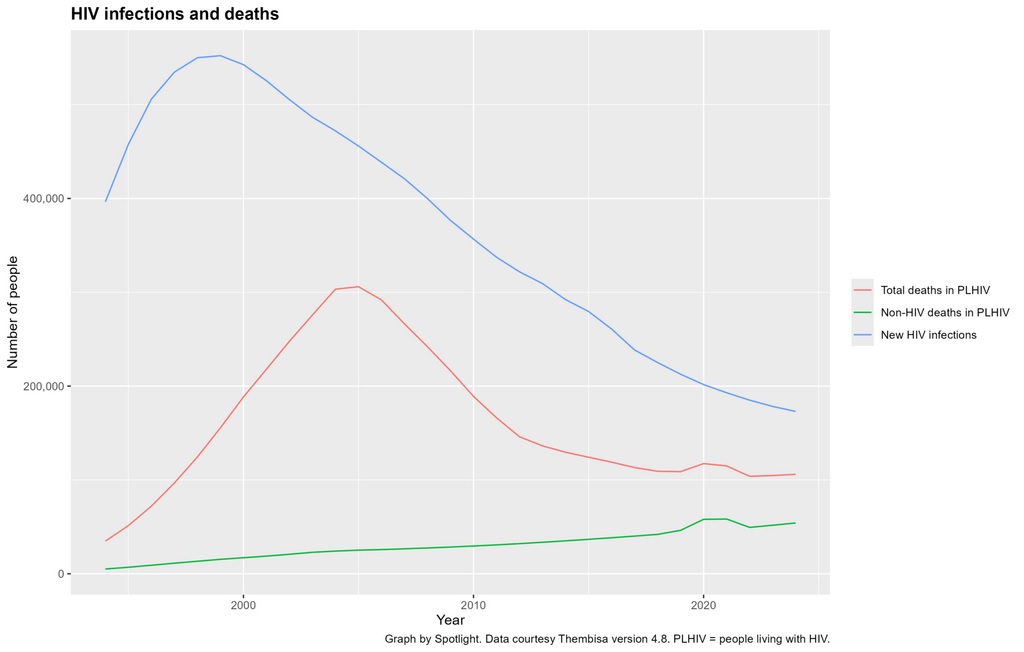
There was an estimated 178 000 new HIV infections in 2023/2024 (mid-2023 to mid-2024). Over the same period, around 105 000 people with HIV passed away – 53 000 due to HIV-related causes and 52 000 for reasons not related to HIV.

The estimates of new HIV infections are slightly higher than in last year’s Thembisa publications. According to Dr Leigh Johnson, of the University of Cape Town and the key developer of the Thembisa model, this is mainly due to the model factoring in new evidence that condom usage is declining.

78% treatment coverage

Of the eight million people living with HIV, around 6.2 million, or 78%, were taking antiretroviral treatment in 2024. Around one in five people living with the virus were thus not on treatment. Treatment is recommended for everyone living with HIV.

On the UNAIDS 95-95-95 targets, also endorsed in South Africa’s National Strategic Plan for HIV, TB and STIs 2023 – 2028, the middle target, helping people start and stay on treatment, continues to be the main area of underperformance. Around 95% of people living with HIV in South Africa knew their status in 2024, around 81.5% of these were on antiretroviral treatment, and of those on treatment, around 92% had viral suppression. (Note that the 78% treatment coverage figure is the product of multiplying the performance on the first two 95 targets.)

There continues to be stark gender disparities in South Africa’s HIV epidemic. On the one hand, there are many more women living with HIV than men – 5.2 million compared to 2.6 million as of mid-2024. On the other hand, slightly more men died of HIV-related causes than women in 2023/2024 – 27 100 men compared to 24 200 women.

Worrying trends

One ongoing area of concern is that many people only start treatment once their immune systems have been severely compromised. In 2023/2024, around 54 000 adults started treatment for the first time with CD4 counts below 200 cells/mm3. A CD4 count above 500 cells/mm3 is generally considered to be healthy. CD4 cells are a type of white blood cell that is vital to the functioning of the immune system. People who start treatment with low CD4 counts tend to have worse long-term outcomes.

The latest Thembisa outputs also contain worrying findings on the extent to which people drop in and out of care. In 2023/2024, an estimated 714 000 people restarted antiretroviral treatment after previously having stopped for at least a month – of these, around 326 000 had CD4 counts below 200 cells/mm3.

Finally, on a more positive note, the latest Thembisa outputs continue to show a rise in life expectancy in South Africa. As shown in the above graph, life expectancy declined severely round the turn of the century, largely due to people dying of AIDS, but then increased over time as antiretroviral therapy started keeping people living with HIV alive. The blip in 2020 and 2021 is due to the COVID-19 pandemic.

Note: This article is based on outputs from Thembisa version 4.8 – published in late March 2025. We have quoted 2023/2024 figures since they are based on more data, and thus more reliable than the estimates for 2024/2025. We have rounded some numbers to make the text more accessible. Graphs were made using the R package ggplot2. Spotlight will soon publish an #InTheSpotlight special briefing in which we will unpack the Thembisa 4.8 outputs in more detail.

Republished from Spotlight under a Creative Commons licence.

Read the original article.

Radiopharmaceuticals Being Tested for Brain Tumours in Children

Credit: National Cancer Institute

Neuroblastoma is a rare disease that affects children, often before the age of two. Some are born with the disease. Paediatric surgeon Jakob Stenman is investigating whether targeted radioactive drugs can slow down the disease in those with the most severe form.

Neuroblastoma is a complicated disease, with the most aggressive variant called high-risk neuroblastoma. Children with this disease are treated very intensively. They may undergo surgery, chemotherapy, high-dose chemotherapy with stem cell transplantation, radiotherapy and antibody treatment. Treatment often lasts up to a year and a half.

Despite this, the survival rate is around 60%, according to the Swedish Childhood Cancer Foundation.

“Some relapse in their disease, and we currently lack curative treatment for them,” says Jakob Stenman, a researcher at the Department of Women’s and Children’s Health at Karolinska Institutet.

It is these children, those who have relapsed, that he is treating in a study with targeted radioactive drugs. These are molecules that attach to the surface of cancer cells. These molecules have an appendage: the radioactive substance lutetium-177. The drug first moves through the bloodstream but then attaches to the cancer cells. The emitted radiation damages the cancer cells but unfortunately also the neighbouring healthy cells.

“We have treated ten children so far. Unfortunately, the disease has not disappeared in any of these cases, but it seems to be slowing down, and some benefit more than others from the treatment. When it comes to side effects, the children have tolerated the treatment well,” says Jakob Stenman.

The hope is to be able to prevent relapse

He reports that the interest has been great from clinics in other countries where these children are treated. Hospitals from Lithuania, the Netherlands, the United Kingdom and are now involved.

In neuroblastoma, cancer cells often look very different, even in the same patient. In some metastases, there may be many cells with a surface where the drug attaches, while in other metastases there may be fewer such cells. This means that the targeted drug attaches to fewer cells in some of the metastases. As a result, the local radiation dose is too low in these metastases, which can then continue to grow and spread further.

Jakob Stenman therefore believes that the treatment could be more effective if the radioactive substance used is even more potent, which in this context means that it emits even more energy (ie, radiation). If it then attaches to fewer cells in a metastasis, it might still be able to eliminate all the cancer cells there. But it must act even more locally to protect other tissues from the higher radiation dose.

The researchers have identified several substances they believe could work in this way. These include actinium-225, astatine-211 or lead-212. The effects and side effects of actinium-225 are now being investigated in cell studies and animal experiments. The goal is to start a clinical trial with actinium in three to five years.

“If what we believe turns out to be true, we hope to be able to prevent relapse and thereby enable a cure for a larger proportion of children who have developed high-risk neuroblastoma,” says Jakob Stenman.

Text: Annika Lund for Medicinsk Vetenskap nr 4 2024 

Source: Karolinska Institutet

Persistent Parasites are Not Totally Protected from Immune Response

Source: Wikimedia CC0

Most humans have long-lived infections in various tissues, including in the nervous system, that typically do not result in disease. The microbes associated with these infections, such as Toxoplasma gondii, enter a latent stage during which they quietly hide in cells, playing the long game to evade capture and ensure their own survival. But a lack of natural models to study these quiescent stages has led to gaps in scientists’ understanding of how latency contributes to pathogen persistence and whether these stages can be targeted by the immune system.

Now, a team led by University of Pennsylvania School of Veterinary Medicine researchers shows that the immune system indeed recognises the latent stage of the parasite Toxoplasma gondii, which causes toxoplasmosis. The work, published in Nature Microbiology, challenges some common assumptions about how the immune system deals with infections in the brain. Senior author Christopher A. Hunter, professor at PennU Vet, says this knowledge supports the idea that Toxoplasma gondii cysts can be targeted and perhaps even cleared, and the findings have implications for other infections and potential future therapies. The paper also demonstrates how cysts promote the mutual survival of the parasite and host.

In its latent stage, Toxoplasma gondii forms long-lived cysts in neurons in the brain, which helps the parasite evade the host’s immune response. In this study, the researchers found that certain T cells can target neurons containing cysts, thereby promoting parasite control. But there’s a tradeoff: They also found that when cysts are not formed, there is an even higher parasite burden and increased damage to the brain. The study is published in Nature Microbiology.

“There’s this balance of the pathogen needing to take hold in the host but not expand so much that it’s detrimental to the host, because if the host dies, the pathogen may not survive,” says author Lindsey A. Shallberg, who at the time of the research was a doctoral student in Hunter’s lab.

Toxoplasma gondii causes toxoplasmosis, an infection that is asymptomatic for most healthy people but poses a greater risk for those who are immunocompromised or pregnant. It is caused by eating contaminated, poorly cooked meat and by exposure to infected cat faeces, as felines are the only animal in which the parasite can sexually reproduce.

Co-author Julia N. Eberhard, an immunology doctoral student, points to two findings that run counter to preexisting literature and common notions among immunologists. She says scientists long thought that Toxoplasma gondii cysts could hide out in neurons to prevent immune recognition, but this study showed that “neurons aren’t this complete refuge for pathogens.”

This image shows Toxoplasma gondii (red) and a neuron (green) in a mouse brain.
(Image: Courtesy of Anita Koshy)

Eberhard says another commonly held belief was that the parasite needs to form cysts to be able to persist, but in looking at a parasite strain that couldn’t convert to the cyst stage, the researchers found that the immune system did not clear the parasite. They could still identify parasites in mice six months later, which Eberhard found very surprising.

Mathematical modelling independently confirmed experimental findings and indicated that immune pressure on the latent stage of Toxoplasma gondii could explain the observed rise and fall in cyst numbers. This was done by Aaron Winn, a doctoral student in the Department of Physics and Astronomy.

Shallberg says this paper came about because co-author Sebastian Lourido, an associate professor of biology at MIT, had identified the key molecular mechanism that allows the parasite to become latent and wanted to know what would happen if the parasite could not form cysts. In addition, co-author Anita Koshy, a neurologist and scientist at the University of Arizona, had evidence that some neurons could rid themselves of this infection. 

While Toxoplasma gondii is a relevant microorganism to study in and of itself, it is also useful in furthering scientists’ understanding of nervous system infections with latent stages in humans that don’t have mouse models, such as cytomegalovirus. “What makes it special is the fact that it’s a tractable model that we can use in the lab and then apply what we’ve learned to other infections,” Shallberg says.

Looking ahead, Hunter says that his laboratory continues to investigate whether T cells directly recognise the neurons and to study the T cell response in more detail.

Source: University of Pennsylvania