Tag: Toxoplasma gondii

Scientists Find Hidden Diversity Among T. Gondii

UC Riverside study reshapes understanding of toxoplasmosis and identifies new paths for treatment
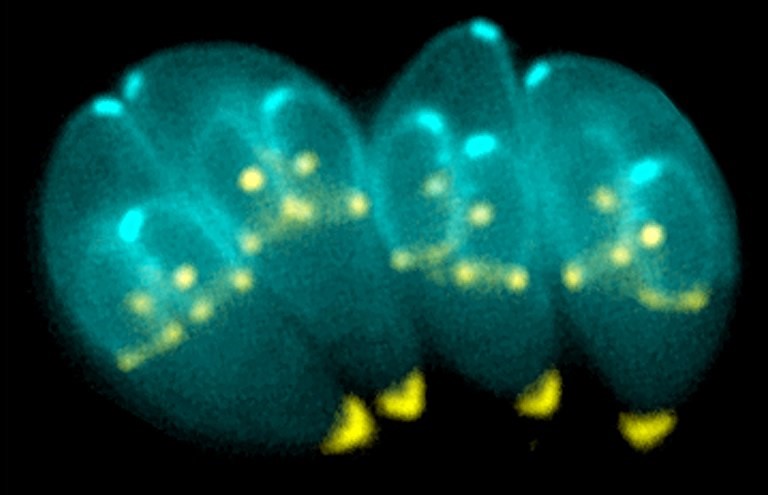
Toxoplasma gondii. Source: Wikimedia CC0

A University of California, Riverside team of scientists has found that Toxoplasma gondii, a common parasite affecting up to one-third of the global population, is far more complex than previously believed. The findings, published in Nature Communications, offer new insight into how T. gondii causes disease and why it has been so difficult to treat.

Humans commonly contract toxoplasmosis by eating undercooked meat or through exposure to contaminated soil or cat faeces. The parasite is best known for its ability to hide in the body by forming tiny cysts in the brain and muscles. 

Most people who are infected never notice any symptoms. However, the parasite remains in the body for life as cysts, which can contain hundreds of parasites. The parasites they lodge can become active again later, however, especially in people with weakened immune systems, leading sometimes to serious problems affecting the brain or eyes. Most people who are infected never notice any symptoms. Infection during pregnancy can cause serious complications for developing babies with limited immune systems. 

Until now, scientists believed that the cysts contained a single, uniform type of parasite lying dormant until it reactivated. But using advanced single-cell analysis techniques, the UC Riverside team discovered that each cyst contains multiple distinct subtypes of parasites, each with different biological roles.

“We found the cyst is not just a quiet hiding place – it’s an active hub with different parasite types geared toward survival, spread, or reactivation,” said Emma Wilson, a professor of biomedical sciences in the UCR School of Medicine who led the study. 

Wilson explained that cysts form slowly under immune pressure and are encased in a protective wall, housing hundreds of slow-replicating parasites called bradyzoites. Although microscopic, cysts are relatively large for intracellular pathogens, reaching up to 80 microns in diameter, with each bradyzoite measuring roughly five microns in length. They reside primarily within neurons but are also commonly found in skeletal and cardiac muscle, which is important since humans are often infected by consuming undercooked meat containing these cysts.

According to Wilson, cysts are clinically and biologically significant for several reasons. They are resistant to all existing therapies and remain in the body once established. They facilitate transmission between hosts. When reactivated, bradyzoites convert into fast-replicating tachyzoites that disseminate throughout tissues, causing severe disease such as toxoplasmic encephalitis (neurological damage) or retinal toxoplasmosis (vision loss).
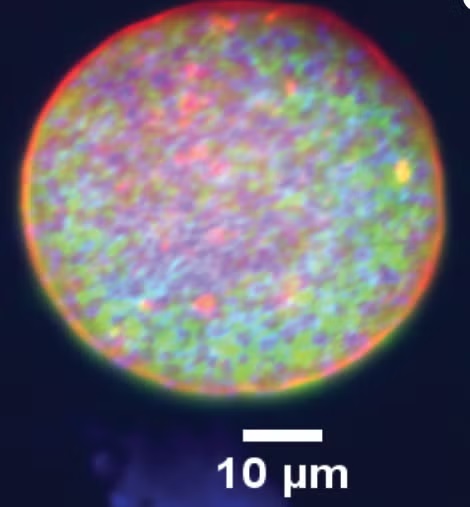
Image shows a cyst which can contain hundreds of T. gondii parasites. (UCR/Wilson lab)

“For decades, the Toxoplasma life cycle was understood in overly simplistic terms, conceptualised as a linear transition between tachyzoite and bradyzoite stages,” Wilson said. “Our research challenges that model. By applying single-cell RNA sequencing to parasites isolated directly from cysts in vivo, we found unexpected complexity within the cyst itself. Rather than a uniform population, cysts contain at least five distinct subtypes of bradyzoites. Although all are classified as bradyzoites, they are functionally different, with specific subsets primed for reactivation and disease.”

Wilson acknowledged that studying cysts has long been a technical challenge. They grow slowly, are embedded deep within tissues like the brain, and do not form efficiently in standard laboratory cultures. As a result, most genetic and molecular studies of Toxoplasma have focused on tachyzoites grown in vitro, leaving the biology of cyst-resident bradyzoites poorly understood. 

“Our work overcomes those limitations by using a mouse model that closely mirrors natural infection,” Wilson said. “Because mice are a natural intermediate host for Toxoplasma, their brains can harbour thousands of cysts. By isolating these cysts, digesting them enzymatically, and analysing individual parasites, we were able to gain a view of chronic infection as it occurs in living tissue.”

Wilson explained that current treatments for toxoplasmosis can control the fast-growing form of the parasite that causes acute illness, but no existing drugs can eliminate the cysts. 

“By identifying different parasite subtypes inside cysts, our study pinpoints which ones are most likely to reactivate and cause damage,” she said. “This helps explain why past drug development efforts have struggled and suggests new, more precise targets for future therapies.”

Congenital toxoplasmosis remains a major concern when primary infection occurs during pregnancy, potentially leading to severe foetal outcomes. Although prior immunity typically protects the foetus, routine screening is lacking in some countries, reflecting how difficult it is to manage an infection that is common but usually symptom-free.

Despite its prevalence, toxoplasmosis has received relatively little attention compared to other infectious diseases. Wilson hopes her team’s work will help shift that perspective.

“Our work changes how we think about the Toxoplasma cyst,” she said. “It reframes the cyst as the central control point of the parasite’s life cycle. It shows us where to aim new treatments. If we want to really treat toxoplasmosis, the cyst is the place to focus.”

Wilson was joined in the study by Arzu Ulu, Sandeep Srivastava, Nala Kachour, Brandon H. Le, and Michael W. White. Wilson and White are co-corresponding authors of the paper.

The study was supported by grants from the National Institute of Allergy and Infectious Diseases of the National Institutes of Health. 

The title of the paper is “Bradyzoite subtypes rule the crossroads of Toxoplasma development.”

Toxoplasma Gondii’s Disruption of the Brain Gives Clues to New Treatments

Source: Wikimedia CC0

A team of scientists at the University of California, Riverside, explains in a paper published in PLoS Pathogens how the microscopic parasite Toxoplasma gondii can significantly disrupt brain function, even when it infects only a small number of neurons. The team found the parasite interferes with essential communication between brain cells — research that can offer new ways to detect and treat chronic brain infections.

Toxoplasma gondii can infect nearly any warm-blooded animal and prefers to live inside brain cells, forming cysts in neurons that can persist for life. The researchers report that they found infected neurons release fewer extracellular vesicles (EVs) — tiny, membrane-bound packets used by cells to exchange information. 

“We found this disruption in EV signalling can interfere with how neurons and glial cells, especially astrocytes, maintain a healthy brain environment,” said Emma H. Wilson, a professor of biomedical sciences in the UC Riverside School of Medicine who led the research team. “Even a handful of infected neurons can shift the brain’s neurochemical balance. This suggests that communication between neurons and supporting glial cells is not only critical, but also vulnerable to hijacking by parasites.”

Approximately 10–30% of people in the United States are infected with Toxoplasma gondii, often without knowing it. The parasite is typically contracted through undercooked meat or exposure to cat feces. Although the immune system typically keeps the infection in check, the parasite can lie dormant in the brain for decades. In individuals with weakened immunity, it can reactivate and cause serious illness.

Current diagnostic tools can only detect whether someone has been exposed to Toxoplasma gondii by identifying antibodies. The tools cannot confirm whether the parasite is still present in the brain or how it may be affecting brain function.

“Our research opens the door to using EVs as biomarkers, which can be isolated from blood,” Wilson said. 

The study was conducted using mouse models and human cells in a laboratory setting.

Wilson explained that in healthy mouse brains astrocytes regulate neurotransmitters like glutamate, ensuring that neurons do not become overexcited. But when neurons infected with Toxoplasma gondii stop sending the right EV signals, this regulation breaks down. The result is elevated glutamate levels, which can lead to seizures, neural damage, or altered brain connectivity.

“The parasite may play a larger role in neurological and behavioural conditions than we previously thought,” she said.

Wilson’s research team is now working to analyse samples from human blood banks to look for EVs linked to Toxoplasma gondii brain infection. The team also hopes to better understand how glial cells detect and respond to parasite proteins — insights that could one day lead to new therapies or even vaccines.

“Our brains have built-in defences that may recognise and respond to neurons infected by Toxoplasma gondii,” Wilson said. “If we can learn how to support or enhance that process, we may be able to better protect people, especially the most vulnerable.”

Despite its potential impact, Toxoplasma gondii is often misunderstood, Wilson added. 

“There’s no need to avoid someone who is infected; most people live their entire lives without symptoms,” she said. “Pregnant individuals should be cautious as the parasite can cause serious birth defects if contracted for the first time during pregnancy. The most effective prevention is proper food handling and hygiene. Cook meat thoroughly, wash vegetables, and always wash your hands after handling cat litter, especially from young cats, which are more likely to shed the parasite.”

Source: University of California, Riverside

Persistent Parasites are Not Totally Protected from Immune Response

Source: Wikimedia CC0

Most humans have long-lived infections in various tissues, including in the nervous system, that typically do not result in disease. The microbes associated with these infections, such as Toxoplasma gondii, enter a latent stage during which they quietly hide in cells, playing the long game to evade capture and ensure their own survival. But a lack of natural models to study these quiescent stages has led to gaps in scientists’ understanding of how latency contributes to pathogen persistence and whether these stages can be targeted by the immune system.

Now, a team led by University of Pennsylvania School of Veterinary Medicine researchers shows that the immune system indeed recognises the latent stage of the parasite Toxoplasma gondii, which causes toxoplasmosis. The work, published in Nature Microbiology, challenges some common assumptions about how the immune system deals with infections in the brain. Senior author Christopher A. Hunter, professor at PennU Vet, says this knowledge supports the idea that Toxoplasma gondii cysts can be targeted and perhaps even cleared, and the findings have implications for other infections and potential future therapies. The paper also demonstrates how cysts promote the mutual survival of the parasite and host.

In its latent stage, Toxoplasma gondii forms long-lived cysts in neurons in the brain, which helps the parasite evade the host’s immune response. In this study, the researchers found that certain T cells can target neurons containing cysts, thereby promoting parasite control. But there’s a tradeoff: They also found that when cysts are not formed, there is an even higher parasite burden and increased damage to the brain. The study is published in Nature Microbiology.

“There’s this balance of the pathogen needing to take hold in the host but not expand so much that it’s detrimental to the host, because if the host dies, the pathogen may not survive,” says author Lindsey A. Shallberg, who at the time of the research was a doctoral student in Hunter’s lab.

Toxoplasma gondii causes toxoplasmosis, an infection that is asymptomatic for most healthy people but poses a greater risk for those who are immunocompromised or pregnant. It is caused by eating contaminated, poorly cooked meat and by exposure to infected cat faeces, as felines are the only animal in which the parasite can sexually reproduce.

Co-author Julia N. Eberhard, an immunology doctoral student, points to two findings that run counter to preexisting literature and common notions among immunologists. She says scientists long thought that Toxoplasma gondii cysts could hide out in neurons to prevent immune recognition, but this study showed that “neurons aren’t this complete refuge for pathogens.”

This image shows Toxoplasma gondii (red) and a neuron (green) in a mouse brain.
(Image: Courtesy of Anita Koshy)

Eberhard says another commonly held belief was that the parasite needs to form cysts to be able to persist, but in looking at a parasite strain that couldn’t convert to the cyst stage, the researchers found that the immune system did not clear the parasite. They could still identify parasites in mice six months later, which Eberhard found very surprising.

Mathematical modelling independently confirmed experimental findings and indicated that immune pressure on the latent stage of Toxoplasma gondii could explain the observed rise and fall in cyst numbers. This was done by Aaron Winn, a doctoral student in the Department of Physics and Astronomy.

Shallberg says this paper came about because co-author Sebastian Lourido, an associate professor of biology at MIT, had identified the key molecular mechanism that allows the parasite to become latent and wanted to know what would happen if the parasite could not form cysts. In addition, co-author Anita Koshy, a neurologist and scientist at the University of Arizona, had evidence that some neurons could rid themselves of this infection. 

While Toxoplasma gondii is a relevant microorganism to study in and of itself, it is also useful in furthering scientists’ understanding of nervous system infections with latent stages in humans that don’t have mouse models, such as cytomegalovirus. “What makes it special is the fact that it’s a tractable model that we can use in the lab and then apply what we’ve learned to other infections,” Shallberg says.

Looking ahead, Hunter says that his laboratory continues to investigate whether T cells directly recognise the neurons and to study the T cell response in more detail.

Source: University of Pennsylvania

Cat-borne Toxoplasma Gondii Linked to Frailty in the Elderly

Photo by FOX: https://www.pexels.com/photo/brown-tabby-cat-scratching-head-1265613/

Toxoplasma gondii, a common, cat-borne parasite already associated with risk-taking behaviour and mental illness in humans may also contribute to exhaustion, loss of muscle mass, and other signs of frailty in older adults, suggests a study published in the Journal of Gerontology: Medical Science.

The research, by an international team of scientists including University of Colorado Boulder, University of Maryland School of Medicine and the University of A Coruña in Spain, is the latest to explore how the tiny, single-celled organism T. gondii could have big impacts on human health.

“We often think of T. gondii infection as relatively asymptomatic, but this study highlights that for some people it may have significant health consequences later on,” said co-author Christopher Lowry, a professor at CU Boulder.

Some 11%–15% of people in the US have been infected with T. gondii at some point and rates tend to be far higher in older individuals. In some countries, more than 65% have been infected. Once infected, people can unknowingly harbour the parasite for life.

For the study, the team examined the blood of 601 Spanish and Portuguese adults over 65, along with measures of a common geriatric syndrome known as frailty – which includes unintentional weight loss, tiredeness, loss of cognitive sharpness and other indications of declining health.

A whopping 67% of study subjects were “seropositive” showing markers in their blood of a latent infection.

The researchers did not, as they originally hypothesized, find an association between any infection to T. gondii and frailty. But they did find that, among those infected, those with higher “serointensity” or a higher concentration of antibodies to the parasite, were significantly more likely to be frail.

Higher serointensity could reflect a more virulent or widespread infection, multiple infections or recent reactivation of a latent infection, the authors said.

“This paper is important because it provides, for the first time, evidence of the existence of a link between frailty in older adults and intensity of the response to T. gondii infection,” said co-author Blanca Laffon, a professor of psychobiology at the Interdisciplinary Centre of Chemistry and Biology at University of A Coruña.

How cats spread T. gondii

Wild and domestic felines are considered the definitive host of the parasite, while warm-blooded animals like birds and rodents serve as secondary hosts: When cats eat infected animals, T. gondii takes up residence and multiplies in their intestines, shedding eggs in their faeces.

People are typically infected via exposure to those eggs (via litter boxes, contaminated water or dirty vegetables) or by eating undercooked pork, lamb or other meat that’s infested.

Most people never know they’ve been infected, with only about 10% initially having brief flu-like symptoms. But T. gondii tends to linger dormant for decades, cloaked in cysts in muscle and brain tissue (specifically the emotion-processing region known as the amygdala) with some insidious impacts, mounting research suggests.

In a creepy evolutionary trick seemingly designed to benefit the parasite’s favourite host, rodents infected with T. gondii tend to lose their fear of felines, making it easier for cats to catch rats and mice. In the wild, infected chimpanzees have been shown to actually grow attracted to the smell of the urine of their feline predator, the leopard.

People who have been infected also tend to engage in risky behaviour, with research showing they tend to be more impulsive, more entrepreneurial and more likely to get in a car accident. They also have higher rates of schizophrenia, certain mood disorders, cognitive problems and are more likely to attempt suicide, according to research by Lowry and Dr Teodor Postolache, a professor in the Department of Psychiatry at University of Maryland School of Medicine and senior author on the new study.

A declining immune response?

The authors caution that the new study does not prove causation, but suggests the association should be researched.

They found that frail people with high T. gondii seropositivity also had higher levels of certain inflammatory markers, suggesting that infection with the parasite could exacerbate inflammation that already occurs with aging – aka. “inflammaging.”

Because latent T. gondii tends to hide out in muscle tissue, Postolache suspects it could also play a role in hastening sarcopenia.

Lowry’s research focuses on the impact microorganisms have on the immune system and, thus, mental health. He notes that many microbes that humans have evolved with impact health in a positive way – a theory known as the ‘Old Friends’ hypothesis. Even T. gondii may have health benefits we aren’t yet aware of, he said. But in some cases, a switch flips, and friends become enemies.

In the case of T. gondii, certain medications or immune compromising diseases like HIV or cancer can enable a latent infection to escape suppression and reactivate, with adverse effects. Even in people with healthy immune systems, Lowry notes, immune function can decline with age, potentially wakening dormant dormant T. gondii.

The researchers hope their study will inspire more research into the relationship between T. gondii and frailty, and ultimately lead to new ways of keeping the parasite from doing harm.

For now, they encourage people – especially pregnant and immunocompromised people – to take steps to avoid infection.

Tips for preventing infection:

Change litter box daily, and wash hands afterward.

Avoid eating undercooked meat.

Rinse fruits and vegetables.

If pregnant or immunocompromised:

Avoid changing the litter box if possible (T. gondii infection during pregnancy can cause serious problems to a developing foetus).

Keep cats indoors.

Avoid stray cats.

Source: University of Colorado at Boulder

New Treatment for Toxoplasmosis Could Target Parasite Cysts

Toxoplasma gondii. Source: Wikimedia CC0

Findings from a new University of Kentucky College of Medicine study published in the Journal of Biological Chemistry could lead to a new treatment for Toxoplasma gondii, the parasite that causes toxoplasmosis.

An estimated 40 million people in the US carry the parasite T. gondii, according to the Centers for Disease Control and Prevention, but most are asymptomatic because the immune system usually keeps the parasite from causing illness. However, for women newly infected during pregnancy and anyone with a compromised immune system, toxoplasmosis can cause severe illness or even death.

In individuals with severe toxoplasmosis, cyst version of the parasite may be present within brain and muscle tissue. These cysts are responsible for causing serious disease, especially in people who are immunocompromised. While there are FDA-approved drugs to treat the symptoms of toxoplasmosis, no current therapeutics target the cyst form of the parasite.

The labs of Matthew Gentry, PhD, and Craig Vander Kooi, PhD, at UKCM and Zhong-Yin Zhang, PhD, at the Purdue Institute for Drug Discovery, collaborated to develop a drug that targets the cyst form of the parasite.

In previous research, Dr Gentry identified an enzyme in T. gondii called TgLaforin, which he hypothesised was critical in allowing the parasite to access energy from a carbohydrate storage molecule. The team developed a new drug that inhibits TgLaforin with the goal of preventing enzymes from accessing and providing energy to the parasite.

The new discovery was made possible thanks to the multidisciplinary collaboration of experts from the four labs, said Dr Gentry.

Robert Murphy, PhD, a member of the Gentry and Sinai labs, conducted initial experiments that characterised TgLaforin and provided a baseline for understanding the enzyme’s function.

Tiantian Chen, a graduate student in Vander Kooi’s lab, generated models of TgLaforin using a new program called AlphaFold2, an AI algorithm that provides valuable insights into research. Chen generated models that provided a picture of the enzyme that demonstrated TgLaforin was a unique and possible drug target.

Jianping Lin, PhD, a postdoc in Dr Zhang’s lab, then used information generated by Dr Murphy and Chen in combination with novel techniques in chemistry to generate the first version of a future anti-Toxoplasma drug.

“I was excited to find that the drug was effective against TgLaforin in test tubes and that it prevented TgLaforin from performing its normal activity against a variety of substrates, including carbohydrates,” said Dr Murphy.

The labs will next test the drug on parasites, and try to increase its potency and selectivity and adapt its chemical properties to allow for animal studies.

“This study is a great example of what Provost DiPaola consistently promotes regarding transdisciplinary research,” Dr Gentry said. “This work was a true team effort and it is very exciting to see where we take it next.”

Source: University of Kentucky College of Medicine

Treating Cancer with the Toxoplasma Gondii Parasite

Source: National Cancer Institute on Unsplash

Scientists have discovered that Toxoplasma gondii, a parasite known to cause illness in pregnant women and immunocompromised patients, could potentially enhance the treatment of various types of tumours.

The parasite Toxoplasma gondii is a single-celled opportunistic protozoan capable of infecting a broad range of warm-blooded animals and has been reported in nearly one-third of the world’s human population. It has a number of health effects, including a strong link to schizophrenia and has even been associated with increased suicide attempts in mothers.

While many treatments have been able to treat tumours and prolong the lives of patients, there is a need to further enhance these. In the study, published in the Journal for ImmunoTherapy Cancer, scientists found that the commonly found parasite  is able to sensitise ‘cold’  tumours, that is, tumours unlikely to trigger a strong immune response, to immune checkpoint blockade therapy.

The researchers believe that this finding could have broader therapeutic implications for many types of cancers.

T. gondii has to live inside the cells of its host and secretes numerous proteins to counter the host’s immune defences and to facilitate their own invasion and colonisation of the host cells. The researchers first built a T. gondii mutant strain with limited growth and disease-causing ability, but which is also able to manipulate the host immune system.

By directly injecting this mutant parasite into solid tumours, it induces inflammatory responses in those tumours and even in tumours located in a distant location in the mouse body. The researchers further demonstrated that this treatment approach has made tumours more responsive to treatment with immune checkpoint inhibitors.

This dual treatment significantly extended the survival of mice and reduced tumour growth in mouse models of melanoma, Lewis lung carcinoma, and colon adenocarcinoma.

Dr Hany Elsheikha, Associate Professor in the School of Veterinary Medicine and Science at the University of Nottingham, and one of the lead authors of the study, said: “The use of a mutant version of Toxoplasma gondii in the treatment of certain tumours in mice models has been previously reported. What makes this study different is the confirmation that intratumoural injection with mutant Toxoplasma gondii strain boosts antitumour immunity and the effectiveness of checkpoint inhibition therapy.

“These are significant findings and are relevant to future tumour therapy. The marked reduction in tumour size and the significant improvement in the survival of mice that received this novel combinational therapy is promising but should be interpreted with caution as further research is needed.”

Source: University of Nottingham