A Moorfields Eye Hospital patient in the UK will be the first to benefit solely from a fully digital 3D printed prosthetic eye. Steve Verze, an engineer, will go home from the Old Street hospital with only a printed eye fitted that day. He first tried his eye on November 11 alongside a traditional acrylic prosthetic.
This new 3D printing process avoids the invasive process of making a mould of the eye socket: a procedure so difficult that in children it can require putting them under general anaesthetic.
Steve said: “I’ve needed a prosthetic since I was 20, and I’ve always felt self-conscious about it. When I leave my home I often take a second glance in the mirror, and I’ve not liked what I’ve seen. This new eye looks fantastic and, being based on 3D digital printing technology, it’s only going to be better and better.”
Professor Mandeep Sagoo, consultant ophthalmologist at Moorfields and professor of ophthalmology at the NIHR Biomedical Research Centre at Moorfields Eye Hospital UCL and Institute of Ophthalmology, said: “We are excited about the potential for this fully digital prosthetic eye.
“We hope the forthcoming clinical trial will provide us with robust evidence about the value of this new technology, showing what a difference it makes for patients. It clearly has the potential to reduce waiting lists.”
The printed eye is more realistic, with clearer definition and giving real depth to the pupil. The way light travels through the full depth of the printed eye is more natural than current prosthetics, which simply have the iris hand-painted onto a black disc embedded in the eye, with no light passage through the eye.
The current process can take six weeks but 3D printing halves that time, and the scanning ensures a precise fit.
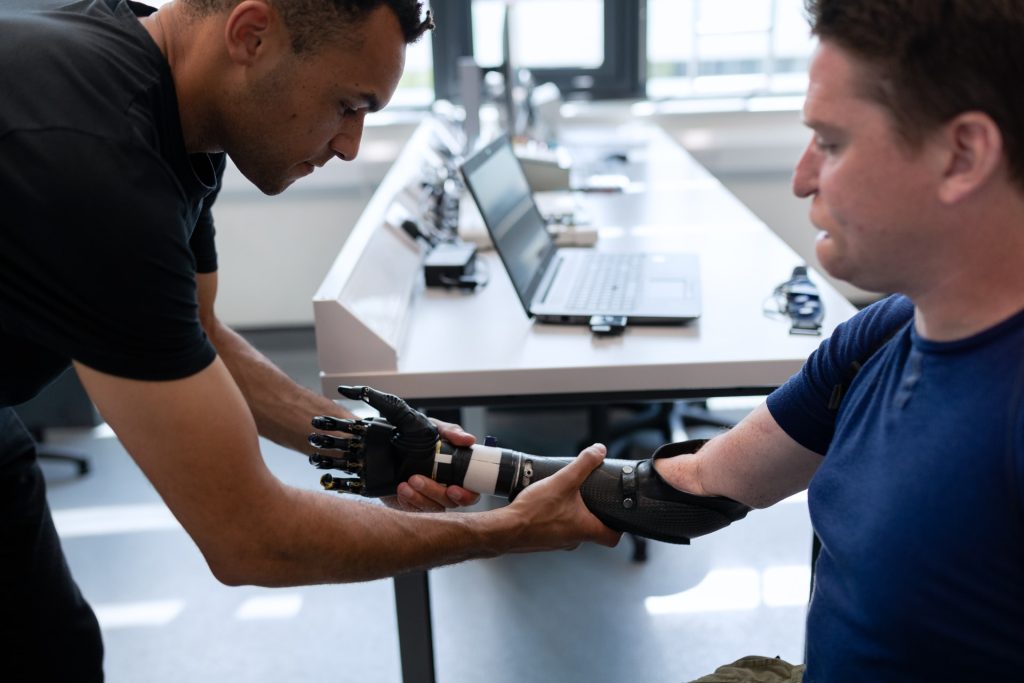
A prosthetic arm being fitted. Source: This is Engineering on Unsplash
Researchers have developed a bionic arm for patients with upper-limb amputations that allows wearers to think, behave and function like a person without an amputation.
The arm combines three important functions – intuitive motor control, touch and grip kinaesthesia, the intuitive feeling of opening and closing the hand. The developers, led by Clevelend Clinic, published their findings in Science Robotics.
“We modified a standard-of-care prosthetic with this complex bionic system which enables wearers to move their prosthetic arm more intuitively and feel sensations of touch and movement at the same time,” said lead researcher Paul Marasco, PhD, associate professor in Cleveland Clinic Lerner Research Institute’s Department of Biomedical Engineering. “These findings are an important step towards providing people with amputation with complete restoration of natural arm function.”
The system is the first to test all three sensory and motor functions in a neural-machine interface simultaneously in a prosthetic arm. The neural machine interface sends impulses from the brain to the arm and sensory information back to the brain.
“Perhaps what we were most excited to learn was that they made judgments, decisions and calculated and corrected for their mistakes like a person without an amputation,” said Dr Marasco. “With the new bionic limb, people behaved like they had a natural hand. Normally, these brain behaviors are very different between people with and without upper limb prosthetics. The researchers tested their new bionic limb on two study participants with upper limb amputations who had previously undergone targeted sensory and motor reinnervation -procedures that establish a neural-machine interface by redirecting amputated nerves to remaining skin and muscles.
In targeted sensory reinnervation, touching the skin with small robots activates sensory receptors that enable patients to perceive the sensation of touch. In targeted motor reinnervation, when patients think about moving their limbs, the reinnervated muscles communicate with a computerised prosthesis to move in the same way. Additionally, small, powerful robots vibrate kinesthetic sensory receptors in those same muscles which helps prosthesis wearers feel that their hand and arm are moving. The new prosthetic arm feels grip movement sensation, touch on the fingertips, and is controlled intuitively by thinking. Cameras lets the computer see the prosthetic’s position.
While wearing the advanced prosthetic, participants performed tasks reflective of basic, everyday behaviours that require hand and arm functionality, which were compared to people with traditional prosthetics and people without amputations.
According to Dr Marasco, because the limb lacks sensation, people with traditional prosthetics behave differently than people without an amputation when performing tasks. For example, traditional prosthesis wearers must constantly watch their prosthetic while using it, and have difficulty correcting for the correct amount of force needed.
The researchers could see that the study participants’ brain and behavioural strategies changed to match those of a person without an amputation. They no longer needed to watch their prosthesis, they could locate things without looking, and they could more effectively correct mistakes.
“Over the last decade or two, advancements in prosthetics have helped wearers to achieve better functionality and manage daily living on their own,” said Dr. Marasco. “For the first time, people with upper limb amputations are now able to again ‘think’ like an able-bodied person, which stands to offer prosthesis wearers new levels of seamless reintegration back into daily life.”
To recreate a sense of ‘touch’, researchers have incorporated stretchable tactile sensors using liquid metal on the fingertips of a prosthetic hand.
When manipulating an object, humans are heavily reliant on sensation in their fingertips, each of which has over 3000 pressure-sensitive touch receptors. While there are many high-tech, dexterous prosthetics available today, they all lack the sensation of ‘touch‘, resulting in objects inadvertently being dropped or crushed by a prosthetic hand. To make a prosthetic hand interface that feels more natural and intuitive, researchers from Florida Atlantic University’s College of Engineering and Computer Science and collaborators incorporated stretchable tactile sensors using liquid metal on a prosthetic hand’s fingertips. Encapsulated within silicone-based elastomers, this technology provides key advantages over traditional sensors, including high conductivity, compliance, flexibility and stretchability.
For the study, published in the journal Sensors, researchers used individual fingertips on the prosthesis to distinguish between different speeds of a sliding motion along different textured surfaces. The four different textures had one variation: the distance between the ridges. To detect the textures and speeds, researchers trained four machine learning algorithms. For each of the ten surfaces, 20 trials were performed to test the ability of the machine learning algorithms to distinguish between the different textured surfaces.
Results showed that integrating tactile information from the fingertip sensors simultaneously distinguished between complex, multi-textured surfaces – demonstrating a new form of hierarchical intelligence. The algorithms could accurately distinguish between the fingertip speeds. This new technology could improve prosthetic hand control and provide haptic feedback for amputees to restore a sense of touch.
“Significant research has been done on tactile sensors for artificial hands, but there is still a need for advances in lightweight, low-cost, robust multimodal tactile sensors,” said senior author Erik Engeberg, PhD, an associate professor in the Department of Ocean and Mechanical Engineering. “The tactile information from all the individual fingertips in our study provided the foundation for a higher hand-level of perception enabling the distinction between ten complex, multi-textured surfaces that would not have been possible using purely local information from an individual fingertip. We believe that these tactile details could be useful in the future to afford a more realistic experience for prosthetic hand users through an advanced haptic display, which could enrich the amputee-prosthesis interface and prevent amputees from abandoning their prosthetic hand.”
Researchers compared four different machine learning algorithms for their successful classification capabilities. The time-frequency features of the liquid metal sensors were extracted to train and test the machine learning algorithms. Of these, a neural network algorithm generally performed the best at the speed and texture detection with a single finger and had a 99.2 percent accuracy to distinguish between ten different multi-textured surfaces using four liquid metal sensors from four fingers simultaneously.
“The loss of an upper limb can be a daunting challenge for an individual who is trying to seamlessly engage in regular activities,” said Stella Batalama, Ph.D., dean, College of Engineering and Computer Science. “Although advances in prosthetic limbs have been beneficial and allow amputees to better perform their daily duties, they do not provide them with sensory information such as touch. They also don’t enable them to control the prosthetic limb naturally with their minds. With this latest technology from our research team, we are one step closer to providing people all over the world with a more natural prosthetic device that can ‘feel’ and respond to its environment.”
A recent case study demonstrates that, with training, neural control of a prosthetic ankle with a powered joint can restore agility.
Traditional prosthetic ankle joints result in slower walking and abnormal gaits due to the way they differ from normal human ankles in distributing walking loads. Autonomously controlled powered prosthetic ankles can restore additional function to users by providing the extra work involved in a natural walking gait. However, they are currently only designed to assist walking or standing, and not to tackle specialised tasks such as squatting.
“This case study shows that it is possible to use these neural control technologies, in which devices respond to electrical signals from a patient’s muscles, to help patients using robotic prosthetic ankles move more naturally and intuitively,” said corresponding author Helen Huang, Jackson Family Distinguished Professor in the Joint Department of Biomedical Engineering at NC State and UNC
“This work demonstrates that these technologies can give patients the ability to do more than we previously thought possible,” says Aaron Fleming, first author of the study and a Ph.D. candidate in the joint biomedical engineering department.
Most research on robotic prosthetic ankles has focused on autonomous control, meaning that the prosthesis handles the fine motions when the wearer decides to walk or stan.
Huang, Fleming and their collaborators sought to find out if amputees could be trained to use a neurally controlled prosthetic ankle to regain more control in the many common motions that people make with their ankles beyond simply walking.
Their powered prosthesis reads electrical signals from two residual calf muscles, which are responsible for controlling ankle motion, and converts the signals into commands for moving the prosthesis.
The researchers recruited a study participant with an amputation between the knee and the ankle, and fitted the powered prosthetic ankle on the participant and did an initial evaluation. Over two and a half weeks, the participant then had five, two-hour training sessions with a physical therapist. A second evaluation was conducted on training completion.
Having had the training, the participant was able to perform a variety of previously challenging tasks, such as going from sitting to standing without any external assistance or squatting to pick something up without compensating for the movement with other body parts. However the participant’s own stability, both self-reported and empirically measured in such tests as standing on foam, was dramatically improved.
“The concept of mimicking natural control of the ankle is very straightforward,” Huang said. “But implementation of this concept is more complicated. It requires training people to use residual muscles to drive new prosthetic technologies. The results in this case study were dramatic. This is just one study, but it shows us what is feasible.”
“There is also a profound emotional impact when people use powered prosthetic devices that are controlled by reading the electrical signals that their bodies are making,” Fleming said. “It is much more similar to the way people move intuitively, and that can make a big difference in how people respond to using a prosthesis at all.”
More participants are already undergoing the training, with the researchers expanding their testing to match. But before this technology is made more widely available, the researchers would like real-world testing, with the prosthesis being used in people’s daily routines.
“As with any prosthetic device for lower limbs, you have to make sure the device is consistent and reliable, so that it doesn’t fail when people are using it,” Huang said.
“Powered prostheses that exist now are very expensive and are not covered by insurance,” Fleming explained. “So there are issues related to access to these technologies. By attempting to restore normal control of these type of activities, this technology stands to really improve quality of life and community participation for individuals with amputation. This would make these expensive devices more likely to be covered by insurance in the future if it means improving the overall health of the individual.”
The researchers are currently working with a larger group of study participants to see how broadly applicable the findings may be.
Journal information: Fleming, A., et al. (2021) Direct continuous electromyographic control of a powered prosthetic ankle for improved postural control after guided physical training: A case study. Wearable Technologies. doi.org/10.1017/wtc.2021.2.
A new type of surgery that links muscles together may improve the precision of prosthetic use and also relieve pain.
In typical amputations, the muscle pairs (such as triceps and biceps) that work together to control the joints are severed. However, an MIT team has discovered that reconnecting these muscles that are in an agonistic-antagonistic (‘push-pull’) relationship improves the sensory feedback and thus precision of the affected limb.
“When one muscle contracts, the other one doesn’t have its antagonist activity, so the brain gets confusing signals,” explained Srinivasan, a former member of the Biomechatronics group now working at MIT’s Koch Institute for Integrative Cancer Research. “Even with state-of-the-art prostheses, people are constantly visually following the prosthesis to try to calibrate their brains to where the device is moving.”
The 15 patients who received the AMI surgery were able to flex their prosthetic ankle joint with more precision than those without it, who were only able to fully extend or flex their joint.
“Through surgical and regenerative techniques that restore natural agonist-antagonist muscle movements, our study shows that persons with an AMI amputation experience a greater phantom joint range of motion, a reduced level of pain, and an increased fidelity of prosthetic limb controllability,” says Hugh Herr, a professor of media arts and sciences, head of the Biomechatronics group in the Media Lab, and the senior author of the paper.
The surgery also had a completely unexpected benefit: the reduction of pain in the amputated area, which can be from neuromas or phantom limb pain. Phantom limb pain can occur in 80% of amputess. Six of the 15 AMI patients reported zero pain. This may be significant as in the five centuries since phantom limb pain was first described, there has not been much advancement in the understanding of it.
“Our study wasn’t specifically designed to achieve this, but it was a sentiment our subjects expressed over and over again. They had a much greater sensation of what their foot actually felt like and how it was moving in space,” Srinivasan says. “It became increasingly apparent that restoring the muscles to their normal physiology had benefits not only for prosthetic control, but also for their day-to-day mental well-being.”
To treat patients who had received the traditional amputation surgery, the team is also working on using muscle grafts to create a ‘regenerative AMI’ procedure that restores the effect of agonist and antagonist muscles.
Journal information: Shriya S. Srinivasan el al., “Neural interfacing architecture enables enhanced motor control and residual limb functionality postamputation,” PNAS (2021). www.pnas.org/cgi/doi/10.1073/pnas.2019555118