The findings may shed new light on disruptions to the circadian clocks during menstruation, pregnancy and menopause
Disruptions to circadian clocks can lead to a wide range of health problems, from sleep disturbances to diabetes and cancer. But there has been no certainty about the identity of the body’s substances that can “shift” these clocks forward or backward and, when altered, potentially cause such disruptions.
A new study from Prof Gad Asher’s lab at the Weizmann Institute of Science, now published in Nature Communications, reveals that sex hormones play a central role in aligning the cellular clocks with one another and with the environment. The research team, led by Drs Gal Manella, Saar Ezagouri and Nityanand Bolshette, showed that female sex hormones – especially progesterone – together with the stress hormone cortisol, have a dramatic effect on the clocks.
It is already known that circadian clocks are affected not only by external signals such as sunlight but also by signals carried through the bloodstream. Until now, however, these blood-borne signals had not been fully mapped, and there was no certainty about the component within the clock that serves as their “point of entry.” The reason: Researchers lacked a precise method for tracking the clock’s response to different signals over a full 24-hour cycle.
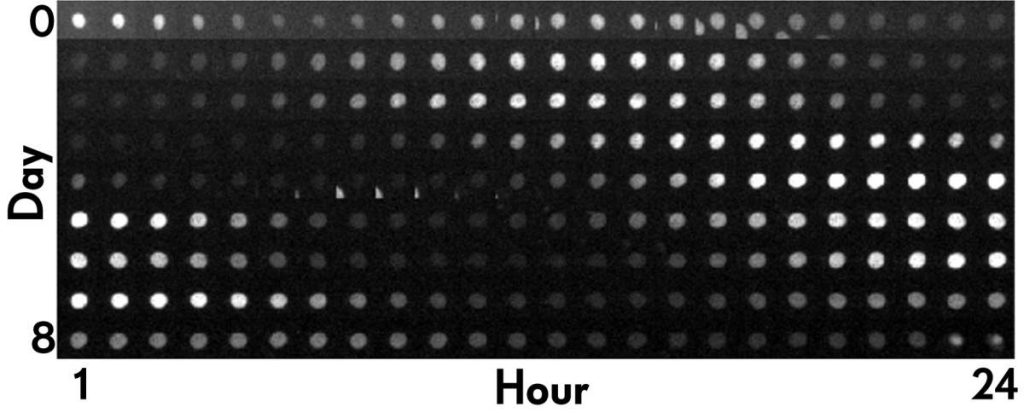
In recent years, Prof Asher’s lab – an international leader in studying the molecular mechanisms of circadian clocks – developed an ingenious method that uses an array of human cells each representing a different “time of day.” It resembles a wall lined with clocks showing the current time in major cities around the world. The new approach enabled the researchers, for the first time and with unprecedented precision, to map how the cellular clocks are synchronized by blood-borne signals.
In addition to uncovering the influence of sex hormones, the study revealed that the clock component receiving these signals is the protein Cry2, rather than Per2, as previously believed.
The “ticking” of a circadian clock inside a human cell over the course of 24 hours. A fluorescent marker allows scientists to tell “what time it is” at any given moment
“The levels of sex hormones change throughout life – during menstrual cycles, pregnancy, hormone therapy, contraceptive use and various disease states. These conditions are also known to be associated with disturbances to circadian clocks,” Asher notes. “Our new findings suggest that these disturbances are linked to interactions between sex hormones and the mechanisms that synchronize circadian clocks.”
A drug mimicking the hormone progesterone has anti-cancer activity when used together with conventional anti-oestrogen treatment for women with breast cancer, a new Cambridge-led trial has found.
In the two-week window that we looked at, adding a progestin made the anti-oestrogen treatment more effective at slowing tumour growth. What was particularly pleasing to see was that even the lower dose had the desired effectRebecca Burrell
A low dose of megestrol acetate (a synthetic version of progesterone) has already been proven as a treatment to help patients manage hot flushes associated with anti-oestrogen breast cancer therapies, and so could help them continue taking their treatment. The PIONEER trial has now shown that the addition of low dose megestrol to such treatment may also have a direct anti-cancer effect.
Around three-quarters of all breast cancers are ER-positive. This means the tumours are abundant in a molecule known as an oestrogen receptor, ‘feeding’ on the oestrogen circulating in the body. These women are usually offered anti-oestrogens, medication that reduces level of oestrogen and hence deprives the cancer of oestrogen and inhibits its growth. However, reducing oestrogen levels can bring on menopause-like symptoms, including hot flushes, joint and muscle pain, and potential bone loss.
In the PIONEER trial, post-menopausal women with ER-positive cancers were treated with an anti-oestrogen with or without the progesterone mimic, megestrol. After two weeks of treatment, those that received the combination saw a greater decrease in tumour growth rates compared to those treated with an anti-oestrogen only.
Although further work is required in larger patient cohorts and over a longer period of time to confirm the findings, researchers at the University of Cambridge say the trial suggests that megestrol could help improve the lives of thousands of women for whom anti-oestrogen medication causes uncomfortable side-effects and can lead to some women stopping taking the medication.
PIONEER was led by Dr Richard Baird from the Department of Oncology at the University of Cambridge and Honorary Consultant Medical Oncologist at Cambridge University Hospitals NHS Foundation Trust (CUH). He said: “On the whole, anti-oestrogens are very good treatments compared to some chemotherapies. They’re gentler and are well tolerated, so patients often take them for many years. But some patients experience side effects that affect their quality of life. If you’re taking something long term, even seemingly relatively minor side effects can have a big impact.”
Some ER-positive breast cancer patients also have high levels of another molecule, known as progesterone receptor (PR). This group of patients also respond better to the anti-oestrogen hormone therapy.
To explain why, Professor Jason Carroll and colleagues at the Cancer Research UK Cambridge Institute used cell cultures and mouse models to show that the hormone progesterone stops ER-positive cancer cells from dividing by indirectly blocking ER. This results in slower growth of the tumour. When mice treated with anti-oestrogen hormone therapy were also given progesterone, the tumours grew even more slowly.
Professor Carroll, who co-leads the Precision Breast Cancer Institute and is a Fellow of Clare College, Cambridge, said: “These were very promising lab-based results, but we needed to show that this was also the case in patients. There’s been concern that taking hormone replacement therapy – which primarily consists of oestrogen and synthetic versions of progesterone (called progestins) – might encourage tumour growth. Although we no longer think this is the case, there’s still been residual concern around the use of progesterone and progestins in breast cancer.”
To see whether targeting the progesterone receptor in combination with an anti-oestrogen could slow tumour growth in patients, Dr Baird and Professor Carroll designed the PIONEER trial, which tested adding megestrol, a progestin, to the standard anti-oestrogen treatment letrozole.
A total of 198 patients were recruited at ten UK hospitals, including Addenbrooke’s Hospital in Cambridge, and randomised into one of three groups: one group received only letrozole; one group received letrozole alongside 40mg of megestrol daily; and the third group received letrozole plus a much higher daily dose of megestrol, 160mg. In this ‘window of opportunity’ trial, treatment was given for two weeks prior to surgery to remove the tumour. The percentage of actively growing tumour cells was assessed at the start of the trial and then again before surgery.
In findings published today in Nature Cancer, the team showed that adding megestrol boosted the ability of letrozole to block tumour growth, with comparable effects at both the 40mg and 160mg doses.
Joint first author Dr Rebecca Burrell from the Cancer Research UK Cambridge Institute and CUH said: “In the two-week window that we looked at, adding a progestin made the anti-oestrogen treatment more effective at slowing tumour growth. What was particularly pleasing to see was that even the lower dose had the desired effect.
“Although the higher dose of progesterone is licenced as an anti-cancer treatment, over the long term it can have side effects including weight gain and high blood pressure. But just a quarter of the dose was as effective, and this would come with fewer side effects. We know from previous trials that a low dose of progesterone is effective at treating hot flushes for patients on anti-oestrogen therapy. This could reduce the likelihood of patients stopping their medication, and so help improve breast cancer outcomes. Megestrol – the drug we used – is off-patent, making it a cost-effective option.”
Because women in the trial were only given megestrol for a short period of time, follow-up studies will be needed to confirm whether the drug would have the same beneficial effects with reduced side-effects over a longer period of time.
The research was funded by Anticancer Fund, with additional support from Cancer Research UK, Addenbrooke’s Charitable Trust and the National Institute for Health and Care Research Cambridge Biomedical Research Centre.
Personalised and precise cancer treatments underpin the focus of care at the future Cambridge Cancer Research Hospital. The specialist facility planned for the Cambridge Biomedical Campus will bring together world-leading researchers from the University of Cambridge and its Cancer Research UK Cambridge Centre and clinical excellence from Addenbrooke’s Hospital under one roof in a brand-new NHS hospital.
Female hormones can suppress pain by making immune cells near the spinal cord produce opioids, a new study from researchers at UC San Francisco has found. This stops pain signals before they get to the brain.
The discovery could help with developing new treatments for chronic pain. It may explain why some painkillers work better for women than men and why postmenopausal women, whose bodies produce less of the key hormones oestrogen and progesterone, experience more pain.
The work reveals an entirely new role for T regulatory immune cells (T-regs), which are known for their ability to reduce inflammation.
“The fact that there’s a sex-dependent influence on these cells – driven by oestrogen and progesterone – and that it’s not related at all to any immune function is very unusual,” said Elora Midavaine, PhD, a postdoctoral fellow and first author of the study, which appears in Science.
The researchers looked at T-regs in the protective layers that encase the brain and spinal cord in mice. Until now, scientists thought these tissue layers, called the meninges, only served to protect the central nervous system and eliminate waste. T-regs were only discovered there in recent years.
“What we are showing now is that the immune system actually uses the meninges to communicate with distant neurons that detect sensation on the skin,” said Sakeen Kashem, MD, PhD, an assistant professor of dermatology. “This is something we hadn’t known before.”
That communication begins when a neuron, often near the skin, receives a stimulus and sends a signal to the spinal cord.
The team found that the meninges surrounding the lower part of the spinal cord harbour an abundance of T-regs. To learn what their function was, the researchers knocked the cells out with a toxin.
The effect was striking: Without the T-regs, female mice became more sensitive to pain, while male mice did not. This sex-specific difference suggested that female mice rely more on T-regs to manage pain.
“It was both fascinating and puzzling,” said Kashem, who co-led the study with Allan Basbaum, PhD. “It actually made me sceptical initially.”
Further experiments revealed a relationship between T-regs and female hormones that no one had seen before: Estrogen and progesterone were prompting the cells to churn out enkephalin, a naturally occurring opioid.
Exactly how the hormones do this is a question the team hopes to answer in a future study. But even without that understanding, the awareness of this sex-dependent pathway is likely to lead to much-needed new approaches for treating pain.
In the short run, it may help physicians choose medications that could be more effective for a patient, depending on their sex. Certain migraine treatments, for example, are known to work better on women than men.
This could be particularly helpful for women who have gone through menopause and no longer produce oestrogen and progesterone, many of whom experience chronic pain.
The researchers have begun looking into the possibility of engineering T-regs to produce enkephalin on a constant basis in both men and women.
Scanning electron micrograph of a B cell. Credit: NIH
When the immune system is compromised due to various conditions and medicines, patients can experience opportunistic infection. Now, researchers reporting in Cell Reports have uncovered a sex-based variance in the trained immune memory response to infection in mice that might translate to humans.
The researchers, from the University of Missouri School of Medicine, found that female mice were more vulnerable to opportunistic infection from a bacterial pathogen to which they had previously been exposed when progesterone levels were naturally elevated as part of their reproductive cycle.
“Differences in immune response in males and females have been observed before. For instance, males had increased morbidity and severity of COVID-19 from SARS-CoV-2 infections,” said Dr Adam Schrum, associate professor in the Department of Molecular Microbiology and Immunology. “But females are known to suffer other infections worse than males. Our research found that female mice were far more vulnerable to opportunistic bacterial infection than male mice because of a sex-based difference in their trained immunity.”
To understand why the immune systems of female and male mice responded differently to a bacterial pathogen, the researchers examined whether the reproductive cycle affected immune training. They found that elevated progesterone levels correlated with lower trained immune responses. To test this more fully, the researchers gave the female mice progesterone blockers and found that their trained immune response was subsequently enhanced.
“The female mice had significantly restored trained immune response when progesterone was blocked, reaching comparable levels to those of male mice,” said Schrum. “Sex hormone-based modulation of immune function needs more study to be fully understood, but as a first step we can conclude that immune training is influenced by a progesterone-dependent mechanism that results in a sex bias in mice.”
In addition to further study to understand how and why progesterone specifically influences trained immune responses in mice, the researchers pointed out that because mice have shorter estrous cycles than the human menstrual cycle, further research is needed to understand how sex hormones might affect human immune training.
The possibility that contraceptive pills might have negative effects on mental health and even lead to depression has long been debated. Now, evidence published in Epidemiology and Psychiatric Sciences shows that contraceptive pills are in fact linked to depression, with teenage girls at particularly increased risk.
This study is one of the largest and widest-ranging to date, following more than a quarter of a million women from UK Biobank from birth to menopause.
The researchers collected data about women’s use of contraceptive pills, the time at which they were first diagnosed with depression and when they first experienced symptoms of depression without receiving a diagnosis. The method of contraception studied was combined contraceptive pills, which contain progestogen and oestrogen. Progestogen prevents ovulation and thickens the cervical mucus to prevent sperms from entering the uterus, while oestrogen thins the uterine lining to hinder the implantation of a fertilised egg.
“Although contraception has many advantages for women, both medical practitioners and patients should be informed about the side-effects identified in this and previous research,” says Therese Johansson at Uppsala University, one of the researchers leading the study.
According to the study, women who began to use contraceptive pills as teenagers had a 130% higher incidence of symptoms of depression, while the corresponding increase among adult users was 92%.
“The powerful influence of contraceptive pills on teenagers can be ascribed to the hormonal changes caused by puberty. As women in that age group have already experienced substantial hormonal changes, they can be more receptive not only to hormonal changes but also to other life experiences,” Johansson says.
The researchers were also able to see that the increased incidence of depression declined when the women continued to use contraceptive pills after the first two years. However, teenage users of contraceptive pills still had an increased incidence of depression even after stopping using the pill, which was not observed in adult users of contraceptive pills.
“It is important to emphasise that most women tolerate external hormones well, without experiencing negative effects on their mood, so combined contraceptive pills are an excellent option for many women. Contraceptive pills enable women to avoid unplanned pregnancies and they can also prevent illnesses that affect women, including ovarian cancer and uterine cancer. However, certain women may have an increased risk of depression after starting to use contraceptive pills.”
The findings of the study point to a need for healthcare professionals to be more aware of possible links between different systems in the body, such as depression and the use of contraceptive pills. The researchers conclude that it is important for care providers to inform women who are considering using contraceptive pills of the potential risk of depression as a side-effect of the medicine.
“Since we only investigated combined contraceptive pills in this study, we cannot draw conclusions about other contraceptive options, such as mini pills, contraceptive patches, hormonal spirals, vaginal rings or contraceptive rods. In a future study, we plan to examine different formulations and methods of administration. Our ambition in comparing different contraceptive methods is to give women even more information to help them take well-informed decisions about their contraceptive options,” Johansson says.
The drug, 17α-hydroxyprogesterone caproate (17-OHPC), is a synthetic progestogen frequently used by women in the 1950s and 1960s, and is still prescribed today to women to help prevent preterm birth. Progesterone helps the uterus grow during pregnancy and prevents early contractions that may lead to miscarriage.
“Children who were born to women who received the drug during pregnancy have double the rate of cancer across their lifetime compared to children born to women who did not take this drug,” said the study’s lead author, Caitlin C. Murphy, PhD, MPH, associate professor in the Department of Health Promotion and Behavioral Sciences at UTHealth School of Public Health in Houston. “We have seen cancers like colorectal cancer, pancreatic cancer, thyroid cancer, and many others increasing in people born in and after the 1960s, and no one really knows why.”
Researchers reviewed data from the Kaiser Foundation Health Plan on women who received prenatal care between June 1959 and June 1967, and the California Cancer Registry, which traced cancer in offspring through 2019.
Out of more than 18 751 live births, researchers discovered 1008 cancer diagnoses were made in offspring ages 0 to 58 years. Additionally, a total of 234 offspring were exposed to 17-OHPC during pregnancy. Offspring exposed in utero had cancer detected in adulthood at more than twice the rate of of those unexposed: 65% of cancers occurred in adults younger than 50.
“Our findings suggest taking this drug during pregnancy can disrupt early development, which may increase risk of cancer decades later,” Murphy said “With this drug, we are seeing the effects of a synthetic hormone. Things that happened to us in the womb, or exposures in utero, are important risk factors for developing cancer many decades after we’re born.”
A new randomised trial shows there is no benefit of taking 17-OHPC, and that it does not reduce the risk of preterm birth, according to Murphy.
The U.S. Food and Drug Administration proposed in October 2020 that this particular drug be withdrawn from the market.