

Cryptococcal Meningitis Claims Many Lives in SA – Stopping it won’t be Easy
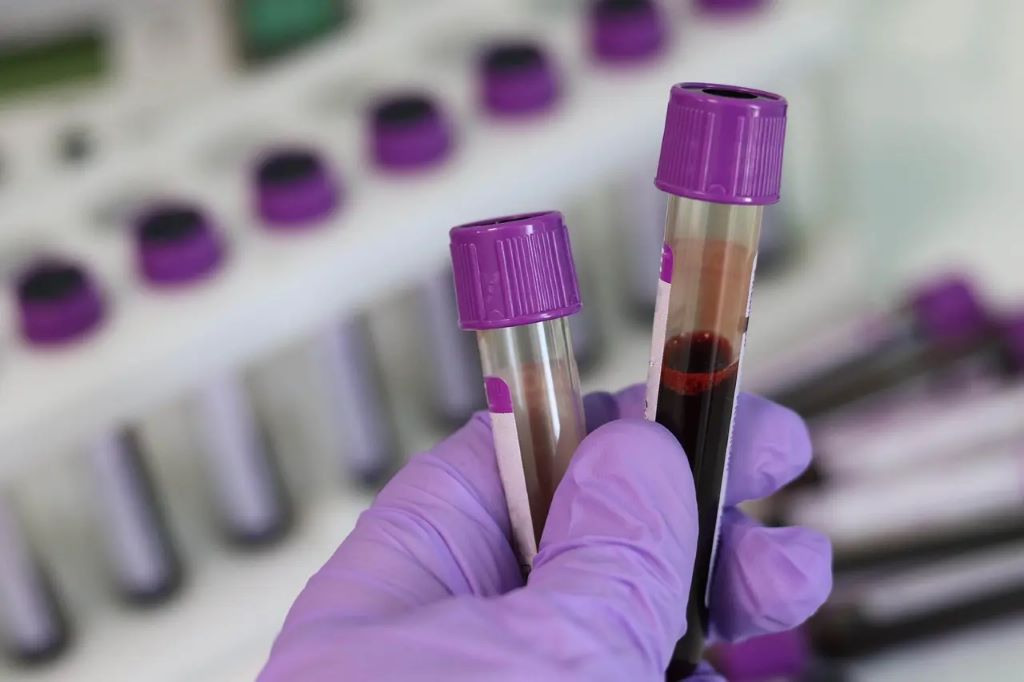
Cryptococcal meningitis is a serious fungal infection causing inflammation of the lining of the brain. (Photo: Pixabay)
By Elri Voigt for Spotlight
One of the top killers of people living with HIV in South Africa is a fungal infection. In this Spotlight special briefing, we unpack what we know about this dangerous disease called cryptococcal meningitis, why it remains so deadly, and what we can do about it.
Someone who is diagnosed with HIV today could live a relatively healthy and normal life. That is providing that they are consistently taking the antiretroviral treatment that successfully suppresses the virus in their bodies.
Roughly four out of every five people living with HIV in South Africa are on treatment. The remaining one in five, or 20%, represents around 1.6 million people who could potentially get very ill from a virus that is attacking their immune system, leaving them at risk of complications and opportunistic infections.
The best-known HIV-related opportunistic infection is tuberculosis, comfortably the top killer of people with HIV in South Africa. The second top killer of people with HIV, at least according to most estimates, originates from the environment around us. Around 19% of HIV-related deaths were attributed to this illness in a 2022 modelling study. Despite the many lives this illness has claimed, it has lurked chronically under the radar, much more so than TB, which itself has been somewhat in the shadows.
A fungus that is all around us
“Cryptococcal meningitis is a serious fungal infection causing inflammation of the lining of the brain (meninges),” explains Dr Richard Lessells. He is an infectious diseases clinical researcher at the KwaZulu-Natal Research Innovation and Sequencing Platform (KRISP) at the University of KwaZulu-Natal (UKZN).
Cryptococcal meningitis is caused by one of two fungi – Cryptococcus neoformans or Cryptococcus gattii. The former is responsible for most infections in people. The fungus is found all around us, particularly in rotting trees and wood, the soil and bird droppings. The tiny fungal spores are routinely inhaled by humans.
In most people, the immune system takes care of the spores and eventually controls it, explains Lessells. The fungus only starts causing problems when the immune system is weakened and not able to contain it. When that happens, the fungus spreads to the bloodstream, from where it can spread all over the body. While it can cause disease in other places, like in the lungs or on the skin, the most common place the fungus heads to is the brain and its lining. This lining, which consists of three membrane layers that cover and protect the brain and spinal cord, is called the meninges.
Classic symptoms of cryptococcal meningitis include headache, stiff neck, light sensitivity, fever, confusion, and nausea and vomiting. The symptoms can eventually be debilitating, with one patient quoted in literature saying that a previous gunshot wound hurt less than his headache. The inflammation in the meninges causes a dangerous build-up of pressure in the skull – called raised intracranial pressure – which explains the severity of the headaches.
Two disease states
When the fungus spreads from the lungs to the rest of the body, it doesn’t immediately cause inflammation in the brain or lead to severe illness. At this early stage, it is possible to stop the infection from spreading to the central nervous system, if it is detected and treated.
The key is a blood test, explains Professor Graeme Meintjes, an infectious diseases specialist based at the University of Cape Town and Clinical Professor of Infectious Diseases at Queen Mary University of London. The test, called a cryptococcal antigen test (CrAg), looks for a complex sugar molecule found in the cell wall of the fungus. When the test detects the sugar molecule in the blood, that person has what is called cryptococcus antigenemia – meaning the antigen is present in the body.
“They would then be treated pre-emptively with antifungal medication, essentially to prevent them from progressing from the antigenemia to the meningitis,” Meintjes says. Fluconazole, the drug used for this early treatment, is cheap, widely available, and works well.
If someone is not treated in time, the fungus spreads to the central nervous system – specifically the brain – and causes dangerous inflammation in the lining of the brain. When it gets to this stage, the infection is called cryptococcal meningitis. It is diagnosed by doing a CrAG test on spinal fluid obtained through a lumbar puncture, explains Lessells.
The key difference between the two disease states is that symptoms only manifest once cryptococcus antigenaemia has progressed to cryptococcal meningitis.
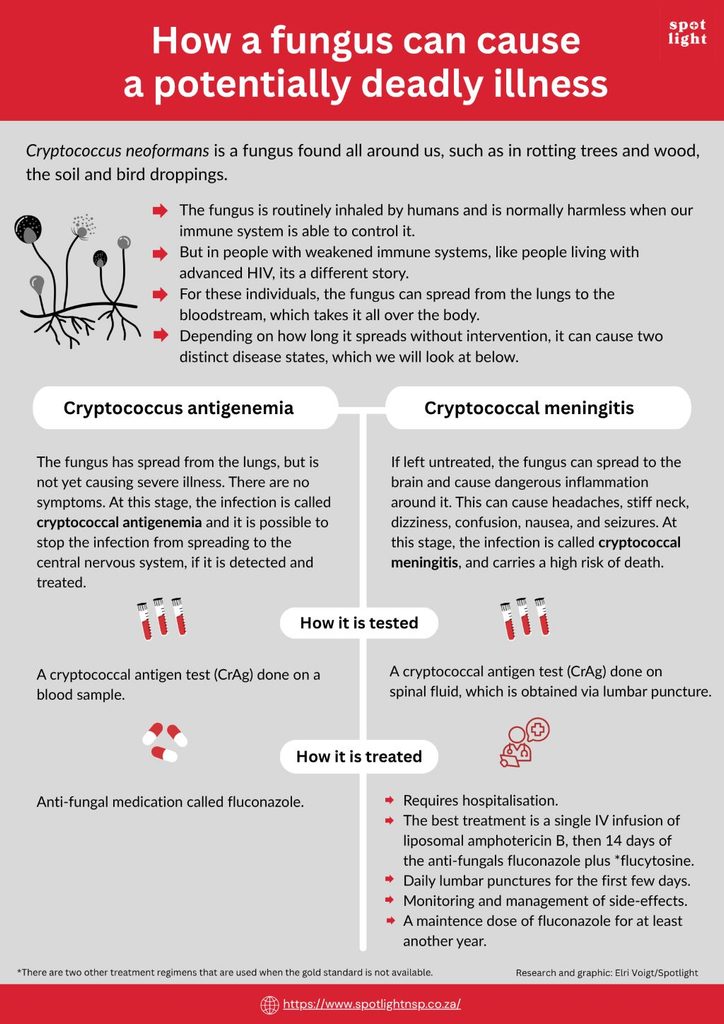
Someone who has cryptococcal meningitis needs to be admitted to hospital. This is because the drugs used to treat it will only start helping to control the dangerous inflammation after a few days. In the meantime, the build-up of intracranial pressure needs to be reduced through daily lumbar punctures during the first few days in hospital, says Lessells. The drugs themselves can also cause some dangerous side effects that need to be monitored closely and managed.
“Cryptococcal meningitis is associated with very high early mortality. GERMS-SA surveillance in South Africa has shown in-hospital mortality in routine care to be between 30-40% for the past 20 years,” points out Lessells. GERMS-SA is a national, population-based laboratory surveillance programme led by the National Institute for Communicable Diseases (NICD). It monitors bacterial, fungal, and parasitic infections across South Africa through a network of laboratories and sentinel hospital sites.
Screening the right people
Since waiting for cryptococcal meningitis symptoms to appear is a losing strategy, the focus has been on proactively identifying and offering CrAg screening to people at high risk of the condition.
In South Africa, says Lessells, cryptococcal meningitis most commonly affects people living with HIV, especially those with advanced HIV disease. This is a state where the virus is not under control in the body and the number of important immune cells called CD4 cells are dangerously low, at less than 200 cells/mm3. CD4 cells are a type of white blood cell important for a well-functioning immune system. A CD4 count above 500 is generally considered to be healthy.
But cryptococcal meningitis can also affect organ transplant recipients, people undergoing cancer treatment or those taking steroids. “Very occasionally, it can affect people with no apparent immunocompromising condition,” adds Lessells.
Either way, people with advanced HIV are the most obvious group to target with screening efforts. In 2025, there were about 7.8 million people living with HIV in South Africa, according to estimates from Thembisa, the leading mathematical model of HIV in the country. Of those, roughly 530 000 had advanced HIV, with a CD4 count of less than 200. This group of around half-a-million people are at highest risk of cryptococcal meningitis.
The National HIV treatment guidelines recommend that people living with HIV should be offered CrAg screening if they present with a blood test showing a CD4 count of less than 200. But the catch is that often people with advanced HIV disease are not accessing healthcare services or only accessing services once they are already very ill. In 2025, around 42 000 of the adults living with HIV who started taking treatment that year had a CD4 count of less than 200, according to Thembisa. This is over 20% of the total number of people who started taking treatment that year.
“Cryptococcal meningitis is essentially a marker for the gaps in our HIV programme,” says Liliwe Shuping, an epidemiologist at the NICD.
“If a patient gets cryptococcal meningitis, it usually means they fell through the cracks of the healthcare system; either they were never tested for HIV, they were lost to follow-up, or their treatment failed without being caught,” she says.
She describes cryptococcal meningitis as “almost exclusively a disease of advanced HIV, untreated HIV, or failed HIV care”.
There are thus two layers to the problem: First, too many people with HIV are not in care and end up developing advanced HIV, and second, even when people are visiting health facilities, they are not always screened in time.
“At the primary healthcare level, there are still challenges with implementation of the CrAg screening programme,” says Lessells. The laboratory component works well, but then he says there are the usual problems of a healthcare worker seeing the result, acting on the result, being able to contact the patient to recall them to the facility, and then referral to a higher level of care for lumbar puncture.
Unfortunately, people do fall through the cracks. Similarly, he suggests there are sometimes avoidable delays at hospital level when it comes to doing lumbar puncture. For example, some doctors might wait for a CT scan of the brain, which is not always necessary and can lead to delays.
At least some of these challenges should be reduced with the latest National HIV treatment guidelines, which address these issues with more information and clarified referral pathways, Lessells says. For example, the guidelines include a chapter on managing advanced HIV, among others covering how to screen for, diagnose and manage cryptococcal meningitis. It also spells out the requirement for automatic CrAg testing for people with CD4 counts below 200.
The big picture – what the data tells us
Some good news from the GERMS-SA report is that there has been a decline of about 11% in reported cryptococcal meningitis cases from 2023 to 2024. There has also been a drop in cryptococcal meningitis incidence over the last six years, says Shuping.
The annual number of recorded cases dropped from about 6 000 in 2018 to 4 000 in 2023, decreasing by about one third overall, says Shuping. This is based on the Public Health Bulletin study on data from 2018 to 2023. The authors caution that the decline in cases could be due to the potential impact of strengthening public health interventions or may reflect an under-detection of cases. Either way, these numbers reflect only confirmed cases. Modelling suggests real cryptococcal meningitis incidence may be several times what is being reported.
Shuping cautions that despite the reduction in reported cases, cryptococcal meningitis is still killing many people living with HIV.
The in-hospital mortality rate for cryptococcal meningitis “has not meaningfully improved,” she points out. Despite treating fewer cases over time, she says that a patient who develops cryptococcal meningitis today has roughly the same high risk of dying in hospital as they did six years ago.
In general, Meintjes explains that brain infections have a high mortality. Even with the best treatment options and under clinical trial settings, around a quarter of patients die despite treatment.
Quality of care matters. Lessells says that while drug treatment generally receives the most attention, it is only one component of the clinical management of cryptococcal meningitis. Monitoring and reducing intracranial pressure and preventing and monitoring side effects from the drugs are vital. In a setting where resources are stretched thin, healthcare workers are overwhelmed and facilities don’t always follow the best practises, he says quality of care can fall, contributing to “stubbornly high mortality rates”.
High mortality despite new drug
Given the serious side effects associated with some medicines used to treat cryptococcal meningitis, there was great optimism in 2022 when an old anti-fungal medicine called flucytosine was approved for use in the country to the treat the illness.
This followed the AMBITION trial, where researchers found that combining flucytosine with two other powerful drugs (liposomal amphotericin B – an IV infusion and fluconazole – an oral medication) improved patient treatment. Meintjes explains that the combination of the three drugs was not “better” than the previous regimen as there were similar mortality rates between the two arms, but it was safer and had far fewer side effects.
Meintjes says that today the first choice for the treatment of cryptococcal meningitis is a single infusion of liposomal amphotericin B, then 14 days of fluconazole plus flucytosine.
The second choice, that has similar mortality outcomes to the first but has more side effects, is seven days of another form of amphotericin B plus flucytosine and fluconazole.
The third-choice regimen is 14 days of amphotericin B plus fluconazole. Meintjes says that the outcomes for this regimen are not as good as with the first two.
After the initial treatment, regardless of which regimen was used, patients then have to take a maintenance dose of fluconazole for at least another year to completely eradicate the fungus. If the fungus is not entirely gone from the body, it can cause disease again in the future. Patients living with HIV also need to be started on antiretroviral therapy around four weeks after the meningitis diagnosis, which helps prevent a relapse.
Best drugs not always in stock
One reason the approval of flucytosine, and the improved treatment regimens it enables together with liposomal amphotericin B, hasn’t yet resulted in better outcomes is that patients simply aren’t always getting the drugs.
“[O]ften we’re in a situation where we have to use the third choice because neither liposomal amphotericin B nor flucytosine are available and that’s associated with worse outcomes,” says Meintjes.
Jessica Burry, a pharmacist and technical officer working on advanced HIV with Unitaid, concurs. “I think what it comes down to is if you don’t have access to liposomal amphotericin B and flucytosine, then you don’t have the gold standard of treatment…and it’s shown quite clearly that mortality rates are much higher in those groups [that don’t have access to these drugs],” she says.
There are several reasons why a drug might not be in stock at the clinic or hospital where it is needed. Often in South Africa, medicines have been in stock in central depots, but not available at all health facilities. A further challenge with medicines for cryptococcal meningitis is that the volumes are comparatively low, and pharmacies may thus be reluctant to hold onto too much stock for fear it might expire.
While such distribution problems have no doubt played a role in limiting access to cryptococcal meningitis medicines, sourcing a reliable supply from manufacturers appears to have been a greater stumbling block in recent years. In this regard, public health imperatives are up against some tough economic realities.
Lessells says that, because flucytosine is an anti-fungal mainly used to treat cryptococcal meningitis, there isn’t much demand for the drug across the world, since many countries very rarely deal with the illness. This, he says, ties into the systemic problem with global drug supplies for rare diseases or rare conditions, where you’ve got a small number of manufacturers and problems in the manufacturing process that then lead to global supply chain problems.
How such dynamics have played out with flucytosine and liposomal amphotericin B is worth a closer look. As often is the case with such questions of medicines access, the picture gets fuzzier before it becomes clearer.
Flucytosine shortages
“During 2026, the availability of flucytosine has been constrained, requiring available stock to be carefully managed and distributed to facilities based on clinical need,” Foster Mohale, spokesperson for the National Department of Health tells Spotlight. He says that there was a global supply problem and that the stockouts were not due to procurement issues at the department. A shortage of flucytosine has also affected several other countries.
Flucytosine is on the Essential Medicines List (EML), which is a list of medicines that are considered vital for the health of the country, like antiretrovirals or insulin. The health department undertakes to supply medicines on the EML to the public health sector, normally via tenders.
Two pharmaceutical companies, Viatris and Macleods, have registered flucytosine with the South African Health Products Regulatory Authority (SAHPRA) for use in South Africa.
Flucytosine was previously procured by the state in terms of a tender awarded to Viatris in 2023. According to Mohale, uptake from provincial health departments was poor, and in July 2024 some expired stock had to be written off. A few months later, the department issued a notice to confirm there was stock and that healthcare facilities should place orders based on their needs.
A new tender was advertised in 2025, but according to Mohale, no “responsive bids” were received. The health department then approached Viatris to supply flucytosine via a Request for Quotation (RFQ). The RFQ process is when the state obtains a quotation on a price when an essential medicine is not available from a contracted tenderer, either because no tender was awarded or the product is out of stock, explains UKZN pharmaceutical sciences expert Dr Andy Gray. This form of procurement, he says, is not unusual.
Viatris initially accepted the RFQ but then informed the department in March 2026 that it was “unable to supply due to manufacturing and global supply constraints”. Macleods was then approached by the health department and is now supplying the drug in terms of a new RFQ. The plan is to issue a new tender when it makes sense to do so. (You can read the health department’s full response here).
Price fluctuations
There have also been challenges with access to another important cryptococcal meningitis medicine. Historically, many low-and-middle income countries have struggled to access liposomal amphotericin B because of the price, says Burry.
Gilead Sciences, the pharmaceutical company that owned the patent for liposomal amphotericin B (which it acquired when purchasing a company called NeXstar Pharmaceuticals) had made it available at an access price for some low-and-middle income countries starting in 2018. It has also taken steps to make the drug more widely available to treat another infection called leishmaniasis through a long-standing partnership with the World Health Organization (WHO).
Initially, it appeared that South Africa was exempt from this access price due to an exclusive distributor agreement Gilead had with some companies. In South Africa, the distributor was Key Oncologics, which at the time had priced the drug for sale in the private healthcare sector at just under $200 a vial (about R2 880 at the time) – a price the health department could not afford when Spotlight first reported on the issue in 2022.
When asked about access to the drug and this agreement, both Gilead and Key Oncologics provided short statements which you can read here and here.
Key Oncologics then did end up supplying the health department with the drug in 2023, through the Gilead Access Programme, explains Mohale, when it was contracted to supply an estimated 5 860 vials at around R600 per vial over two years. That R600 price tag was used to support the inclusion of the drug on the EML and Adult Hospital Level Standard guidelines. There were initially some supply issues as demand for the drug increased, but Mohale says that was resolved when production and supply volumes were adjusted.
Under the current three-year tender, Key Oncologics is contracted to supply an estimated 166 056 vials at R1 167.48 per vial. Although, Mohale adds that following engagements with Gilead and Key Oncologics, the price has been reduced to R1 035 per vial. This is still substantially higher than the previous price of R600. Mohale says the department’s understanding is that South Africa is no longer eligible for the lower access price since a generic alternative has been registered in the country. (You can read the health department’s full response here.)
How outcomes can be improved
As we’ve seen in this Spotlight special briefing, South Africa has made substantial progress against cryptococcal meningitis, but the fungal infection nevertheless continues to cause suffering and death. The reasons for the disease’s continued toll on people living with HIV are varied and complex, but three issues stand out.
First, there is the fact that far too many people living with HIV in South Africa are not on antiretroviral treatment and are thus at increased risk of developing cryptococcal meningitis. As with our HIV response more generally, the priority here must simply be to help more people with HIV to start and stay on antiretroviral treatment. Special attention needs to be paid to finding and supporting the subset of people who don’t go to the clinic or the hospital until they are very ill.
Second, we need to get better at diagnosing infection early, ideally before the development of full-on cryptococcal meningitis. Automatic CrAg testing for people with low CD4 counts is the right move – it needs to be backed up with a push for greater healthcare worker awareness to respond quickly to a positive test.
And third, there is the question of having the best treatments available where they are needed. There was much optimism a few years ago over the introduction of new safer treatments with fewer side effects, but issues with drug supply has dampened the mood considerably since then. The good news, for now at least, is that the national supply of the most important medicines seems to have stabilised. As we know from experience, however, having the medicines in the country does not always mean they are available in the right health facilities when needed.
Ultimately, in all three of these areas much will depend on how well our public healthcare system is, or is not, functioning. As Lessells puts it: “We have the right approach to prevention, diagnosis and management of cryptococcal meningitis. Our guidelines are informed by the best evidence (including clinical trial evidence generated in Africa by African research teams). It’s really about broader health systems strengthening so that we can realise the benefits of this.”
*Reviewed by Professor Graeme Meintjes and Dr Richard Lessells. Spotlight takes full responsibility for any errors.
This special briefing is part of a series by Spotlight – health journalism in the public interest. Sign up to the Spotlight newsletter.
