

Tag: cold temperatures

How Body’s ‘Cold Sensor’ Works – and Why Menthol Tricks it

First-ever molecular snapshots show the body’s “cold sensor” in action, with implications for treating pain, migraines, and dry eye
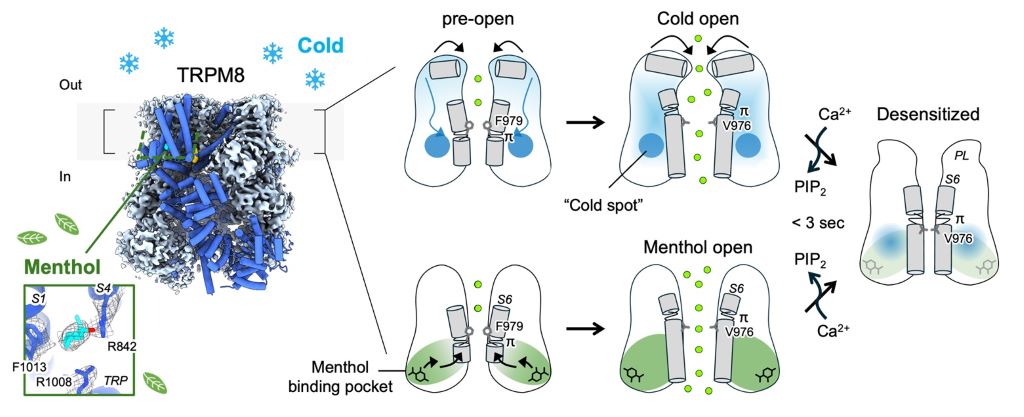
Using cryo-electron microscopy, researchers captured multiple conformational snapshots of the cold sensing channel, TRPM8, as it transitions from closed to open.

When you step outside on a winter morning or pop a mint into your mouth, a tiny molecular sensor in your body springs into action, alerting your brain to the sensation of cold. Scientists have now captured the first detailed images of this sensor at work, revealing exactly how it detects both actual cold and the perceived cool of menthol, a compound derived from mint plants. The research was presented at the 70th Biophysical Society Annual Meeting in San Francisco from February 21–25, 2026.

The study focused on a protein channel called TRPM8. “Imagine TRPM8 as a microscopic thermometer inside your body,” said Hyuk-Joon Lee, a postdoctoral fellow from Seok-Yong Lee’s laboratory at Duke University. “It’s the primary sensor that tells your brain when it’s cold. We’ve known for a long time that this happens, but we didn’t know how. Now we can see it.”

TRPM8 sits in the membranes of sensory neurons innervating the skin, oral cavity, and eyes. It responds to cold temperatures – roughly between 8°C and 28°C – by opening up and allowing ions to flow into the cell, which triggers a nerve signal to the brain. It’s also the reason menthol, eucalyptus, and certain other compounds produce that characteristic cooling sensation.

“Menthol is like a trick,” Lee explained. “It attaches to a specific part of the channel and triggers it to open, just like cold temperature would. So even though menthol isn’t actually freezing anything, your body gets the same signal as if it were touching ice.”

Using cryo-electron microscopy – a technique that images flash-frozen proteins with an electron beam – Lee and colleagues captured multiple conformational snapshots of TRPM8 as it transitions from closed to open. They discovered that cold and menthol activate the channel through shared yet distinct allosteric networks: cold primarily triggers changes in the pore region (the part that actually opens to let ions through), while menthol binds a different part of the protein and induces shape changes that propagate to the pore.

“When cold is combined with menthol, the response is enhanced synergistically,” Lee said. “We used this combination to capture the channel in its open state – something that hadn’t been achieved with cold by itself.”

The findings have medical implications. When TRPM8 doesn’t function properly, it has been linked to conditions including chronic pain, migraines, dry eye and certain cancers. Acoltremon, a drug that activates TRPM8, is an FDA-approved eye drop for dry eye disease. As a menthol analogue, it works by activating the cooling pathway to stimulate tear production and soothe irritated eyes.

The researchers also identified what they call a “cold spot” – a specific region of the protein that is uniquely important for sensing temperature and helps prevent the channel from becoming desensitised during prolonged cold exposure.

“Previously, it was unclear how cold activates this channel at the structural level,” Lee said. “Now we can see that cold triggers specific structural changes in the pore region. This gives us a foundation for developing new treatments that target this pathway.”

The work offers the first molecular definition of how cold and chemical stimuli are integrated to create the sensation of coolness – answering a fundamental question in sensory biology that has puzzled scientists for decades.

Source: Biophysical Society

Researchers Uncover Protein that Enables Sensation of Cold

Photo by Ian Keefe on Unsplash

University of Michigan researchers have identified the protein that enables mammals to sense cold, filling a long-standing knowledge gap in the field of sensory biology. The findings, published in Nature Neuroscience, could help unravel how we sense and suffer from cold temperature in the winter, and why some patients experience cold differently under particular disease conditions.

“The field started uncovering these temperature sensors over 20 years ago, with the discovery of a heat-sensing protein called TRPV1,” said neuroscientist Shawn Xu, a professor at the U-M Life Sciences Institute and a senior author of the new research.

“Various studies have found the proteins that sense hot, warm, even cool temperatures – but we’ve been unable to confirm what senses temperatures below about 60 degrees Fahrenheit (15.5°C).”

In a 2019 study, researchers in Xu’s lab discovered the first cold-sensing receptor protein in Caenorhabditis elegans, a species of millimetre-long worms that the lab studies as a model system for understanding sensory responses.

Because the gene that encodes the C. elegans protein is evolutionarily conserved across many species, including mice and humans, that finding provided a starting point for verifying the cold sensor in mammals: a protein called GluK2 (short for Glutamate ionotropic receptor kainate type subunit 2).

For this latest study, a team of researchers from the Life Sciences Institute and the U-M College of Literature, Science, and the Arts tested their hypothesis in mice that were missing the GluK2 gene, and thus could not produce any GluK2 proteins. Through a series of experiments to test the animals’ behavioural reactions to temperature and other mechanical stimuli, the team found that the mice responded normally to hot, warm and cool temperatures, but showed no response to noxious cold.

GluK2 is primarily found on neurons in the brain, where it receives chemical signals to facilitate communication between neurons. But it is also expressed in sensory neurons in the peripheral nervous system.

“We now know that this protein serves a totally different function in the peripheral nervous system, processing temperature cues instead of chemical signals to sense cold,” said Bo Duan, U-M associate professor of molecular, cellular, and developmental biology and co-senior author of the study.

While GluK2 is best known for its role in the brain, Xu speculates that this temperature-sensing role may have been one of the protein’s original purposes. The GluK2 gene has relatives across the evolutionary tree, going all the way back to single-cell bacteria.

“A bacterium has no brain, so why would it evolve a way to receive chemical signals from other neurons? But it would have great need to sense its environment, and perhaps both temperature and chemicals,” said Xu, who is also a professor of molecular and integrative physiology at the U-M Medical School. “So I think temperature sensing may be an ancient function, at least for some of these glutamate receptors, that was eventually co-opted as organisms evolved more complex nervous systems.”

In addition to filling a gap in the temperature-sensing puzzle, Xu believes the new finding could have implications for human health and well-being. Cancer patients receiving chemotherapy, for example, often experience painful reactions to cold.

“This discovery of GluK2 as a cold sensor in mammals opens new paths to better understand why humans experience painful reactions to cold, and even perhaps offers a potential therapeutic target for treating that pain in patients whose cold sensation is overstimulated,” Xu said.

Source: University of Michigan