
Tag: 3/12/25

Headache Disorders Affect Nearly One in Every Three People

Photo by Kindel Media

Headache disorders affected almost 3 billion people worldwide in 2023 – nearly one in every three people, a figure unchanged since 1990 – and ranked sixth among causes of health loss, according to new research published in The Lancet Neurology. The analysis is part of the Global Burden of Disease (GBD) 2023 study and estimated health loss from migraine, tension-type headache, and medication-overuse headache from 1990 through 2023.

The study, led by researchers at IHME and the Norwegian University of Science and Technology (NTNU), examined the health loss resulting from headache disorders, and how long people have headache across different ages and sexes. Health loss was measured in years lived with disability (YLDs), which captures the total time people spend living with health conditions that limit daily activities and overall well-being. Drawing on population-based studies worldwide, the analysis provides the most comprehensive picture to date of how headache disorders affect daily life and overall health.

Headache disorders rank among the world’s most disabling conditions, disproportionately affecting women

In 2023, headache disorders accounted for an age-standardised rate of 541.9 YLDs per 100 000 people, ranking sixth among all causes of disability globally. The burden of headache disorders was more than twice as high among women as men, with rates of 739.9 and 346.1 YLDs per 100 000, respectively. Across every age group, women consistently spent more time experiencing headache symptoms than men.

“Our analysis shows that headache disorders have remained unchanged in three decades,” said Yvonne Xu, co-author and research scientist at IHME. “And women experience significantly higher levels of headache-related disability because they have headaches more frequently and for longer durations than men. Recognizing this is essential for improving how we prevent and manage headache disorders worldwide.”

Migraine and medication overuse drive most of the global burden from headache disorders

Although tension-type headache is nearly twice as prevalent as migraine, migraine accounts for about 90% of headache-attributed YLDs. In 2023, migraine alone caused an estimated 40.9 million YLDs globally, with an age-standardised rate of 487.5 YLDs per 100 000. Tension-type headache accounted for 54.4 YLDs per 100 000, showing that migraine, though less common, is far more disabling and drives most of the overall burden of headache disorders. While the highest rates of disability from migraine were seen in North Africa and the Middle East, closely followed by high-income regions such as Europe and North America, the burden remains high worldwide.

Medication-overuse headache, defined as the worsening of an existing headache due to excessive use of medication (e.g., pain medication) mainly used to treat migraine or tension-type headache, further amplifies this burden. While this condition affects relatively few, its impact on population-level disability is substantial because of the high individual burden. For migraine, medication overuse accounted for 22.6% of YLDs in men and 14.1% in women, while for tension-type headache, it contributed 58.9% and 56.1%, respectively. Overall, medication overuse was responsible for more than one-fifth of all headache-related disability globally. 

“Our findings show that a large part of the global headache burden is preventable,” said Andreas Kattem Husøy, lead author and post-doctoral fellow in the Department of Neuromedicine and Movement Science at NTNU and Norwegian Centre for Headache Research (NorHead). “Integrating headache services into primary care, especially in low- and middle-income countries where effective treatments remain scarce, could reduce lost productivity and improve quality of life for hundreds of millions.”

Improved care and education are key to reducing the global burden of headache disorders.

Headache disorders remain one of the most common and disabling health conditions worldwide. The burden is unevenly distributed by sex and further intensified by overuse of pain medication, a preventable cause of long-term pain and disability. Although effective and affordable treatments are available, access to appropriate care and education on safe medication use remain limited in many settings.

The findings highlight an urgent need to strengthen prevention, management, and access to care for headache disorders worldwide. With greater awareness and coordinated action, much of the global burden of headache disorders can be prevented.
Source: Institute for Health Metrics and Evaluation

A Simple Neck Scan Could Detect Men at High Risk of Heart Failure

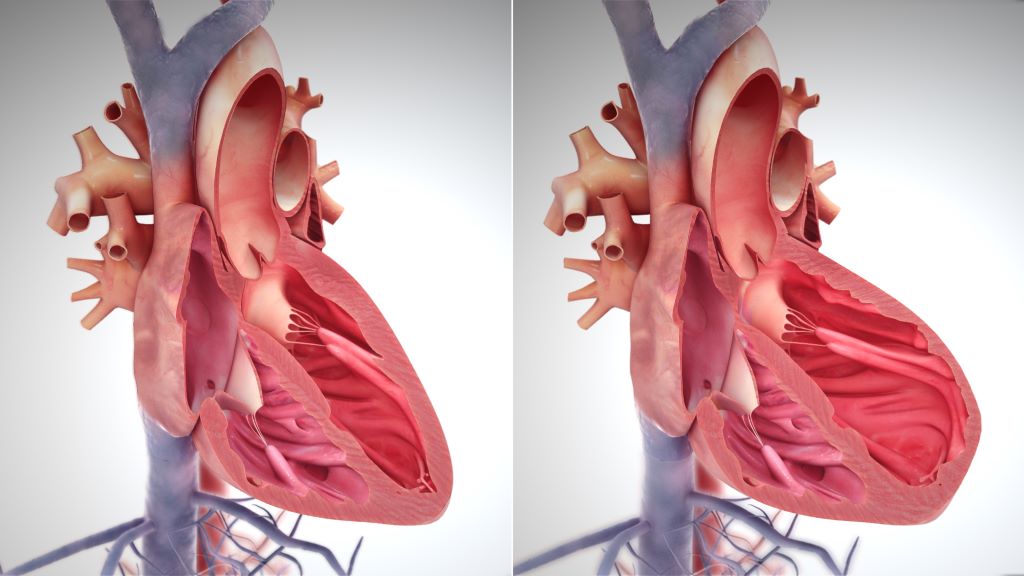
Right side heart failure. Credit: Scientific Animations CC4.0

A simple neck scan can identify men with double the risk of heart failure, according to a new study led by UCL researchers and funded by the British Heart Foundation and the National Institute for Health and Care Research.

A carotid ultrasound, like the ultrasound for pregnant women, is quick and painless, using a small handheld device moved gently over the neck to scan the arteries underneath.

When around 1600 men over the age of 70 received the scan, it showed the ‘flexibility’ of their carotid arteries – how much they stretch and expand with each heartbeat.

Researchers found that the quarter of men with the least flexible carotid arteries were 2.5 times more likely to develop heart failure than those with the most flexible carotid arteries.

These people could be encouraged by doctors to eat more healthily, do more exercise and take medications, if needed, to help reduce their risk of developing heart failure.

GPs do not currently routinely carry out the cheap and easy scan on healthy patients without symptoms. But, where GP surgeries have the capacity, offering a neck scan to older people to measure the flexibility of their arteries could help them better understand their risk of future heart failure, according to the researchers.

Having relied upon data from the British Regional Heart Study, which began in the 1970s and only involved men, researchers highlight that these findings next need to be looked at in women.

Dr Atinuke Akinmolayan (UCL Primary Care & Population Health), who is now a GP, said: “The carotid ultrasound is a safe, cheap and painless investigation, and our findings suggest it may be able to provide an early warning sign for heart failure.

“More research is needed, especially to see if this works for women, but this is something GPs could look at offering to people over the age of 60, where possible and believed needed.

“A patient who gets an ultrasound result indicating they may be at higher risk of future heart failure could have an important conversation with their doctor about lifestyle changes they could make to lower that risk.”

Doctors tend to scan the two carotid arteries, which run up either side of the neck, when someone has had a stroke or is at risk of a stroke following a transient ischaemic attack, known as a ‘mini-stroke’. A scan can identify carotid artery disease – a build-up of fatty material which can cause a stroke by breaking off and travelling into the brain or by narrowing the arteries and stopping blood reaching the brain.

However, the carotid arteries may be a red flag for heart failure also. This is because, when the carotid arteries become less flexible, they do not expand properly to let blood through. This can raise blood pressure, which forces the heart muscle to work harder. Over time, this can lead to heart failure.

The study, published in the Journal of the American Heart Association, looked at 1631 British men, aged 71 to 92, who had a carotid artery ultrasound between 2010 and 2012 as part of the British Regional Heart Study.

A carotid ultrasound, sometimes called a Doppler scan, takes an average of 15 to 30 minutes for most people, although this can vary.

A small handheld sensor is moved back and forth over the neck, generating sound waves which bounce off the arteries. That provides an echo which changes in frequency when blood flow is reduced in the blood vessels because they are narrowed by built-up fatty material.

The narrowing identified by a carotid scan can then be used to calculate the arteries’ flexibility, after factoring in other measures, including blood pressure. Researchers were able to identify the quarter of men with the least flexible carotid arteries, and the quarter of men whose carotid arteries were most flexible.

They then compared the rates of heart failure in each group  over an average of six years after their neck scans.

Even after considering other causes of heart failure, like age, weight, smoking and whether people had previously suffered a heart attack, the quarter of men with the least flexible carotid arteries had 2.5 times the risk of developing heart failure, compared to the quarter with the most flexible carotid arteries.

In a separate finding, looking at the thickness of people’s carotid arteries rather than their flexibility, the study found that men with thicker carotid arteries were more likely to have a heart attack or die from one.

For every ‘unit’ increase in the thickness of the carotid artery wall – with a unit equalling 0.16 millimetres – the risk of having a heart attack increased by about 29 per cent, even after considering other relevant factors like age and weight.

However the thickness of the carotid arteries was not found to be significantly linked to future heart failure in the study.

There are around 200 000 new cases of heart failure diagnosed every year in the UK.

It occurs when the heart is not pumping blood around the body as well as it should, most commonly when the heart muscle has been damaged – for example, after a heart attack.

Heart failure can cause extreme fatigue, shortness of breath and fainting.

Professor Bryan Williams, chief scientific and medical officer at the British Heart Foundation (BHF), who is also Chair of Medicine at UCL Institute of Cardiovascular Science, said: “The findings of this study are interesting and show that stiffening of arteries is associated with increased risk of heart failure, most likely due to the heart having to work harder against the resistance caused by these stiffer arteries.

“It is an important signal that whenever we detect such changes in the carotid arteries, we should also be thinking of the potential impact on the heart and an increased risk of heart failure – which we have treatment strategies to prevent.”

Source: University College London