Fermented Soy Products Found to Reduce Asthma Inflammation

A bowl of tofu, a fermented soy food. Photo by Polina Tankilevitch from Pexels

Fermented soy products are common in the Japanese diet, and one brand known as ImmuBalance has been found to suppress airway inflammation in animal models of asthma.

Bronchial asthma causes symptoms such as wheezing and cough due to chronic airway inflammation, but there is no fundamental treatment for it, leaving a desire for new prevention and treatment methods. Osaka University researchers found that in a ImmuBalance-treated group of asthma model mice, eosinophils associated with asthma were significantly reduced in the bronchoalveolar lavage fluid (BALF). As well as a decrease in inflammation and mucus around the bronchi, the team observed a suppression of proteins that induce eosinophilic inflammation.

“The relationship between soy intake and allergic diseases has been epidemiologically reported in the past,” explained first author Hideaki Kadotani, “suggesting that the components of soy may have some anti-allergic effects”

“It was reported that imbalances in the gut microbiota may be involved in immune system and allergic diseases, and fermented dietary fiber, like that found in soy, might have beneficial effects in allergic asthma models.” continues Associate Professor Kazuhisa Asai, supporting author of the study.

In the study, which appears in the journal Nutrients, such a gut imbalance’s effect on asthma were examined by giving ImmuBalance-enriched feed to asthma model mice. In the ImmuBalance-treated group, there was a significant drop in the number of eosinophils in BALF, and inflammation around the bronchi and mucus production in the bronchial epithelium was suppressed. Additionally, the expression of Th2 cytokines and the immunoglobulin serum IgE that induce eosinophilic inflammation in BALF were found to be significantly suppressed.

“In clinical practice, steroid inhalants are the basis of asthma treatments, yet they are known to have adverse side effects“, stated lead advisor to the study, Professor Tomoya Kawaguchi. “Our results suggest that the intake of fermented soybean products should be recommended as a complementary coping strategy to asthma with fewer side effects”

Source: Osaka University
Interleukin-12 no Longer the Villain in Psoriasis

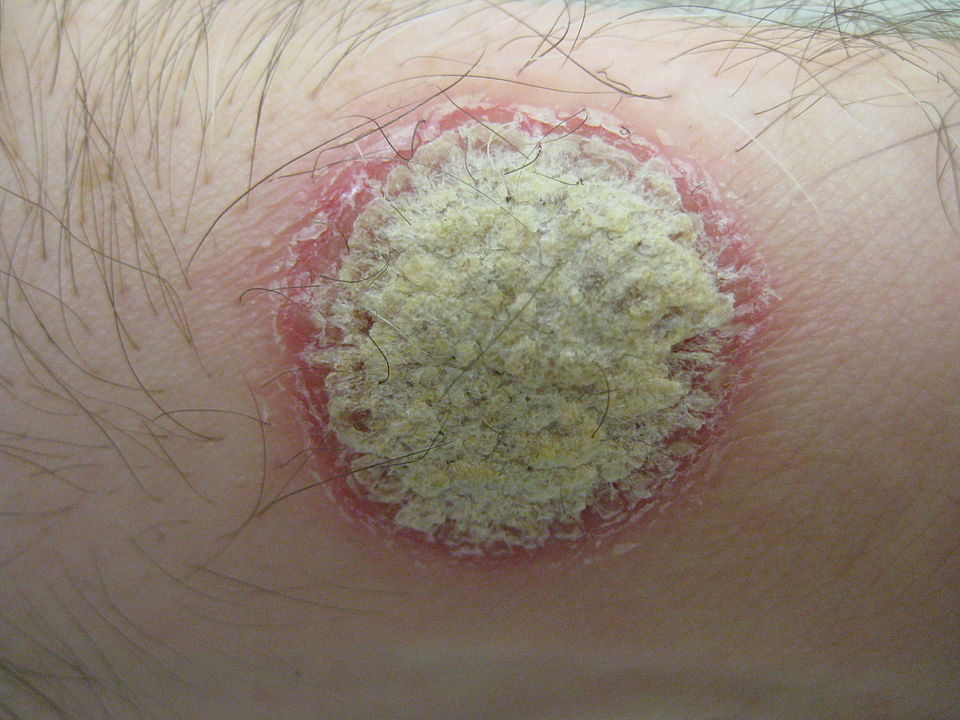
Psoriatic plaque, showing a silvery center surrounded by a reddened border. Source: Wikimedia. By James Heilman, MD – Own work, CC BY-SA 3.0

Considered to be the trigger for psoriais, the immune messenger molecule Interleukin-12 (IL-12) has now been shown to actually cause the skin disease but in fact protects against it. This finding also explains why common psoriasis drugs that block the messenger show insufficient treatment efficacy.

Psoriasis is a chronic inflammatory autoimmune disease that manifests as red, scaly skin patches. No causal treatment for the disease exists, but the symptoms can be significantly alleviated with modern therapies. The development of the skin disease arises from complex changes immune cell networks and the messengers they use for communication. Clinical trials showed that newly developed drugs that blocked only IL-23 are more effective than previous treatments targeting both IL-23 and IL-12 in psoriasis patients, but why this was so was not known. Now, researchers at the University of Zurich (UZH) have uncovered the underlying molecular mechanisms.

From human and mouse studies, they found that various cell types in the skin are also equipped with receptors for IL-12. Not only the T cells of the immune system, but also keratinocytes, horn-forming skin cells that build up the epidermis, can thus recognise the messenger. In fact, the recognition of interleukin-12 by these skin cells was responsible for the protective effect of the messenger, as the researchers found out. “Interleukin-12 is essential for the normal, physiological function of keratinocytes. For example, it prevents the increased cell division observed in psoriasis,” explained group leader Sarah Mundt from the Institute of Experimental Immunology at UZH.

“These results surprised us, because so far drugs for the treatment of psoriasis also aim at blocking interleukin-12,” said immunology professor Burkhard Becher.

“Our findings indicate that blocking IL-12 is not advisable, and such drugs should therefore no longer be used to treat psoriasis patients,” advised first author  Pascale Zwicky, PhD student. Accordingly, psoriasis drugs should only block the messenger substance IL-23, but no longer IL-23 and -12 together.

The UZH researchers’ findings could be important for the treatment of other diseases. “The combined blocking of IL-23 and -12 is also used in the treatment of chronic inflammatory bowel diseases and psoriatic arthritis,” said Prof Becher. “In these diseases, the role of IL-12 has not yet been sufficiently studied. But here, too, a protective role of the messenger substance is possible.”

Source: University of Zurich

A New, Lasting Diabetes Treatment

Source: National Cancer Institute on Unsplash

Israeli researchers have come up with a novel approach to the treatment of type 2 diabetes, using an autograft of muscle cells engineered to take in sugar at increased rates.

The disease’s long-term complications include heart disease, strokes, retinal damage leading to blindness, kidney failure, and poor blood flow in the limbs that may result in amputations. Currently a combination of lifestyle changes, medication, and insulin injections are used to treat it, however it is still associated with a 10-year reduction in life expectancy.

Professor Shulamit Levenberg led the study alomg with PhD student Rita Beckerman from the Stem Cell and Tissue Engineering Laboratory in the Technion’s Faculty of Biomedical Engineering. An autograft of muscle cells engineered to take in sugar at increased rates were tested in mice, which displayed normal blood sugar levels for months after a single procedure. The study findings were published in Science Advances.

Muscle cells are among the main targets of insulin, and they are supposed to absorb sugar from the blood. In their study, Prof. Levenberg’s group isolated muscle cells from mice and engineered these cells to present more insulin-activated sugar transporters (GLUT4). These cells were then grown to form an engineered muscle tissue, and finally put back into diabetic mice. The engineered cells not only proceeded to absorb sugar correctly, improving blood sugar levels, but also induced improved absorption in the mice’s other muscle cells through intercellular signalling. After this one treatment, the mice remained cured of diabetes for four months – the entire observation period. Their blood sugar levels remained lower, and they had reduced levels of fatty liver normally seen in type 2 diabetes.

Prof. Levenberg explained how the process worked. “By taking cells from the patient and treating them, we eliminate the risk of rejection.” These cells can easily integrate back into being part of the body and respond to the body’s signaling activity.

An effective treatment, especially as a once-off, could significantly improve both quality of life and life expectancy of those who have diabetes. The same method could also be used to treat various enzyme deficiency disorders.

Source: Technion Israeli Institute of Technology

Up to Five Times Higher Costs for Those with Rare Diseases

Credit: Thirdman on Pexels

By studying medical and insurance records indicates health care costs for people with a rare disease, researchers have found that these have been underestimated and are three to five times greater than the costs for people without a rare disease.

The findings, appearing in the Orphanet Journal of Rare Diseases, provides new evidence of the impact rare diseases could have on public health, suggesting that medical costs for individuals with rare diseases are on par with those for cancer and heart failure.  

“There needs to be greater public awareness of the large and growing medical footprint of rare diseases in society,” said senior author Anne Pariser, MD, director of the NCATS Office of Rare Diseases Research. “Only about 10% of rare diseases have an FDA-approved therapy for their treatment. The findings underscore an urgent need for more research, and earlier and more accurate diagnoses of and interventions for these disorders.”

Most of the 7000 to 10 000 known rare diseases disproportionately affect children, adolescents and young adults. Individually, most rare diseases might affect only a few hundred to a few thousand people around the world. Rare diseases however are collectively common, affecting an estimated 4% of the world’s population. Many of these diseases have a genetic cause, are serious or life-threatening and are hard to diagnose and treat.

The pilot study used International Classification of Diseases (ICD) codes, which designate a disease diagnosis and other methods, to determine those individuals with rare diseases and their direct medical costs for 14 rare diseases in four health care systems compared to non-rare disease patients of a similar age.

The 14 rare diseases represented a diverse set of disorders differing in prevalence, organ systems affected, age of onset, clinical course, and availability of an approved treatment or specific ICD code. These rare diseases include sickle cell disease, muscular dystrophy and eosinophilic esophagitis.

The analysis showed wide variations of rare diseases prevalence in the different health care systems, possibly due in part to geographic differences, as well as the use of public versus private insurance, which may include different patient group representation. Some genetic diseases can also have a higher prevalence in certain regions, due to demographic make-up.

With the Eversana health care system database, the cost per patient per year (PPPY) for those with a rare disease, ranged from $8 812 to $140 044 for rare diseases patients compared to $5862 for those without a rare disease. The NCATS data indicated PPPY costs ranging from $4859 to $18 994 for rare diseases patients versus $2211 for those without a rare disease.

Using patient medical records, the researchers also traced the diagnostic journeys of four people with a rare disease, including two individuals who had a form of Batten disease, an inherited neurological disorder, and two others with cystic fibrosis. These journeys provided detailed descriptions of direct medical costs, such as for hospitalisations and procedures for these diseases, and provided insights into patient clinical management before and after disease diagnosis.

Analysis of medical records also revealed that rare diseases patients often shared commanilities in symptoms (eg, seizures, infections, and developmental delay) and characteristics, which could aid in earlier diagnosis and treatmen. As many receive a rare disease diagnosis at a young age and because most rare diseases are serious conditions, rare disease patients are likely to require hospital time and incur greater medical expenses over a lifetime.

Such commonalities among rare disease patients could point to the potential use of machine learning techniques on health care system databases to improve diagnoses, said study co-author Joni L. Rutter, PhD, NCATS Acting Director.

The researchers would also like to determine whether these methodologies could be scaled to thousands of other known rare diseases.

“Ultimately, to improve the lives of people with rare diseases,” said Dr Rutter, “we need to find innovative ways, including new technologies, to help shorten the lengthy diagnostic odysseys so many patients and families experience and make more treatments available faster.”

Source: National Center for Advancing Translational Sciences

A New Clue to Disarming C. Difficile’s Toxic Weaponry

C difficile. Source: CDC

Therapeutic interventions for Clostridioides difficile infection (CDI) could make use of a glucosyltransferase domain (GTD) as an ideal molecular target, potentially yielding new, effective treatments for this deadly disease.

The study, published in Science Advancesprovided new insights into TcdB, the toxic molecular weaponry of C. difficile and its hypervirulent strains, creating an opportunity to disarm it.

CDI is the leading cause of antibiotic-associated diarrhoea and gastroenteritis-associated deaths worldwide, accounting for 500 000 cases and 29 000 deaths in the US every year and is classified by the Centers for Disease Control and Prevention as one of the top health threats. The emergence and spread of hypervirulent C. difficile strains is of global concern, resembling as it does the occurrence of new virus variants in current COVID pandemic. TcdB is one of two homologous C. difficile exotoxins, and TcdB alone is capable of causing the full spectrum of CDI diseases.

“We focused on the structure and function of TcdB’s crucial GTD, which is the toxin’s ‘warhead.’ The GTD is delivered by the toxin inside the host cells and causes most of the cytosolic damage to patients,” said corresponding author Rongsheng Jin, PhD, professor in the Department of Physiology & Biophysics at the UCI School of Medicine. “We discovered molecular mechanisms by which the GTD specifically recognises and blocks the physiological functions of the human GTPases Rho and R-Ras enzyme families that are crucial signaling molecules.”

The team also showed that the classic form of TcdB and the hypervirulent TcdB recognise their human targets in different ways, leading to distinct structural changes to the host cells caused by bacterial invasion.

“Once the GTD of TcdB is inside the cells, it is shielded by our cells and becomes inaccessible to passive immunotherapy. But our studies suggest that small molecule inhibitors could be developed to disarm the GTD, which will directly eliminate the root cause of disease symptoms and cellular damage,” Prof Jin explained. “This new strategy can potentially be integrated with and complement other CDI treatment regiments.”

Source: UCI School of Medicine

Gut Inflammation and Mental Health Link

Image by Falkurian Design on Unsplash

Using mouse models, scientists have discovered a link between gut inflammation and mental comorbidities. In response to gut inflammation like that caused by inflammatory bowel disease (IBD), they observed that the vascular barrier in the brain choroid plexus closes, clamping down access to the brain. The findings were published in Science.

Though this gut-brain vascular axis deregulation is likely a protective mechanism for the brain against inflammation, the findings suggest it may also result in the various cognitive and psychiatric symptoms that are occasionally associated with IBD.

Usually associated with intestinal inflammation, IBD can also cause a wide variety of symptoms in other organs. There is a robust link between anxiety and IBD; up to 40% of patients with IBD also present with psychiatric symptoms such as anxiety or depression. While the gut-brain axis is thought to be involved in driving these symptoms, no other related mechanisms are currently known.

Using a mouse model of intestinal inflammation, Sara Carloni and colleagues identified a potential pathogenic link between IBD and its associated mental comorbidities. According to the findings, the gut vascular barrier becomes more permeable due to the inflammatory process, which allows inflammation to spread beyond the intestines.

In response to this spread, the vascular barrier in the choroid plexus of the brain shuts down, which helps to protect the brain from inflammation. However, in doing so, the process also potentially impairs communications between organs and may hinder brain function.

In a mouse model of genetically driven closure of choroid plexus endothelial cells, Carloni and colleagues observed a deficit in short-term memory and anxiety-like behaviour. Thus, the mental deficits observed alongside IBD may result from deregulation of the gut-brain vascular axis, the authors said. This finding could be used for the development of therapeutic targets in treating some behavioural disorders.

Source: News-Medical.Net

Sleep is Also Important in Avoiding Overweight in Babies

Photo by Danijel Durkovic on Unsplash

While the importance has long been known, little research has examined the necessity of sufficient sleep during the first months of life. New research suggests that newborns who sleep longer and wake up less throughout the night are less likely to be overweight in infancy. Their results are published in Sleep.

“While an association between insufficient sleep and weight gain is well-established in adults and older children, this link has not been previously recognized in infants,” said study co-author Susan Redline, MD, MPH, senior physician in the Division of Sleep and Circadian Disorders at the Brigham. “In this study, we found that not only shorter nighttime sleep, but more sleep awakenings, were associated with a higher likelihood of infants becoming overweight in the first six months of life.”

To conduct this research, Dr Redline and colleagues observed 298 newborns born at Massachusetts General Hospital between 2016 and 2018. The infants’ sleep patterns were monitored using ankle actigraphy watches – devices that measure patterns of activity and rest over multiple days. Researchers obtained three nights’ worth of data at the one- and six-month marks while parents kept sleep diaries, recording their children’s sleep and wake episodes.

Scientists measured infant height and weight and determined their body mass index, classifying infants as overweight if they fell into or above the 95th percentile on the World Health Organization’s growth charts.

Notably, researchers found that just one extra hour of sleep was associated with a 26% decrease in overweight risk. Additionally, infants that woke up less during the night faced a lower risk of excess weight gain. Scientists speculate that having more sleep promotes routine feeding practices and self-regulation, factors that mitigate overeating.

Investigators noted an underrepresentation of African-American individuals and lower-income families in their dataset. Additionally, confounding variables, such as breastfeeding duration, could have impacted infant growth. In the future, the researchers aim to extend this study to evaluate how sleep patterns impact growth within the first two years of life and identify key factors that mediate the correlation between sleep and weight gain. They also aim to evaluate interventions for promoting healthy sleep habits.

“This study underscores the importance of healthy sleep at all ages,” said Dr Redline. “Parents should consult their pediatricians on the best practices to promote healthy sleep, like keeping consistent sleep schedules, providing a dark and quiet space for sleeping, and avoiding having bottles in bed.”

Source: EurekAlert!

Distinct Lower Airways Bacterial Profile inChildren with Cystic Fibrosis

Phot by Ben Wicks on Unsplash

In children with cystic fibrosis (CF), their lower airways have a higher burden of infection, more inflammation and lower diversity of microorganisms, compared to children with other illnesses who also have lung issues, researchers have found. They noted a clear divergence in these bacterial communities in toddlers, before progressive lung disease manifests in CF patients. 

Their findings, published in the journal PLOS ONE, could help providers target specific pathogens earlier, treat them and potentially prevent more severe lung disease.

As lead author Jack O’Connor, at Ann & Robert H. Lurie Children’s Hospital of Chicago explained, “We compared lower airway samples from bronchoscopy in children with CF and disease controls across the age spectrum, and used genetic sequencing to identify microorganisms, finding that a few common cystic fibrosis pathogens begin to dominate at very early ages. Such a clear split from disease controls in this young age group has not been shown before. Our findings deepen our understanding of the disease trajectory in cystic fibrosis and could help improve outcomes through earlier intervention.”

Chronic airway infection and inflammation which leads to progressive, obstructive lung disease is the main cause of illness and death in people with cystic fibrosis.

Researchers tested lower airway samples from 191 patients (63 with cystic fibrosis) aged 0-21 years. The disease controls included patients with diverse conditions, such as cancer, immune deficiency and pneumonia. Using genetic sequencing, researchers were able to identify distinct pathogens that are more dominant at different ages in patients with cystic fibrosis.

“Establishing key age-related differences in lower airway bacterial communities and inflammation in patients with CF, especially during early childhood, may give us a window of opportunity for earlier and more precise treatment,” said senior author Theresa Laguna, MD, MSCS, Division Head of Pulmonary and Sleep Medicine at Lurie Children’s and Associate Professor of Pediatrics at Northwestern University Feinberg School of Medicine. “If we can prevent worse infections, we could improve the quality of life and potentially expand the life expectancy of patients with CF.”

Source: News-Medical.Net

Up to 180 000 Health Workers may Have Died from COVID

Photo by Mulyadi on Unsplash

Between 80 000 and 180 000 health and care workers (HCWs) are estimated to have died from COVID between January 2020 and May 2021, the World Health Organization (WHO) said on Thursday.

That grim estimate features in a new WHO working paper based on the 3.45 million coronavirus-related deaths reported globally to the UN health agency up to May. The WHO warns it may well be an underestimate of 60%. To highlight the need for better protection, WHO was joined by global partners working to end the pandemic, to issue an urgent call for concrete action on behalf of workers in the sector.  

WHO Director-General, Dr Tedros Adhanom Ghebreyesus, said that “the backbone of every health system is its workforce.”

“COVID-19 is a powerful demonstration of just how much we rely on these men and women, and how vulnerable we all are when the people who protect our health are themselves unprotected”, he added.  

WHO and partners said that besides the deaths, more and more HCWs are suffering from burnout, stress, anxiety and fatigue. They are urging  equitable access to vaccines so that HCWs are prioritised.  

By the end of last month, on average, two in five HCWs were fully vaccinated, but with considerable differences across regions.

“In Africa, less than one in ten health workers have been fully vaccinated. Meanwhile, in most high-income countries, more than 80% of health workers are fully vaccinated”, Dr Ghebreyesus pointed out.  

For him, over 10 months since the approval of the first vaccines, “the fact that millions of health workers still haven’t been vaccinated is an indictment on the countries and companies that control the global supply of vaccines”.

Currently, 82 nations risk missing the target of vaccinating 40% of their population by year end, and 75% of those countries are faced with insufficient supply. The remainder have some limitations that WHO is helping solve.

Speaking to journalists via videolink, Gordon Brown, former UK Prime Minister and currently WHO’s Ambassador for Global Health Financing, said it would be a “moral catastrophe of historic proportions” if G20 countries cannot act quickly.

These nations have pledged to donate more than 1.2 billion vaccine doses to COVAX. According to WHO, so far, only 150 million have been delivered.  

With wealthy countries stockpiling millions of unused doses, close to expiration, Brown said they should start an “immediate, massive, concerted” airlift of vaccines to low income countries.  

If they do not, he argued, they will be guilty of an “economic dereliction of duty that will shame us all.”  

Brown also warned that “the longer vaccine inequity exists, the longer the virus will be present.”

Source: UN News

No Finding of Early Miscarriage Risk from COVID Vaccinations

Photo by Shvets Productions on Pexels

A new study has found no association between COVID vaccinations and risk of first-trimester miscarriages, providing further evidence of the safety of COVID vaccination during pregnancy. The findings were published in the New England Journal of Medicine.

Study co-author Dr Deshayne Fell said, “The study analysed several national health registries in Norway to compare the proportion of vaccinated women who experienced a miscarriage during the first trimester and women who were still pregnant at the end of the first trimester.”  Dr Fell, is Associate Professor in the School of Epidemiology and Public Health in the University of Ottawa’s Faculty of Medicine and a Scientist at the Children’s Hospital of Eastern Ontario (CHEO) Research Institute.

“Our study found no evidence of an increased risk for early pregnancy loss after COVID vaccination and adds to the findings from other reports supporting COVID vaccination during pregnancy,” the study authors wrote. 

“The findings are reassuring for women who were vaccinated early in pregnancy and support the growing evidence that COVID vaccination during pregnancy is safe.”

Dr Fell and colleagues found no relationship between the type of vaccine received and miscarriage. In Norway, the vaccines used included Pfizer, Moderna and AstraZeneca.

“It is important that pregnant women are vaccinated since they have a higher risk of hospitalisations and COVID-complications, and their infants are at higher risk of being born too early. Also, vaccination during pregnancy is likely to provide protection to the newborn infant against COVID infection in the first months after birth,” the study authors stressed.

Source: University of Ottawa