Day: March 13, 2026

NHI Pause Should be Used to Build Stronger Healthcare Foundations

By Haseena Majid and Mogie Subban

Universal health coverage cannot succeed with fragmented systems, weak data, and largely symbolic participation. A recent court-ordered pause to NHI implementation offers a chance to build the foundations properly, argue Dr Haseena Majid and Professor Mogie Subban.

Implementation of the NHI Act has been delayed following a High Court order, by agreement between the parties, prohibiting the proclamation or implementation of its provisions until the Constitutional Court rules on challenges related to public participation.

Beyond the legalities, the pause reveals something more consequential. Universal health coverage cannot succeed on fragile administrative foundations.

If the NHI is to deliver equity, efficiency and quality care, the state must first confront the structural weaknesses that continue to shape large parts of South Africa’s health system. These include fragmented governance across national, provincial and local levels that weakens coordination and accountability; persistent shortages of health professionals that leave facilities understaffed and overburdened; and weak information systems that limit the state’s ability to track performance, allocate resources effectively and plan services based on reliable data.

The NHI Act can mandate pooled financing and new purchasing arrangements, but financing reform alone cannot fix fragmented governance, uneven data systems or inconsistent coordination between stakeholders. When reforms are layered onto unstable administrative systems, the result is not transformation but increased risk.

The eye health example

Eye health illustrates this challenge clearly. This is because it depends on coordination across many parts of the health system including clinics, skilled cadres such as optometrists and ophthalmologists, hospitals, NGOs and screening programmes. When these stakeholders do not work together effectively, patients fall through the gaps.

South Africa’s burden of chronic disease is rising, and with it preventable vision loss. The International Diabetes Federation estimates that around 2.3 million people in South Africa aged 20–79 live with diabetes, a condition that can affect the eyes and lead to vision loss and blindness if not detected early. Studies in South Africa have reported high rates of diabetic eye disease, including prevalence estimates of 39% in a tertiary diabetes clinic in Durban and around 25% in primary care settings in Tshwane.

These figures are not simply about eye disease. They reflect gaps in chronic disease coordination, screening coverage and referral systems. When diabetic eye screening is inconsistent, when referral pathways are unclear and when health data are incomplete, preventable vision loss becomes far more likely.

Cataract surgery, one of the most effective medical procedures available, is rightly prioritised. Yet provincial reporting continues to show significant surgical backlogs. While numbers fluctuate, the pattern remains consistent: demand continues to outpace coordinated capacity.

Vision challenges are also increasing as the population ages. A KwaZulu-Natal study reported presbyopia prevalence of 77% among examined adults. As the population grows older, near-vision impairment becomes not only a clinical concern but also one that affects productivity, mobility and independence.

Taken together, diabetes-related eye disease, cataracts and age-related vision decline illustrate a predictable and growing demand for eye-care services. The burden is clear, but the health system response remains uneven.

Only around 6–7% of optometrists practice in the public sector, while the majority work in private urban settings. Across the country, eye-care services are delivered through a mix of public facilities, private practitioners, NGOs, outreach surgical programmes and school screening initiatives. Yet there is no single national picture showing who is providing which services, where those services are located, and how well they are functioning. Government therefore does not consistently have a clear view of which partnerships are active, which communities are overserved or neglected, what equipment is functioning at facilities, or how the workforce is distributed relative to need. This is not a minor administrative gap, instead it is a governance failure with real consequences.

No clear view

Government cannot plan for what it cannot see. Data gaps and poor system visibility are creating blind spots that will paralyse even the best financing reforms. Without clear stakeholder mapping and infrastructure audits, planning becomes reactive. Procurement decisions become distorted and workforce deployment misaligned. Funding reform under the NHI may change how services are purchased, but if the underlying service network remains fragmented, inefficiencies will simply be redistributed.

The consequences extend beyond clinics. Children with uncorrected vision problems struggle at school. Adults with untreated diabetic eye disease risk losing income and economic stability. Older persons waiting for cataract surgery may lose mobility and independence. When health systems fail to coordinate care, the costs are first absorbed by households and later by the state through disability, preventable complications and lost productivity.

The NHI Act aims to improve equity and purchasing efficiency. But efficiency depends on knowing where services exist and where they are missing. Equitable access depends on understanding how infrastructure and human resources are distributed. Quality oversight depends on reliable data that allows performance to be monitored. What the NHI pause ultimately exposes is unfinished work in health-system governance. South Africa does not lack policy ambition. The country is widely recognised for progressive health policy. The challenge lies in fragmented implementation, limited visibility of service networks and uneven coordination across institutions.

A strategic choice

The Department of Health now faces a strategic choice. It can wait for the courts to resolve the legal process, or it can use this moment to strengthen the operational foundations needed for equitable reform.

Eye health presents a practical place to begin. It may not command the urgency of oncology, emergency medicine or infectious disease management, but that is precisely why it offers an opportunity to test workable solutions. Even under the best financing model, sustainable eye care depends on coordinated collaboration between public facilities, private practitioners, NGOs and community networks. A focused national pilot could map eye care services geographically, combining stakeholder mapping with infrastructure audits and workforce distribution analysis. This would strengthen planning in eye health while providing the system visibility that large-scale purchasing reforms like NHI depend on. The efficiency gaps are already known. What is needed now is coordinated implementation. If government can demonstrate that fragmented service environments can be mapped and coordinated within eye health, it will create a practical reform model for other strained areas of the health system.

Universal health coverage will not be secured simply by moving money differently. It will be secured by making the system visible, coordinated and accountable. The current pause has given us more time. What matters now is whether it is used to build the governance foundations that real reform requires.

*Dr Majid is a Postdoctoral Research Fellow at the College of Law and Management Studies, University of KwaZulu-Natal. Professor Subban is Academic Mentor and Public Governance Expert, at the College of Law and Management Studies, University of KwaZulu-Natal.

Note: Spotlight aims to deepen public understanding of important health issues by publishing a variety of views on its opinion pages. The views expressed in this article are not necessarily shared by the Spotlight editors.

Republished from Spotlight under a Creative Commons licence.

Read the original article.

Power Outages Linked to More Emergency Hospital Visits for Older Adults

In 2018, 4246 excess hospitalisations occurred among adults over 65 in the US due to power outages

Photo by Camilo Jimenez on Unsplash

Adults over age 65 experience greater numbers of emergency hospitalisations for cardiovascular and respiratory diseases during and after power outages, reports a new study by Heather McBrien of Columbia Mailman School of Public Health, US, and colleagues, published March 12th in the open-access journal PLOS Medicine.

In the US, power outages are becoming increasingly common and longer-lasting due to severe weather events associated with climate change. Studies from New York State have suggested that power outages likely lead to more hospitalisations for cardiovascular and respiratory disease in older adults – due to air conditioners, heaters, phones and medical devices, like oxygen tanks, losing power. Previously, however, researchers did not have sufficient data for national studies of the impacts of power outages on health.

In the new study, researchers identified outages nationwide that occurred in 2018 and used data from 23 million Medicare patients to estimate daily rates of emergency hospitalisations. They found that power outages lasting longer than eight hours were associated with increases in the number of older adults hospitalised for cardiovascular and respiratory disease. Hospital visits for respiratory disease were most likely the day of the outage, while visits for cardiovascular issues were more common the day after. They estimate that 4246 additional hospitalisations occurred in 2018 among adults over age 65 due to power outages.

The researchers conclude that improving the reliability of electric grids would be a key opportunity to support community health and protect older adults. Other interventions, like backup batteries for medical devices and cellphones, or generators for air conditioners and heaters, could also protect the health of vulnerable individuals. In the current study, researchers examined power outages at the county level, but future studies looking at outages and health at the level of the individual could lead to a more accurate understanding of the associated health risks.

The authors add, “We found that across the United States, power outages were related to increased risk of hospitalizations among older adults for cardiovascular and respiratory causes.”

“The risk of hospitalisation for respiratory disease was highest the day of power outage, and for cardiovascular disease it was highest the day after power outages.”

“We find evidence that the larger the proportion of people affected by power outage, the higher the risk of hospitalization for older adults.”

“Power outages are increasing due to climate change-related severe weather and an aging grid. Finding ways to prevent power outages could protect the health of older adults.”

“While our studies keep finding so many downstream consequences of climate change that lead to hospitalisation and death, including this study on power outages, [the US] government continues to repeal regulations protecting the public.”

Provided by PLOS

Psychological Study Shows that Multitasking has Limits

Photo by Fakurian Design on Unsplash

Even with highly extensive training, the human brain is not really capable of performing two tasks simultaneously. Moreover, even the smallest deviations from trained routines can have a significant impact on how quickly and successfully people complete tasks simultaneously. This is shown by a new study conducted by Martin Luther University Halle-Wittenberg (MLU), the FernUniversität in Hagen and the Medical School Hamburg. It was recently published in the Quarterly Journal of Experimental Psychology.

In three experiments, the researchers investigated how people perform two tasks simultaneously that involve different senses: participants were asked to indicate the size of a circle that was briefly displayed with their right hand and simultaneously to say whether a sound played at the same time was high, medium or low. The speed at which the participants completed the tasks and the number of mistakes they made were measured. The tasks were repeated over a period of up to twelve days. The results showed that the more often the test subjects completed the test, the faster they solved both tasks without errors.

Earlier studies with similar findings had therefore suggested that so-called dual-task costs, ie, performance losses when working on two tasks simultaneously, could almost completely disappear after extensive practice. “This phenomenon, known as virtually perfect time sharing, has long been considered evidence of true parallel processing in the brain and proof that our brain is capable of unlimited multitasking. The results of our study clearly contradict this assumption,” says psychologist Professor Torsten Schubert from MLU.

The new study shows that the underlying cognitive processes still do not run completely in parallel. What’s more, even the smallest changes to the tasks caused the error rate to rise and the participants to take longer to complete the tasks. “Our brain is very adept at sequencing processes so that they no longer interfere with each other. However, this optimisation has its limits. In particularly challenging situations, our cognitive apparatus therefore tires very quickly and becomes error prone,” Schubert continues.

The study also provides new impetus for safety research. “Our results show why multitasking can often be risky in everyday life, despite routine, for example when driving and talking on the phone at the same time. This is also relevant for professions with complex activities where several tasks have to be performed in parallel, such as air traffic controllers or simultaneous translators,” says Professor Tilo Strobach from the Medical School Hamburg. Professor Roman Liepelt from the FernUniversität in Hagen adds: “Our study sheds new light on the limits of human information processing. Understanding such cognitive bottlenecks is crucial for improving work processes, learning environments and safety measures in everyday life.”

The results were published in the Quarterly Journal of Experimental Psychology.

Tom Leonhardt

Source: Martin Luther University Halle-Wittenberg

Gut Bacteria Regulate the Four Sections of the Colon

Source: CC0

The gut microbiome drives a process vital for protecting the colon against tissue injury, according to the findings of a study co-led by Cedars-Sinai Health Sciences University investigators. The discovery, published in Cell, has important implications for understanding how a wide variety of intestinal disorders may develop.

“Our research opens the door to treatments that focus on restoring key molecular signals in vulnerable regions of the colon,” said Ophir Klein, MD, PhD, executive director of Cedars-Sinai Guerin Children’s, executive vice dean of Children’s Health, and the David and Meredith Kaplan Distinguished Chair in Children’s Health. Klein is the senior author of the study.

Prior research has shown that the four sections of the colon – ascending, transverse, descending and sigmoid – have different functions and risks for disease, but it wasn’t clear why these variations exist.

In this study, the investigators showed that the identity of distinct regions of the colon are regulated by the gut microbiome. They identified nicotinic acid, a molecule produced by certain bacteria in the gut microbiome, as a main driver of these regional differences in the colon’s sections. Nicotinic acid, also known as niacin, part of the vitamin B3 family, helps the body convert food into energy and supports the health of cells.

The researchers compared laboratory mice with and without a microbiome. They found that production of nicotinic acid by bacteria in the upper colon activates a protective mechanism in colon cells. In mice without a microbiome, minimal nicotinic acid was produced, and cells in the upper colon became more vulnerable to damage and disease.

Investigators also studied human colon tissue samples. They found that the different sections of the human colon showed regional characteristics similar to patterns observed in mice. And in samples from human patients with the autoimmune disorder Crohn’s disease, this protective mechanism was reduced.

“Our work highlights the importance of studying host microbiome interactions with careful attention to specific colon regions, rather than treating the colon as a uniform organ,” said Jeremie Rispal, PhD, a postdoctoral scholar at the University of California, San Francisco, and the first author of the study. “We learned that the microbiome controls regional differences and tissue protection.”

Further study will be needed to confirm the precise mechanisms behind this protective effect and to determine how these findings might be used in new therapies for intestinal disorders.

Source: Cedars-Sinai Medical Center

How do GLP-1 Agonists Improve Pancreatic Beta Cell Health?

Salk Institute researchers find protein that connects GLP-1 agonist drugs to long-term, broad genomic responses that can promote pancreatic health and resilience

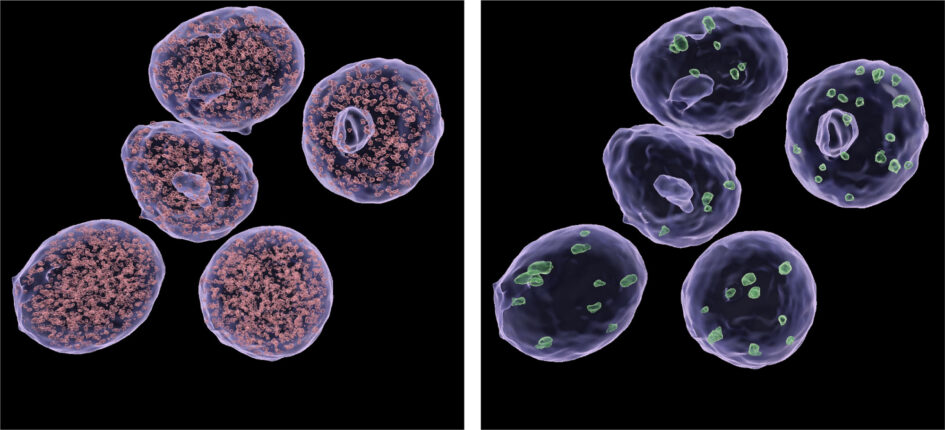
Small (left) and large (right) condensates of the Mediator complex inside nuclei of a pancreatic beta cell-derived cell line. Salk researchers discovered that GLP-1s interact with the multi-protein complex called Mediator to cause a broad genomic response.
Click here for a high-resolution image.
Credit: Salk Institute

GLP-1s are building a reputation as “wonder drugs.” First characterised for their ability to improve insulin release and treat diabetes, the drugs were later found to promote weight loss and improve cardiovascular health. In addition to these surprising bonus benefits is the ability of GLP-1 drugs to improve pancreatic beta cell health. But how, exactly, are they doing that?

Salk Institute researchers are burrowing down into the mechanistic details behind how GLP-1 drugs promote viability and stress resistance in pancreatic beta cells. Since cellular performance adaptations arise from gene expression changes, the team screened for regulatory proteins that can flip “on” advantageous gene programs during prolonged GLP-1 use. They identified a protein called Med14, part of a larger protein complex called Mediator, that was enabling the GLP-1-dependent changes in gene expression that lead to pancreatic health benefits.

The study was published in Proceedings of the National Academy of Sciences on March 4, 2026, and was funded by federal research grants from the National Institutes of Health and private philanthropy.

“The broad salutary effects of GLP-1 drugs in diabetes, cardiovascular disease, and obesity have sparked a wave of exciting scientific research at the mechanistic level. We’re left wondering,  ‘How are GLP-1s causing these effects?’” asks senior author Marc Montminy, MD, PhD, a biochemist, physiologist, and distinguished professor emeritus at Salk. “We were able to single out a protein, Med14, whose activation downstream of GLP-1 helps reprogram pancreatic beta cell gene expression to improve the cells’ viability and insulin production.”

What are GLP-1 drugs?

Often simply called “GLP-1 drugs” or “GLPs,” glucagon-like peptide-1 receptor agonists work by mimicking a hormone our bodies naturally make. The hormone, called glucagon-like peptide-1, helps regulate blood sugar.by promoting the secretion of insulin. They do so by attaching to corresponding GLP-1 receptors on pancreatic beta cells, which then produce and release insulin into the body.

But GLP-1 drugs differ in one significant way from their natural counterpart: Unlike human-made GLP-1 hormones that appear and disappear quickly around mealtimes, artificial GLP-1 receptor agonists can stick around much longer. The Salk researchers suspect this longer-term presence may explain some of the “wonder drug” benefits of GLP-1 drugs. But what, exactly, on the molecular level, are GLP-1 drugs doing when they stick around? And how does their staying power turn into effects like lower risk of stroke or improved osteoarthritis?

“The fact that these drugs based off our hormones are stable seems to be important to the longer-term effects we’re witnessing in pancreatic beta cells and other tissues,” says first author Sam Van de Velde, PhD, a staff scientist in Montminy’s lab. “To understand how we are getting these longer-term effects, we need to study these drugs on a longer time scale – and that’s exactly what we did.”

How do GLP-1 drugs influence pancreatic health?

When the hormone GLP-1 finds a pancreatic beta cell, the ensuing chain of signals, proteins, and gene expression changes that lead to insulin secretion is very well documented. On the other hand, the mechanisms and changes on the longer-term GLP-1 drug scale are poorly understood.

So, the researchers set out on a molecular fishing expedition in a pancreatic beta cell line. The team was hoping to hook a protein (or proteins) that, post-GLP-1 activation, had a particular chemical modification called phosphorylation. And that’s exactly what they found in Med14.

Med14 is a subunit in a multi-protein complex called Mediator, which is a well-described general regulator of gene expression throughout the genome. To confirm whether Med14 was an integral link between GLP-1 drugs and ultimate changes in gene expression and pancreatic beta cell behavior, the researchers decided to mutate Med14, making the protein resistant to phosphorylation.

The gene expression patterns associated with prolonged GLP-1 drug exposure disappeared in a Med14 mutant pancreatic beta cell line and in beta cells of a Med14 mutant mouse model. With working Med14, the helpful gene programs were activated – supercharging pancreatic beta cells to grow and better handle sugar-rich environments after meals.

How else might GLP-1 drugs affect the body?

None of the Salk team’s experiments were conducted in humans, yet the relevance remains. For example, some of the genes regulated by Med14 phosphorylation are known to be linked to type 2 diabetes susceptibility in humans.

“Our findings unexpectedly reveal that phosphorylation of just a small part of the Med14 protein plays a significant role in the response to GLP-1 drugs – and in the metabolic response to hormones more broadly,” says Reuben Shaw, PhD, a professor and holder of the William R. Brody Chair at Salk, and director of the National Cancer Institute-Designated Salk Cancer Center. “Now there are many new questions to answer, from validating our findings in human tissues to seeing whether Med14 has a similar role in other cells and organs.”

The team is especially curious about the effects of prolonged GLP-1 exposure beyond pancreatic beta cells. One of the messenger molecules between GLP-1 and Med14, called cAMP, is a commonly used messenger molecule in many other situations that don’t include GLP-1. With that in mind, could other drugs or hormones activate genetic programs similar to GLP-1? And what’s going on in other metabolically intensive tissues, like fat?

The questions keep coming for the so-called “wonder drug,” and Salk scientists are enthusiastically working to answer them.

Source: Salk Institute