Day: February 18, 2026

Scientists Find Hidden Trigger Behind Achilles Pain and Tennis Elbow

Achilles tendon injury. Credit: Scientific Animations CC0

Complaints such as pain in the Achilles tendon, tennis elbow, swimmer’s shoulder and jumper’s knee are familiar to many young sportspeople, as well as to older individuals. These conditions are all caused by overloading of tendons and are generally very painful.

“Tendons are fundamentally susceptible to overuse,” explains Jess Snedeker, a professor of orthopaedic biomechanics at ETH Zurich and Balgrist University Hospital in Zurich. “They must withstand powerful loads, with all the forces of our muscles being concentrated to the relatively thin tendons that transmit these forces into movement of our skeleton.”

In medical terms, the aforementioned conditions are known as tendinopathies. They are some of the most frequent conditions seen by orthopaedic specialists, but treatment options are extremely limited. Although physiotherapy can help, there are many serious cases for which this treatment does not achieve much. Scientists are therefore keen to research these tendon problems in greater depth with a view to developing effective treatments.

Not just correlation – causation

Now, a team of researchers led by Snedeker and by Katrien De Bock, professor of exercise and health at ETH Zurich, has reached a new milestone. In the HIF1 protein, they have identified a central molecular driver of tendon problems of this kind. A part of HIF1 acts as a transcription factor, which controls the activity of genes in cells.

This protein was already known to be present at elevated levels in diseased tendons. However, it was unclear whether the increase was simply a concomitant phenomenon or whether the conditions are actually triggered by the protein. In experiments in mice and with tendon tissue from humans, the team of researchers has now shown the latter to be the case.

Treatment before it is too late

In mouse experiments, the researchers either activated the HIF1 protein permanently or switched it off completely. Whereas they observed tendon disease even without overloading in the mice with permanently activated HIF1, no tendon disease occurred in the mice if HIF1 was deactivated in tendons, even in the case of overloading.

Both in the mice and in the experiments with human tendon cells, which the researchers obtained from tendon surgeries at the hospital, they were able to show that elevated HIF1 levels in the tissue leads to a pathogenic remodelling of the tendons: More crosslinks form within the collagen fibres that make up the basic structure of the tendons.

“This makes the tendons more brittle and impairs their mechanical function,” explains Greta Moschini, a doctoral student in De Bock and Snedeker’s groups and lead author of the study. In addition, blood vessels and nerves growth into the tendon tissue. “This could be the explanation for the pain commonly observed in tendinopathy,” says Moschini.

“Our study not only provides new insight into how the disease develops. It also shows that it’s important to treat tendon problems early,” says Snedeker. He is thinking particularly of young athletes, who frequently struggle with tendinopathies. In these cases, it is often still possible to treat the problems. “However, the damage caused by HIF1 in tendon tissue can accumulate and become irreversible over time. Physiotherapy then no longer helps, and the only treatment at this moment is to surgically remove the diseased tendon.”

A starting point to search for treatments

The fact that HIF1 has now been identified as a molecular driver raises the question whether it is possible to develop medicines that deactivate HIF1 and therefore can prevent or cure tendon disease. It is not quite that easy, explains ETH Professor De Bock. In many organs of the body, HIF1 is responsible for detecting hypoxia and activating a physiological adaptation. “Switching HIF1 off throughout the body would likely lead to side effects,” she says.

It may be possible to look for methods that specifically deactivate HIF1 only in the tendon tissue. In De Bock’s view, however, the more promising approach would be to explore the biochemical processes around HIF1 in the cells in greater detail. This could help to identify other molecules that are influenced or controlled by HIF1 and that could be more suitable targets for the treatment of tendinopathy. The researchers will now embark on precisely that search.

Source: ETH Zurich

Research Uncovers Factors Most Affecting Life Expectancy in Spina Bifida

Photo by National Cancer Institute

Studies have reported on survival probabilities of people born with open spina bifida, a condition where the spinal cord and nerves are exposed through an opening in the back. Research published in Developmental Medicine & Child Neurology now provides life expectancies, with results reported by age, sex, and different levels of impairment.

In the study of 1659 patients with open spina bifida who received support from the California Department of Developmental Services in 1986–2019, survival varied significantly by walking and feeding ability and by bowel/bladder continence.

As an example, at age 5, the life expectancy was 27 additional years for males in the most severely impaired group and 65 years in the least severely impaired, compared with 70 years in the general population. Life expectancies also decreased markedly with age and were modestly lower for males compared with females.

“This is the first long-term study of spina bifida patients to report life expectancies by age, sex, and severity of impairment,” the authors wrote. “We hope the results… will aid patients and caregivers alike in the proper planning for and treatment of those living with spina bifida.”

Source: Wiley

Ketamine High not Why Treatment Works for Acohol Use Disorder, Study Finds

Photo by Bruce Christianson on Unsplash

The psychedelic effects recreational users often seek from taking ketamine do not predict the therapeutic benefits for people being treated for alcohol use disorder, according to new research from King’s College London and University of Exeter.

The popular theory, which says that ketamine may have its therapeutic benefits because it produces strong psychedelic effects, has been called into question by the new study, published in Addiction. The findings suggest the treatment response may be down to other effects of the drug. 

The research, led by the Institute of Psychiatry, Psychology & Neuroscience at King’s, is the largest randomised controlled trial to date examining the use of intravenous ketamine-assisted psychotherapy for individuals with moderate to severe alcohol use disorder. It uses data from the Ketamine for reduction of Alcoholic Relapse (KARE) clinical trial at the University of Exeter and University College London.

For the first time, we thoroughly investigated the acute psychoactive effects of repeated ketamine infusions in people with alcohol use disorder. The effects didn’t predict ketamine’s therapeutic benefit, which leaves open other psychological or neural mechanisms that need to be investigated.

Dr Will Lawn, Senior Lecturer at King’s College London and study lead

Researchers carried out a secondary analysis of the KARE clinical trial which was conducted at two clinical research facilities in England involving 96 adult participants and sought to clarify the role of ketamine’s psychoactive effects in supporting abstinence from alcohol. 

Participants receiving three weekly infusions of intravenous ketamine reported marked psychoactive experiences, including altered reality, out-of-body sensations, and perceptual distortions, compared to those receiving placebo. These effects were consistently strong across all three dosing sessions. This suggests little to no development of tolerance to ketamine’s subjective effects over the short dosing schedule.

But despite the pronounced psychoactive effects, the study found no significant evidence that these experiences mediated ketamine’s therapeutic benefit in reducing alcohol consumption. The percentage of days abstinent from alcohol over six months was not predicted by the intensity of subjective drug effects.

A larger trial will explore ketamine’s effects in brain connection and function changes, as well as dosing.

Source: King’s College London

Cancer Treatment Moving Towards Earlier Immunotherapy

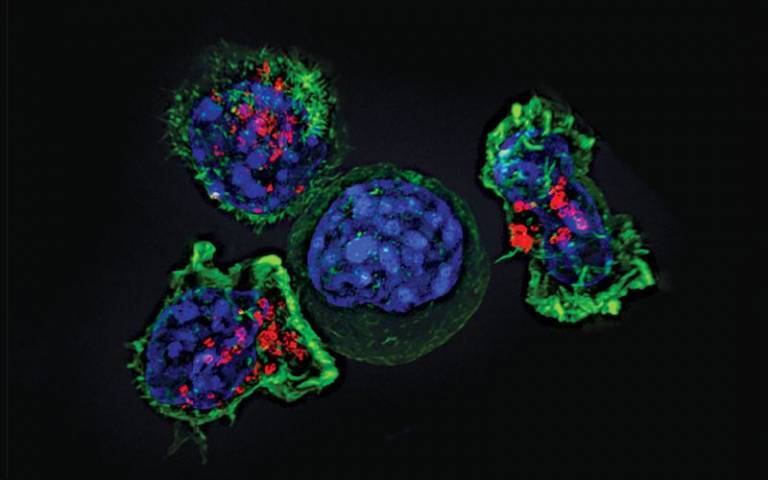
Killer T cells surround a cancer cell. Credit: Alex Ritter, Jennifer Lippincott Schwartz and Gillian Griffiths, National Institutes of Health (CC BY 2.0).

Immunotherapy given before or after surgery is increasingly used across several cancer areas. In an article published in the Journal of Internal Medicine, researchers at Karolinska Institutet present a comprehensive review of studies across seven tumour areas, showing how the field is moving towards earlier treatment.

For several years, immunotherapy has transformed the treatment of advanced cancer that can no longer be removed surgically. It is now used more frequently in earlier stages of disease as well – before surgery, known as neoadjuvant treatment, or after surgery, known as adjuvant treatment. In the new article, the researchers summarise findings from studies on several cancer diagnoses, grouped into seven tumour areas: skin cancer, lung cancer, breast cancer, gastrointestinal cancer, gynaecological cancer, head and neck cancer, and urological cancer.

Suggested benefits of treatment both before and after surgery

Several studies in recent years have shown that adjuvant immunotherapy after surgery can reduce the risk of the disease returning. Additional studies indicate that neoadjuvant treatment, given while the tumour is still in place, in many cases can provide the immune system with better conditions to recognise tumour cells. In several tumour areas, the results also suggest that immunotherapy given both before and after surgery may offer advantages compared with adjuvant treatment alone. 

At the same time, the authors emphasise that the results vary between different cancer types and that the treatment involves challenges, such as the risk of side effects and the possibility that some patients may receive more treatment than necessary if surgery alone would have been sufficient.

“We see that immunotherapy in early stages of disease is developing rapidly across many tumour areas. By bringing together studies from many cancer types, it becomes clearer how the field is evolving and what experiences can be shared between different specialties,” says last author Hildur Helgadottir, researcher at the Department of Oncology-Pathology at Karolinska Institutet.

How the researchers carried out the review

The work behind the article is a collaboration between 14 researchers at the Department of Oncology-Pathology, Karolinska Institutet. All of them also work with cancer treatment in clinical care. Because the researchers come from seven different tumour areas, the article gathers experiences from many parts of cancer care.

“It is valuable that we have come together from so many different tumour areas. This gives a broader understanding of how immunotherapy is used across cancer care and can, in the long term, support both clinical decision-making and future research,” says Hildur Helgadottir.

The researchers also point to areas where more knowledge is needed. One of these is the development of biomarkers, measurable characteristics that can help healthcare determine which patients benefit from immunotherapy, both before and after surgery. They also discuss how introducing immunotherapy at earlier stages raises questions about costs, side effects, and whether healthcare resources will be sufficient, questions that current studies do not yet clearly answer.

Information about funders and potential conflicts of interest can be found in the scientific publication.

Publication

Perioperative immune checkpoint inhibitor therapy across tumors: Insights and shared lessons from a rapidly evolving field.
Björkström K, Matikas A, Svedman FC, Björgvinsson E, Zupancic M, Villabona L, Eriksson H, Skribek M, Fernebro J, Lindskog M, Frödin JE, Ullén A, Ekman S, Helgadottir H
J Intern Med 2026 Feb;():

Source: Karolinska Institutet

Study Identifies Risk Genes for Bicuspid Aortic Valve

Source: CCO

Bicuspid aortic valve (BAV) is a common congenital heart defect where the aortic valve has two leaflets (cusps) instead of the usual three, resulting in abnormal blood flow and development of aortic valve diseases such as aortic stenosis and incompetence. In addition, the BAV is sometimes accompanied by development of an enlarged aorta – the main artery in the body.  Both the bicuspid aortic valve and an enlarged aorta often require cardiac surgery, usually after the age of 50 years. Despite this, only a limited number of genes have been associated with the disease and the molecular mechanisms remain unexplained in most cases.

In a new study aimed to further understand the genetic architecture of BAV, an international group of researchers led by Boston University Chobanian & Avedisian School of Medicine and Laval University in Quebec City, Canada, along with the Bicuspid Aortic Valve Consortium, the Genetic Aortic Network (a division of The Marfan Foundation) and participating Institutions, believe the condition is strongly influenced by the cumulative effect of variation in many different genes(polygenic contribution).

“We found that variation in 36 genetic regions increases the risk of a bicuspid aortic valve. These findings support the notion that bicuspid aortic valve disease is an inherited disease caused by a combination of many common genetic variants, not merely a single mutation in a single gene,” explains co-corresponding author Simon C. Body, MD, MPH, professor of anesthesiology at Boston University Chobanian & Avedisian School of Medicine.

From a group of 65 677 US, Canadian and European participants, the researchers performed a genome-wide association study (GWAS) meta-analysis on 9631 individuals with BAV. After identifying general genetic regions through GWAS, they used RNA sequencing to study gene activity (expression levels) in specific, relevant tissues.

They observed 36 regions with genetic variants associated with a bicuspid aortic valve, four of which had been previously identified. They prioritised 55 genes in these regions based upon expression in human aortic valve tissues from individuals who had surgery, then tested the effect of changing four selected genes, upon heart development in an experimental model, demonstrating that all four altered genes had effects on development of the valve. The researchers also looked at the effect of these genes in a statistical model finding a three-fold increase in risk for a BAV in individuals in the top 10% and association with aortic aneurysmal disease, a bulge in the aortic wall that can rupture. Some of these 36 genetic regions are also involved in aortic stenosis and aortic aneurysm development, which could lead to better prediction of these complications in people with BAV and point to biological mechanisms responsible for these joint effects.

According to the researchers, while these findings support the notion that BAV is an inherited disease, the findings do not currently support genetic testing, either prenatally or later in life, for predicting a bicuspid aortic valve.  “Echocardiography and other imaging modalities remain the gold standard for diagnosis.  In addition, the identified heritability supports performing screening echocardiography on first-degree relatives of a person with an identified bicuspid valve,” adds Body.

These findings appear online in the journal Circulation.

Source: University of Boston