

Tag: peptides

Wound-healing Peptides Can Limit Bacterial Infection in Cystic Fibrosis
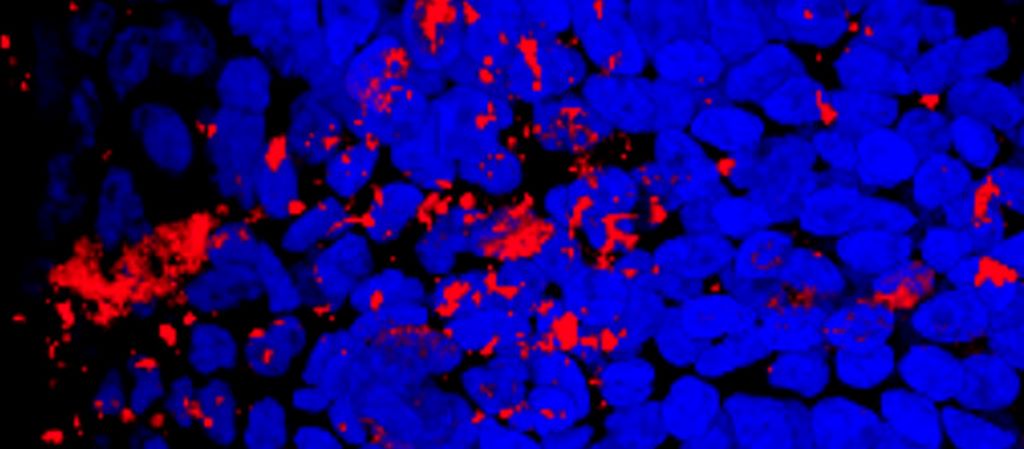
Treatment with peptide mimetics reduced the number of bacteria present on the surface of the airways (shown in red) in a cystic fibrosis model. © UNIGE – Marc Chanson

Cystic fibrosis promotes chronic bacterial infections by impairing the protective barrier of the airways. Scientists at the University of Geneva (UNIGE) have discovered that this dysfunction is caused by the abnormal activation of a protein, connexin 43, which disrupts cellular organisation and compromises the integrity of the airways.

The team has not only shed light on this molecular mechanism using 3D models of cells derived from human lungs, but has also succeeded in correcting the defect using molecules already undergoing clinical trials in dermatology and oncology. Preventing pathogenic bacteria from attaching to the airways of people with cystic fibrosis could therefore help limit serious complications. These findings are published in the journal Communications Biology.

Despite significant therapeutic advances, chronic pulmonary infections persist in many patients with cystic fibrosis. Eradicating respiratory pathogens therefore remains a major challenge. In previous work, the team of UNIGE professor Marc Chanson, discovered that this vulnerability to infection stemmed from abnormal adhesion sites on the surface of respiratory cells – true “anchor points” to which bacteria attach firmly. “But to develop treatments, we first needed to understand the underlying mechanisms,” explains Marc Chanson.

A protein at the origin of bacterial anchor points

Connexin 43 is a protein known for its role in communication between cells, a process essential to the functioning of tissues and organs. In the airways, it is normally active only when cells need to regenerate. In people with cystic fibrosis, however, it remains abnormally active, triggering a cascade of dysfunctions.

“Using 3D models of cells derived from human lungs, we discovered that prolonged connexin 43 activity alters cell communication, disrupts cell orientation, and progressively disorganises tissue integrity,” says Mehdi Badaoui, senior lecturer in the Department of Cell Physiology and Metabolism at the UNIGE Faculty of Medicine and first author of the study. “It then promotes the formation of the anchor points to which the bacteria responsible for respiratory infections attach.”

Restoring the integrity of the airways

By blocking connexin 43 activity in their 3D models, the research team was able to restore cell orientation, re-establish the spatial organisation of cells, and prevent the formation of anchor points. “Mimetic peptides – short synthetic molecules already used to promote wound healing – drastically reduced the ability of bacteria to colonise respiratory cells,” explains Mehdi Badaoui.

“These findings demonstrate that the regulation of cell communication by connexin 43 is a fundamental element in maintaining pulmonary defence,” concludes Marc Chanson. “By targeting the deep mechanisms underlying airway dysfunction, our results could offer an additional treatment approach.”

Source: University of Geneva

Scientists Use Modified Peptides to Create New Class of Antibiotics

Photo by CDC on Unsplash

New antibiotics are urgently needed to tackle resistant bacteria. Researchers at the University of Zurich and the company Spexis have now modified the chemical structure of naturally occurring peptides to develop antimicrobial molecules that bind to novel targets in the bacteria’s metabolism.

In a study recently published in Science Advances, chemist Oliver Zerbe, head of the NMR facilities at the University of Zurich now discusses the development of a highly effective class of antibiotics that fight Gram-negative bacteria in a novel way.

The WHO classifies this group of bacteria as extremely dangerous. The group, whose resistance is particularly high due to their double cell membrane, includes carbapenem-resistant enterobacteria, for example.

Natural peptide chemically optimised

The starting point for the researchers’ study was a naturally occurring peptide called thanatin, which insects use to fend off infections. Thanatin disrupts an important lipopolysaccharide transport bridge between the outer and inner membrane of Gram-negative bacteria, as revealed a few years ago in a study by now retired UZH professor John Robinson. As a result, these metabolites build up inside the cells, and the bacteria perish. However, thanatin isn’t suitable for use as an antibiotic drug, among other things due to its low effectiveness and because bacteria quickly become resistant to it.

The researchers therefore modified the chemical structure of thanatin to enhance the peptide’s characteristics. “To do this, structural analyses were essential,” says Zerbe. His team synthetically assembled the various components of the bacterial transport bridge and then used nuclear magnetic resonance (NMR) to visualize where and how thanatin binds to and disrupts the transport bridge. Using this information, researchers from Spexis AG planned the chemical modifications that were necessary to boost the peptide’s antibacterial effects. Further mutations were made to increase the molecule’s stability, among other things.

Effective, safe and immune to resistance

The synthetic peptides were then tested in mice with bacterial infections – and yielded outstanding results. “The novel antibiotics proved very effective, especially for treating lung infections,” says Zerbe. “They are also highly effective against carbapenem-resistant enterobacteria, where most other antibiotics fail.” In addition, the newly developed peptides aren’t toxic or harmful to the kidneys, and they also proved stable in the blood over a longer period – all of which are properties that are required for gaining approval as a drug. However, further preclinical studies are needed before the first tests in humans can begin.

When choosing the most promising peptides for their study, the researchers made sure that they would also be effective against bacteria that have already developed resistance to thanatin. “We’re confident this will significantly slow down the development of antibacterial resistance,” says Zerbe. “We now have the prospect of a new class of antibiotics becoming available that is also effective against resistant bacteria.”

Source: University of Zurich