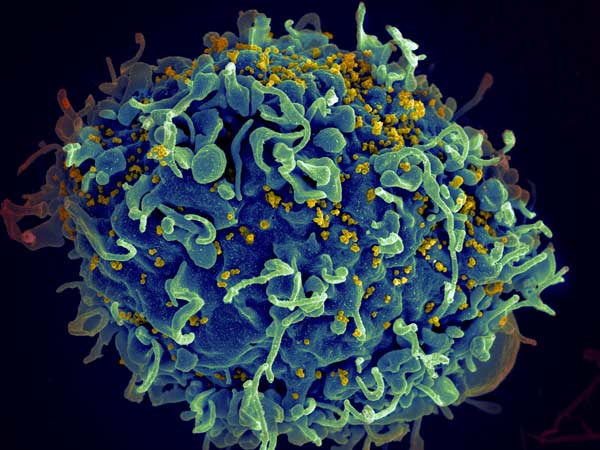
Researchers from Tel Aviv University have demonstrated success of a novel technology that may be developed into a one-time vaccine to treat people with HIV and AIDS. Using CRISPR technology, the researchers engineered B cells that in turn stimulate the immune system to produce HIV-neutralising antibodies.
Published in Nature, the study was led by Dr Adi Barzel and PhD student Alessio Nehmad and conducted in collaboration with additional researchers from Israel and the US.
“Based on this study,” said Dr Barzel, “we can expect that over the coming years we will be able to produce a medication for AIDS, additional infectious diseases and certain types of cancer caused by a virus, such as cervical cancer, head and neck cancer and more.”
He explains that the treatment can become a kind of permanent medication, lingering in the body to fight the virus. “We developed an innovative treatment that may defeat the virus with a one-time injection, with the potential of bringing about tremendous improvement in the patients’ condition. When the engineered B cells encounter the virus, the virus stimulates and encourages them to divide, so we are utilising the very cause of the disease to combat it. Furthermore, if the virus changes, the B cells will also change accordingly in order to combat it, so we have created the first medication ever that can evolve in the body and defeat viruses in the ‘arms race’.”
When they mature, the antibody-generating B cells move into the blood and lymphatic system and from there to the different body parts.
Dr Barzel explained: “Until now, only a few scientists, and we among them, had been able to engineer B cells outside of the body. In this study, we were the first to do this within body and then make those cells generate the desired antibodies. The genetic engineering is conducted with viral carriers derived from viruses that were also engineered. We did this to avoid causing any damage, and solely bring the gene coded for the antibody into the B cells in the body.”
“Additionally, in this case we have been able to accurately introduce the antibodies into a desired site in the B cell genome. All lab models that had been administered the treatment responded, and had high quantities of the desired antibody in their blood. We produced the antibody from the blood and made sure it was actually effective in neutralising the HIV virus in the lab dish.”
A new study published in Nature Biotechnology identifies risks in the use of CRISPR gene editing, which is employed in a number of therapies. Looking at its use in T cells, the researchers detected a loss of genetic material in a significant percentage – up to 10% of the treated cells. They explain that such loss can lead to destabilisation of the genome, which might cause cancer.
The study was led by Drs Adi Barzel, Dr Asaf Madi and Dr Uri Ben-David at Tel Aviv University.
Developed about a decade ago, CRISPR cleaves DNA sequences at certain locations in order to delete unwanted segments, or alternately repair or insert beneficial segments. It has already proved impressively effective in treating a range of diseases – cancer, liver diseases, genetic syndromes, and more. In 2020 at the University of Pennsylvania, the first approved clinical trial ever to use CRISPR took T cells from a donor, and expressed an engineered receptor targeting cancer cells, while using CRISPR to destroy genes coding for the original receptor – which otherwise might have caused the T cells to attack cells in the recipient’s body.
In the present study, the researchers sought to examine whether the potential benefits of CRISPR therapeutics might be offset by risks resulting from the cleavage itself, assuming that broken DNA is not always able to recover.
Dr Ben-David and his research associate Eli Reuveni explained: “The genome in our cells often breaks due to natural causes, but usually it is able to repair itself, with no harm done. Still, sometimes a certain chromosome is unable to bounce back, and large sections, or even the entire chromosome, are lost. Such chromosomal disruptions can destabilise the genome, and we often see this in cancer cells. Thus, CRISPR therapeutics, in which DNA is cleaved intentionally as a means for treating cancer, might, in extreme scenarios, actually promote malignancies.”
To examine the extent of potential damage, the researchers repeated the 2020 Pennsylvania experiment, cleaving the T cells’ genome in exactly the same locations – chromosomes 2, 7, and 14. Using single-cell RNA sequencing, they analysed each cell separately and measured the expression levels of each chromosome in every cell.
They detected a significant loss of genetic material in some of the cells. For example, when chromosome 14 had been cleaved, about 5% of the cells showed little or no expression of this chromosome. When all chromosomes were cleaved simultaneously, the damage increased, with 9%, 10%, and 3% of the cells unable to repair the break in chromosomes 14, 7, and 2 respectively. The three chromosomes did differ, however, in the extent of the damage they sustained.
Dr Madi and his student Ella Goldschmidt explained: “Single-cell RNA sequencing and computational analyses enabled us to obtain very precise results. We found that the cause for the difference in damage was the exact place of the cleaving on each of the three chromosomes. Altogether, our findings indicate that over 9% of the T-cells genetically edited with the CRISPR technique had lost a significant amount of genetic material. Such loss can lead to destabilisation of the genome, which might promote cancer.”
Based on their findings, the researchers caution that extra care should be taken when using CRISPR therapeutics. They also propose alternative, less risky, methods, for specific medical procedures, and recommend further research into two kinds of potential solutions: reducing the production of damaged cells or identifying damaged cells and removing them before the material is administered to the patient.
Dr Barzel and his PhD student Alessio Nahmad conclude: “Our intention in this study was to shed light on potential risks in the use of CRISPR therapeutics,” adding that as scientists, they “examine all aspects of an issue, both positive and negative, and look for answers.”
Researchers have developed a new method to precisely and rapidly correct genetic alterations in cultured patient cells.
The genetically corrected stem cells are produced from a 2–3 mm skin biopsy taken from patients with different genetic diseases. The corrected stem cells are essential in the research and for the development of new therapies for the diseases in question.
The scientists based the new method on previous groundbreaking research in the fields of stem cells and gene editing; the first technique is the invention of induced pluripotent stem cells, iPSCs from differentiated cells, which won the Nobel in 2012. The other technique is the CRISPR-Cas9 ‘gene scissors’, which got the prize in 2020. The new method combines these techniques to correct gene alterations that cause inherited diseases, creating fully functional new stem cells.
The researchers aim to eventually produce autologous cells with therapeutic properties. The use of the patient’s own corrected cells could help in avoiding the immunological challenges hampering the organ and tissue transplantation from a donor. The new method was developed by PhD student Sami Jalil and is published in Stem Cell Reports.
More than 6000 inherited diseases are known to exist, which are caused by various gene alterations. Currently, some are treated with a cell or organ transplant from a healthy donor, if available.
“Our new system is much faster and more precise than the older methods in correcting the DNA errors, and the speed makes it easier and diminishes also the risk of unwanted changes,” commented adjunct professor Kirmo Wartiovaara, who supervised the work.
“In perfect conditions, we have reached up to 100 percent efficacy, although one has to remember that the correction of cultured cells is still far away from proven therapeutic applications. But it is a very positive start” Prof Wartiovaara added.
An intravenous CRISPR gene editing infusion lowered levels of a disease-causing protein in vivo for the first time in humans, according to interim findings from a phase I trial.
Hereditary (ATTR) amyloidosis is a rare, rapidly progressive disease caused by a mutation in the serum transthyretin (TTR) gene that results in the buildup of misfolded transthyretin and leads to the formation of amyloid deposits in the heart, gastrointestinal tract, and peripheral nerves. Life expectancy is about 3 to 15 years after the onset of neuropathy. Researchers used the DNA-editing tool CRISPR-Cas9 to inactivate the TTR gene in liver cells to prevent misfolded TTR protein from being produced. The liver produces almost all circulating TTR.
The treatment reduced TTR by 87% in three people with hereditary transthyretin (ATTR) amyloidosis with polyneuropathy. The findings were published in the New England Journal of Medicine.
“This is the first successful demonstration of therapeutic gene editing within patients’ bodies, making it a watershed moment in modern medicine,” noted Kiran Musunuru, MD, PhD, MPH, director of the Genetic and Epigenetic Origins of Disease Program at the University of Pennsylvania in Philadelphia, who was not involved with the study.
“The investigators used lipid nanoparticle technology — the same technology used in COVID mRNA vaccines — to deliver CRISPR into the liver, with the goal of turning down a gene responsible for hereditary ATTR amyloidosis,” Dr Musunuru told MedPage Today.
“What was astonishing about this first-in-human study is not just that the treatment worked, but that it worked extremely well in patients, in one case turning off the disease gene close to 100%. It’s like launching a rocket ship in the hope of just getting into orbit, but making it all the way to the moon on the first try.”
Previously, other studies have removed blood stem cells from people with sickle cell anaemia and beta-thalassemia, editing them using CRISPR, and infusing them back into patients. In a trial of people with inherited blindness, a subretinal injection also has delivered CRISPR treatment. Towever, the findings of NTLA-2001 represent the “first-ever clinical data suggesting that we can precisely edit target cells within the body to treat genetic disease with a single intravenous infusion of CRISPR,” noted John Leonard, MD, president and CEO of Intellia Therapeutics, which co-sponsored the trial with Regeneron Pharmaceuticals.
“Solving the challenge of targeted delivery of CRISPR-Cas9 to the liver, as we have with NTLA-2001, also unlocks the door to treating a wide array of other genetic diseases with our modular platform, and we intend to move quickly to advance and expand our pipeline,” said Dr Leonard in a statement.
NTLA-2001 is based on the clustered regularly interspaced short palindromic repeats and associated Cas9 endonuclease (CRISPR-Cas9) system. It consists of a lipid nanoparticle encapsulating messenger RNA for Cas9 protein and a single guide RNA targeting TTR.
The ongoing phase I study looked at safety and pharmacodynamic effects of single doses of NTLA-2001 in six patients with hereditary ATTR amyloidosis with polyneuropathy. Half received 0.1 mg/kg, the other received 0.3 mg/kg. Three patients had a p.T80A mutation, two a p.S97Y mutation, and one a p.H110D mutation. Three patients received no prior therapy; three previously had received diflunisal.
Dose-dependent reductions in serum TTR were seen from treatment with NTLA-2001. At day 28, mean serum TTR levels declined by 52% in the 0.1 mg/kg group and by 87% in the 0.3 mg/kg group. No serious adverse events were recorded.
Two treatments for hereditary ATTR amyloidosis nerve pain won FDA approval in 2018: patisiran (Onpattro), an RNA interference drug, and inotersen (Tegsedi), an RNA-targeting drug that reduces the production of TTR protein.
The NTLA-2001 study could have profound clinical implications, noted Joel Buxbaum, MD, of Scripps Research Institute in La Jolla, California, who was not involved with the study. “If, as the authors surmise, the effect is permanent, and without off-target effects when studied in a much larger patient population, it would be a significant improvement [over] current therapies for this class of disorders, at least with respect to frequency of therapy,” he said.
“However, all that depends on the clinical effect of long-term suppression of hepatic TTR synthesis,” Buxbaum told MedPage Today. “In the published studies of the various currently available ATTR therapeutics, approximately one-third of subjects have little or no clinical response, regardless of the degree of suppression of circulating protein levels, suggesting that while diminishing the supply side for TTR aggregation is likely to be necessary for clinical responsiveness, it may not be sufficient for optimal or profound therapeutic efficacy.”
After phase I studies are complete, the company plans to move forward to pivotal studies for both polyneuropathy and cardiomyopathy manifestations of ATTR amyloidosis.
Journal information: Gillmore JD, et al “CRISPR-Cas9 in vivo gene editing for transthyretin amyloidosis” N Engl J Med 2021; DOI: 10.1056/NEJMoa2107454.