

Tag: common cold

The Cold Virus ‘Hides’ and Multiplies in the Tonsils and Adenoids, Even in People Without Symptoms

2026-04-15

A study conducted at the University of São Paulo shows that the pathogen can persist in these tissues for long periods, be transmitted unexpectedly, and trigger new outbreaks of the disease.

The rhinovirus can infect B lymphocytes, which produce antibodies, and CD4 T cells, which conduct the local immune response (image: PDB/Wikimedia Commons)

By Karina Toledo  |  Agência FAPESP – A study conducted at the University of São Paulo (USP) in Brazil reveals that tissues such as the tonsils and adenoids can serve as hiding places for the rhinovirus, which causes the common cold and is responsible for most respiratory infections worldwide.

Using samples from 293 children who underwent surgery to remove these tissues, the study showed that the pathogen can infect immune cells known as lymphocytes and remain there for long periods without causing symptoms. This allows the virus to potentially be transmitted to others without warning.

“The virus has a ‘date’ with the child population. Every year, about two or three weeks after school starts in temperate regions, there’s a rhinovirus outbreak. And children pass it on to their parents and grandparents. We’ve always wondered: What does the start of school have to do with it? Well, children gather in closed spaces, and some of them with the virus in their throats can spark an outbreak at school, even if they’re asymptomatic,” comments rhinovirologist Eurico de Arruda Neto, a professor at the Ribeirão Preto School of Medicine (FMRP-USP) and coordinator of the research, supported by FAPESP (projects 13/06380‐013/16349‐2 and 17/25654‐4).

As the researcher explains, it was already known that the rhinovirus infects the epithelium (the outermost layer of the mucosa) of the nose and throat, hijacks the cellular machinery to multiply, and causes the host cell to rupture once this process is complete, releasing progeny capable of generating new infections. For this reason, scientists consider it a lytic virus, one that causes cell lysis, or rupture. This rapid and destructive cycle quickly draws the attention of the immune system, which, in most cases, eliminates the virus from the body within about five to seven days.

The major finding of the study was that the rhinovirus can reach the deeper layers of tonsil and adenoid tissues in addition to the epithelium. There, it can infect B lymphocytes, which produce antibodies, and CD4 T lymphocytes, which conduct the local immune response. These cells have a long lifespan and store the “memory” of the immune system. Rather than killing them, the rhinovirus remains inside these cells for extended periods, in a state of persistence similar to that seen with herpes viruses, HPV, and cytomegalovirus.

“The samples we analyzed are from children who underwent surgery due to snoring, sleep apnea, or recurrent infections related to tonsillar and adenoid hypertrophy. At the time of surgery, they were necessarily asymptomatic. Nevertheless, we detected the rhinovirus in a large number of participants,” says Arruda.

In addition to the tonsils and adenoids, the children’s nasal secretions were analyzed as well. According to data published in the Journal of Medical Virology, the virus was present in at least one of the three sites (tonsil, adenoid, or secretion) in 46% of the volunteers. Viral proteins and other signs that the rhinovirus was replicating – and therefore capable of infecting another person – were also observed in these tissues.

The research was conducted in collaboration with Ronaldo Martins, a virologist from the Ribeirão Preto School of Pharmaceutical Sciences (FCFRP-USP), as well as professors Wilma Anselmo-Lima, Edwin Tamashiro, and Fabiana Valera from the FMRP-USP.
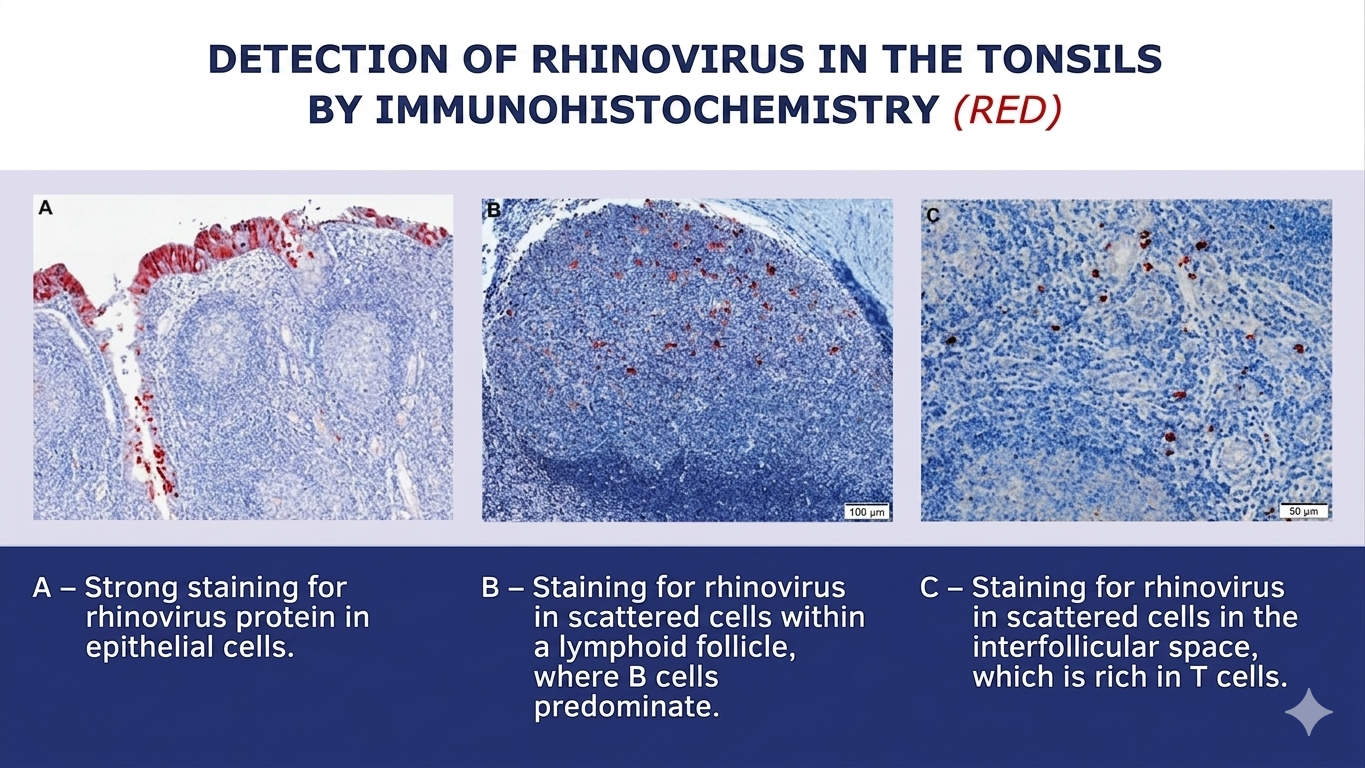

(image: press release)

Virus garden

In previous studies, Arruda’s team detected adenovirus (another cause of the common cold), influenza A (flu), and SARS-CoV-2 (COVID-19) in samples of tonsils and adenoids from children who had undergone surgery. The latter two are known to cause longer-lasting infections in some patients. In the case of the rhinovirus, however, this came as a surprise.

“I get the impression that no matter what common virus we look for, we’ll find it. And not just in the tonsils and adenoids, but in other lymphoid tissues throughout the body, such as lymph nodes. We already have some preliminary evidence that lymphoid tissues are a sort of ‘garden’ for viruses. And our hypothesis is that this is a good thing. It acts as a booster for immune memory, meaning antibodies continue to be produced even long after initial exposure,” says Arruda.

However, in the case of people with asthma, this can be problematic. One hypothesis raised by the authors of the article is that infectious viruses in tonsil CD4 T lymphocytes may release inflammatory substances that act on the lungs and cause asthma attacks. It is already known that colds and the flu are among the most common causes of asthma attacks, especially in young children.

Additionally, a previous study by the group detected respiratory viruses in normal adenoids (without hypertrophy), which are located next to the Eustachian tube. This may explain why some children suffer from recurrent otitis media.

“This virus can pass from the adenoids to the middle ear and cause inflammation there. The child won’t sneeze or cough, but the ear will become inflamed, closing the narrow Eustachian tube and leading to a buildup of fluid in which the local bacterial flora begins to proliferate,” the researcher explains.

Clinical implications

Based on these findings, Arruda believes that pediatricians should be mindful of the possibility of diagnostic confusion regarding the causes of childhood illnesses.

“For example, a child with hypertrophic tonsils arrives at the emergency room with a respiratory infection and bronchiolitis symptoms caused by respiratory syncytial virus, but the throat swab test detects rhinovirus from a previous infection. In other words, tests performed on secretions may not always reflect what’s actually happening in the lungs,” says the researcher. “We have evidence that this viral persistence can also occur in people with normal-sized tonsils and adenoids.”

Another hypothesis to be investigated, Arruda says, is whether viruses that persist in lymphoid tissues can cause problems for immunosuppressed patients. “Patients who undergo bone marrow transplants, for example, frequently develop lung infections and bronchiolitis. Doctors, nurses, and medical students are usually blamed for bringing the virus into the high-risk ward. But could it be that the virus was already present in the patient’s tonsils or adenoids and has now been reactivated due to low immunity? It doesn’t have to be transmission from outside to inside. That’s what we’ve started to investigate in mice,” he explains.

The article “Rhinovirus infects B and CD4 T lymphocytes in hypertrophic tonsils in children” can be read at pmc.ncbi.nlm.nih.gov/articles/PMC12831225/.

Republished from Agência FAPESP under a Creative Commons licence.

Read the original article.

Saline Nasal Drops Shorten the Common Cold in Children by Two Days

Photo by Andrea Piacquadio on Unsplash

Using hypertonic saline nasal drops can reduce the length of the common cold in children by two days, according to a study presented at the European Respiratory Society (ERS) Congress in Vienna, Austria [1]. They can also reduce the onward transmission of colds to family members.

The results of the ELVIS-Kids randomised controlled trial were presented by Professor Steve Cunningham from Child Life and Health, University of Edinburgh, UK.

He said: “Children have up to 10 to 12 upper respiratory tract infections, what we refer to as colds, per year, which have a big impact on them and their families. There are medicines to improve symptoms, such as paracetamol and ibuprofen, but no treatments that can make a cold get better quicker.”

ELVIS-Kids Chief Investigator Dr Sandeep Ramalingam, consultant virologist, NHS Lothian, Edinburgh, UK, had noted that salt-water solutions are often used by people in South Asia, as nasal irrigation and gargling, to treat a cold and wanted to explore if this clinical benefit could be replicated in a large study.

The research team recruited 407 children aged up to six years to a study where they were given either hypertonic saline ~2.6% (salt-water) nasal drops or usual care when they developed a cold. Overall, 301 children developed a cold; for 150 of these, their parents were given sea salt and taught to make and apply salt-water nose drops to the children’s noses (three drops per nostril, a minimum of four times per day, until well) and 151 children had usual cold care.

Professor Cunningham explains: “We found that children using salt-water nose drops had cold symptoms for an average of six days where those with usual care had symptoms for eight days. The children receiving salt water nose drops also needed fewer medicines during their illness.

“Salt is made up of sodium and chloride. Chloride is used by the cells lining the nose and windpipes to produce hypochlorous acid within cells, which they use to defend against virus infection. By giving extra chloride to the lining cells this helps the cells produce more hypochlorous acid, which helps suppress viral replication, reducing the length of the virus infection, and therefore the duration of symptoms.”

When children got salt-water nose drops, fewer households reported family members catching a cold (46% vs 61% for usual care). Eighty-two per cent of parents said the nose drops helped the child get better quickly and 81% said they would use nose drops in the future.

Professor Cunningham added: “Reducing the duration of colds in children means that fewer people in their house also get a cold, with clear implications for how quickly a household feels better and can return to their usual activities like school and work etc.

“Our study also showed that parents can safely make and administer nose drops to their children and therefore have some control over the common cold affecting their children.”

Professor Alexander Möeller is Head of the ERS Paediatric Assembly and Head of the Department for Respiratory Medicine at the University Children’s Hospital Zurich, Switzerland, and was not involved in the research. He said: “This is an important study that is the first of its kind to investigate the impact of salty nose drops in children with colds. Although most colds usually don’t turn into anything serious, we all know how miserable they can be, especially for young children and their families.

“This extremely cheap and simple intervention has the potential to be applied globally; providing parents with a safe and effective way to limit the impact of colds in their children and family would represent a significant reduction in health and economic burden of this most common condition.”

The team hope to further investigate the effect of saltwater nose drops on wheeze during colds, after initial results from this study showed that children who received the drops had significantly fewer episodes of wheeze (5% vs 19%).

Reference

[1] Abstract no: OA1985 “A randomised controlled trial of hypertonic saline nose drops as a treatment in children with the common cold (ELVIS-Kids trial)”, by Dr Sandeep Ramalingam et al; Presented in session “Advancements in paediatric infectious respiratory health” at 15:45–17:00 CEST on Sunday 8 September 2024.

https://live.ersnet.org/programme/session/92864

Source: European Respiratory Society

Not Just ‘Long COVID’: Researchers Find ‘Long Colds’

Photo by Kelly Sikkema on Unsplash

A new study from Queen Mary University of London, published in The Lancet’s EClinicalMedicine, has found that people may experience long-term symptoms, termed ‘long colds’, after non-COVID acute respiratory infections.

The ‘long cold’s’ most common symptoms included coughing, stomach pain, and diarrhoea more than four weeks after the initial infection. While the severity of an illness appears to be a key driver of risk of long-term symptoms, just why some people suffer extended symptoms while others do not is a focus of further research.

The findings suggest that there may be long-lasting health impacts following non-COVID acute respiratory infections such as colds, influenza, or pneumonia, that are currently going unrecognised. However, the researchers do not yet have evidence suggesting that the symptoms have the same severity or duration as long COVID.

The research compared the prevalence and severity of long-term symptoms after an episode of COVID versus an episode of another acute respiratory infection that tested negative for COVID. Those recovering from COVID were more likely to experience light-headedness or dizziness and problems with taste and smell compared to those who had a non-COVID respiratory infection.

While long COVID is now a recognised condition, there have been few studies comparing long-term symptoms following SARS-CoV-2 coronavirus infection versus other respiratory infections.

The study is the latest output from COVIDENCE UK, Queen Mary University of London’s national study of COVID, launched back in 2020 and still in follow-up, with over 19 000 participants enrolled. This study analysed data from 10 171 UK adults, with responses collected via questionnaires and statistical analysis carried out to identify symptom clusters.

Giulia Vivaldi, researcher on COVIDENCE UK from Queen Mary University of London and the lead author of the study, said: “Our findings shine a light not only on the impact of long COVID on people’s lives, but also other respiratory infections. A lack of awareness – or even the lack of a common term – prevents both reporting and diagnosis of these conditions.

“As research into long COVID continues, we need to take the opportunity to investigate and consider the lasting effects of other acute respiratory infections.

“These ‘long’ infections are so difficult to diagnose and treat primarily because of a lack of diagnostic tests and there being so many possible symptoms. There have been more than 200 investigated for long COVID alone.”

Source: Queen Mary University of London

Common Cold may Have Conferred COVID Immunity to Children

Young girl sneezing
Photo by Andrea Piacquadio on Unsplash

Early in the COVID pandemic, it became clear that children infected with the coronavirus rarely developed serious disease. One hypothesis has been that children already have some immunity provided by memory T cells generated by common colds. Researchers at Karolinska Institutet are now able to show that OC43, one of the coronaviruses that cause common colds, boosts the immune response to COVID. The study, which is published in PNAS, could give rise to more tailored vaccine programmes for children and adults.

After studying unique blood samples from children taken before the pandemic, Karolinska Institutet researchers have now identified memory T cells that react to cells infected with SARS-CoV-2.

This new study reinforces this hypothesis and shows that T cells previously activated by the OC43 virus can cross-react against SARS-CoV-2.

Four coronaviruses cause common colds

One of the four coronaviruses causing seasonal common cold symptoms could stimulate an immune response with T cells able to also react to cells infected with SARS-CoV-2.

“These reactions are especially strong early in life and grow much weaker as we get older,” says the study’s corresponding author Annika Karlsson, research group leader at the Department of Laboratory Medicine, Karolinska Institutet. “Our findings show how the T-cell response develops and changes over time and can guide the future monitoring and development of vaccines.”

Strong immunity at the age of two

The results indicate that the memory T-cell response to coronaviruses develops as early as the age of two. The study was based on 48 blood samples from two- and six-year-old children, and 94 samples from adults between the ages of 26 and 83. The analysis also included blood samples from 58 people who had recently recovered from COVID-19.

“Next, we’d like to do analogous studies of younger and older children, teenagers and young adults to better track how the immune response to coronaviruses develops from childhood to adulthood,” says Marion Humbert, postdoctoral researcher currently at the Department of Medicine Huddinge, Karolinska Institutet, joint first author with Anna Olofsson, doctoral student at the Department of Laboratory Medicine.

Source: Karolinska Institutet