

Tag: cold sores

New Antivirals Could Help Prevent HSV-1 by Changing Cell Structures

Lab tests confirm that antiviral class known as Pin1 inhibitors could reduce and stop outbreaks of herpes simplex virus-1
Photo by Cottonbro on Pexels

A class of antivirals called Pin1 inhibitors could reduce or stop outbreaks of herpes simplex virus 1 (HSV-1), the common infection behind oral herpes, according to new research published in Antiviral Research.

HSV-1 causes sores around the mouth, commonly called cold sores or fever blisters. Most people are infected with HSV-1 in childhood, and between 50% and 90% of people worldwide have HSV-1. After the initial infection, HSV-1 remains in the body and can reactivate throughout a person’s life. While HSV-1 infections are usually mild, they can be serious and even deadly for people with suppressed immune systems. Finding new, more effective antivirals for this common illness is essential. 
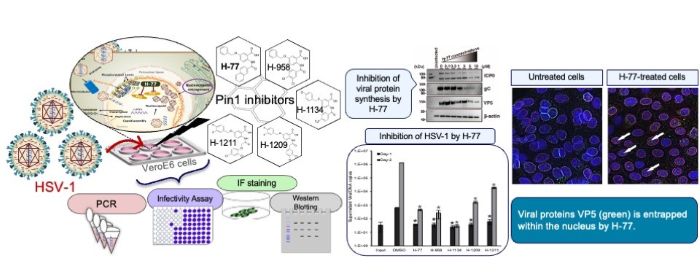
Pin1 inhibitors suppress HSV-1 replication by inhibiting viral protein synthesis and preventing nucleocapsid egress from the nucleus. (Takemasa Sakaguchi/Hiroshima University)

Researchers focused on an enzyme called peptidyl-prolyl cis-trans isomerase NIMA-interacting 1, or Pin1, that regulates protein stability, function, and cellular structure. When this enzyme is dysregulated, it can play a role in a variety of conditions, including obesity, cancer, heart failure, and more. Viruses, such as cytomegalovirus (CMV) and SARS-CoV-2, are known to affect Pin1, and Pin1 inhibitors have been developed to reduce the impact of these viruses. 

Because HSV-infected cells over-express Pin1, researchers wanted to know if Pin1 inhibitors could also be used to treat HSV-1. “This study revealed that the host factor Pin1 is a crucial therapeutic target for the proliferation of HSV-1. Pin1 inhibitors potently suppress HSV-1 replication at low concentrations,” said Takemasa Sakaguchi, a professor at the Graduate School of Biomedical and Health Sciences at Hiroshima University in Hiroshima, Japan. 

In laboratory tests, the Pin1 inhibitor H-77 and the four newly developed Pin1 inhibitors successfully stopped the replication of HSV-1. VeroE6 cells, derived from the kidney of an African green monkey and commonly used in virology research, were infected with HSV-1 and cultured in the presence of different amounts of a Pin1 inhibitor. As the amount of the inhibitor increased, the effects of HSV-1 on the cells became less pronounced and completely disappeared at 1 μM. They also found that any viral particles released from the treated cells were non-infectious. 

The most important finding is how Pin1 inhibitors affect cell structures to prevent the virus from escaping. They do this by stabilising nuclear membrane structure, physically trapping the virus in the cell nucleus. “The nuclear lamina initially functions as a ‘barrier’ when nucleocapsids of progeny viruses, that replicate within the nucleus, bud from the nuclear membrane. Pin1 overexpressed by the virus removes this barrier. However, through the action of the Pin1 inhibitor H-77, this barrier is rather reinforced, forming a thick and robust lamina layer. This demonstrates that H-77 transforms the nuclear lamina into an ‘impregnable defensive wall,’ physically blocking the escape of viruses from the nucleus of the cell,” said Sakaguchi.

Looking ahead, researchers will continue to evaluate the effectiveness of Pin1 inhibitors to treat HSV-1. They will also research how Pin1 inhibitors could be used to treat other viruses. “The ultimate goal for the future is to aim for the clinical application of Pin1 inhibitors as ‘host-directed therapeutics,’ which are less likely to cause drug resistance. To achieve this, we will first evaluate their efficacy against diverse viruses to clarify the treatable range. Simultaneously, research to optimise the compound structure is essential for creating more potent and selective drugs,” said Sakaguchi. 

Source: University of Hiroshima

Cold Sore Discovery Reveals an Unexpected Trigger for Flare-ups

Photo by Cottonbro on Pexels

Scientists have a new target to prevent cold sores after University of Virginia researchers discovered an unexpected way the herpes virus re-activates in the body. The finding, published in PNAS, could also have important implications for genital herpes caused by the same virus.

The discovery from UVA’s Anna Cliffe, PhD, and colleagues seems to defy common sense. She and her team found that the slumbering herpes virus will make a protein to trigger the body’s immune response as part of its escape from dormancy. You’d think this would be bad for the virus – that activating the body’s antiviral defences would be like poking a bear. But, instead, it’s the opposite: The virus hijacks the antiviral process in infected neurons to make the type of comeback nobody wants.

“Our findings identify the first viral protein required for herpes simplex virus to wake up from dormancy, and, surprisingly, this protein does so by triggering responses that should act against the virus,” said Cliffe of UVA’s Department of Microbiology, Immunology and Cancer Biology. “This is important because it gives us new ways to potentially prevent the virus from waking up and activating immune responses in the nervous system that could have negative consequences in the long term.”

Herpes Simplex Virus-Associated Disease

Cold sores are caused primarily by herpes simplex virus 1 (HSV-1), one of two forms of the herpes virus. HSV-1 is very contagious, and worldwide more than 60% of people under 50 (more than 3.8 billion) have been infected, the World Health Organization estimates.

In addition to causing cold sores, herpes simplex virus 1 can also cause genital herpes, a condition most often associated with HSV-1’s cousin, herpes simplex virus 2. Now, however, there are more new cases of genital herpes in the United States caused by HSV-1 than HSV-2. Notably, the UVA researchers found that herpes simplex virus 2 also makes this same protein and may use a similar mechanism to reactivate. So UVA’s new discovery may also lead to new treatments for genital herpes. 

In addition to cold sores and genital herpes, HSV-1 can also cause viral encephalitis (brain inflammation) and has been linked to the development of Alzheimer’s disease.

Once HSV-1 makes its way into our bodies, it stays forever. Our immune systems can send it into hiding, allowing infected people to be symptom free. But stress, other infections and even sunburns are known to cause it to flare. UVA’s new discovery adds another, surprising way it can spring back into action.

The researchers found that while the virus can make a protein called UL12.5 to reactivate, the protein was not needed in the presence of another infection. The scientists believe this is because the infections trigger certain “sensing pathways” that act as the home security system for neurons. Detection of a pathogen alone may be sufficient to trigger the herpes virus to begin replicating, the scientists believe, even in instances of “abortive infections” – when the immune system contains the new pathogen before it can replicate.

“We were surprised to find that HSV-1 doesn’t just passively wait for the right conditions to reactivate – it actively senses danger and takes control of the process,” researcher Patryk Krakowiak said. “Our findings suggest that the virus may be using immune signals as a way to detect cellular stress – whether from neuron damage, infections or other threats – as a cue to escape its host and find a new one.” 

With the new understanding of how herpes flares can be triggered, scientists may be able to target the protein to prevent them, the researchers say. 

“We are now following up on this work to investigate how the virus is hijacking this response and testing inhibitors of UL12.5 function,” Cliffe said. “Currently, there are no therapies that can prevent the virus from waking up from dormancy, and this stage was thought to only use host proteins. Developing therapies that specifically act on a viral protein is an attractive approach that will likely have fewer side effects than targeting a host protein.” 

Source: University of Virginia Health System