Tag: 25/2/26

Study: Adolescent Cannabis Use Linked to Doubling Risk of Psychotic and Bipolar Disorders

Photo by Thought Catalog on Unsplash

Adolescents who use cannabis could face a significantly higher risk of developing serious psychiatric disorders by young adulthood, according to a large new study published in JAMA Health Forum. The longitudinal study followed nearly half a million adolescents ages 13 to 17 through age 26 and found that past-year cannabis use during adolescence was associated with a significantly higher risk of incident psychotic (doubled), bipolar (doubled), depressive and anxiety disorders.

The study was conducted by researchers from Kaiser Permanente, the Public Health Institute’s Getting it Right from the Start, the University of California, San Francisco and the University of Southern California, and was funded by a grant from NIH’s National Institute on Drug Abuse (R01DA0531920).

The study analysed electronic health record data from routine paediatric visits between 2016 and 2023. Cannabis use preceded psychiatric diagnoses by an average of 1.7 to 2.3 years. The study’s longitudinal design strengthens evidence that adolescent cannabis exposure is a potential risk factor for developing mental illness.

“As cannabis becomes more potent and aggressively marketed, this study indicates that adolescent cannabis use is associated with double the risk of incident psychotic and bipolar disorders, two of the most serious mental health conditions,” said Lynn Silver, MD, program director of the Getting it Right from the Start, a program of the Public Health Institute, and a study co-author.

The evidence increasingly points to the need for an urgent public health response — one that reduces product potency, prioritises prevention, limits youth exposure and marketing and treats adolescent cannabis use as a serious health issue, not a benign behaviour. 

Lynn Silver, MD, Program Director, PHI’s Getting it Right from the Start

Cannabis is the most used illicit drug among U.S. adolescents. The Monitoring the Future study shows use rising with grade level — from about 8% in 8th grade to 26% in 12th grade — and according to the 2024 National Survey on Drug Use and Health, more than 10% of all U.S. teens aged 12 to 17 report past-year use. At the same time, average THC levels in California cannabis flower now exceed 20%, far higher than in previous decades, and concentrates can exceed 95% THC.

Unlike many prior studies, the research examined any self-reported past-year cannabis use, with universal screening of teens during standard pediatric care, rather than focusing only on heavy use or cannabis use disorder.

“Even after accounting for prior mental health conditions and other substance use, adolescents who reported cannabis use had a substantially higher risk of developing psychiatric disorders — particularly psychotic and bipolar disorders,” said Kelly Young-Wolff, PhD, lead author of the study and senior research scientist at the Kaiser Permanente Division of Research.

This study adds to the growing body of evidence that cannabis use during adolescence could have potentially detrimental, long-term health effects. It’s imperative that parents and their children have accurate, trusted, and evidence-based information about the risks of adolescent cannabis use.

Kelly Young-Wolff, PhD, Lead Study Author and Senior Research Scientist, Kaiser Permanente Division of Research

The study also found that cannabis use was more common among adolescents enrolled in Medicaid and those living in more socioeconomically deprived neighbourhoods, raising concerns that expanding cannabis commercialisation could exacerbate existing mental health disparities.

Source: Public Health Institute

New Antenna Upgrade Boosts MRI Image Quality

Photo by Mart Production on Pexels

Magnetic resonance imaging (MRI) is one of medicine’s most powerful diagnostic tools. But certain tissues deep inside the body – including brain regions and delicate structures of the eye and orbit that are of particular relevance for ophthalmology – are difficult to image clearly. The problem is not the scanner itself, but the hardware that sends and receives radio signals. 

Now, researchers at the Max Delbrück Center have developed an advanced materials-based MRI antenna that overcomes these limitations – delivering enhanced images more quickly and that can be used in existing MRI machines. The research, led by Nandita Saha, a doctoral student in the Experimental Ultrahigh Field Magnetic Resonance lab of Professor Thoralf Niendorf, was published in Advanced Materials.

Niendorf and his team worked closely with researchers at Rostock University Medical Center, combining expertise in MRI physics with clinical ophthalmology and translational imaging. The Rostock team is also supporting clinical validation of the technology.

“By using concepts from metamaterials, we were able to guide radiofrequency fields more efficiently and demonstrate how advanced physics can directly improve medical imaging,” says Niendorf, senior author of the paper. “This work shows a pathway toward faster, clearer MRI scans that could benefit patients in many clinical areas.” 

Rethinking MRI hardware with metamaterials

MRI works by sending radiofrequency (RF) signals into the body and detecting how tissues respond inside a strong magnetic field. The stronger the signal response, the better the image. Conventional MRI antennas – also called RF coils – often struggle to collect enough signal from deep or anatomically complex regions. This leads to images that lack detail and prolongs scan times.

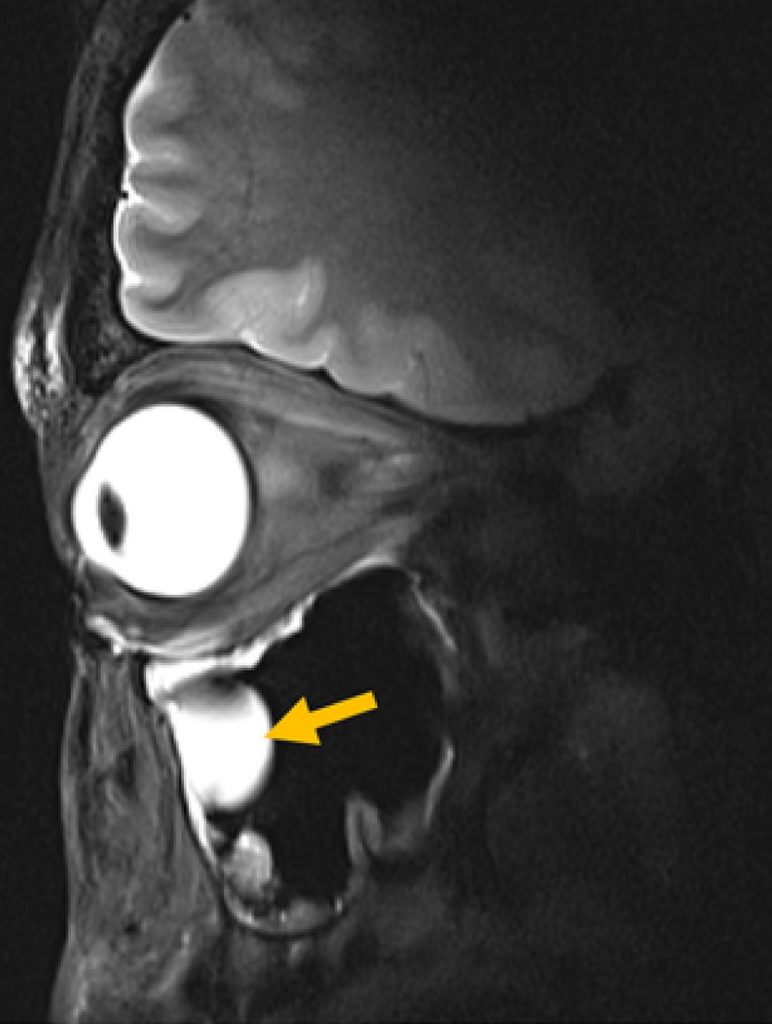
The research team addressed this bottleneck by integrating metamaterials directly into the MRI antenna. Metamaterials are engineered structures that interact with electromagnetic waves in ways not found in natural materials. The engineered RF antenna increases signal strength from targeted tissues, improves spatial resolution and image sharpness and enables faster data acquisition. Crucially, the antenna fits into existing MRI systems, avoiding the need for new infrastructure. The team validated the technology by imaging the eye and orbit region in a group of volunteers at 7.0 Tesla.

MRI image of an eye, the eye socket and the brain.
© AG Niendorf, Max Delbrück Center

“Our research demonstrates clear relevance for ophthalmological applications as it can facilitate anatomically detailed, high-spatial resolution MRI of the eye,” says Professor Oliver Stachs, a co-author of the paper at University Medicine Rostock. “It offers the potential to open a window into the eye and into (patho)physiological processes that in the past have been largely inaccessible.” 

“Our goal was to rethink MRI hardware from the modern physics of antenna design,” adds Saha. This technology can also be tuned to protect sensitive areas of the body during MRI, for example, to reduce unwanted heating around medical implants, she adds. It could also be used to focus RF energy more effectively for MRI guided therapies for various cancer treatments, such as gentle heating of tumors (hyperthermia) or thermal ablation of tissue. 

Better diagnostics

For patients, MRI scans can be uncomfortable and time-consuming – even more so when images need to be repeated because important details are hard to see. Faster scans mean patients spend less time inside scanners. Clearer images mean doctors can make diagnoses with greater confidence. And because the new antenna is lightweight and compact, it can also be designed to better fit specific parts of the body, improving comfort even further.

The technology could also be adapted to support MRI systems running at magnetic field strengths lower or higher than 7.0T, to image target anatomy other than the eye, orbit or the brain or to track metabolism or drug movement inside the body, says Niendorf. Special MRI scans that use other atoms, such as sodium or fluorine, could also benefit from this technology by producing clearer signals and better images, he adds. 

“Innovations in imaging hardware have the potential to transform diagnostics, and this study is an important step toward next-generation MRI technology,” says Dr Ebba Beller, a co-author of the paper at Rostock University Medical Center.

The researchers are already planning larger studies at multiple hospitals and adapting the design for other organs, such as the heart and kidneys. The collaboration will continue to be strengthened by long-standing reciprocal visiting scientist appointments of Stachs and Niendorf. 

Source: Max Delbrück Center for Molecular Medicine

Rare Disease Day 2026 Puts Equity for Patients in the Spotlight

Photo by Cottonbro on Pexels

Rare diseases each affect relatively small numbers of people, but collectively they impact more than 300 million individuals worldwide across over 7000 known conditions, with 70% of these starting in childhood.1 For many patients and families, the reality is often long diagnostic journeys, uncertainty and ongoing challenges in accessing treatment and support.

This year’s global Rare Disease Day theme: “More Than You Can Imagine,” highlights the often unseen challenges faced by rare disease communities and the need for more equitable healthcare systems for people living with rare conditions worldwide.

Ahead of Rare Disease Day 2026, observed globally on 28 February, Sanofi South Africa is reaffirming its commitment to improving outcomes for people living with rare diseases through ongoing research, collaboration to improve access to treatment, and engagement in policy and advocacy discussions that support patients and caregivers.

According to Monique Nel, Medical Adviser for Rare Diseases at Sanofi South Africa, rare diseases demand a long-term mindset. “Patient populations may be small, but that makes every data point even more valuable. Building evidence takes time, yet each insight brings us closer to understanding these conditions and the unique needs of patients – enabling us to deliver better care.”

Research remains essential in rare diseases, where evidence is often limited and every patient experience matters. Global disease registries, such as the Global Gaucher Registry, allow clinicians and researchers to collect real-world data that deepens understanding of how conditions present across different regions and healthcare settings. Participation from South African patients helps ensure local experiences are reflected in global research.

“For me, equity starts with representation,” says Nel. “Patients are not the same everywhere. Genetics, environment, and healthcare systems all shape how a disease presents and progresses. If our research doesn’t reflect the diversity of the populations we serve, we risk missing a critical part of the picture.”

From scientific progress to real-world access

Innovation can transform outcomes for people living with rare diseases, but scientific progress only matters if patients can actually reach and stay on treatment.

Rare disease therapies are often complex and highly specialised, which means access depends on collaboration across clinicians, funders, policymakers and industry. The focus is increasingly on sustainable solutions that support affordability, continuity of care and long-term patient support.

“Access isn’t only about availability,” says Nel. “It’s also about what happens after treatment starts – whether patients can continue therapy, feel supported, and navigate their care with confidence.”

Strengthening policy and advocacy

Policy and legislative frameworks play an important role in shaping diagnosis, treatment pathways and long-term patient support. Ongoing engagement between stakeholders is essential to strengthen South Africa’s rare disease landscape and ensure decisions reflect real patient needs.

Patient voices are becoming increasingly important in policy and reimbursement discussions, offering insights that clinical data alone cannot provide.

“Patients and caregivers become experts through their own lived experiences,” says Nel. “Listening to their voices is what enables us to design better systems and ultimately deliver better care.”

“When we say rare diseases impact lives more than you can imagine, we’re talking about the invisible barriers patients face before they ever receive care,” says Nel. “Healthcare systems matter because they determine how quickly families find answers, how care is funded, and whether patients are truly included.”

She notes that South Africa’s constitutional commitment to healthcare, together with opportunities created through National Health Insurance, presents an important moment to strengthen support for rare disease communities.

South Africa’s support for the May 2025 rare diseases resolution at the World Health Assembly followed advocacy by Rare Diseases South Africa, which engaged the Department of Health and Health Minister Aaron Motsoaledi, calling for rare diseases to be recognised as a national health priority.

“Progress comes from sustained advocacy, partnership and action. Strong policy needs partners who understand that acting for patients means helping build systems that work for them,” says Nel.

Working with patient communities

As part of Rare Disease Day 2026, Sanofi South Africa is once again partnering with Rare Diseases South Africa (RDSA) to raise awareness around rare disease equity and amplify the lived experiences of patients and families. The collaboration focuses on education, awareness and encouraging meaningful dialogue around patient needs.

“Healthcare is a constitutional right in South Africa,” says Kelly du Plessis, CEO & Founder of Rare Diseases South Africa. “The opportunity now is to ensure rare disease patients are fully included in that promise. Equity means policies that don’t simply acknowledge rare diseases but actively prioritise them.”

RDSA remains an independent patient advocacy organisation, while the partnership supports awareness initiatives and responsible collaboration that strengthens patient-centred advocacy.

“We remain committed to working for patients, but we’ve learned to do that more effectively by collaborating with patient societies,” says Nel. “That partnership approach is essential. Equity means ensuring every patient is heard, every voice contributes, and every partnership has the opportunity to drive better care.”

The partnership with RDSA aims to:

  • Increase understanding of rare diseases and their impact
  • Support patient-centred advocacy and awareness
  • Encourage informed dialogue across healthcare stakeholders
  • Highlight the importance of equity in research, access and policy

Both organisations agree that meaningful progress in rare diseases depends on collective action across patients, healthcare professionals, policymakers and industry partners.

Reference:
1. World Health Organization (WHO). Rare diseases: a global health priority for equity and inclusion. Seventy-eighth World Health Assembly, Draft Resolution A78/51, Fifth report of Committee A, 24 May 2025. Available from: https://apps.who.int/gb/ebwha/pdf_files/WHA78/A78_51-en.pdf

Ibuprofen: How an Everyday Drug Might Offer Protection Against Cancer

Photo by Towfiqu barbhuiya: https://www.pexels.com/photo/bottle-with-pills-11361813/

Dipa Kamdar, Kingston University; Ahmed Elbediwy, Kingston University, and Nadine Wehida, Kingston University

Ibuprofen is a household name – the go-to remedy for everything from headaches to period pain. But recent research suggests this everyday drug might be doing more than easing discomfort. It could also have anti-cancer properties.

As scientists uncover more about the links between inflammation and cancer, ibuprofen’s role is coming under the spotlight – raising intriguing questions about how something so familiar might offer unexpected protection.

Ibuprofen belongs to the non-steroidal anti-inflammatory drugs (NSAIDs) family. The connection between NSAIDs and cancer prevention isn’t new: as far back as 1983, clinical evidence linked sulindac – an older prescription NSAID similar to ibuprofen – to a reduced incidence of colon cancer in certain patients. Since then, researchers have been investigating whether these drugs could help prevent or slow other cancers too.

NSAIDs work by blocking enzymes called cyclooxygenases (COX). There are two main types. COX-1 helps protect the stomach lining, maintains kidney function, and plays a role in blood clotting. COX-2, on the other hand, drives inflammation.

Most NSAIDs, including ibuprofen, inhibit both, which is why doctors recommend taking them with food rather than on an empty stomach.

Ibuprofen and endometrial cancer

A 2025 study found that ibuprofen may lower the risk of endometrial cancer, the most common type of womb cancer, which starts in the lining of the uterus (the endometrium) and mainly affects women after menopause.

One of the biggest preventable risk factors for endometrial cancer is being overweight or obese, since excess body fat increases levels of oestrogen – a hormone that can stimulate cancer cell growth.

Other risk factors include older age, hormone replacement therapy (particularly oestrogen-only HRT), diabetes, and polycystic ovary syndrome. Early onset of menstruation, late menopause, or not having children also increase risk. Symptoms can include abnormal vaginal bleeding, pelvic pain, and discomfort during sex.

In the Prostate, Lung, Colorectal, and Ovarian (PLCO) study, data from more than 42,000 women aged 55–74 was analysed over 12 years. Those who reported taking at least 30 ibuprofen tablets per month had a 25% lower risk of developing endometrial cancer than those taking fewer than four tablets monthly. The protective effect appeared strongest among women with heart disease.

Interestingly, aspirin – another common NSAID – did not show the same association with reduced risk in this or other studies. That said, aspirin may help prevent bowel cancer returning.

Other NSAIDs, such as naproxen, have been studied for preventing colon, bladder, and breast cancers. The effectiveness of these drugs seems to depend on cancer type, genetics, and underlying health conditions.

Ibuprofen’s broader potential

Ibuprofen’s possible cancer-protective effects extend beyond endometrial cancer. Studies suggest it may also reduce risk of bowel, breast, lung, and prostate cancers.

For example, people who previously had bowel cancer and took ibuprofen were less likely to experience recurrence. It has also been shown to inhibit colon cancer growth and survival, and some evidence even suggests a protective effect against lung cancer in smokers.

Inflammation is a hallmark of cancer and ibuprofen is, at its core, anti-inflammatory. By blocking COX-2 enzyme activity, the drug reduces production of prostaglandins, chemical messengers that drive inflammation and cell growth – including cancer cell growth. Lower prostaglandin levels may slow or stop tumour development.

But that’s only part of the story. Ibuprofen also appears to influence cancer-related genes such as HIF-1α, NFκB, and STAT3, which help tumour cells survive in low-oxygen conditions and resist treatment.

Ibuprofen seems to reduce the activity of these genes, making cancer cells more vulnerable. It can also alter how DNA is packaged within cells, potentially making cancer cells more sensitive to chemotherapy.

A word of caution

But not all research points in the same direction. A study involving 7,751 patients found that taking aspirin after an endometrial cancer diagnosis was linked to higher mortality, particularly among those who had used aspirin before diagnosis. Other NSAIDs also appeared to increase cancer-related death risk.

Conversely, a recent review found that NSAIDs, especially aspirin, may reduce the risk of several cancers – though regular use of other NSAIDs could raise the risk of kidney cancer. These conflicting results show how complex the interaction between inflammation, immunity, and cancer really is.

Despite the promise, experts warn against self-medicating with ibuprofen for cancer prevention. Long-term or high-dose NSAID use can cause serious side effects such as stomach ulcers, gut bleeding, and kidney damage.

Less commonly, they may trigger heart problems like heart attacks or strokes. NSAIDs also interact with several medications, including warfarin and certain antidepressants, increasing the risk of bleeding and other complications.

The idea that a humble painkiller could help prevent cancer is both exciting and provocative. If future studies confirm these findings, ibuprofen might one day form part of a broader strategy for reducing cancer risk, especially in high-risk groups.

For now, experts agree it’s wiser to focus on lifestyle-based prevention: eating anti-inflammatory foods, maintaining a healthy weight and staying physically active.

Everyday medicines may yet hold surprising promise, but until the science is settled, the safest prescription for cancer prevention remains the oldest one: eat well, move often, and listen to your doctor before reaching for the pill bottle.

Dipa Kamdar, Senior Lecturer in Pharmacy Practice, Kingston University; Ahmed Elbediwy, Senior Lecturer in Cancer Biology & Clinical Biochemistry, Kingston University, and Nadine Wehida, Senior Lecturer in Genetics and Molecular Biology, Kingston University

This article is republished from The Conversation under a Creative Commons license. Read the original article.