The South African Health Products Regulatory Authority (SAHPRA) has officially been accepted as a member of the International Council for Harmonisation of Technical Requirements for Pharmaceuticals for Human Use (ICH), following an ICH assessment of compliance with requirements for membership, including a formal presentation outlining SAHPRA’s interest, progress, and milestones in implementing ICH principles.
The ICH is a unique global body that brings together regulatory authorities and the pharmaceutical industry to align scientific and technical standards for the registration of medicines. Since its establishment in 1990, it has evolved to support an increasingly globalised pharmaceutical environment. Its mission is to promote worldwide harmonisation to ensure that safe, effective, and high-quality medicines are developed and registered efficiently. This harmonisation is achieved through the development of ICH Guidelines, which are formulated through scientific consensus between regulators and industry experts. Successful adoption relies heavily on regulators’ commitment to implement these final Guidelines within their national systems.
The ICH Assembly met in person on 18-19 November 2025 in Singapore, in parallel with meetings of 12 Working Groups and preceded by meetings of the ICH Management Committee (MC) and the MedDRA Steering Committee (SC).
“ICH is delighted to welcome NAFDAC, Nigeria, and SAHPRA, South Africa, as new ICH Members, in addition to two new Observers: DIGEMAPS, Dominican Republic, and Philippine FDA, Philippines, bringing ICH to a total of 25 Members and 41 Observers.”
Welcoming SAHPRA’s membership, CEO Dr Boitumelo Semete-Makokotlela said: “This is a significant milestone for the South African Health Products Regulatory Authority. Membership of the ICH strengthens our commitment to the three pillars of safety, quality, and efficacy, while ensuring that our processes remain resource-efficient. This development allows SAHPRA to benchmark its regulatory practices against global best practice for the benefit of all people living in South Africa.”
Two global trials show durable improvements in skin clearance, itch, and quality of life by targeting OX40 immune receptor
Source: Unsplash CC0
An international team of investigators led by Emma Guttman-Yassky, MD, PhD, Waldman Professor and System Chair of the Kimberly and Eric J. Waldman Department of Dermatology at the Icahn School of Medicine at Mount Sinai, has reported results from the first phase 3 clinical trials of rocatinlimab, a novel treatment for moderate-to-severe atopic dermatitis (eczema). The landmark findings from the ROCKET-IGNITE and ROCKET-HORIZON studies were published in The Lancet.
Eczema affects hundreds of millions of people worldwide and is notoriously difficult to treat due to its complex and chronic inflammatory pathways. Current biologics focus on blocking “allergy” cytokines but fail to address the memory T cells that sustain disease activity. Rocatinlimab is the first antibody to selectively block the OX40 receptor on effector and memory T cells, rebalancing the immune system and altering the long-term course of disease.
Across the two global, double-blind, placebo-controlled randomised phase 3 clinical trials, nearly 1,500 patients were followed for 24 weeks, and rocatinlimab showed robust and lasting benefits. Patients receiving the treatment were three times more likely to achieve significant improvement in eczema severity, as measured by EASI and vIGA-AD scores, compared to those on placebo. Improvements continued beyond week 24, suggesting that the benefits strengthen over time. The therapy also led to meaningful reductions in itch, pain, and sleep disturbances, enhancing overall quality of life. Importantly, rocatinlimab was well tolerated, with adverse events comparable to placebo, and demonstrated high selectivity by reducing only the OX40R+ CD4+ T cells responsible for eczema’s persistence, without off-target effects.
“These findings represent a major advance for patients living with eczema, who often face years of uncontrolled symptoms and few effective options,” said physician scientist, Dr. Guttman-Yassky, lead author of the study. “By targeting memory T cells through OX40, rocatinlimab not only clears the skin and relieves itch, but continues to improve patients’ lives over time with a strong safety profile. This is the first phase 3 proof that rebalancing these immune cells can transform how we treat atopic dermatitis.”
The results establish OX40 as a validated treatment target in eczema and position rocatinlimab as a potential first-in-class therapy. Patients from the phase 3 trials are now being followed in the ROCKET-ASCEND extension study, which will track outcomes for up to two years. Additional research will explore its role in paediatric patients, in combination with other therapies, and in direct comparisons to existing systemic treatments.
Breast cancer cells. Image by National Cancer Institute
Triple-negative breast cancer is one of the most aggressive cancers. The name tells the story: It lacks the three main targets that make other types of breast cancers more treatable with powerful therapies.
UCLA researchers have developed a novel therapy that could fundamentally change the treatment plan for this deadly disease. In a study published in the Journal of Hematology & Oncology, the team details how this new type of immunotherapy, called CAR-NKT cell therapy, could attack tumors from multiple fronts while dismantling their protective shields.
“Patients with triple-negative breast cancer have been waiting far too long for better treatment options,” said senior author Lili Yang, a professor of microbiology, immunology and molecular genetics and a member of the Eli and Edythe Broad Center of Regenerative Medicine and Stem Cell Research at UCLA. “To finally have a therapy that shows superior cancer-fighting ability – and to be just one step away from clinical testing – is incredibly exciting.”
The therapy uses engineered immune cells called CAR-NKT cells, which can be mass-produced from donated blood stem cells and stored ready-to-use. This off-the-shelf approach offers an immediately available treatment option at a fraction of the cost of current personalized cell therapies, which can soar into the hundreds of thousands of dollars.
A triple threat against a triple-negative cancer
CAR-T cell therapies have transformed treatment for certain blood cancers by turning patients’ own immune cells into precision weapons. However, these therapies have struggled against solid tumours like breast cancer, which employ sophisticated defence mechanisms and constantly evolve to evade treatment.
To tackle these hurdles, the UCLA team’s cell therapy harnesses a rare but powerful type of immune cell called invariant natural killer T cell, or NKT cell. When equipped with a chimeric antigen receptor, or CAR, targeting mesothelin (a protein found on triple-negative breast cancer cells) these potent tumour-fighting cells gain the ability to recognise and destroy cancer through three distinct mechanisms.
The first mechanism uses the engineered CAR to target mesothelin, which is associated with more aggressive, metastatic disease. The second leverages the cells’ natural killer receptors that recognize more than 20 molecular markers, making it nearly impossible for tumours to evade all of them. The third employs the cells’ unique T cell receptor to reshape the tumour microenvironment by eliminating immunosuppressive cells.
“We’re not just targeting one molecular marker on cancer cells — we’re identifying dozens of them simultaneously,” said first author Yanruide (Charlie) Li, a postdoctoral scholar in the UCLA Broad Stem Cell Research Center Training Program. “It’s like attacking a fortress from every direction at once. The cancer simply can’t adapt fast enough to escape.”
When the research team tested the novel therapy on tumour samples from patients with late-stage metastatic breast cancer, the CAR-NKT cells successfully killed cancer cells in every single sample tested, while also eliminating the immunosuppressive cells that tumours recruit as protective escorts.
Engineering universal accessibility
Beyond its multipronged cancer-fighting capabilities, the CAR-NKT platform addresses critical barriers that have limited cell therapy access: manufacturing complexity and cost.
Current cellular immunotherapies require collecting each patient’s immune cells, shipping them to specialised laboratories for genetic modification, then returning the customized product into the patient weeks later — a process that can cost six figures and create dangerous delays for patients with aggressive cancers.
Yang’s team takes a fundamentally different approach. Because NKT cells naturally work with any immune system, they can be mass-produced from donated blood stem cells using a scalable system. A single donation could generate enough cells for thousands of treatments, reducing costs to approximately $5,000 per dose.
One product to tackle multiple cancers
The therapy’s promise extends beyond triple-negative breast cancer. Since mesothelin is also highly expressed in ovarian, pancreatic and lung cancers, the same cell product could potentially treat multiple cancer types that remain difficult to address with current immunotherapies.
With all preclinical studies complete for both triple-negative breast cancer and ovarian cancer, the team is preparing to submit applications to the Food and Drug Administration to begin clinical trials.
“We’ve walked 99 steps to get here,” Yang said. “We’re missing just one final step to begin clinical testing and demonstrate what this promising therapy can really do for patients.”
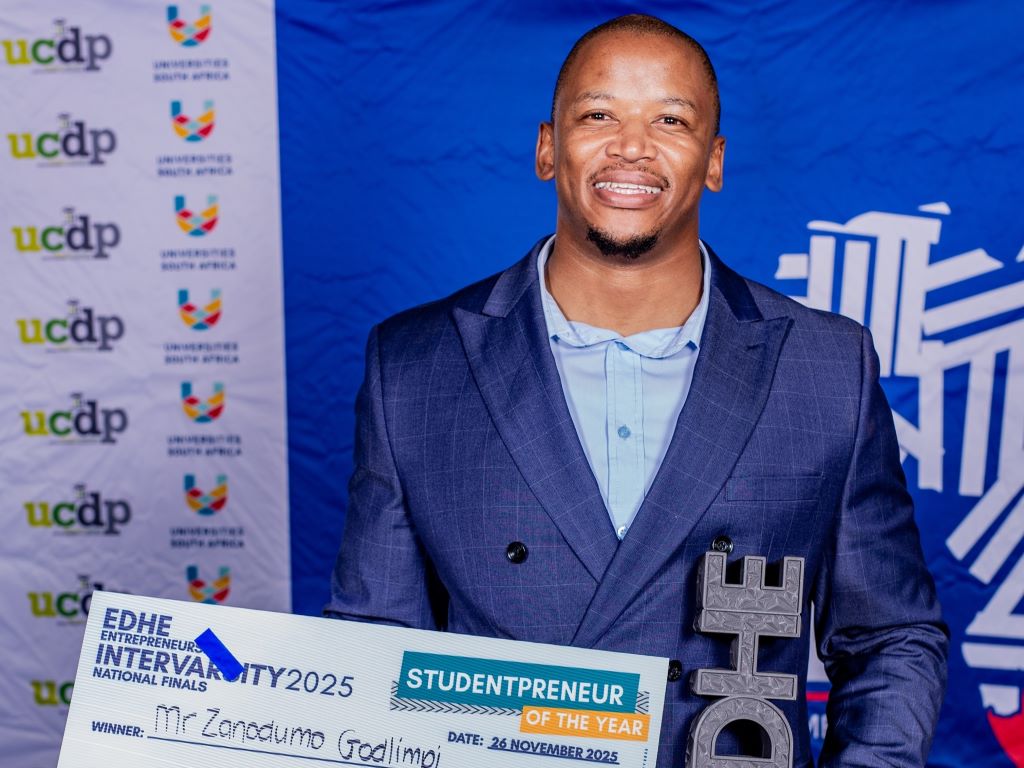
A young man’s determination to help the thousands of South Africans who cannot afford a quality prosthetic spurred him into action. It led him to design a pneumatic-actuated prosthetic foot, winning him the title of 2025 EDHE Studentpreneur of the Year at the seventh annual EDHE Entrepreneurship Intervarsity.
Mr Zanodumo Godlimpi, a postgraduate student at Walter Sisulu University, won R120 000 in overall prize money and a further R25 000 for another win in the Academic Research Commercialisation category.
A fellow prosthetic designer and innovator – Ms Amohetsoe Shale from Stellenbosch University – was named Top Student Womanpreneur, winning R25 000. Her company, Navu, designs and produces cost-effective, high-performance assistive technologies, beginning with a passive polycentric prosthetic knee. Ms Shale emerged a runner-up in the Academic Research Commercialisation category.
Below is the breakdown of the 2025EDHE Entrepreneurship Intervarsity Award winners:
The EDHE Studentpreneur of the Year
· Zanodumo Godlimpi (Walter Sisulu University), founder of a pneumatic-actuated and affordable prosthetic foot. (R120 000).
Top Student Womanpreneur
· Ms Amohetsoe Shale (Stellenbosch University) founder of the NAVU Group, who design affordable, high-performing prosthetic knees for amputees. (R25 000).
Existing Business – Tech
· Winner: Ms Kholofelo Makhubupetsi (University of Mpumalanga), co-founder of CSK Environmental Consulting which guides businesses towards sustainable practices while leveraging government grants. It helps organisations reduce greenhouse gas emissions and conserve biodiversity (R25 000).
· Runners-up: Ms Khanyisa Mokgolobotho and Ms Rosemary Erawemen (Stellenbosch University), co-founders of Techmed Connect, a company revolutionising South African healthcare with technology through innovative AI solutions and helping bridge language gaps (R10 000).
Existing Business – Social Impact
· Winner: Ms Malehu Mohale (University of Cape Town), founder of the Early Bird Testimony Academy, an online tutoring and mentorship platform. (R25 000).
· Runner-up: Mr Kabelo Makhetha (Central University of Technology), founder of OWA Jewellers which creates jewellery that blends African design with safety technology, making it a potential life-saving tool for individuals with conditions like epilepsy or dementia. (R10 000).
· 2nd runner-up: Mr Katleho Mphutlane (University of Fort Hare), co-founder of Incremental Education which seeks to bridge the gap between education and employability and empowers students with practical skills and global opportunities, focusing on supporting TVET college and university of technology students in tourism, hospitality and agriculture. (R10 000)
Existing Business – General
· Winner: Mr Tumelo Ratala (University of South Africa), founder of Drink & Print which offers purified water and printing services (R25 000).
· Runner-up: Mr Thando Mzimela (University of Cape Town), co-founder of uniMark by TM Agrichem that connects university students with essential services through an online platform that streamlines access to local businesses (R10 000).
Academic Research Commercialisation
· Winner: Zanodumo Godlimpi (Walter Sisulu University), founder of a pneumatic-actuated and affordable prosthetic foot. (R25 000).
· Runner-up: Ms Amohetsoe Shale (Stellenbosch University) founder of the NAVU Group who designs affordable, high-performing prosthetic knees for amputees. (R10 000).
The Entrepreneurship Development in Higher Education (EDHE), a programme of the Department of Higher Education and Training (DHET) administered and implemented by Universities South Africa (USAf), is the custodian of the annual EDHE Entrepreneurship Intervarsity. EDHE is predominantly funded through the University Capacity Development Programme (UCDP) of the DHET.
The Intervarsity is a platform designed to identify, recognise and celebrate top student entrepreneurs at South Africa’s 26 public universities. The event has, over the years, enjoyed the support of numerous private sector entities, including the Allan Gray Foundation, the Entrepreneurs’ Organisation and the SAB Foundation, which, in 2025, supports the initiative for the sixth year in a row.
Mr Phillip Tshabalala, Chief Director: Teaching, Learning and Research Development in the Department of Higher Education and Training, delivered the keynote address during the award ceremony. Labelling the event both timely and significant, he said it represented an important step forward in collective efforts to advance entrepreneurial universities.
Referencing the recent G20 Summit and its commitment to boost inclusive growth — with a strong focus on Africa and the broader Global South – he said: “Universities play a vital role in preparing students, not only to participate in the labour market as employees, but also to serve as future employers, industrialists, innovators and leaders. DHET works closely with universities, USAf and other key partners to transform the academic landscape. A major component of this transformation is the integration of entrepreneurship within our universities and in the curriculum nationally.
“I congratulate the winners who are part of a movement to turn the tide for economic growth in our country. May they continue with their businesses and mentor those who are still finding their way.”
Said Dr Kirston Greenop, Head of Corporate Citizenship, Standard Bank South Africa: “For us at Standard Bank, there are only two ways to achieve growth in this country – through education and with entrepreneurship. With these awards, and with the work done by EDHE, you combine the two and so, for us, it is an absolute win/win.
“Without a small and medium enterprise and entrepreneur base, this country is lost. We need to get the EDHE message out there to a wider community while celebrating its work. It is an absolute truth that when we invest in entrepreneurs, we invest in hope, in self-determination and in community upliftment.”
Mr Mahlubi “Chief” Mabizela, Director: Operations and Sector Support at USAf, emphasised the importance of entrepreneurship for higher education.
“Every graduate of higher education must come out equipped with entrepreneurial skills, whether or not they intend to use them thereafter. Universities cannot simply produce graduates who wait for jobs that may never come. Universities that embrace entrepreneurship remain relevant by aligning curriculum with societal and economic needs while producing well rounded graduates. Entrepreneurship fosters creativity, problem solving and adaptability; skills which are critical to compete, to participate in society, and for social development. In other words, entrepreneurship is not just about profit but about social innovation.
“Our ultimate aim is to have entrepreneurship embedded in the DNA of higher education, not as an elective, but as a pillar of the sector’s transformation,” he concluded.
Participating in the panel of judges for the 2025 EDHE Entrepreneurship Intervarsity Awards were Mrs Pabalelo Banks, representing Analytics X, Mr Billy Bokako from the Small Enterprises Development Agency, Ms Khwezi Cenenda, representing Avocado Vision, Ms Onthatile Ditshego from the SAB Foundation, Ms Uve Nathi Gcilishe from The Innovation Hub) and Mr Marshall Grant, representing the Garden Route Innovation Hub.
A new study shows that a TXA autoinjector delivers lifesaving treatment for severe bleeding as effectively as traditional IV methods – but in under five minutes and without the need for medical expertise. This breakthrough could transform trauma care in emergencies, making rapid, easy-to-administer treatment available in settings ranging from battlefields to roadside accidents, where every second counts.
In a major breakthrough for emergency and trauma medicine, a group of researchers led by Prof Arik Eisenkraft and Prof David Gertz of the Institute for Research in Military Medicine (IRMM), Faculty of Medicine at The Hebrew University of Jerusalem, partnered with the IDF Medical Corps, have demonstrated that a simple autoinjector device can rapidly deliver Tranexamic Acid (TXA), an antifibrinolytic drug that helps stabilise blood clots and reduce blood loss, with the same effectiveness as traditional intravenous (IV) administration.
The study, recently published in the peer-reviewed journal Injury, highlights the potential for this technology to save lives in pre-hospital and battlefield settings, where timely intervention is critical and IV access may be delayed or impossible.
In Trauma, Every Second Counts
Severe bleeding is the leading cause of preventable death in trauma situations, from combat zones to highway accidents. TXA is already widely used in hospitals and dedicated trauma centres and by pre-hospital emergency responders. However, the standard IV method of administration can be difficult to perform in chaotic, high-stress environments, leading to dangerous delays in treatment.
Research has shown that for every 15-minute delay in administering TXA, its effectiveness drops by 10%, underscoring the need for a faster, simpler solution.
In the new study, the researchers found that TXA delivered via autoinjector reached effective therapeutic levels in less than five minutes and remained active throughout the treatment window.
Importantly, outcomes were comparable to intravenous delivery, with stable haemodynamic parameters and effective clot formation observed across all test subjects.
“When someone is bleeding heavily, every minute matters,” said Dr Eisenkraft. “With this autoinjector, even non-medical responders can administer lifesaving treatment almost instantly – and that can mean the difference between life and death.”
“This innovation could transform trauma response in the field,” added Dr Gertz. “From combat zones to roadside accidents and natural disasters, the ability to deliver a proven treatment quickly and easily has the potential to save countless lives.”
The simplicity and portability of the autoinjector device allow it to be used widely by paramedics, first responders, and military medics, ensuring that TXA can be administered within the critical early minutes following severe injury.
This research builds on ongoing efforts by Hebrew University and IDF scientists to improve emergency medical care in high-risk environments, ensuring that patients receive fast, effective interventions when and where they need them most.