

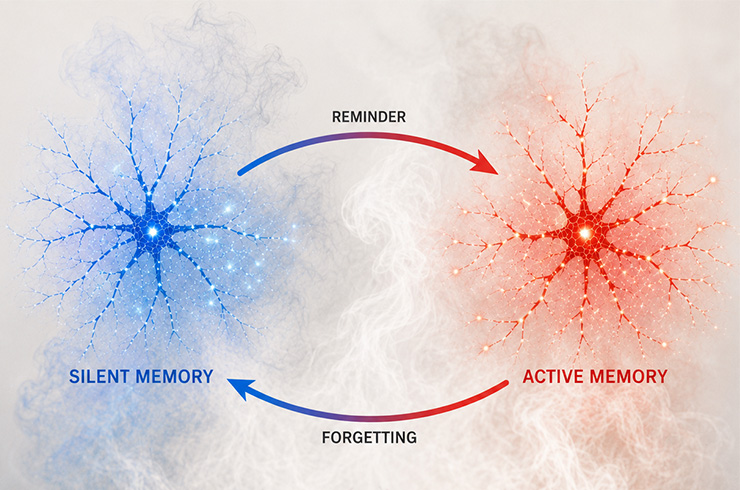
A forgotten memory is not always a vanished one. FMI neuroscientists investigating the fruit fly brain found that some memories become inaccessible while leaving a silent trace behind. The right reminder can bring them back, but misleading reminders can distort their recovery, producing false memories. The findings show how memories can be rebuilt from stored information and current clues, which may help explain why recall can sometimes alter what we remember.
Memory is not a perfect record. Some memories fade, while others remain hidden and can be brought back by reminders. But reminders can also distort what is remembered, and scientists still know little about how the brain accurately recovers memories or forms false ones.
In a new study, researchers in the group of Johannes Felsenberg trained fruit flies to associate one odour with mild electric shocks. Soon after training, the flies avoided that odour, but by 24 hours later the learned avoidance had faded. When the researchers later exposed the flies to the same odour as a reminder, the aversive memory was recovered, and the flies avoided the odour again.
The reminder only worked when key parts of the original setting, such as the chamber’s texture and lighting, were unchanged, suggesting that the fly brain used both the odour and its context to bring the memory back.
When the researchers looked inside the flies’ brain, they found that the original pattern of neural activity linked to the memory faded over time. At the same time, the memory left a silent trace in a different group of neurons. A specific reminder could reactivate this silent trace, restoring the brain activity that guides behaviour. These findings suggest that some forgotten memories are not erased but persist in the brain in a silent form that can later be recovered.
The team also showed how memory recovery can go wrong. During training, the flies had experienced a second odour that was not paired with shock. When researchers later used that harmless odour as the reminder, the flies began avoiding it too, as if it had predicted danger.
The neuronal pathways involved in forming the false memory were different from those used to recover the true memory. This suggests that, at least in flies, the brain may process recovered and distorted memories through distinct circuits.
This work does not show that fly memory is the same as human recollection, but it offers a circuit-level example of how remembering can depend on stored information, current cues and context, and why that process can sometimes distort past memories, the researchers say.
Source: Friedrich Miescher Institute for Biomedical Research
