

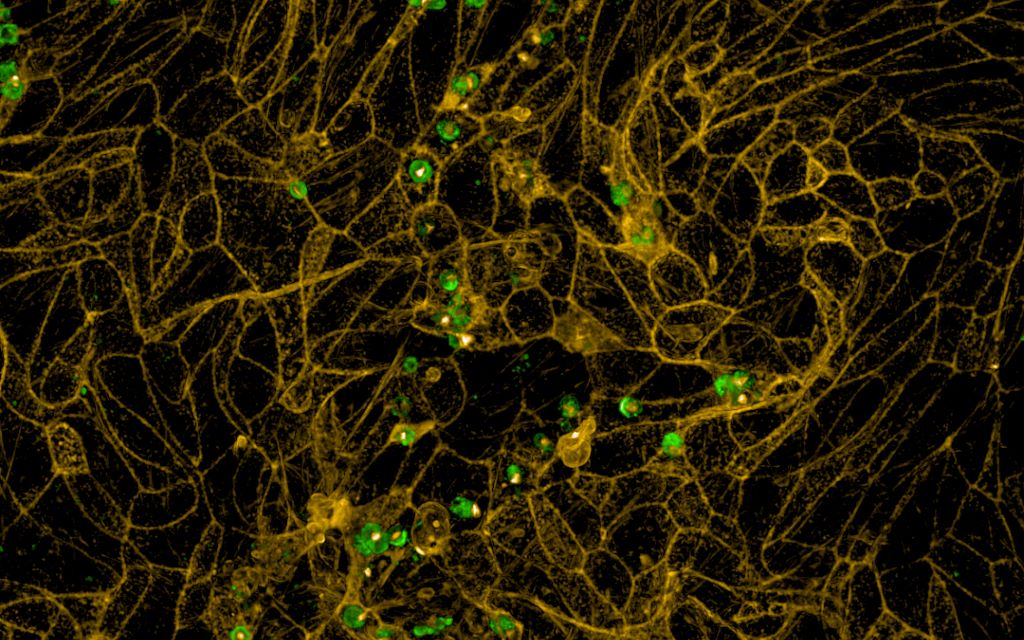
The Cryptosporidium parasite lives within cells that line the human intestine, but how does this pathogen find, recognise and then successfully invade these cells without triggering immunity? An international collaboration aims to find out.
Parasites have lived on and within humans throughout history, co-evolving along with us to adjust to new climates and challenges. In some cases, this relationship has left significant genetic imprints. For example, the prevalence of sickle-cell disease in humans has been driven by selective pressure from the malaria parasite.
Cell biologist Adam Sateriale and his team at the Crick study a close relative of the malaria parasite, known as Cryptosporidium, which infects the intestinal tract of a wide range of animals, including humans. Most human infections are mild and asymptomatic, but Cryptosporidium can be deadly within immunocompromised people or very young children.
“Certain species of the Cryptosporidium parasite are adapted to specifically invade and then live within the human intestinal lining, or epithelium,” Adam explains. “We’re interested to find out how the parasite recognises, and then successfully invades, these cells within the epithelium.”
Cryptosporidium and the malaria parasite, known as Plasmodium, diverged from one another nearly 500 million years ago, yet many of their features are conserved. Two organelles (or cellular compartments) can be found within both parasites: micronemes, which contain proteins that help parasites move, and rhoptries, which contain proteins that help parasites invade cells.
Micronemes of the malaria parasite are important vaccination targets, as proteins from these organelles are displayed on the surface of the parasite and are critical for infection. While Cryptosporidium has these invasion organelles, very little is known about their function and how they diverge from those of the malaria parasite.
A recently awarded Wellcome Discovery grant has allowed Adam’s team to join forces with Gavin Wright’s team at the University of York and Amandine Guérin’s team at the University of Geneva to tackle these questions. Together, they will examine the function of micronemes and rhoptries and explore how Cryptosporidium specifically recognises and invades intestinal epithelial cells. To do that, they will harness the power of genetic editing.
“We’re going to use CRISPR gene editing to switch off, one by one, all the genes that code for the proteins in Cryptosporidium’s micronemes and rhoptries,” says Adam. “If the parasites can’t complete their normal functions without a particular protein, we’ll know that it’s a critical part of Cryptosporidium’s offensive strategy.”
Working together over the next five years, this multidisciplinary team are each bringing unique expertise: Adam’s team have developed CRISPR screening technology for the parasite, Amandine’s team work on Cryptosporidium invasion in detail and Gavin’s team specialise in identifying and studying cell surface protein interactions.
“Although there are many species of the Cryptosporidium parasite, some can only infect very specific hosts,” says Adam. “For instance, there are human species that can only invade and replicate within humans, suggesting a specific lock and key mechanism between the parasite and host. If we can find the essential parasite proteins that engage and unlock human cells for infection, we can then study these interactions and learn how to block them.”
He’s also excited about the impact this work could have, adding, “Ultimately this will lay the foundation for new treatments and preventions for children living in endemic areas.”
Source: Crick Institute
