

As 2027 medical scheme premiums rise, members moving to cheaper plans face even bigger out-of-pocket costs

Tuesday, 17 November 2026, Johannesburg: With significant increases coming in 2027, many medical scheme members will need to decide whether to buy down to a cheaper option. However, many aren’t considering how much specialist fees have risen while medical scheme payouts have lagged.
Kaelo’s claims analysis shows that between 2021 and 2026, specialist fees rose 50% while the amounts medical schemes pay rose just 24%, lifting the typical shortfall on a specialist account by 74% over the 5-year period. Specialists set their own fees and schemes set their own rates, so the patient must settle the difference. Only about one in five scheme members has gap cover, which would cover this shortfall.
“Even members who stay on the same plan face larger shortfalls every year, and buying down increases the exposure,” says Sian MacGregor, sales director at Kaelo. “Our actuaries have shown that gap cover is not an optional extra these days, given the dynamics at play in the medical scheme landscape. It has become a necessary add-on to medical aid.”
Kaelo’s modelling shows that once a typical earner has covered their monthly expenses, they’re left with about R850, and that’s all they would have to put towards an unexpected medical bill. At that rate, the average shortfall on childbirth (R18 500) takes 22 months to repay, uterine scarring (R19 000) takes 23 months, and spinal stenosis (R30 000) takes three years. These are just three examples of common medical procedures; others can cost a lot more.
For example, a young woman with endometriosis, on a medical scheme, will face about R35 000 in shortfalls and co-payments for surgery. On a first-job salary of R20 000 a month, and without gap cover, the operation would likely be put off, but delayed intervention has consequences. Postponing treatment for uterine scarring can raise miscarriage risk in a later pregnancy by up to 33%, while a delayed colonoscopy has major implications for survival rates if cancer is found.
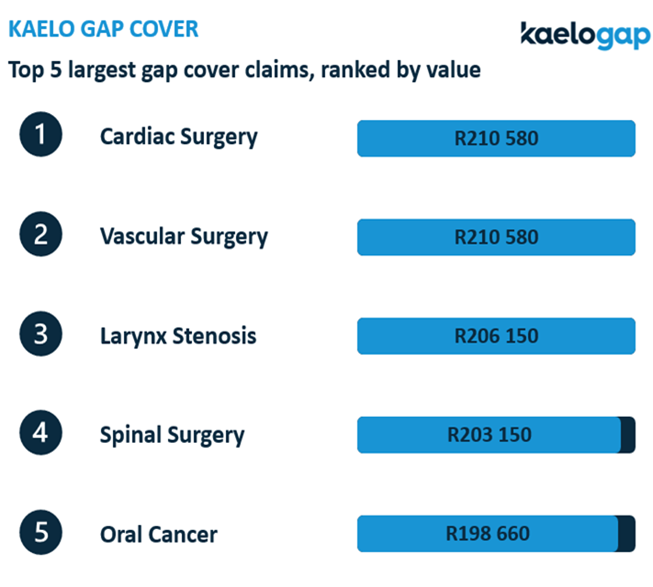
Kaelo has paid the annual maximum gap cover of about R210 000 on numerous claims in the past year, including cardiac and vascular surgery.
How an employer offers gap cover affects what staff pay. In one Kaelo employer group, gap cover moved from voluntary to compulsory for staff on a medical scheme. Covered employees rose from an average of 960 to nearly 3,600. Total monthly claims tripled, and that year 166 more employees who previously could not afford care could now access and claim from gap cover. At the same time, the average cost per covered employee fell by 16%.
“When cover is voluntary, the people who sign up are mostly those who already expect to claim, so costs and premiums climb,” says MacGregor. “When it is the default, the cost is spread across a bigger, healthier pool.” Kaelo projects that within five years, premiums for a group where cover is the default will be 30% to 50% lower than for the same cover offered voluntarily. Policyholders also get Dis-Chem Better Rewards, a benefit that helps offset the premium.
In addition to covering medical aid shortfalls, Kaelo Gap pays hospital co-payments upfront, so members don’t have to find the cash before a planned procedure. After a claim, trained counsellors call members to check on their overall wellbeing, such as phoning new mothers or offering support on a cancer diagnosis.
Kaelo Gap has grown about 11% year to date, across corporate and individual clients.
Members who plan to buy down on their medical scheme plan should check that their gap option is still appropriate, MacGregor advises. One Kaelo Gap option pays up to an additional 500% of the scheme rate, which may suit a comprehensive plan, while a basic plan may call for another option, which pays up to an additional 600%. Individual policies usually have a three-month waiting period, so arrange cover well before you need treatment. Individual cover starts from R219 a month.
