Day: March 12, 2026

Scientists Discover a Gut Bacterium Linked to Muscle Strength

Photo by Jonathan Borba on Unsplash

Ageing naturally weakens our muscles, but a new study published in the journal Gut have found a gut bacterium that may help turn the tide. The researchers Leiden University Medical Center and the Universities of Granada and Almería, found that Roseburia inulinivorans is linked to stronger muscles in both people and mice. The discovery hints at the potential for new probiotics to support muscle strength and healthy ageing.

While exercise and good nutrition remain important for maintaining muscle strength, scientists are now turning their attention to a lesser‑known player: the gut. “The bacteria living in our intestines help us process nutrients, regulate inflammation and manage energy,” Patrick Rensen, professor at the division of Endocrinology, notes. “All of these processes are essential for keeping our muscles healthy as we age.”

A gut bacterium linked to stronger muscles

In their new work, the researchers identified one particular gut bacterium, Roseburia inulinivorans, that appears to be linked to stronger muscles across the lifespan. “When we compared young adults aged 18 to 25 with older adults aged 65 and above, we noticed clear differences,” postdoc Borja Martínez-Téllez says. “Older adults who carried this bacterium had 29 percent stronger handgrip strength than those who didn’t.” In young adults, higher levels of Roseburia inulinivorans were associated with stronger muscles and better overall fitness. “It was remarkable to see the same pattern in both age groups,” Martínez-Téllez adds.

Testing the bacterium in mice

To find out whether this link was more than coincidence, the researchers carried out a series of experiments in mice. “We wanted to understand whether this bacterium actually causes improvements in muscle strength,” Rensen explains. After clearing the mice’s gut bacteria using antibiotics, they introduced human strains of Roseburia inulinivorans for eight weeks.

“The results were striking,” Rensen says. “The mice became 30 percent stronger, developed larger muscle fibres and produced more fast‑twitch fibres.”

The team also found that the bacterium changed how the muscles used certain building blocks and activated energy‑related pathways inside the muscle. “These metabolic changes may help explain why the muscles grew stronger,” according to Martínez-Téllez.

From discovery to potential probiotic treatment

Another key observation is that levels of Roseburia inulinivorans naturally decline with age. “This could partly explain why muscle strength drops as we get older,” Martínez-Téllez says. “If this bacterium supports muscle metabolism, then restoring it might one day help preserve muscle function later in life.”

Together, the findings suggest that Roseburia inulinivorans could become a future probiotic, developed into a safe, supplement‑like product aimed at preventing age‑related muscle‑wasting conditions. “A nutraceutical approach – using food‑based or naturally derived products – could offer a gentle and non‑invasive way to support healthy ageing,” Martínez-Téllez explains.

The researchers however caution that considerable work needs to be done before these findings can be turned into a treatment for humans.

Source: Leiden University Medical Center
How Body’s ‘Cold Sensor’ Works – and Why Menthol Tricks it

First-ever molecular snapshots show the body’s “cold sensor” in action, with implications for treating pain, migraines, and dry eye

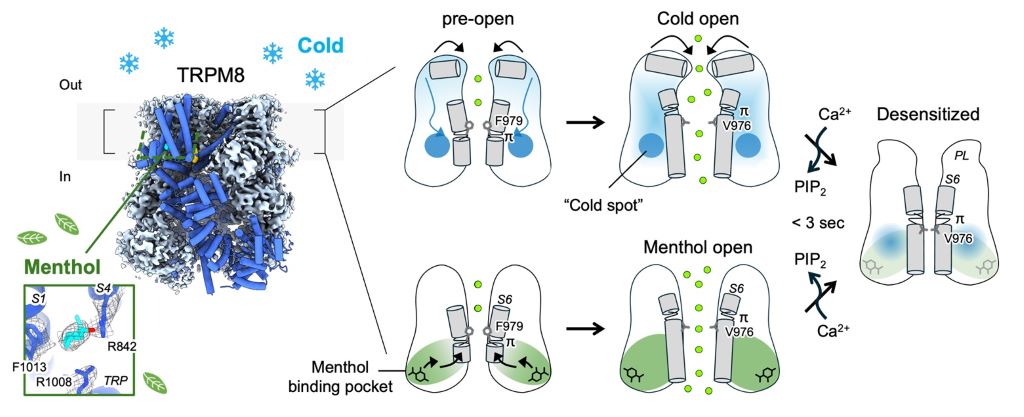
Using cryo-electron microscopy, researchers captured multiple conformational snapshots of the cold sensing channel, TRPM8, as it transitions from closed to open.

When you step outside on a winter morning or pop a mint into your mouth, a tiny molecular sensor in your body springs into action, alerting your brain to the sensation of cold. Scientists have now captured the first detailed images of this sensor at work, revealing exactly how it detects both actual cold and the perceived cool of menthol, a compound derived from mint plants. The research was presented at the 70th Biophysical Society Annual Meeting in San Francisco from February 21–25, 2026.

The study focused on a protein channel called TRPM8. “Imagine TRPM8 as a microscopic thermometer inside your body,” said Hyuk-Joon Lee, a postdoctoral fellow from Seok-Yong Lee’s laboratory at Duke University. “It’s the primary sensor that tells your brain when it’s cold. We’ve known for a long time that this happens, but we didn’t know how. Now we can see it.”

TRPM8 sits in the membranes of sensory neurons innervating the skin, oral cavity, and eyes. It responds to cold temperatures – roughly between 8°C and 28°C – by opening up and allowing ions to flow into the cell, which triggers a nerve signal to the brain. It’s also the reason menthol, eucalyptus, and certain other compounds produce that characteristic cooling sensation.

“Menthol is like a trick,” Lee explained. “It attaches to a specific part of the channel and triggers it to open, just like cold temperature would. So even though menthol isn’t actually freezing anything, your body gets the same signal as if it were touching ice.”

Using cryo-electron microscopy – a technique that images flash-frozen proteins with an electron beam – Lee and colleagues captured multiple conformational snapshots of TRPM8 as it transitions from closed to open. They discovered that cold and menthol activate the channel through shared yet distinct allosteric networks: cold primarily triggers changes in the pore region (the part that actually opens to let ions through), while menthol binds a different part of the protein and induces shape changes that propagate to the pore.

“When cold is combined with menthol, the response is enhanced synergistically,” Lee said. “We used this combination to capture the channel in its open state – something that hadn’t been achieved with cold by itself.”

The findings have medical implications. When TRPM8 doesn’t function properly, it has been linked to conditions including chronic pain, migraines, dry eye and certain cancers. Acoltremon, a drug that activates TRPM8, is an FDA-approved eye drop for dry eye disease. As a menthol analogue, it works by activating the cooling pathway to stimulate tear production and soothe irritated eyes.

The researchers also identified what they call a “cold spot” – a specific region of the protein that is uniquely important for sensing temperature and helps prevent the channel from becoming desensitised during prolonged cold exposure.

“Previously, it was unclear how cold activates this channel at the structural level,” Lee said. “Now we can see that cold triggers specific structural changes in the pore region. This gives us a foundation for developing new treatments that target this pathway.”

The work offers the first molecular definition of how cold and chemical stimuli are integrated to create the sensation of coolness – answering a fundamental question in sensory biology that has puzzled scientists for decades.

Source: Biophysical Society

“Two-for-one” C-section and Tummy Tuck Idea Alarms Surgeons

Photo by Jonathan Borba on Unsplash

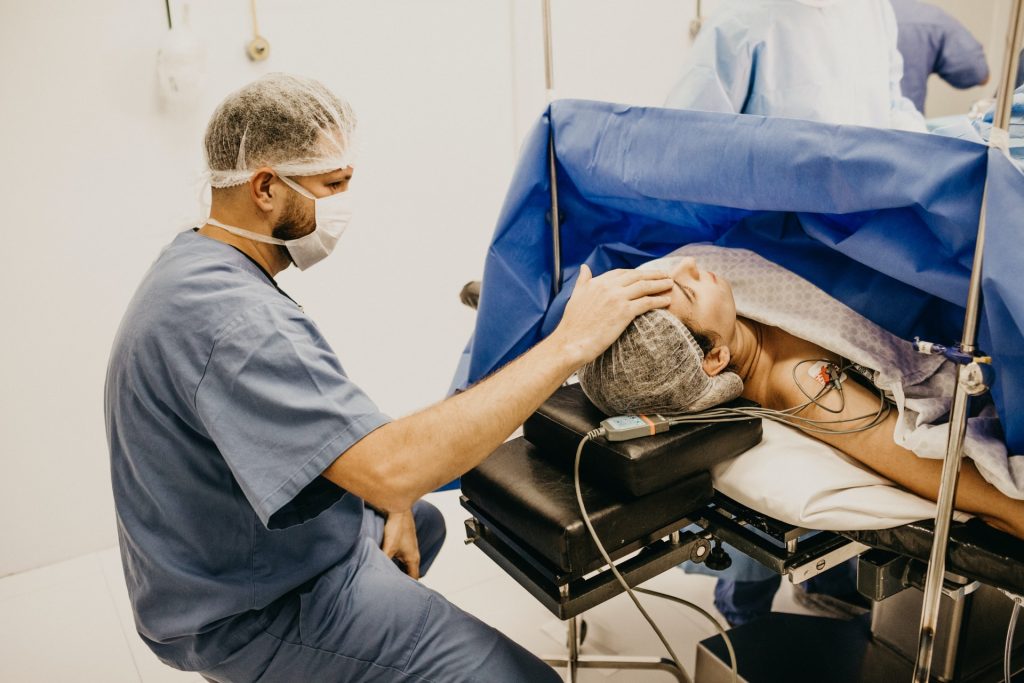
The ‘mommy makeover’ is trending, and a growing number of patients are now asking whether cosmetic procedures such as a tummy tuck, liposuction, or breast augmentation can be performed at the same time as a Caesarean section. But surgeons warn that combining elective cosmetic surgery with a C-section can sharply escalate risk during an already vulnerable period for the body.

Professor Chrysis Sofianos, a triple-board certified plastic surgeon and Academic Head of the Division of Plastic and Restorative Surgery at the University of the Witwatersrand, says procedures such as a tummy tuck should only be considered once the body has adequately recovered after childbirth – typically around six months after delivery, depending on individual healing.

“Our practice is seeing a growing number of patients ask whether body-contouring surgery can be performed while they are already in theatre for a C-section. But this reflects a dangerous misunderstanding of surgical safety and postpartum physiology.

“While the idea may appear efficient or financially attractive, pairing medically necessary obstetric surgery with elective cosmetic procedures significantly increases operative risk at a time when the patient is physiologically vulnerable.”

Combining surgeries and compounding risks

C-sections account for around 75% of private sector hospital births in South Africa. Professor Sofianos notes that because there is often an overlap between women accessing private medical care and those who may later consider elective cosmetic procedures, more patients are likely to ask whether these operations can be combined.

“However, the more important question is whether they should. And the simple answer is no,” he says. “A C-section is already a major abdominal operation. Introducing additional surgical trauma before the body has recovered would introduce excessive strain and substantially raise the risk of complications.”

Pregnancy and the immediate postpartum period are associated with a hypercoagulable state, meaning the blood has an increased tendency to clot. Postpartum women therefore face a markedly elevated risk of venous thromboembolism, particularly in the first six weeks after delivery. Prolonging operative time and increasing tissue disruption may further elevate this risk by contributing to immobility, tissue stress, and inflammatory response.

A C-section on its own carries recognised complications, including haemorrhage, infection, anaesthetic complications, and clotting risk. Adding abdominoplasty (tummy tuck) can introduce additional risks such as bleeding, fluid accumulation, wound breakdown, delayed healing, and blood clots.

Liposuction also introduces risks, such as fluid imbalance, internal injury, infection, and, in rare but serious cases, fat embolism – a potentially life-threatening condition in which fat enters the bloodstream and compromises vital organs.

The false economy of combining procedures

Professor Sofianos also notes that combining procedures rarely provides the financial or practical advantages patients may assume.

“There is a common a misconception that theatre and anaesthetic fees can be consolidated if surgeries are combined into a single session. In reality, longer operative times, greater monitoring requirements, and the potential for complications may result in far higher medical costs. More importantly, financial reasoning should never supersede patient safety.”

He adds that the combined recovery period can also be far more demanding than patients anticipate.

“Recovery after a C-section already places significant physical, emotional, and psychological demands on a new mother. Adding major cosmetic surgery to that recovery period can complicate mobility, wound care, and pain management at a time when the patient must also care for a newborn.

“A more intensive recovery process may further require extended postoperative care, closer medical oversight, and additional support at home, all of which can add to the existing financial burden.”

Finally, he warns that operating during the immediate postpartum period might not produce the optimal long-term aesthetic result a patient may be looking for, and could expose them to unnecessary revision surgery later.

“Medically and ethically, I do not believe combined C-section and ‘mommy makeover’ surgeries should ever be considered. No responsible surgeon should minimise the compounded risks associated with performing such procedures. Ultimately, safe, staged care remains the gold standard for medical care, or allowing the body to recover fully before elective cosmetic surgery is undertaken.”