This is the first study using a combination of immunotherapies in humans. The results show promise for sustained control of the virus.
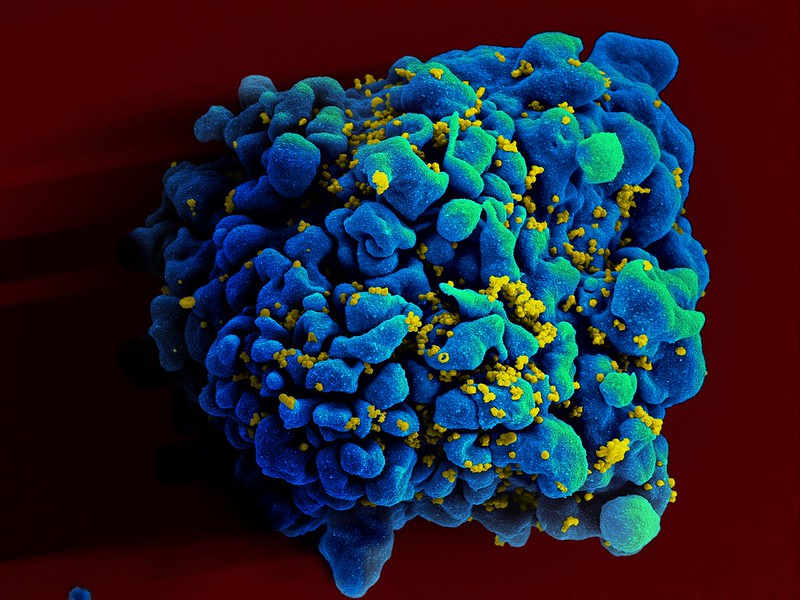
Colourised scanning electron micrograph of HIV (yellow) infecting a human T9 cell (blue). Credit: NIH
A new study from UC San Francisco shows it may be possible to control HIV without long-term antiviral treatment – an advance that points the way toward a possible cure for a disease that affects 40 million people around the world.
Treatment with a combination of experimental immunotherapy agents enabled 7 out of 10 participants to keep the virus at low levels for many months after going off antiretroviral therapy (ART).
The results appear on Dec. 1, World AIDS Day, in Nature.
The trial, which relied on a collaboration with nearly a dozen pharmaceutical companies and other partners in HIV research, offers a proof of concept that the approach could work. Although the study was small and did not include a control arm, investigators said the results are extremely encouraging.
“The majority had some evidence of control, which we believe is unprecedented,” said the paper’s co-senior author, Steven Deeks, MD, a professor of Medicine at UCSF who is in the Division of HIV, Infectious Diseases, and Global Medicine at Zuckerberg San Francisco General Hospital. “I do believe we are finally making real progress towards developing a therapy that may allow people to live a healthy life without the need of life-long medications.”
The trial was made possible by the Foundation for AIDS Research (amfAR)’s $20 million, five-year partnership with UCSF to advance AIDS cure research, launched in 2015. It was also supported by the National Institutes of Health (NIH).
Reprogramming the body’s immune system
Antiretroviral therapy (ART) was introduced in the 1990s and turned HIV infection from a death sentence into a chronic disease. But it is not a cure, and the virus stays in the body ready to reawaken as soon as someone stops taking ART.
The study was designed to test whether a triple combination of immunotherapies could reprogram the body’s immune system to control the virus after going off ART. Most of the participants had started ART soon after they acquired HIV, which helped preserve their immune response.
First, participants received a therapeutic vaccine to encourage their T cells to go after the latent HIV in their bodies. Then, they received an antibody cocktail to reduce the amount of HIV in the body. Finally, they were given another round of anti-HIV antibodies before being taken off ART.
Typically, when a person with HIV stops HIV medicines, the virus starts to rebound in about two weeks and then skyrockets. This time, only three of the 10 patients experienced the typical rapid rebound. Six maintained low levels of the virus for months, and one did not rebound at all.
The pouncing cat analogy
The investigators then examined the immune responses of those who controlled the virus to see how they did it.
“It turns out the controllers had T cells that were able to expand dramatically once they ran into the virus,” said Rachel Rutishauser, MD, PhD, an associate professor in UCSF’s Division of Experimental Medicine and co-senior author of the paper. “It’s like they were hanging out waiting for their target, kind of like a cat getting ready to pounce on a mouse.”
The treatment would need to be simplified and proved effective in much larger studies before it could replace standard HIV treatment.
“This is not the end game,” said Michael Peluso, MD, an assistant professor in UCSF’s Department of Medicine and the study’s first author. “But it proves we can push progress on a challenge we often frame as unsolvable.”
A study led by McMaster University researchers shows that a widely available and inexpensive medication not only prevents potentially serious stomach bleeding in critically ill patients, but also saves hospitals thousands of dollars.
Published in JAMA Network Open on Dec. 1, 2025, the study is the first to demonstrate the economic benefits of the medication, pantoprazole, when prescribed in hospital for mechanically ventilated patients in the intensive care unit (ICU). These patients on life support are at high risk of upper gastrointestinal bleeding, a complication caused by stress-induced ulcers in the stomach that can prolong hospital stays and increase costs.
“In an era of rising health-care costs, interventions that are both clinically effective and cost-saving are rare. Pantoprazole checks both boxes,” said Feng Xie, lead author of the study and a professor in the Department of Health Research Methods, Evidence and Impact at McMaster.
The findings build on the landmark Re-evaluating the Inhibition of Stress Erosions (REVISE) Trial led by McMaster, which established pantoprazole’s clinical effectiveness in preventing bleeding. The trial was run in 68 centres in eight countries and over 4800 patients were enrolled.
Until now, the economic impact of prescribing pantoprazole each day for patients on breathing machines had been unclear. The researchers conducted a cost-effectiveness analysis using international data from the REVISE trial, comparing outcomes and resource use between patients who received pantoprazole daily and those who did not. The results have significant implications for critical care practitioners, pharmacy departments, and policymakers.
“Pantoprazole costs between 50 cents and two dollars per dose across the country, yet our analysis showed how prescribing it to invasively ventilated patients can save healthcare resources by reducing bleeding events and reducing length of stay in the intensive care unit and hospital,” said senior author Deborah Cook, a professor in the Department of Medicine at McMaster.
“In the expensive, high-technology ICU setting, this is a simple, low-cost intervention that improves outcomes and reduces health-care costs,” adds Cook, a critical care physician practising at St. Joseph’s Healthcare Hamilton.
By Lushan Sundram, Senior Sales & Business Development Manager at Essential Employee Benefits
Despite making significant investments in employee benefits, many organisations continue to struggle with low employee engagement, growing healthcare expenses, and diminishing productivity. A lack of insight, not a lack of investment, seems to be the problem.
Even the most extensive medical coverage may fall short if the true health needs of the workforce are not thoroughly understood. Employers must first understand the individuals they are attempting to assist in order to make health benefits genuinely meaningful.
The business case for healthier workforces
It is now indisputable that employee well-being and company performance are related. Investing in the physical, mental, and social well-being of employees yields quantifiable benefits, according to numerous studies. According to research, a single unit improvement in staff health can result in an 80% boost in productivity, and well-run wellness programmes can yield a Return on Investment (ROI) of up to 6:1. Healthy workers are more engaged, more productive, and less likely to quit, demonstrating that promoting health, benefits businesses as well as individuals.
Moving from guesswork to insight
Understanding that health encompasses more than just physical well-being is the first step in creating pertinent and efficient medical coverage. Four important aspects are taken into account in a holistic approach: social, financial, mental and emotional, and physical welfare. The difficulty, though, is in understanding worker health without violating personal privacy. Data-driven platforms that provide aggregated insights while maintaining privacy hold the key to the solution. Digital nurse checks, for example, can evaluate vital signs including Body Mass Index (BMI) , blood pressure, body composition and more. Analysis of this anonymised data can then reveal patterns across age groups, genders, and departments. Employers can use these data to identify areas where their employees most need help, such as managing stress, preventing chronic diseases, or improving nutrition, all while maintaining complete compliance with privacy laws. Essentially, it gives leaders the insight they need to allocate resources strategically.
From one-size-fits-all to tailored support
Once health insights are gathered, employers can move beyond generic benefit structures. Tailored medical cover ensures that plans address the most pressing needs of specific employee groups. For example, one division might prioritise diabetes prevention, while another invests in weight management or mental health programmes.
Barriers to access are also addressed by meaningful medical cover. Employees may be deterred from obtaining private medical care by expensive premiums or difficult claims procedures. Instead, offering basic yet comprehensive cover promotes prompt treatment and keeps small problems from becoming more serious and expensive. Rather than concentrating only on reactive treatment, integrating preventative care contributes to the development of a sustainable culture of wellbeing.
Building loyalty through wellbeing
A targeted, data-driven benefits strategy does more than optimise healthcare spending, it strengthens trust and retention. Employee loyalty and engagement increase when they see that their employer truly cares about their well-being. Businesses with wellness programmes that are very successful report voluntary attrition rates of only 9%, whereas those with programmes that are less successful report rates of 15%.
This exemplifies the principles of Social Exchange Theory: when employees perceive that the organisation values them and supports their health, they reciprocate with loyalty and effort. In this way, wellbeing becomes a performance strategy, not merely a perk.
Partnering for precision and impact
To move from assumption to precision, many organisations are partnering with experts who use innovative, privacy-preserving tools to provide data-backed insights into workforce health. These insights enable executives to create inclusive and appropriate benefits that yield quantifiable increases in retention and productivity.
The capacity to act on data-driven health insights is a strategic imperative in a setting where healthcare expenditures and talent competitiveness are both on the rise. The healthiest, most resilient, and most dedicated workforces of tomorrow will be created by employers who make the investment to understand their employees today.
Mycobacterium tuberculosis drug susceptibility test. Photo by CDC on Unsplash
By Elri Voigt
From studies of new medicines and a mask used to diagnose TB, there was no shortage of interesting findings presented at the recent Union World Conference on Lung Health, held in Copenhagen, Denmark. Spotlight rounds up six studies that stood out.
1. People do better if we dispense all TB prevention pills at once
One of the most important questions in TB is how to best prevent people from getting ill if they’ve been exposed to the bug. While effective treatments to prevent TB disease in people who have been exposed exist, uptake has generally been poor.
Now, researchers have found that, dispensing all the pills in a three-month course of TB preventive Therapy (TPT) at once, instead of asking people to collect pills at the clinic every few weeks, led to many more people completing the treatment course.
The study, called ThiPhiSA, was conducted in four clinics and communities in KwaZulu-Natal. 268 households who qualified to receive TPT were enrolled in the trial. 301 participants from these households were randomised to one of two arms, explained Dr Adrienne Shapiro, Assistant Professor of Global Health and Infectious Diseases at the University of Washington.
In the first arm, 159 people were given a two-week supply of the standard of care 3HP (consisting of the drugs isoniazid and rifapentine, taken once a week for 3 months). They then had to go to clinic to receive their refills as per the clinic schedule. They received weekly sms reminders to take their pills and were visited by researchers at month one and two and at the end of the study.
In the second arm, 142 people were given all the pills for the full three-month course of 3HP at once. While no clinic visits were required, they were remotely registered at their clinics just in case they had to visit the clinic. This group also got weekly sms reminders to take their pills and were visited at month one and two and at the end of the study.
Whether people had taken their pills was assessed through self-reporting, as well as a calendar dosing diary, pill count and assessment of urine colour change if the visit was on a day when the participant had recently taken a dose of 3HP.
For those who had to go to the clinic at regular intervals to collect their pills, only 28% completed their treatment course. By contrast, 86% of those who had the full course dispensed at once completed their treatment.
Much of the difference was due to the fact that some people in the prior group simply did not go to the clinic every time to collect pills. There was also a drug stockout at one of the clinics – which somewhat skewed the results in favour of the latter group, but not enough so to change the fact that people were more likely to complete treatment if they got all the pills at once.
Dispensing a full course of TPT at once was safe, according to Shapiro, with no serious adverse events seen in the study.
“Multi-month delivery of TPT is safe, and person-friendly approaches improving the convenience of TPT should be adopted to decompress health facilities and improve TPT coverage to meet TB prevention goals,” she concluded.
2. A new medicine might help shorten TB treatment
Much TB research in recent years have focussed on reducing the duration of TB treatment – it typically takes six months. In addition, researchers have also been looking for medicines that have fewer side effects. Growing resistance to some existing TB drugs is also a concern.
One of the big talking points at this year’s conference was data on an experimental new drug called sorfequiline. It is thought that sorfequiline could be a replacement for bedaquiline, arguably the most important TB drug developed in recent decades. This is because sorfequiline appears to be more potent than bedaquiline and because of worries over TB strains that are resistant to bedaquiline.
The new data is from a phase 2 trial of sorfequiline used in combination with two other TB drugs – pretomanid and linezolid – to treat drug susceptible TB. The regimen is called SpaL for short. 309 participants with newly diagnosed TB were either given the standard of care first-line drugs isoniazid, rifampicin, pyrazinamide, and ethambutol (HRZE) for 26 weeks, the BPaL regimen consisting of the drugs bedaquiline, pretomanid and linezolid for 26 weeks (not all drugs in these first two arms are taken for the entire period), or one of three different doses – 25mg, 50mg or 100mg – of sorfequiline along with linezolid and pretomanid for 8 weeks.
Once those in the sorfequiline arms completed the initial 8-week course, they had to take the drugs isoniazid and rifampicin (HR) for another 7 weeks and were then tested for TB again. Meaning at this point they had gotten treatment for 15 weeks (or around 3 and a half months). If they tested negative and had no TB symptoms, they could stop treatment. But if they tested positive for TB and had symptoms then they’d have to continue taking isoniazid and rifampicin.
Among the participants who got sorfequiline, 64% in the 100mg arm were able to stop treatment after 15 weeks, compared to 46% in the 50mg arm, and 28% in the 25mg arm.
Study participants gave regular sputum samples that were tested for the presence of TB bacteria. The researchers then estimated the probability of a “stable sputum culture conversion at week 8”. In simple terms, this means the researchers wanted to find out what the probability is that all the TB bacteria had been killed by the different regimens after 8 weeks of treatment.
For the 25mg arm, there was 31% stable culture conversion, in the 50mg arm 48%, and in the 100mg arm 59%. For both HRZE and BPaL it was 45%. In other words, 100mg of sorfequiline plus pretomanid and linezolid showed better stable sputum culture conversion after eight weeks than HRZE, the regimen currently used to treat drug-susceptible TB in South Africa and most other countries.
“[W]e believe that SPaL is a promising four-month regimen,” said Dr Morounfolu Olugbosi, the medical lead for the study, which is being conducted by the non-profit TB Alliance.
The regimen was well tolerated at all dose levels, according to Olugbosi, with no difference in safety signals in the sorfequiline arm compared to the other treatment arms. “So that lack of observable difference is what we consider positive news,” he said.
While this trial looked at people with drug susceptible TB, the research team will be investigating how well it works for drug resistant TB in an upcoming phase 3 study, said Dr Maria Beumont, the Chief Medical Officer at TB Alliance, during a press conference.
Indeed, while these phase 2 results are promising, the real test for this drug will be in the larger phase 3 study to come.
3. Co-morbidities are really important when people have TB
A prospective cohort study in South Africa looked at the burden of co-morbidities and the impact it has on TB mortality. The researchers followed around 2 000 adults with pulmonary TB, diagnosed with Gene Xpert (a molecular TB test), and looked at mortality rates for 1 896 of those people after 15 months. Of those, 272 people (14.3%) had passed away during the study duration.
According to the study presenter, Dr Greta Wood, a Clinical Research Fellow in Infectious Diseases at the University of Liverpool, the prevalence of TB multimorbidity among the whole study group was 86%. Meaning most had TB as well as another illness or risk factor.
The researchers looked at five key co-morbidities identified by the World Health Organization (WHO) – HIV, smoking, undernutrition, diabetes and alcohol use. “These five key comorbidities alone explained over half of the mortality that we saw in this cohort,” Wood said.
The researchers found that the more co-morbidities a person had, the higher their risk of dying was when they got ill with TB. The risk of dying for someone with TB was 19% if they had three or more co-morbidities compared to 16% if they had two, and 11% if they had no co-morbidities.
The key conditions driving mortality in this group of people with TB is HIV and undernutrition. Undernutrition in particular was flagged in the study, as in this setting it was responsible for around one in five TB deaths in people under the age of 40, according to Wood.
“[I]n this cohort, we didn’t find an association between diabetes, smoking, alcohol and mortality, but that has been demonstrated in other settings,” she added.
This data should lead to urgent action, concluded Wood, saying that “to reduce the risk of death, we need to urgently start operationalising screening for these key five TB comorbidities and linking people into treatment”.
4. Point-of-care testing leads to people starting treatment faster
As shown in several studies at this year’s conference, the details of how TB services are delivered can make a significant difference to TB outcomes.
One such study, led by researchers from the University of Cape Town (UCT), explored whether it made a difference if someone had a TB test done at a mobile van, or had their sputum sample collected and sent off to a lab. In other words, the study was indirectly testing whether it makes a difference if someone gets a test result right after testing, versus having to wait a day or two to be contacted with a result.
The study, of over 7 000 people, was conducted in South Africa, Zambia, Zimbabwe, and Mozambique. Around half of those screened in the study were at high risk for TB and randomised to either receive point of care testing on a GeneXpert machine in a mobile van or centralised GeneXpert testing at a laboratory.
In the point of care arm, results were available for 1 641 people, and of those 55 (3.3%) had microbiologically confirmed TB. While 67 (4.1%) of the 1 632 tested in the centralised testing arm had microbiologically confirmed TB. Overall, across both arms, 93 of the people diagnosed with TB (76%) were successfully linked to care.
“When compared to those who had their Xpert performed at a central laboratory, those who had their Xpert done at point of care had a 43% lower probability of treatment initiation failure and initiated treatment twice as fast,” said Tahlia Perumal, a researcher at UCT, who presented the results. Participants in the point of care arm on average started treatment four days sooner than those whose TB tests were done in a centralised laboratory.
“[T]here is an argument to be made about the clinical significance of a four-day reduction. We are in the process of doing transmission modelling to be able to provide more granular details about the difference this may make in active case finding models in larger population sizes,” she said.
5. Promising signs for a portable TB test
In the above study, point-of-care testing was done in a relatively large machine in a mobile van. We may however be able to go much smaller.
Tessa Mochizuki, a Research Scientist at University of California in San Francisco, presented results from a multi-country study evaluating how accurate a portable, battery-operated testing device, called MiniDock MTB, was at diagnosing TB from sputum swabs and tongue swabs.
“The test is run on a small device about the size of my hand, and results are available in under 30 minutes, often even faster for positive results,” Mochizuki said.
1 380 people, aged 12 years and older with presumptive TB were enrolled across seven countries – South Africa, India, Nigeria, the Philippines, Uganda, Vietnam, and Zambia. Sputum samples from all participants were tested using two MIDGIT cultures (a test in which the bug will grow if present), smear microscopy (where the bug is looked for under a microscope), and GeneXpert Ultra (a molecular test).
Results from these tests were then compared with results from the MiniDock MTB machine.
For the tongue swab test, a healthcare worker runs a swab over the participants tongue for 30 seconds, then it is put into a buffer liquid, mounted on a testcard which is run through the portable machine. For the sputum swab, a swab is dipped into a test tube that contains sputum for about 15 seconds, put into a buffer liquid and mounted onto a testcard and run through the portable machine.
When comparing sputum swabs results to the Xpert Ultra results there was not a statistically significant difference, according to Mochizuki, as sputum swabs showed 87% sensitivity compared to GeneXpert Ultra’s 89%. Sensitivity is a measure of how likely the test is to detect a bug if the bug is present in the sample.
Tongue swabs performed a bit worse with 81% sensitivity. This was however much better than the 62% with microscopy. Microscopy is rarely used for TB diagnosis in South Africa, but this finding could be important in other countries where health systems haven’t switched as fully over to molecular testing as we’ve done here.
All sample types and tests achieved 98% specificity. Specificity is an indication of how likely a test is to give a negative result if the bug being tested for is not present in the sample.
These findings meet the WHO target product profile requirements – a minimum of 85% sensitivity and 98% specificity for sputum tests and a minimum of 75% sensitivity and 98% specificity for non-sputum tests.
“We submitted this data to the WHO guideline development group that convened last week, and we look forward to news on any official recommendations in the coming year,” Mochizuki said. “These results show that we can achieve high accuracy with a low-complexity platform, bringing molecular testing closer to people seeking care without sacrificing performance.”
6. A mask that can help diagnose TB
An even more interesting idea that some researchers have been working on is to use a diagnostic mask to diagnose TB.
At this year’s conference, Dr Rouxjeane Venter, a researcher based at the Clinical Mycobacteriology and Epidemiology (CLIME) research group at Stellenbosch University, presented a proof-of-concept study testing whether a mask, called the Avelo Mask, can be used to diagnose whether TB bacteria is present in the air a person breathes out.
58 adults, across four clinics in Cape Town, who had TB symptoms and tested positive for TB on a molecular test were given the mask to wear for 45 minutes. The filter in the mask is able to trap tiny particles from .3 micrometers and above – meaning it can trap viruses and bacteria. This filter is then pushed into a buffer tube using a sample stick – where it can be stored or tested directly. The mask as well as the stick and buffer tube are part of the Avelo mask kit developed by Avelo Diagnostics. For this study, the researchers used a qPCR test – a rapid test that looks for TB DNA – to detect TB bacteria.
When the mask filters were tested, 34 people were found to be negative for TB bacteria and 24 were positive. When compared to their Xpert Ultra sputum results, it was found that there were two false positives.
Overall, according to Venter, the mask had a sensitivity of 71% when compared to GeneXpert Ultra and 65% when compared to the Microbiological Reference Standard and a specificity of about 92%.
People with higher bacillary loads – meaning lots of bacteria – in their sputum were more likely to be positive, but there was still a large percentage of participants with low or very low bacillary loads that were picked up by the mask.
These numbers aren’t nearly as good as those for the MiniDock MTB, but it is positive that masks like these are showing promise. A long-standing problem in TB diagnosis is that not everyone can produce sputum samples. The more alternatives we have, be it tongue swabs or masks, the better.