

Tag: medical education

Surgical Simulations Confer Better Skills and Reduce Complications
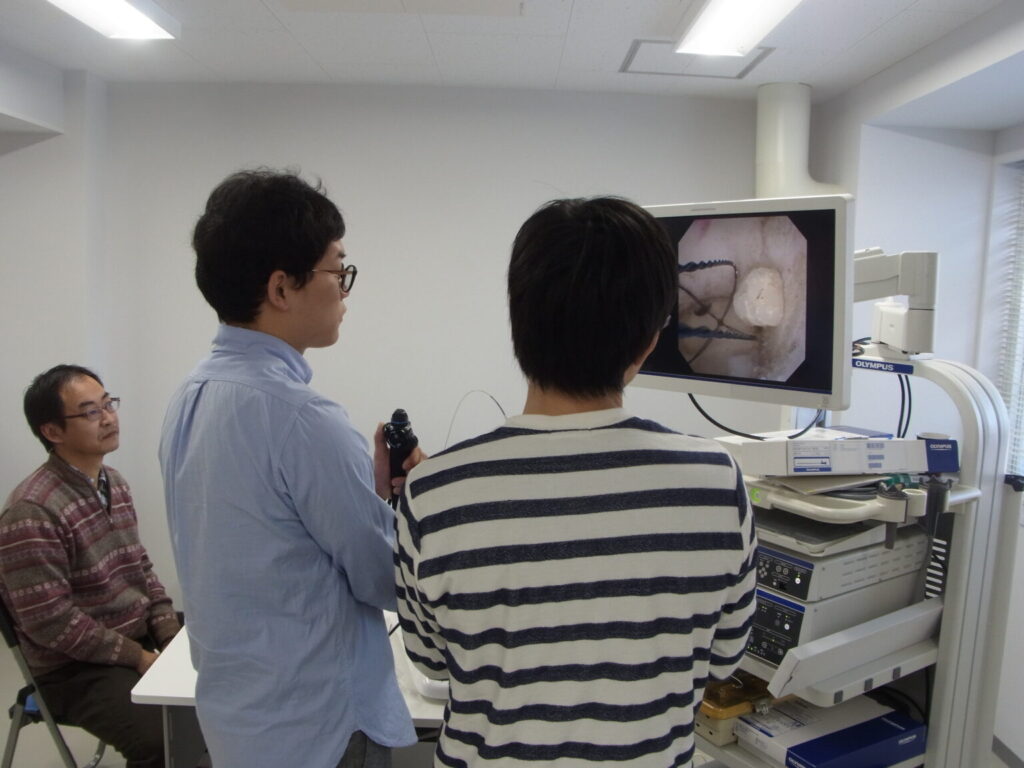
A surgical simulation unit used in the study. Credit: Takashige Abe.

An international trial found that while simulation-based training for ureteroscopy did not speed up surgeons general proficiency acquisition, it did increase skills in more complex surgeries, with fewer total complications and ureteric injuries. The results were published in the journal European Urology.

“To date, there have been limited data, mostly from small-scale studies conducted with medical students, assessing the transferability of surgical simulation,” said paper authors Takashige Abe, Associate Professor of Urology at Hokkaido University. The aim, he said, was to evaluate whether surgical residents undergoing additional simulation training can achieve proficiency sooner and with better patient outcomes, compared to usual operation room-based training.

The trial followed 65 participants in 10 countries for 18 months, or up to 25 procedures. A total of 32 participants received simulation-based training while 33 received conventional apprenticeship-style training. Both remained supervised by more experienced surgeons. Participants performed a total of 1140 surgeries, either semi-rigid or flexible ureteroscopy to remove ureteral or renal stones, respectively, demonstrating “mixed results” in proficiency.

“For our primary outcome measure, while we showed what might be deemed a clinically meaningful difference, it was not statistically significant,” Prof Abe said. “However, when stratified to each procedure type, there were higher rates of proficiency in the simulation-based training group when it came to the more technically challenging flexible ureteroscopy procedure.”

Prof Abe also noted that the simulation group scored higher on a standard assessment for each surgerythe other group.

“Simulation-based training led to higher overall proficiency scores than for conventional training, and fewer procedures were required to achieve proficiency in the complex form of the index procedure, with fewer serious complications overall,” Prof Abe said. “It is expected that the results of the trial will have a positive impact for advanced procedural training beyond the fields of surgery and urology in order to promote patients’ safety as well as better surgical outcomes.”

Source: University of Hokkaido
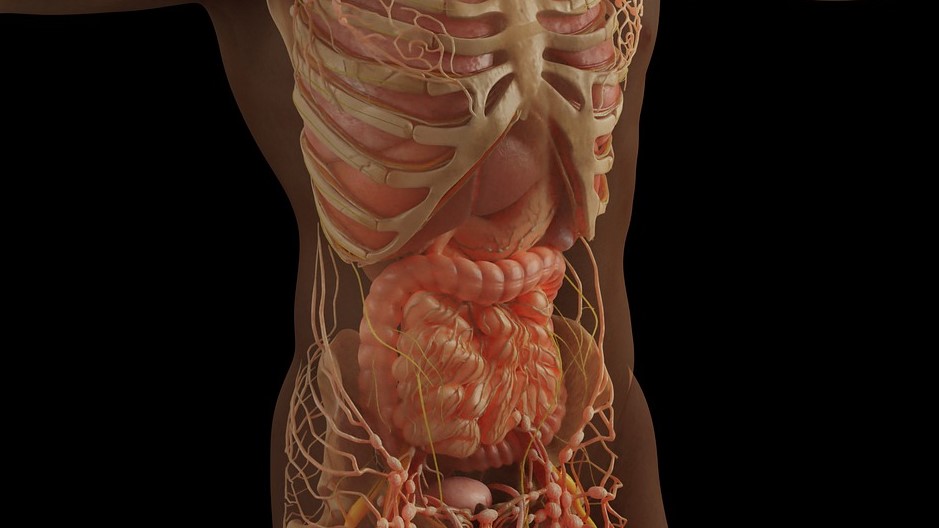
A New Understanding of the Fundamental Order of the Abdomen

Source: Pixabay

In a research paper published in Communications Biology, researchers from the University of Limerick have detailed the development and structure of the mesentery. In doing this, they uncovered a new order by which all contents of the abdomen are organised or arranged – or the “fundamental order of the abdomen”, where organs are in one of two compartments.

Professor Calvin Coffey, Foundation Chair of Surgery at UL’s School of Medicine in Ireland, whose major discovery led to the reclassification of the mesentery as a new organ in 2016, has published new research on the makeup and structure of the abdomen.

The importance of these findings on the mesentery and the impact these have on our understanding of the abdomen have been further explained in a review article just published in the Lancet Gastroenterology and Hepatology.

Prof Coffey explained that his team have been looking at the development and structure of the mesentery since 2016.

“We showed how the mesentery is a single and continuous organ in and on which all abdominal digestive organs develop and then remain connected to throughout life,” he explained.

“These findings revealed a simplicity in the abdomen that was not apparent in conventional descriptions of anatomy.”

The international team of researchers used cutting edge techniques to clarify how the mesentery develops and the shape it has in adults.

Their work revealed that the organisation of the abdomen has a remarkably simple design.

“The abdomen is not the dauntingly complex collection of separate organs it was previously thought to be,” said Prof Coffey.

“Instead, all digestive organs are neatly packaged and arranged by the mesentery into a single digestive engine. That simplicity lay hidden until clarification of the nature of the mesentery.”

The model itself was described by the team in the most recent edition of Gray’s Anatomy. The supportive evidence was published in Communications Biology and the clinical importance was explained in the review in The Lancet Gastroenterology and Hepatology.

“The most important finding here was the discovery of the fundamental order of the abdomen. At the foundation level, all contents of the abdomen are simply organised into one of two compartments,” explained Prof Coffey.

“The fundamental order of any structure is of considerable importance, in particular when it comes to diagnosing patients with illness and treating their disease. The fundamental order is the foundation from which all science launches and clinical practice is based.

“The organisational simplicity of the abdomen now immediately explains the behaviours of viral and bacterial infections, cancer, inflammatory bowel disease, obesity, diabetes and many others,” he added.

Improvements in surgery have been made to surgery by a better understanding of the mesentery and its functions, and the new research builds on those advances. There are also exciting areas for future investigation, according to Prof Coffey.

“Patients are already benefiting from what we now call mesenteric-based approaches to the diagnosis and treatment of most abdominal conditions. The Mesenteric Model of Abdominal Anatomy – or the description of the order of the abdomen – is being incorporated into numerous reference curricula at this moment,” he said.

“Regarding the future, it is being argued that we are seeing a paradigmatic shift from old to new order. Already, intriguing questions are emerging that we can call ‘legitimate or admissible’ in the strictest scientific sense. Science can approach numerous questions in a new light.  Clinicians can design diagnostic and treatment approaches based on a new foundation,” Prof Coffey concluded.

Source: EurekAlert!