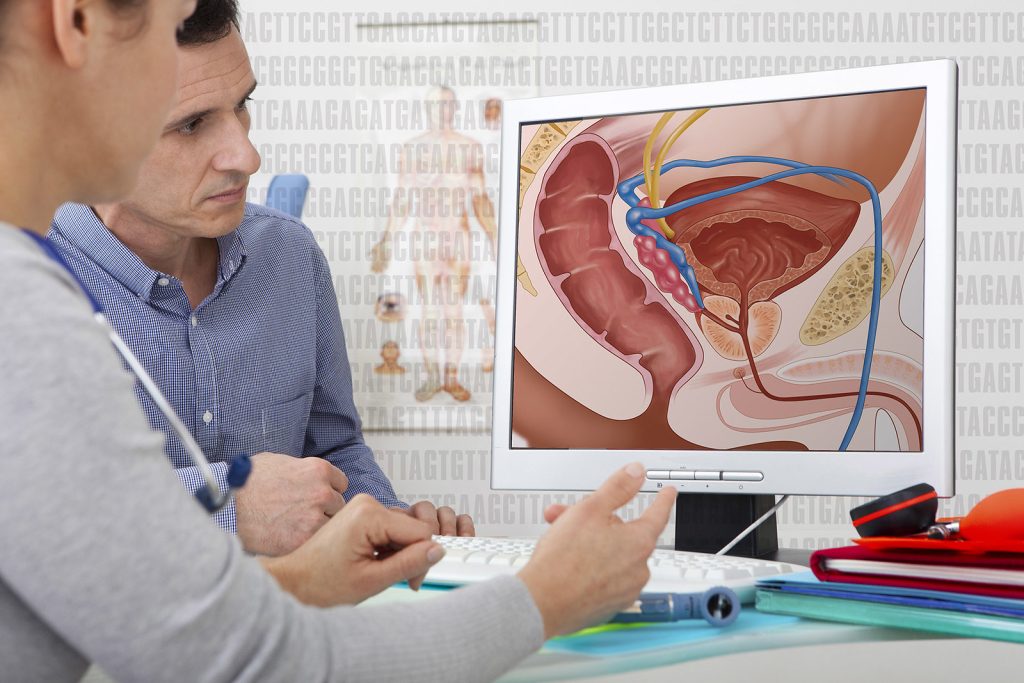
Credit: Darryl Leja National Human Genome Research Institute National Institutes Of Health
Because treatment of the whole prostate can lead to long-term side effects in patients with prostate cancer, interest in minimally invasive, focal treatment options has been growing for certain patients. A clinical trial published in BJU International generated promising results for a type of focal therapy, which directly targets the cancer and spares the remainder of the unaffected prostate gland.
The ProFocal Laser Therapy for Prostate Tissue Ablation (PFLT-PC) trial is the first pivotal trial of ProFocal®, a novel, cooled laser focal therapy device for prostate cancer treatment.
In the 100-participant trial, 84% of patients had no clinically significant prostate cancer on their 3-month post-treatment biopsy. The treatment provided similar cancer-related outcomes to those that have been reported for other focal therapy devices, but with an improved safety profile and low rates of incontinence.
“This new technology is very promising with excellent cancer control while preserving patients’ quality of life,” said corresponding author Jonathan Kam, MD, of Nepean Hospital, in Australia. “Traditional radical prostatectomy and radiotherapy for prostate cancer results in very high rates of incontinence and erectile dysfunction. With this new technology, patients can have their prostate cancer treated with very low risk of suffering the side effects associated with traditional prostate cancer treatments.”
Researchers from the University of Birmingham have designed and developed a novel diagnostic device to detect traumatic brain injury (TBI) by shining a safe laser into the eye.
The technique is radically different from other diagnostic methods and is expected to be developed into a hand-held device for use in the critical ‘golden hour’ after traumatic brain injury, when life critical decisions on treatment must be made.
The device, described in Science Advances, incorporates a class 1, CE marked, eye-safe laser and a unique Raman spectroscopy system, which uses light to reveal the biochemical and structural properties of molecules by detecting how they scatter light, to detect the presence and levels of known biomarkers for brain injury.
There is an urgent need for new technologies to improve the timeliness of TBI diagnosis. TBI is caused by sudden shock or impact to the head, which can cause mild to severe injury to the brain, and rapid intervention is necessary to prevent further irreversible damage.
Diagnosis at the point of injury is difficult. Moreover, radiological investigations such as X-ray or MRI are very expensive and slow to show results.
Birmingham researchers, led by Professor Pola Goldberg Oppenheimer from the School of Chemical Engineering, designed and developed the novel diagnostic hand-held device to assess patients as soon as injury occurs.
It is fast, precise and non-invasive for the patient, causing no additional discomfort, can provide information on the severity of the trauma, and will be suitable to be used on-site to assess TBI.
Professor Pola Goldberg Oppenheimer said: “Early diagnosis of TBI is crucial, as life-critical decisions on treatment must be made with the first ‘golden hour’ after injury. However current diagnostic procedure relies on observation by ambulance crews, and MRI or CT scans at a hospital – which may be some distance away.”
The device works by scanning the retina where the optic nerve sits. Since the optic nerve is so closely linked to the brain, it carries the same biological information in the form of protein and lipid biomarkers.
These biomarkers exist in a very tightly regulated balance, meaning even the slightest change may have serious effects on the ‘brain-health’. TBI causes these biomarkers to change, indicating that something is wrong.
Previous research has demonstrated the technology can accurately detect the changes in animal brain and eye tissues with different levels of brain injuries — picking up the slightest changes.1,2,3
The device detailed in the current paper detects and analyses the composition and balance of these biomarkers to create ‘molecular fingerprints’.
The current study details the development, manufacture, and optimisation of a proof-of-concept prototype, and its use in reading biochemical fingerprints of brain injury on the optic nerve, to see whether it is a viable and effective approach for initial ‘on the scene’ diagnosis of TBI.
The researchers constructed a phantom eye to test its alignment and ability to focus on the back of the eye, used animal tissue to test whether it could discern between TBI and non-TBI states, and also developed decision support tools for the device, using AI, to rapidly classify TBIs.
The device is now ready for further evaluation including clinical feasibility and efficacy studies, and patient acceptability.
The researchers expect the diagnostic device to be developed into a portable technology which is suitable for use in point-of-care conditions capable to rapidly determine whether TBI occurs as well as classify whether it is mild, moderate or severe, and therefore, direct triage appropriately and in timely manner.