

Tag: amyloid plaques

Long Stays in Space can Cause Brain Injury

Source: Wikimedia Commons

A study of five Russian cosmonauts who had stayed on the International Space Station (ISS) reveals that extended time in space causes signs of brain injury. The study is published in the scientific journal JAMA Neurology

Scientists followed five male Russian cosmonauts working on the permanently manned International Space Station (ISS), in an orbit 400km above the surface of the Earth.

Early on in spaceflight history, extended time in zero gravity was found to result in muscle atrophy and bone loss. More recently, changes in vision were discovered during long flights, a potentially serious hazard. The vision changes were ascribed to increased cerebral pressure caused by the lack of gravity no longer pulling fluid into the lower extremities. On Earth this is similar to lying with a head-down tilt, causing fluids to pool in the upper body and head.

Blood samples were taken from the cosmonauts, whose mean age was 49, 20 days before their departure to the ISS, where they had an average stay of 169 days.

After landing on Earth, follow-up blood samples were taken one day, one week, and about three weeks after landing. Concentrations of three of the biomarkers analysed – NFL, GFAP and the amyloid beta protein Aβ40 – were increased after their stay in space. The peak readings did not occur simultaneously after the men’s return to Earth, but their biomarker trends nonetheless broadly tallied over time.

“This is the first time that concrete proof of brain-cell damage has been documented in blood tests following space flights. This must be explored further and prevented if space travel is to become more common in the future,” said Henrik Zetterberg, professor of neuroscience and one of the study’s two senior coauthors.

”To get there, we must help one another to find out why the damage arises. Is it being weightless, changes in brain fluid, or stressors associated with launch and landing, or is it caused by something else? Here, loads of exciting experimental studies on humans can be done on Earth,” he continued.

Changes also seen in magnetic resonance imaging (MRI) of the brain after space travel add evidence to the notion of spaceflight causing brain injurt. Clinical tests of the men’s brain function that show deviations linked to their assignments in space further support this, but the present study was too small to investigate these associations in detail.

Prof Zetterberg and his coauthors are currently discussing follow-up studies.

“If we can sort out what causes the damage, the biomarkers we’ve developed may help us find out how best to remedy the problem,” Prof Zetterberg said.

Source: University of Gothenburg
Brain Cholesterol Production Linked to Alzehimer’s

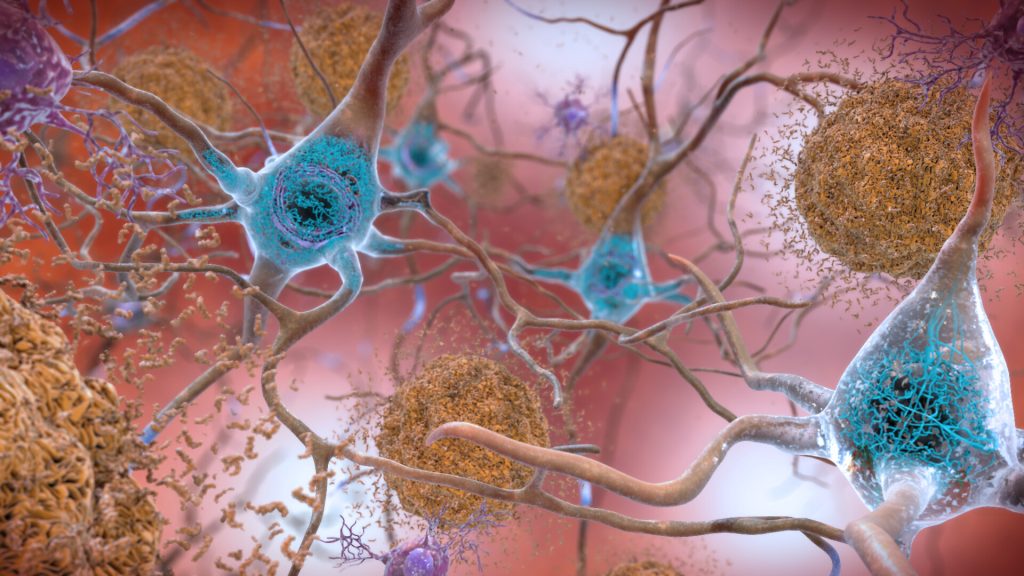
Amyloid plaques and neurons. Source: NIAH

Cholesterol manufactured in the brain appears to play a key role in the development of Alzheimer’s disease, new research indicates.

Scientists found that cholesterol produced by cells called astrocytes is required for controlling the production of amyloid beta, a sticky protein which forms the characteristic plaques in patients with Alzheimer’s. These plaques have been the target of efforts to remove or prevent them  in the hopes that this could treat or prevent Alzheimer’s.

The new findings offer important insights into how and why the plaques form and may explain why genes associated with cholesterol have been linked to increased risk for Alzheimer’s. The results also provide scientists with important direction as they seek to prevent Alzheimer’s.

“This study helps us to understand why genes linked to cholesterol are so important to the development of Alzheimer’s disease,” Heather Ferris, MD, PhD, Researcher, UVA’s Division of Endocrinology and Metabolism. “Our data point to the importance of focusing on the production of cholesterol in astrocytes and the transport to neurons as a way to reduce amyloid beta and prevent plaques from ever being formed.”

The work sheds light on the role of astrocytes in Alzheimer’s disease. Scientists have known that these common brain cells undergo dramatic changes in Alzheimer’s, but they have been uncertain if the cells were suffering from the disease or contributing to it. The new results suggest the latter.

The scientists found that astrocytes help drive the progression of Alzheimer’s by making and distributing cholesterol to brain cells called neurons. This cholesterol buildup increases amyloid beta production and, in turn, fuels plaque accumulation.

Normally, the buildup of amyloid beta is limited because cholesterol is kept quite low in neurons. But in Alzheimer’s, the neurons are no longer able to regulate amyloid beta, leading to plaque formation.
Blocking the astrocytes’ cholesterol manufacturing “robustly” decreased amyloid beta production in lab mice, the researchers reported. While it is presently unknown whether this could be applied in people to prevent plaque formation, the researchers believe that further research is likely to yield important insights that will benefit the battle against Alzheimer’s.

The fact that amyloid beta production is normally tightly controlled suggests an important role in brain cells, the researchers said. Doctors may therefore need to be cautious about blockage or removal of amyloid beta. Additional research into the discovery could shed light on how to prevent the over-production of amyloid beta as a strategy against Alzheimer’s, the researchers believe.

“If we can find strategies to prevent astrocytes from over-producing cholesterol, we might make a real impact on the development of Alzheimer’s disease,” Dr Ferris said. “Once people start having memory problems from Alzheimer’s disease, countless neurons have already died. We hope that targeting cholesterol can prevent that death from ever occurring in the first place.”

Source: University of Virginia Health System