

Tag: 25/3/26

Severe Infections May Raise Dementia Risk, Study Finds

Finnish registry study finds that infections like cystitis and bacterial disease are linked to higher dementia risk independently of other coexisting conditions
Source: CC0

Severe infections increase the risk of dementia independently of other coexisting illnesses, according to a new study published March 24th in the open-access journal PLOS Medicine by Pyry Sipilä of the University of Helsinki, Finland, and colleagues.

Severe infections have been linked to an increased risk of dementia. However, it has been unclear whether this association is explained by other coexisting, non-infectious diseases that predispose people to both infections and dementia.

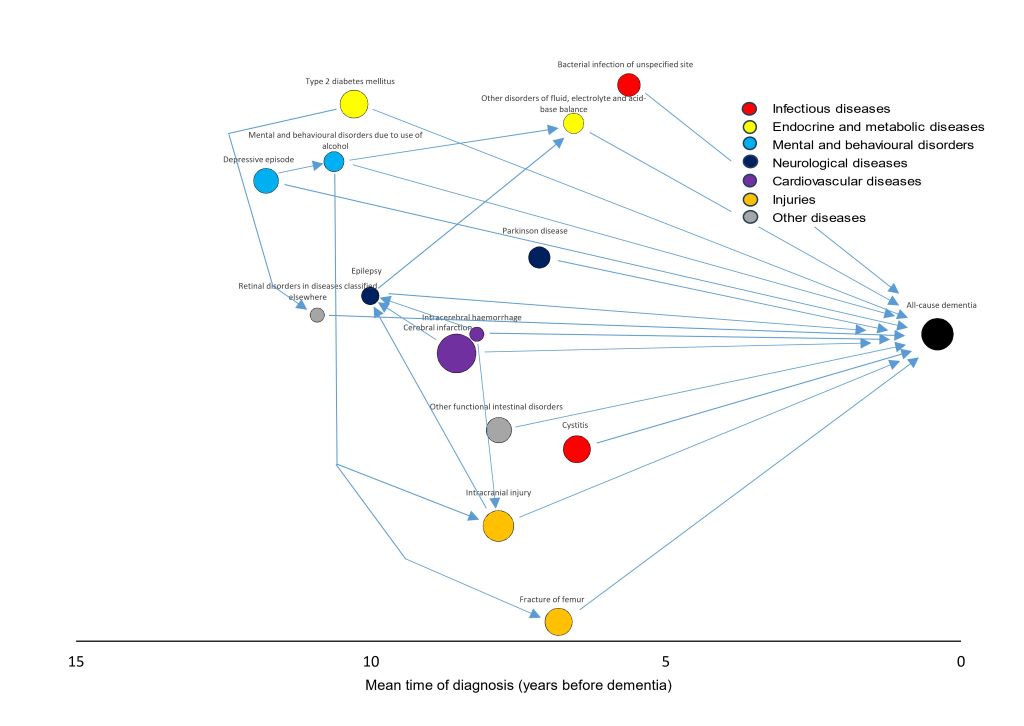
In the new study, researchers used nationwide Finnish health registry data covering more than 62 000 individuals aged 65 or older who were diagnosed with late-onset dementia between 2017 and 2020, along with more than 312 000 matched dementia-free controls. Taking a broad approach, they examined all hospital-treated diseases recorded during the previous twenty years, identifying 29 diseases that were robustly associated with increased dementia risk. Nearly half (47%) of dementia cases had at least one of the 29 identified diseases before their diagnosis.

Of those diseases, two were infections: cystitis (a urinary tract infection) and bacterial infection of an unspecified site. Among the non-infectious diseases, the strongest associations with dementia were seen for mental disorders due to brain damage or physical disease, Parkinson’s disease, and alcohol-related mental and behavioural disorders.

When the researchers then adjusted for all 27 non-infectious dementia-related diseases identified, the association between both infections and dementia remained largely intact. Less than one-seventh of the excess dementia risk among individuals with hospital-treated cystitis or bacterial infections was attributable to pre-existing conditions. The link between infections and dementia was even stronger for early-onset dementia (diagnosed before age 65), where five types of infection – including pneumonia and dental caries – were associated with elevated risk.

The study was limited by the lack of baseline cognitive assessments and clinical examination data before dementia diagnoses, as well as a lack of data on infection treatments.

“Overall, our findings support the possibility that severe infections increase dementia risk; however, intervention studies are required to establish whether preventing or effectively treating infections yields benefits for dementia prevention,” the authors say.

The authors add, “We found 27 diverse severe, hospital-treated diseases that were robustly associated with an increased risk of dementia. Two of these diseases were infections, namely urinary tract infections and unspecified bacterial infections.” 

“In our study, dementia-related infections occurred on average 5 to 6 years before dementia diagnosis. Given that the development of dementia often takes years or even decades, these findings suggest that severe infections might accelerate underlying cognitive decline. However, as these findings were observational, we cannot exclude the possibility that some unmeasured confounding factors might also have affected our findings. Thus, we cannot prove cause and effect.”

“Ideally, intervention trials should examine whether better infection prevention helps reduce dementia occurrence or delay the onset of this disease.”

Provided by PLOS

The Next Leap for AI Scribes Provides Eyes in the Clinic

Vision-enabled artificial intelligence (AI) medical scribes could increase the accuracy of patient notes and save valuable time for clinicians

The introduction of vision-enabled artificial intelligence (AI) to medical scribes – the recording devices used by doctors to document meetings with patients in real-time – could increase the accuracy of patient notes and save valuable time for clinicians.

Flinders University study, published in npj Digital Medicine, has found that AI medical scribes already reduce some administrative work that takes time away from patients, but these devices have the capacity to do more when fitted with visual recording apparatus.

Researchers from Flinders’ College of Medicine and Public Health found that a vision-enabled AI scribe, employing a combination of Google’s Gemini model and Ray-Ban Meta smart glasses, substantially improved the documentation accuracy of pharmacist-patient consultations and reduced omissions and errors in clinical notes.

“AI scribes are already helping clinicians by listening to consultations, but healthcare involves far more than spoken words,” says research author Bradley Menz, an academic pharmacist in Flinders’ College of Medicine and Public Health.

“A lot of clinically important information is visual. Important visual cues during consultations include patients’ medicine containers, prescriptions and devices, as well as their body language. When an AI system can use both what it hears and what sees in these consultations, it captures more of the details that matter for patient care.”

In the study, 10 clinical pharmacists recorded 110 ‘mock’ medication-history interviews, which contained more than 100 different medicine containers, including tablets, capsules, injections and creams.

Researchers wore Meta AI Ray-Ban glasses to record the interview before passing the video footage through to the AI scribe, which was developed using Google’s Gemini AI model.

An AI scribe that analysed both video and audio achieved 98% accuracy, compared with 81 per cent  when the same system processed only audio information.

A significant benefit was capturing medication strength and form, which are crucial details for safe dosing. The AI scribe with video input captured this information 97% of the time, while audio-only recordings fell to 28%.

“This is an augmented tool, not a replacement for clinical judgement,” says Mr Menz. “The clinician still needs to review and sign off the document.

“The AI scribe can contain a verification step, take screenshots of medication packages, and generate a full spoken transcript, giving the health professional a much stronger basis for checking what the AI has produced.”

Senior author, Associate Professor Ashley Hopkins, says the study may point to the next stage of AI scribe usage in health care.

“AI scribes have gained traction because they reduce the burden of documentation and give clinicians more time with their patients. These findings suggest that the next step – when the scribe can see as well as hear – produces a more accurate and complete draft,” says Associate Professor Hopkins. “This means less time editing AI-documentation and even more time focusing on patient care.

“These findings suggest the next step may be that all scribe systems can interpret visual information as well as speech, which could open the door to wider clinical uses.”

The authors say the study has some limitation and underlines the need for human oversight and careful governance before these tools are adopted more broadly. The paper also highlights privacy, consent, data security and workflow integration as important issues that will need to be addressed as vision-enabled AI scribes move closer to practice.

Source: Flinders University

Promising Advances in Accurately Diagnosing Sepsis

Photo by Rodnae Productions on Pexels

Doctors in the UK have identified promising evidence for the effectiveness of an early and rapid diagnostic test for sepsis.

Sepsis is a serious complication arising from infection, which can swiftly progress to life-threatening organ failure and is responsible for around 48 000 deaths annually in England. Recent findings, published today in The Lancet Respiratory Medicine, demonstrate that an accessible clinical decision-making tool significantly reduced mortality, with the greatest benefit seen among patients from the most deprived communities. However, the study also showed no difference in the speed of intravenous antibiotic initiation, despite initial expectations.

Diagnosing sepsis in emergency departments remains difficult, as many non-infectious illnesses can mimic its symptoms and there is currently no definitive diagnostic test. This uncertainty contributes to both over- and underdiagnosis. In both situations, delayed treatment can cost lives, while rapid antibiotics are required for those with confirmed sepsis some patients may be treated for sepsis unnecessarily, contributing to the urgent global issue of antimicrobial resistance (AMR). At the same time, misdiagnosis can lead to a failure to correctly identify and treat the actual underlying condition.

A procalcitonin‑guided algorithm is a clinical decision‑making tool that uses levels of the biomarker procalcitonin (PCT) to help guide antibiotic therapy in patients with suspected bacterial infections. However, it is not currently recommended for use in emergency settings because previous research has been inconsistent.

To address this gap, the research team conducted a large, controlled trial which randomised 7667 patients who presented to emergency departments with suspected sepsis. The study tested whether adding the rapid procalcitonin-guided algorithm testing to current clinical practice could help clinicians recognise sepsis more accurately, reduce unnecessary antibiotic prescribing, and maintain at least the same level of patient safety, measured by overall mortality.

The study shows:

  • There was a 17% relative reduction in mortality from 16.6% to 13.6% which means for every 1000 patient treated as suspected sepsis, 31 lives are potentially saved.
  • Patients from the most deprived areas experienced the greatest mortality benefit. Existing research explores inequality in sepsis outcomes, and this latest research may help to overcome identified systemic biases.
  • Importantly, the trial found that regardless of whether patients were treated with the procalcitonin‑guided algorithm or received standard care, there was no difference in how quickly intravenous antibiotics were started. Although the research team had anticipated that the algorithm might improve early antibiotic initiation, the trial showed it did not – a key finding, given this was one of the co‑primary outcomes.

Co-chief investigator, Dr Stacy Todd, Consultant in Infectious Diseases and General Medicine, NHS University Hospitals of Liverpool Group, said: “The evidence supports the value of early and rapid diagnostics and indicates a need for further biomarker and algorithm development. Uptake of procalcitonin-guided care into health systems will now depend on greater understanding of the mechanism of effect, further health economic evaluations, and robust implementation frameworks.”

Source: University of Liverpool